Wednesday, October 21, 2026
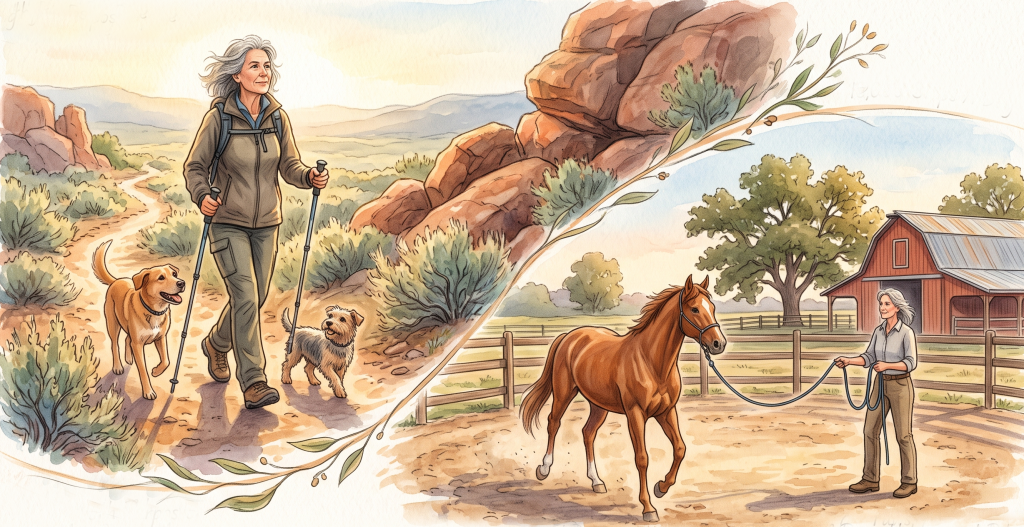
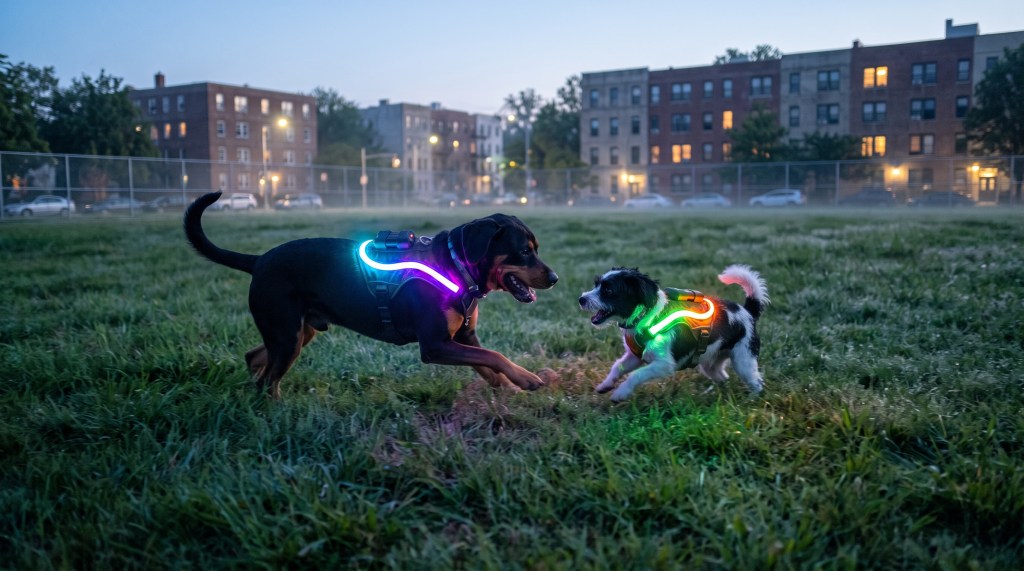
For many months, I have been witnessing very early mornings like this. My dogs romp around in large public areas, playing vigorously with each other or with neighborhood dogs, while I log thousands of steps while carrying an eight-pound vest across my shoulders. The dogs are burning off energy, and I’m busy building bone density and staying strong.
The lighted vests that keep both dogs visible in the predawn dusk have been an absolute game-changer. My bigger dog, Chase, especially needed one—hes a born long-distance runner who can vanish into the dim morning light in seconds. He’s generally trustworthy and checks in regularly with little Mitzvah and me. But that vest’s vivid neon colors, tracing his paths across the grass and through the trees, give me more peace of mind
For readers who have followed Chase’s story since I brought him home as a tiny puppy: he is five years old now, and he has mellowed into a wonderful companion.
Back at the beginning, right after that tiny tired pup got a good night’s sleep, he turned into an epic handful. As he grew, this Rottweiler mix proved strong enough to scale or dig under virtually any barrier. Keeping him safely contained seemed impossible. Fortunately, kind neighbors often spotted him wandering around before he could get into traffic or harm himself and brought him home. Other times while I was away at work, Chase would break out, go on a grand perimeter tour, fortunately finding his way back home in time to meet me. I’d turn into my long driveway and see him bounding over to greet my car.
For a long time, my property has looked like a makeshift fortress. Along the entire fenceline, I have stacked lava rocks, flattened cardboard boxes, empty bottles, and heavy cans—using anything to deter him from easy digs. Much of that debris remains in place today, because he’ll still test an easy spot if temptation strikes.
Those early years brought plenty of worry, and enough that I featured Chase regularly on this blog. Surrendering him to a shelter was never a viable option, as an adopter might not have the patience or physical setup to manage an escape artist of his caliber. So, and often reluctantly, I stayed in the game.
Someone once told me a rule of thumb: that high-energy working breeds start to mature around four years old. That “four-year mark” became my mental beacon, a ray of hope. Sure enough, right around his fourth birthday, Chase began to settle. He didn’t become “entirely easy,” but was noticeably a little more manageable.
At five, he’s mostly a pure delight. Chase remains physically powerful, and also, deeply opinionated, but he respects the fence line while I’m away. It’s hard-won peace of mind that makes every ounce of effort over the last five years worthwhile.
Nowadays, while putting in early walking miles and focusing on my own physical fitness, I’m taking the dogs along. With little Mitzvah trotting right alongside Chase and me, we’ve settled into a great rhythm.
I used to worry that Chase’s sheer size, strength, and guarding instincts might make him reactive toward unfamiliar dogs, but he’s sailed through with flying colors. His absolute favorite thing in the world is simply running flat out. He loves a hard sprint but has no interest in fighting. He welcomes strangers we meet on the trail, happily pausing long enough to collect a quick pat on the head before taking off again.
To everyone who, along with me, has wondered about Chase over the years: he’s doing wonderfully. Chase is strong, affectionate, and thoroughly entertaining. Next year he turns six. Mitzvah is a couple of years his senior. Both are winners, and together, as thick as thieves.
— Diana