
Monday, January 12, 2026
Yesterday’s weather was mild and beautiful here in Central Oregon. That gifted me with two versions of the same bird (and two versions of my attention span). The gifts were a couple of Woodhouse’s Scrub-Jays (known also as “California Jay”) making themselves known.
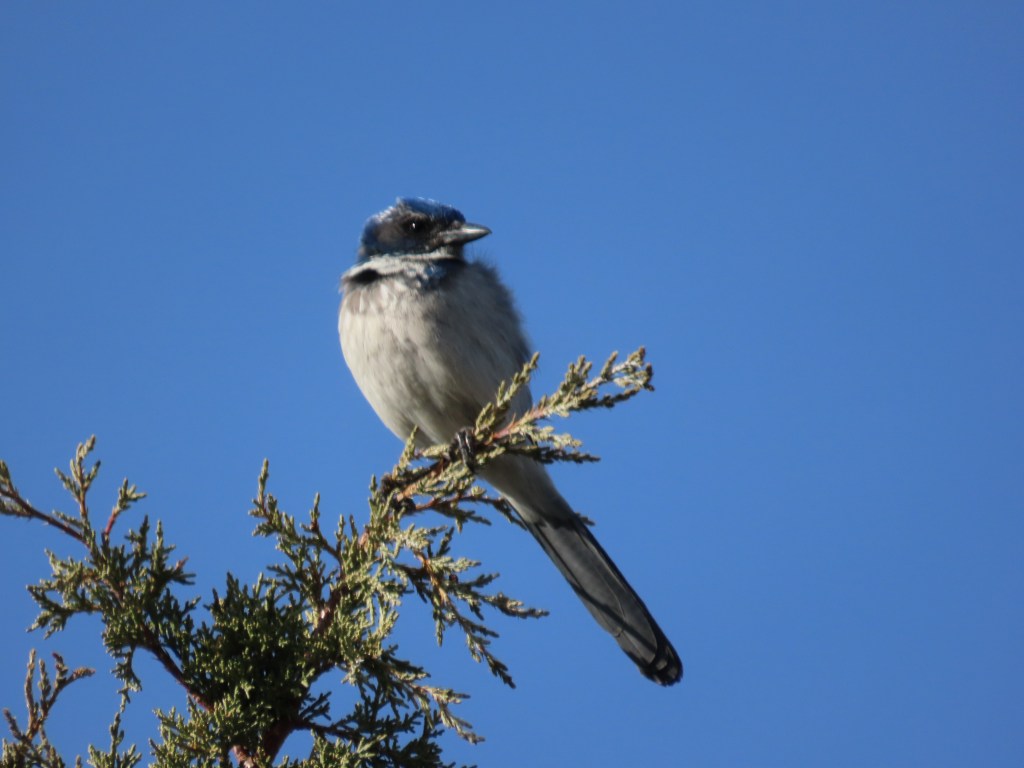
My first sighting (the header photo) was almost theatrical. The jay, perched high in a juniper, was lit cleanly by winter sun. Its soft blues and pale throat were fully visible. That bird seemed to be allowing me a proper look. It sat still for a surprisingly long time (for that very active type), and was well composed against the light wind that rocked its branch.
In the clear light, the bird’s shape was unmistakable. A quick glance said I might be seeing a scrub-jay—if so, familiar, and nothing unusual. It teetered on that waving branch long enough for me to wait. I took a second, longer look before snapping my camera lens. I could see more of the bird emerging: its muted blues, the gentle edging of its throat feathers, and an intelligence in its posture and focus.
By letting my eye stay a little longer, I saw more than what I had first assumed. The details helped me recognize, in my lens, for sure, a jay. I snapped the header photo just before it flew.
A little later, I spotted what might be the same bird species, perhaps even the same jay—but this time it appeared in silhouette, completely backlit. It appeared almost as a sketch, with a long tail, a dark head, a pale underside catching only the faintest wash of sun.
No color, no detail, just an outline against the sky. Yet something about this stripped-down version was compelling. Even without color, the bird’s identity was clear–another jay.
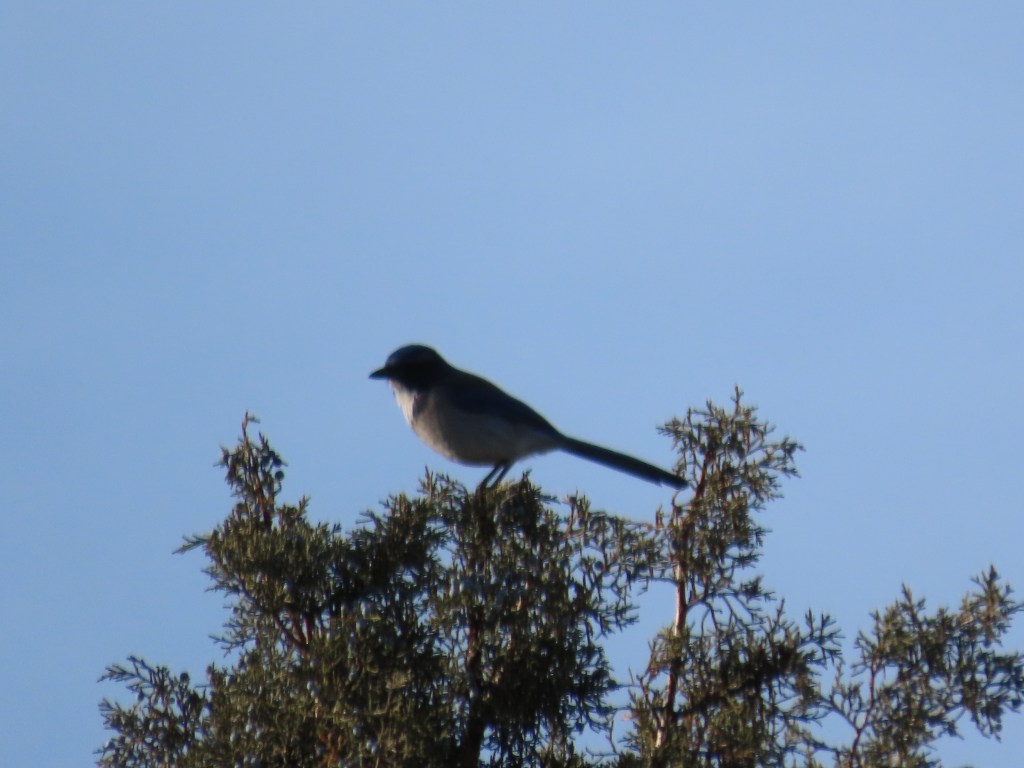
I studied the two images and their contrasts. One offered detail; the other offered reduction. One was about color; the other, about shape. The bird type doesn’t change—but the angle and the light do.
These two captures show that it’s easy to “assume what we’re seeing.” Usually, however, that assumption makes us aware of perhaps only one of many possible perspectives.
These images of two scrub-jays, separated by just minutes and a slight shift in light, are reminders that spending more time to “see the familiar” adds to our information. Comparing these images made me feel that, if I chose to, it would be fun to study individuals of this species and learn to recognize more of their subtleties, silhouettes, and ways of carrying themselves.
Often, there are times when “we know,” and quickly, because the world has handed us details. At other times, we’re given only outlines. Either way, “getting to know” comes from studying — by being willing to pause and look again.
These images are proof of the value in taking a pause. By looking again, we give each sighting enough time to reveal itself, and on its own terms. Essentially, noticing—and especially something essential, like maybe a shift in the lighting—pulls us closer.
Time and attention create a story.
— Diana
 Diana's Morning Blog