Remembering “Sounder” (1972)

Sunday, September 21, 2025

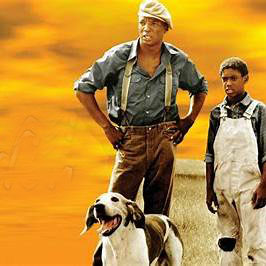
Over coffee yesterday morning, I started thinking about a long-ago movie that featured a dog and a family. It’s one of my all-time favorites and has stayed with me more than most. Today’s header photo, a still from that movie, shows Sounder the dog, the father (played by Paul Winfield), and the eldest child (played by Kevin Hooks).

It came to mind after I’d just finished reading a New York Times piece about “all-time best movies,” in which the writer asked readers to email him with their own favorites. As a former heavy-duty movie buff, I started thinking. The article listed some great films, but it left out the one that immediately came to me: Sounder. That 1972 film has never left my personal best list. I felt so strongly about its absence that I did something I’ve never done before—I emailed the writer, explained briefly why Sounder belongs there.

Reflecting further, I recalled the film’s extraordinary cast: Cicely Tyson, Paul Winfield, and other fine actors. Their performances earned Oscar nominations, and the film itself did something Hollywood had rarely attempted—showing a Black family’s dignity and endurance in a powerful, touching way.

The story follows a sharecropping family in Depression-era Louisiana. Daily life is already difficult before the father is jailed for stealing food to feed his children, leaving his wife and son to carry on. What struck me then—and still does now—is the quiet strength of that family, the boy’s coming of age, and the resilience that carries them through.

And of course—Sounder, the family’s hound dog. His loyalty and presence underscore the family’s strength and make the story unforgettable. Remembering him today, I half-wish I had a hound dog of my own.

Sounder is central to the film—both literally and symbolically. Loyal and loving, he represents resilience and hope, even when he’s gravely injured early on. The story’s emotional core is tied to the boy’s bond with Sounder, and how that love helps him endure his father’s absence.

The film received four Academy Award nominations: Best Picture, Best Actor, Best Actress, and Best Adapted Screenplay. Before then, no movie featuring an all-Black principal cast and story had ever received such high recognition. Its excellent director was Martin Ritt.

To me, Sounder belongs on every “best movies” list—as a film about survival, love, and hope. Remembering it reminds me that sometimes the quietest stories stay with us the longest.

— Diana

Underground Railroad, Canine Edition

Saturday, September 20, 2025

Yesterday I was late to work. I had just opened the front door to leave when little Mitzvah appeared, panting and wagging, eager to come inside. I let her in, gave her a cookie, and tucked her into her crate before heading out to discover how she’d escaped. It didn’t take long—bigger, stronger, and endlessly determined Chase had dug yet another hole under the fence. The gap was just wide enough for Mitzvah to slip through, but not big enough for him.

So, once again, I was running late thanks to my nonstop digger. On days when he doesn’t manage to tunnel under, he digs straight down, anywhere and everywhere. The dogs have nearly half an acre to run in, surrounded by a six-foot fence that I’ve even raised to seven feet to keep Chase from climbing or leaping over. Yes, he’s proved capable of both. And in the middle of all that dog space? Holes—deep, straight-down craters that I discover and fill in while treading carefully so I don’t step into one.

As for his under-fence escape holes, I’ve got a new problem. Over the years, I’ve blocked Chase’s tunnels with lava rocks, but I’ve run out of any I can carry. What’s left are boulders too big for me to budge. My substitute solution has been filling empty plastic containers—kitty litter tubs, half-gallon milk jugs, anything I can find—with water to make them heavy enough to block the digs. I’m running out of those, too, and I’m considering buying several jugs of distilled water just for this purpose.

What really gets me is that Chase has now taught Mitzvah his tricks. She’d never have tried escaping on her own, but now she knows to wait while he digs and then slip through the opening he makes.

I wouldn’t care as much if my property didn’t back onto a road that’s grown dangerously busy with fast-moving cars. This used to be a quieter stretch of countryside, but Central Oregon has exploded with growth. The through-roads are jammed with frustrated drivers, and I come home every day wanting only one thing: the dogs safe inside, far from that traffic.

— Diana

Discovering Wristwatches Anew

Friday, September 19, 2025

In my outside job, I work in a department where I frequently sell high-end watches. At first, I was fascinated to discover how many customers still enjoy studying and wearing traditional wristwatches. I wondered why they bothered with conventional styles when smart watches can do so much more—letting us know when a phone call or text arrives, reminding us to pause, breathe, and reflect, and so on. I’d been almost satisfied with my smart watch.

Almost—because I’ll admit, those sudden prompts to “pause and breathe” or “note your feelings” often left me annoyed. Meanwhile, through the process of presenting and selling traditionally styled watches, I became intrigued by their strong points: accuracy, battery technology, sturdiness, dependability, and, not least, their wearable beauty.

On impulse, I ordered two wristwatches online. One is a refurbished brand I’ve been selling—a high-end, good-looking piece that is fashionable, accurate, and reliable. The other is a $9 rugged-style timepiece that has unexpectedly become my favorite. Sporty and lightweight, it offers day, date, time, alarm, seconds, and stopwatch functions. My only concern is whether its “crystal” (likely hardened plastic) will scratch easily. But at $9, if it does—who cares?

So, I’ve retired my smart watch. No more charging, no more unwanted nudges. I’ll miss alerts to incoming calls, but my phone is usually in my pocket with a ringtone I can hear. I might miss step counting, but I know my daily steps already run into the thousands.

Reflecting on this change, I’m reminded again how learning shifts perspective. For years, I never once considered wanting a traditional wristwatch. Now, understanding their dependability, durability, and sheer beauty has made them alluring—and even a “heapy-cheepy” rugged model proves that simple technology can be capable and cool.

Perhaps best of all, my own experiment gives me more insight—and more articulate ways to share the appeal of high-end wristwatches with customers.

— Diana

Finding Balance in a Competitive Workplace

Thursday, September 18, 2025

Sometimes my outside job feels overwhelming. This past week included incidents that upset me enough to wonder if I should quit. In a different retail department store, I might have started the process, but my current workplace is so family-like most of the time that I genuinely enjoy being there.

I work in one of the store’s few departments where sales earn commissions. That naturally creates a competitive environment, and my struggles stem from a long-time employee—my co-worker—who, in my view, crossed a line. That left me feeling discouraged and out of balance.

I’m not easily intimidated, but I do prefer to avoid conflict. My goal is simple: show up, do my job as well as I can, and feel supported by management. Most days, that’s exactly what happens.

This time, however, upper managers recognized what had occurred. They spoke with both my co-worker and me, and I felt they truly understood my concerns. They reminded me that competition in sales is never easily solved, but they also reassured me of their support. Their advice was that I learn to defend myself—something easier said than done by one who’s new to a competitive workplace.

Still, knowing management stands behind me eased the anger enough for me to stay and focus on how I can adapt. For me, it isn’t about commissions. It’s about fairness. What makes staying and working on the problem worthwhile is the fairness of being listened to, heard, supported, and encouraged.

At the end of the day, my workplace feels like a genuine family, and I find myself wanting to stay more than I want to leave.

— Diana

A Gentle Donkey’s Recovery

Wednesday, September 17, 2025

Thanks to everyone who’s asked about Pimmy’s sore foot—here’s the latest. Yesterday, our equine veterinarian came out, took X-rays, found the problem, and went straight to work. She cleaned the wound, treated it, and wrapped the foot.

This flare-up turned out to be related to Pimmy’s Cushing’s disease, which in her case often shows up as a hoof abscess. The X-rays made this one visible—and it was a doozy. Tomorrow, our farrier will be here to re-clean the hoof and help me re-wrap it so we can keep everything protected for a few more days.

By last evening, Pimmy was already limping less and putting more weight on that foot. This morning at the barn, I expect to find her feeling much better.

One question remains: what triggered this flare-up? The vet drew a blood sample, and once it’s analyzed we’ll know whether Pimmy’s daily meds need adjusting.

For now, the outlook is good. The foot is healing, Pimmy has slimmed down noticeably (to the vet’s delight), and she stayed her usual calm, gentle self through all of yesterday’s poking, prodding, and X-rays. Our vet said it again: “Pimmy is the nicest donkey.” And yes—she truly is.

—Diana

History Reminds

Tuesday, September 16, 2025

I am reading The Berlin Wall by Frederick Taylor, published in 2006. I picked it up after someone described it as a history that “…reads like a novel, and I couldn’t put it down!” I can’t say I agree with the “novel read” part—at least not yet—but for me it has opened a window onto Germany’s tangled past, and some of it feels uncomfortably familiar today.

Before Hitler ever arrived on the scene, Germany had spent 400 years as a patchwork of kingdoms, dukes, and city-states loosely tied together under the Holy Roman Empire. From 1400 on, there was endless infighting, power struggles, and even catastrophes like the Thirty Years’ War. When the country finally unified in the late 1800s, it still swung wildly between strongmen and shaky experiments with democracy.

That long, messy history makes me think of how easily fractured nations—then and now—can be pulled toward extremes. The old German pattern of division, promises of “restored greatness,” and sudden hard turns in politics has its modern echoes.

Americans today are asking fresh questions about the Constitution: what’s in it, what’s not, and whether it’s strong enough to steer the nation toward a future most of its citizens can embrace. Contemporary glimpses of social and national histories–and of course, not only Germany’s–remind us that human struggle is almost constant. And yet, the 20th and 21st centuries opened doors to hopeful new possibilities—spurred by human inventiveness, expanding wealth, and a broader reach of education and enlightenment.

Now we are witnessing history in motion once again—but this time in a broader stage, and unfolding not over centuries but at breakneck speed. Our real-time view of evolving nations is filled with warning signs: dehumanization, threats, and, too often, bloody conflict.

Events may feel distant from our own daily lives. But are they?

—Diana

Relishing Our Eats

Monday, September 14, 2025

Last evening, I decided to try my hand at steaming eggs. I set them on a steamer rack, gave them 10 minutes to cook, and when they came out, the eggs were just fine. They peeled easily, with delicate yellow and white textures. Peeling and tasting proved them perfectly well done.

My new all-capable cooking pot invites me on a journey of discovery. Already, I’m steaming many big root vegetables, learning to love them, and from a pot that’s cooking them up just fine. It also efficiently steams what are becoming my daily meal staples — brown rice and quinoa — quickly.

So little effort from me, and so many great rewards from the pot. I share what comes out of it, all cooked, with my dogs and birds (Cockatoo, racing pigeon, and chickens). They’re gobbling, like in heaven! (To explain a bit more, they also receive commercially designed foods tailored to their specific needs and activities.)

We’re eating well, losing excess weight, and maintaining energy–key elements of my “family maintenance” plan. I fell into this new personal routine after watching a learning series that featured a physician explaining “good eating.” His perspective made a lot of sense. I was motivated enough to explore new ways to assess food products and try out new items. I’ve been pleasantly surprised.

My critter-family and I are eating better now, focusing on quality more than on calories. It’s a “freeing experience” for me, after lifelong dieting, avoiding carbs, and hoping to find my weight shrinking a little more someday.

— Diana

Lessons From Pimmy

Sunday, September 14, 2025

.This photo of Pimmy shows her looking fit and fine just a couple of days ago. Yesterday, though, she began limping uncomfortably. I couldn’t find anything wrong with her hoof, so at first I suspected a flare-up of her Cushing’s disease. Later, I noticed swelling around her “ankle” joint, and when I touched it my hand came away with a couple of tiny blood spots. Could it have been an insect bite?

I’m off work today and, if needed, I’ll call an equine vet to come examine her. It’s been a full year since Pimmy’s stay at the emergency veterinary clinic, when she was diagnosed with Cushing’s disease and Type 2 diabetes. These days she’s doing well. She doesn’t fight me too hard over her daily meds, and she’s lost some weight. Since separating her from her horse buddies to control her feed, I’ve been surprised by how close we’ve grown.

Nowadays, Pimmy feels less like just a cute donkey and more like a lovable big dog. She’s teaching me more about donkeys than I ever expected. For example, I’ve learned to give her time to “think over” what I’m asking. More often than not, she’ll eventually decide to do it.

She’s a special one. Now that I know better how to communicate with her, I sometimes dream of training her to pull a cart. That’s still a fantasy, but maybe one day I’ll write more about it.

Meanwhile, please hold good thoughts for Pimmy—that her limp eases without leading to new troubles.

—Diana

Watch Stories

Saturday, September 13, 2025

Recently, with the help of ChatGPT, I sold a high-end wristwatch to a Spanish-speaking customer. The person understood some English, but I don’t speak Spanish, so I couldn’t fully understand them. They examined a few of the available watches while also mentioning the word “crystal.” I wasn’t sure about the question and how to respond. As their overall interest in the watches appeared to be waning, I said, “Wait just a minute.”

I quickly found my cellphone, returned to the watch counter, and opened Chat in voice mode. I said, “Chat, I have a customer looking at watches who is interested in their crystals. Can you look at one of the watches and explain its strong points and benefits?”

When Chat responded, “Yes,” I hovered my phone over the watch that my customer had appeared to be most interested in. Immediately, Chat confirmed that it was an excellent timepiece with a crystal of synthetic sapphire, rated for hardness just below diamonds. My customer relaxed, nodded, and showed renewed interest. Chat wasn’t finished and continued by describing other highlights: its excellent water resistance, battery-free accuracy, and the brand’s fine reputation. That assistance sealed the sale.

I’m relatively new to selling high-end wristwatches, and this was actually the second time I had used Chat to help explain to a customer the benefits of a high-end watch. That earlier customer had wondered if a particular watch was shatterproof. I knew it was, but couldn’t explain why with confidence. So, on an impulse, I turned to Chat. It “looked” at the watch, confirmed its durability, explained its highly-rated shatter-resistance characteristics, and then went on to describe, overall, what made it an excellent timepiece. Sold!

The more I experiment with AI and find new ways to use it, the more impressed I become.

— Diana

Chills & Checklists

Friday, September 12, 2025

Here in early morning Central Oregon, I’m warding off another drizzly chill by wearing a mid-weight jacket. I lack the motivation to turn on a portable heater in this coolness. It’s a good bet that I won’t enjoy summery days for most of this fall, as that’s sometimes happened. Among other urgencies, I must arrange for an electrician to replace a GFCI that monitors the water temperatures in my horses’ troughs.

There’s little worse than going out to feed horses and discovering their water frozen over. Some years ago, I encountered an ice cover that was too thick to break up with a hammer. I remember trying and failing, feeling frustrated and frightened. I recall enough space above the ice to add some water. Heavy ice will quickly take over fluid water, a worrisome condition. We got through that morning, and I don’t want any repeats.

That’s for starters. There are always many needs in preparing for this season’s weather change. I’ve written about routine challenges ahead to prepare my small property and animals for the winter ahead. This year, I’ll prepare my vehicle extra by getting a set of “Snowflake tires,” designed to navigate the snowy roads without also needing tire chains.

Then, there’s my roof, which is old and calling for repair or replacement. Sigh….

My challenges are familiar to anyone with an aging house, some acreage, and animals, situated in an environment that faces routine and significant seasonal changes. The fall seasons are gorgeous, bringing cooler weather and changing natural colors. While I love this season, it calls for almost-immediate action, and too soon after lazy summers.

Okay, I’ll buckle up and get moving.

— Diana