The Ham Sandwich Heist

Monday, September 01, 2025

Happy Labor Day!

The other afternoon, I took a small break from the big challenge of improving the fencing in my dry lot. I perched myself on a small ladder, and with a protein bar in my hand, watched my Morgan pony, Sunny, working her way with gusto through an allotment of hay. She always eats energetically, and I smile at being reminded of how joyfully a horse approachs even the simplest meal. Also, seeing her, that moment brought back one of my favorite memories of riding the trails with her.

It happened years ago. Sunny had been taking me over a moderately challenging mountain trail and we’d gone a long way. It was time to pause our trip for a lunch break. I slid off Sunny, tied her to a tree branch, and gave her a carrot. She was standing near the log I was sitting on while pulling my lunch from a paper bag: a plain ham sandwich — nothing glamorous, just fuel for our miles ahead. Before I could take a bite, or even realize what was happening, I sensed a whiskered nuzzle near my shoulder, and in one swift move, my entire sandwich was gone — clamped between my horse’s delighted teeth.

She chewed, and I swear, with the satisfaction of a thief who knows she’s won. I watched her eager chewing, and in amazement, for horses are herbivores by design. Ha! Try explaining that to one smack in the middle of discovering the joys of bread and lunch meat. Sunny was enthusiastic, licking her lips as if to say, “Why haven’t you been sharing this all along?”

Of course, that sandwich had to be a one-time treat. Horse folks are well aware that moderation and common sense always comes first in feeding. But that moment sticks with me to this day. It’s one of those horse-unique surprises that makes me laugh anytime I remember it. That sandwich may be long gone, but recalling how it disappeared feeds a fun moment to this day.

Besides, that little incident taught me more about horses. About their endlessly curious nature. From that moment on, while out on the trails, I knew the importance of staying very aware of my eats versus theirs.

Dear Friends, Sunny also loves whole oranges — peel and all — and consumes them with the same sheer delight she once gave to that ham sandwich.

— Diana

Happy Fireworks Day!

Friday, July 04, 2025

Here in Central Oregon, it’s an overcast, rainy holiday—perfect for taking a short break from the gloomy weather.

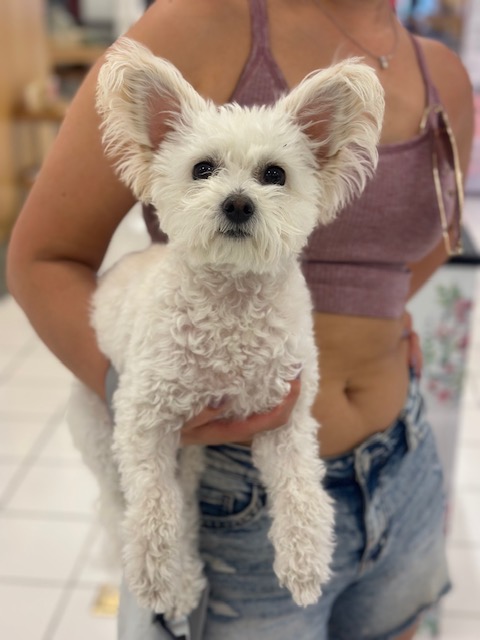
So, here’s a little cheer: a photo of one of the cutest pups you’ll ever see. Earlier this week, “Malti” and her person came shopping where I work.

Malti is a Maltese-Yorkie mix. She has the cushy-soft coat of a Maltese and a set of perky Yorkie ears. One glance at her expressive face, and I fell in love!

Dear Friends: Just a quick hello, and a little joy–courtesy of an adorable pup.—Diana

“Stayin’ Alive”

Tuesday, July 01, 2025

Lately, I’ve been watching videos and reading books about how eating “natural foods” supports a healthy body from the inside out. It’s made me pay much closer attention to what I buy, and especially to how foods are grown and processed. Learning how natural and minimally processed foods interact with the human gut has been an eye-opener.

Even someone just starting to explore this topic will quickly grasp the critical role of gut health—and likely begin to rethink their own. Knowledge is power, and already, in my case, it’s shaping my choices. I’ve changed what I shop for and how I eat. It’s still early days, but I can feel some encouraging shifts, and I like them.

This journey is teaching me why a living gut is so much more than just a stopover where food gets digested. The gut actually is a bustling, living community, teeming with a diverse array of microbes. Now, I understand this and know how, in countless ways, these tiny residents are “talking” to the rest of my body, influencing everything from how efficiently I absorb nutrients to how balanced—or frazzled—my moods can be.

All this has changed the way I shop and what I bring home to eat. My trusty Yuka app helps by scanning and rating products, steering me toward simpler, more natural foods and away from the ultra-processed. It’s become second nature to check Yuka scores before anything goes into my cart.

And honestly, the more I learn and the more I swap in these “different foods,” the better I feel. A big part of it is weaning myself off the highly processed products surrounding us—quick, tempting, cleverly marketed, but often stripped of what truly nourishes us. The sad truth is that many processed foods replace critical gut nutrients with fillers, additives, and hidden sugars. That’s great for sales, but not for our health.

Our bodies were never meant to handle so many artificial, sneaky ingredients. In reality, we need to feed the bacteria that live inside us. That means avoiding foods so stripped down by processing that they’re useless to our digestive system. These products are popular precisely because they’re engineered to light up our brains and keep us coming back for more—they’re everywhere.

I won’t claim to have transformed overnight. But I can say I’m noticing—and welcoming—some subtle but meaningful changes. My digestion feels calmer, my energy a bit steadier, and my mood a little brighter.

Most of all, there’s an unexpected, gentle undercurrent. Maybe it’s simply more happiness, rising from this new sense of actively caring for myself, of being less passive about my own well-being. It’s an inner nourishment, rooted in making choices that are more aware, thoughtful, and real.

Dear Friends: This is my current take on succeeding, “one day at a time.”—Diana

“Leading Wing”

Monday, June 30, 2025

Years ago, long before I imagined a life in Central Oregon or the daily ritual of writing blogs, I worked in a world so classified I couldn’t even discuss my job with friends. Lately, I’ve found myself reflecting on those details—my small but precise role during the early development of the B-2 bomber.

I served as the lead negotiator for a section of the B-2, responsible for negotiating costs and understanding the construction intricacies of my assigned area. That work pushed me deep into technical territory, whether I felt ready for it or not. My focus was on a particular part of the wing. Only later did I fully appreciate how closely my work was tied to the company’s and the nation’s ambitious vision.

Unlike conventional aircraft with a fuselage and protruding wings, the B-2 was designed as a “flying wing.” That changed everything, including how we talked about it. I recall that we often referred to my section as a “leading wing,” which, in hindsight, is a bit of a misnomer. In a flying wing, every part is forward-facing, structurally critical, aerodynamically sensitive, layered with radar-absorbing materials, fuel compartments, and stealth design features. There is no separate wing area that sticks out; the entire aircraft is the wing.

And there I was—a non-technical civilian—tasked with negotiating costs for a vital section. I sat across from contractors, flanked by my team of engineers, as we discussed pricing that had to align with strict budgets while justifying the necessity and feasibility of every element. These were intense conversations, involving components stamped with a national security imprint. Every dollar needed a clear, defensible rationale. More than once, we joked that maybe this whole thing we were helping to build existed only on paper—a purely theoretical concept.

Much later, we were all invited to witness the first rollout of a completed B-2. I stood in a crowd of employees buzzing with anticipation. We each knew our own “assigned parts,” but only the designers and top officials knew the entire aircraft design. Someone near me quipped that when the hangar doors opened, there might be nothing at all—that the bomber was just a myth. Given the secrecy and fragmented way we’d each touched the project, it almost seemed possible.

Then the hangar doors began to part.

Out of deep shadow, something black, angular, and breathtaking slowly rolled. The aircraft emerged bit by bit—majestic yet alien-looking, unlike anything we’d ever seen. It moved forward with a kind of eerie grace into the light, and the crowd fell completely silent. Then, quietly, tears welled up. Years of effort, meetings, debates, and pages of paperwork had culminated in this astonishing reality. A wing that could fly.

I often forget to include that experience among the formative chapters of my life. But seeing recent images of B-2s soaring through the sky, flanked by fighter jets, brought it all back. That made me want to recapture it here.

Dear friends: Sometimes the small fragments we handle—negotiations, line items, a section of structure—turn out to be part of something far bigger. Sometimes, even airborne.—Diana

Emerging

Sunday, June 29, 2025

Yesterday, I shared my shock on learning it could cost me up to $10,000 to repaint my small car. I’m a product of living in Southern California and remember a very different time. Back then, several successful auto body repair businesses offered remarkably low prices. Earl Scheib’s, for instance, promised to repaint an entire car for anywhere between $99 and $299 — a deal that drew in countless customers.

So why could repainting my modest vehicle today run as high as $10,000? That question might shed light on why the auto repair company that’ll repair my dented fender specializes in doing only insurance repairs. It estimated my fender repair job at $1,400, which, frankly, felt to me like reverse sticker shock. Back in my old California days, it was common to feel taken advantage of by auto repair shops. Today’s quote, which to me seemed cheap, likely reflects pricing which represents prenegotiated figures acceptable to insurance companies.

Curious, I decided to dig deeper into the modern automotive paint industry. What I found didn’t just give me logical explanations — it also made me realize how out of touch I’d become with current standards, not just in auto painting, but across many trades.

I’m learning that today’s auto repair materials are worlds apart from what was common during my California years — and they’re also vastly more expensive. Similarly, labor costs have increased because of today’s higher performance standards. There are stricter environmental regulations and added compliance expenses, along with inflation and overhead charges. All of those factors contribute to modern repainting quotes.

Consumer expectations also have changed. The old Earl Scheib approach was all about speed and budget, providing quick, cheap, purely cosmetic “spray over and go” jobs. In contrast, a modern $10,000+ paint job typically involves a complete surface restoration, performed to rigorous standards and utilizing advanced materials, handled by skilled technicians who meticulously adhere to environmental laws.

Years ago, low-cost repaints in any color were easy to find, although minimal prep work meant those jobs rarely lasted for long. Today’s high-end shops strive for results that meet or exceed factory standards. That requires painstaking labor, high-quality paints, and strict adherence to environmental compliance. All those drive costs up dramatically.

Dear Friends: Like Rip Van Winkle–awaking to a world more changed than I realized.— Diana

Grasping

Saturday, June 28, 2025

I had some surprising learning, which began after I was involved in a minor fender-bender in a small roundabout that damaged my bumper, but my vehicle continued to run perfectly. That incident made me roll my eyes more than wring my hands. My insurance company sent me to get an estimate for repairing the cracked bumper. I did so, bracing myself for a wallet-shocker, but to my surprise, the estimated repairs came in only around $1,500.

I say “only” because that repair was far less than I had anticipated. It struck me as weird-funny, considering how almost everything else these days seems to cost more. My insurance bills keep climbing, and my groceries keep leaping off the shelves, totaling higher. These days, even the basics for my home and pets regularly strain my budgeting attempts, and unfortunately, very often.

The insurance estimate for my car’s bumper prompted me to explore why and how auto body shops are evolving, from fulfilling private repairs to focusing on fulfilling insurance claims. The costs for labor and materials are making the world of commerce out there constantly change, and so rapidly, both economically and otherwise, that my old mental price tags can’t keep up. Others are like me and equally surprised when comparing today’s costs to those we faced twenty or thirty years ago, making us feel vaguely foolish and newly worried all at once.

So what’s to do? Perhaps the best answer is learning to adapt, rethinking our spending more carefully, and also seriously reevaluating what we genuinely need and what we consume. Some of us, and indeed I, who are confronted with the need for more grace time, are struggling to reevaluate our economies and grasp how best to adjust our daily lives and expectations to the rapidly shifting economic landscape.

Dear Friends: The new economic realities are continually surprising and frightening. Diana

Surprising Shifts

Sunday, June 15, 2025

For a few weeks now, I’ve been using the Yuka app. It’s my guide when I’m shopping for food. I use it to scan product labels, read its product scorings, and—most of the time—choose only items Yuka rates as excellent or good. This started as a curiosity but is transformed into something closer to a quiet commitment. I didn’t expect the app to influence or particularly change me much, but something’s has been shifting.

Without planning for an outcome, just by consuming recommended foods, my taste for certain ones—especially meats, sweets, and heavily processed items—has quickly faded. I’m surprised by not following a diet or set of rules; it’s simply that Yuka-friendly foods have quietly rearranged my plate. The big surprise is how they’re rearranging more than just my plate.

I’m hungrier at times, but in a cleaner, differently expectant way. I recognize feeling more satisfied with far less than I used to need. I’ve also noticed more steadiness in my mood. Also, my energy seems more even. I’ve begun studying what could be happening, trying to learn, and am fascinated. It could be that my enzymes are doing their job more efficiently, or maybe my gut microbes are celebrating better meal plans—but I’m feeling like a calmer, more assured version of myself.

I’m not writing this to make an announcement or trying to become a food evangelist. I’m simply trying to explain being surprised—and now, more than a little fascinated—by how sensitive the body is when given better inputs. My body seems to notice and respond well before my brain does.

Dear Friends: This brings to mind the old saying–that “truth is in the pudding.” Diana

Mind & Body Agree

Monday, June 09, 2025

Lately, I sense a changing relationship between my mind and body. They seem less like opposing forces and more like partners in change. This is because several weeks ago, I began using the Yuka app constantly to guide my grocery shopping, and now it’s dictating most of my food choices.

I use Yuca to scan labels on all products that interest me. The app scores product quality; it dislikes those with unhealthy and/or unnecessary additives, and too much salt, sugar, or fat. Yuca has encouraged me to study labels more and to seek minimal food processing. Nowadays, only products with “excellent” or “good” scores land in my shopping cart.

The process has been surprising. I didn’t start with any firm resolutions or iron-willed plans to eliminate certain foods, but this new way of selecting foods has softened my long-standing cravings for meat and sweets. Those always were high-need foods, my comfort zones—taste and habit needs. But now? Not so much. I’m not intentionally cutting out sweets and meats—they simply no longer have such high appeal.

I am fascinated by this change: how it’s occurred—not with declarations and resolutions, but with small, steady nudges, by shifting my awareness and offering a new framework. In this process, I’m enjoying foods not before bothered with–for fear of high calories and/or taste boredom. These days, I enjoy grains, root vegetables, and canned and frozen foods with quality equal to their fresh versions. The only non-vegan foods still in my routine are whipping cream for my coffee, Greek Yogurt for my smoothies, and fresh eggs from my chickens.

In exploring the possible reasons behind my perceived changes, I’ve learned that modern science recognizes how preferred foods make taste buds adjust and cause the gut to rebalance. Occurring, too, is a more subtle process. New foods will cause the brain to relearn, expect, and efficiently process them as rewards.

I’m no scientist, but I sense my body and mind having new conversations and responding to each other. This reminds me that changing doesn’t necessarily require forcing. Sometimes it just takes responding to noticing what works and allowing the rest to disappear.

Today’s header image reflects a quieter life. A wooden kitchen table, open notebook, small bowl of berries, and half-peeled orange feel fresh and peaceful in the soft morning light–reflecting an already-begun shift.

Dear Friends: In partnership, our bodies lead our minds, or is it the other way around? –Diana

Big News from My Friends at HeliLadder

Thursday, June 05, 2025

My longtime friends, Dale and Susie Neubauer, have taken a major step forward—they’ve purchased a commercial building! It will house their rapidly growing HeliLadder business. The other evening, they gave me a tour of the new space: a 5,000-square-foot facility situated on a full acre in a bustling commercial area of the city.

The building includes a spacious office and design area, as well as a wide-open warehouse where their team will stock ladder components, assemble the finished ladders, and prepare them for shipping. Out back are two large truck-ready bays, ideal for efficient shipping and receiving. There’s also plenty of parking and a lovely perimeter of shading trees, under which Dale and Susie plan to set up a picnic area for their team—how thoughtful is that?

HeliLadder had its humble beginnings in 2015, right in Dale and Susie’s garage. With 30 years of aircraft maintenance experience, Dale understood the challenges of working on helicopters—especially their thin skins that can easily become damaged by a traditional leaning ladder. So, he designed a modular, free-standing maintenance ladder specifically for helicopters. The result was something portable, safe, and elegant. Local fabricators helped produce the custom parts, and HeliLadder was born.

I first saw the HeliLadder years ago and thought it looked like a modern art sculpture—tall, balanced, and colorfully wearing its very own signature “HeliLadder colors.” I still “see it,” as not just functional, it’s beautiful. I’ve followed Dale and Susie’s journey with admiration, and seeing them now—owners of a big, bright commercial building—it’s hard not to be just as thrilled as they are.

Dear friends: Visit HeliLadder.com, a very cool site and a remarkable story. –Diana

Lunch with Judy and Candy

Computer-generated Image–surprisingly close to reality

Monday, June 02, 2025

I had lunch yesterday with long-time friends I hadn’t seen in years. We first met during a pivotal chapter in my life, when I was a breast cancer patient participating in a support group. They were the group’s unofficial leaders—steady and compassionate, offering wise listening and unwavering kindness. The connections forged in that group felt deep and enduring. Despite years and distance, our shared strengths and vulnerabilities still feel familiar.

It had been a long time since we’d laid eyes on one another, but recently, they wandered separately into the department store where I work. We recognized each other immediately—like “old friends,” which we are—and promised to meet for lunch soon.

Judy and Candy are continuing to nurture the cancer support group–welcoming women facing breast cancer and other illnesses. Their dedication says much about their character, and just as much about our deep human need for community when we’re navigating illness. Sitting with them again felt comforting as they shared how the group continues to evolve.

Conversation came easily. We didn’t need to fill in every gap—we simply slipped into the familiarities of our old connection: talking about our lives now, the realities of aging, fond memories, and the ever-present question: What may come next? There was laughter, warmth, and a few comfortable silences. Our lunch felt less like a reunion and more like a quiet rekindling—an affirmation of ties built during significant uncertainties and shared strengths.

They spoke of their early lives—how, as young women, they each bravely moved to Alaska during its formative days, just as it prepared for Statehood. They met there, in a time when its cities were small and its spirit was wide open. Those were the early days of loosening social constraints for women, and they embraced the freedom and opportunity. Eventually, each moved—independently but around the same time—to Central Oregon, where they reconnected.

They asked after my donkey, Pimmy, who is doing well—her illnesses are stable and under control. They asked about my other critters: sweet turkey Lacey, noisy Cockatoo Peaches, and Chase (yes, that Puppy-from-Hell, Chase, who still lives with me).

The best part of our lunch was simply knowing—knowing one another well and knowing where we’ve been. We didn’t just share memories; we shared something more enduring–a kind of bond formed while at our most human, our most open. That’s what has made the cancer group so special, and it’s what made our lunch such a gift.

Dear Friends: Like Alaska in its frontier days, Central Oregon is an “honest place.”—Diana