Zelenskyy

Sunday, March 02, 2025

Volodymyr Zelenskyy’s rise from actor-comedian to wartime president has been an incredible journey that testifies to his extraordinary adaptability, resilience, and moral clarity. Few modern leaders have been tested as brutally as he has, and even fewer have risen “to the occasion” with equally unwavering resolve.

Russia launched its full-scale invasion of Ukraine in February 2022. Many assumed the Kyiv Government would collapse under the weight of that major military aggression. But, Zelenskkyy didn’t. Standing firm and refusing opportunities to flee, he insisted, “I need ammunition, not a ride.”

Immediately, Zelenskyy transformed himself from a political newcomer into a global symbol of courage. He has proved daily that True Leadership isn’t only about experience. It’s also about conviction, integrity, and an unshakable sense of mission to one’s people.

Zelenskyy is more than brave: he has demonstrated exceptional intelligence and strategic acumen. Leading Ukraine’s war effort has revealed him capable of rallying international support, a requirement he clearly understands. He has shown the world that the battle in modern warfare is fought as much in the information sphere as on the battlefield.

When Zelenskyy addresses world leaders, from the U.S. Congress to the European Parliament, it’s like a masterclass in persuasion that strengthens alliances by invoking shared history and democratic ideals. He communicates not with bureaucratic platitudes but with raw emotion and clarity.

Those skills have proved him one of this era’s most effective wartime leaders. We have watched Zelenskyy skillfully navigate the complexities of global politics, secure military and economic aid, and (incredibly) maintain Ukraine’s sovereignty in the face of existential threats.

Last Friday, Zelensky visited the Oval Office and the President. While there, he demonstrated his deep understanding of the media’s influence. He employed precision and confidence to bait the President and the President’s ever-watchful team into revealing more than they intended and, equally, that group’s sheer brutality.

Negotiations to end the war in Ukraine are taking place; however, Zelenskyy hasn’t been allowed to participate in the discussions to end the war in his country. While seated in the Oval Office, Zelenskyy subtly and successfully nudged “key hidden negotiation and decision elements” into the public eye.

Diplomacy isn’t just about closed-door discussions—it’s about shaping the narrative. Zelenskyy’s shaping skills have made it impossible for the world to ignore Ukraine’s plight. He has leveraged the press as a tool and managed to keep the war and Ukraine in our global consciousness.

His communication skills and focus keep forcing nation leaders to reckon with the consequences of inaction. Last Friday’s televised event in the Oval Office emphasized clearly that Ukraine might not match Russia’s military strength, but Ukraine can outmaneuver opponents in the court of public opinion.

Zelenskyy is extra-deeply admirable because he never sought to be a wartime president, yet he embraced that role with an unwavering sense of responsibility. We’ve seen him staying in Kyiv through bombings and blackouts, walking the same streets as his citizens, showing the world that he’s not just the leader of Ukraine—he is “of Ukraine.”

He is a modern hero who represents more than defiance. He represents a hope that democracy and national identity can withstand even the most ruthless adversaries. Zelenskyy’s story is one of remarkable transformation—from an entertainer to a statesman, from an underdog to an historical figure.

Dear Friends: His legacy will endure long after the war has ended. Diana

Upturn in “The Oval”

Saturday, March 01, 2025

Zelenskyy…Ukraine. A brave man, a worthy nation.

I’ve always wanted to visit—or perhaps even live in—Odessa, a vibrant, multicultural city in Ukraine. Over a century ago, my maternal grandparents emigrated to the United States from Odessa (then a Russian city). They had escaped the violent persecution that Russia’s Jewish population was facing.

Notably, Russia’s brutality toward Jews predated Germany’s even worst atrocities.

Modern Odessa became a thriving and cosmopolitan center of European-style culture that I felt eager to experience (in the footsteps of my ancestors). Today, however, the city endures immense destruction from three years of war, in which Russia is relentlessly attempting to reclaim independent Ukraine and make it Russian territory again.

Much of the larger world fears Russia’s aggressiveness toward Ukraine and wants that warring stopped. Those concerns focus on Russia’s unyieldingly aggressive intent and behaviors in trying to overcome Ukraine.

A Russian win over Ukraine could predate more future aggressiveness, and then, toward other now-independent and vulnerable nations.

Dear Friends: I will write about the courageous, intelligent, deeply admirable Zelenskyy. Diana

Mild Weather

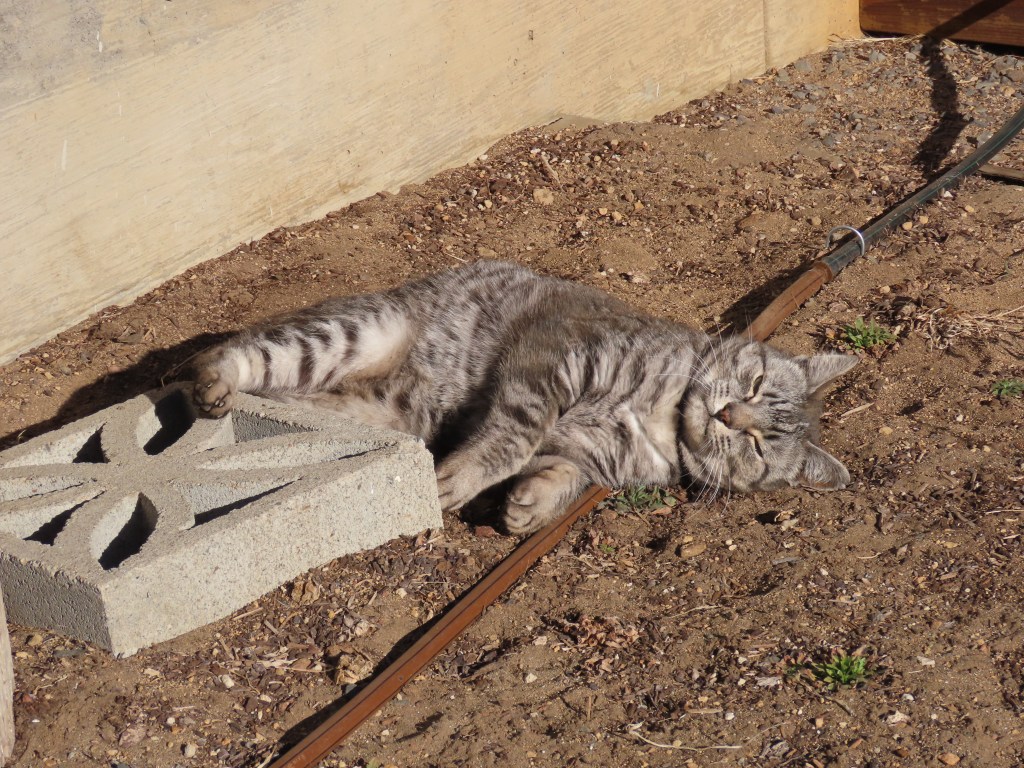
Max, sunning in a wintery garden

Friday, February 28, 2025

Tomorrow will pop us into March. The weather here in Central Oregon feels summery, a relief and a pleasure, but that won’t last, as March may come roaring in like a lion. The current warm spell will make the return of cold weather feel even harsher. These are “transitional months” when the weather tends to assume back-and-forth patterns.

Later, long after every wintertime, although “it ain’t necessarily so,” I usually recall these months as the most freezing period.

Yes, instead of recalling good weather days like yesterday, when at midday I worked outside in shirt sleeves, I remember the coldest days, with episodes of frozen watering troughs, snow-blown paths to and from the barn, and hoping my four-wheel-drive vehicle won’t slide in braking for stops.

Usually, spring officially starts in March, but not necessarily in Central Oregon. While many areas receive warmth in April or May, the waiting for steady warmth here can continue until sometime in June. A psychological notion is that if you feel surprised by an unseasonal warm or cold day, it’s a sign you’ve adjusted to the current season. Maybe I’m thinking about that now.

There’s more: I am having an unexpected mood change. Lately, I’m feeling slightly more sluggish and am wondering why. I’m also mindful that there are “seasonal mood changes” (Seasonal Affective Disorder [SAD]). Maybe winter is making me feel sluggish; if so, it’s a coin with another side that might re-energize me. But spring’s a long wait from now.

Dear Friends: Ahead a beautiful morning, before I must leave for work. Diana

Imagining CRISPR

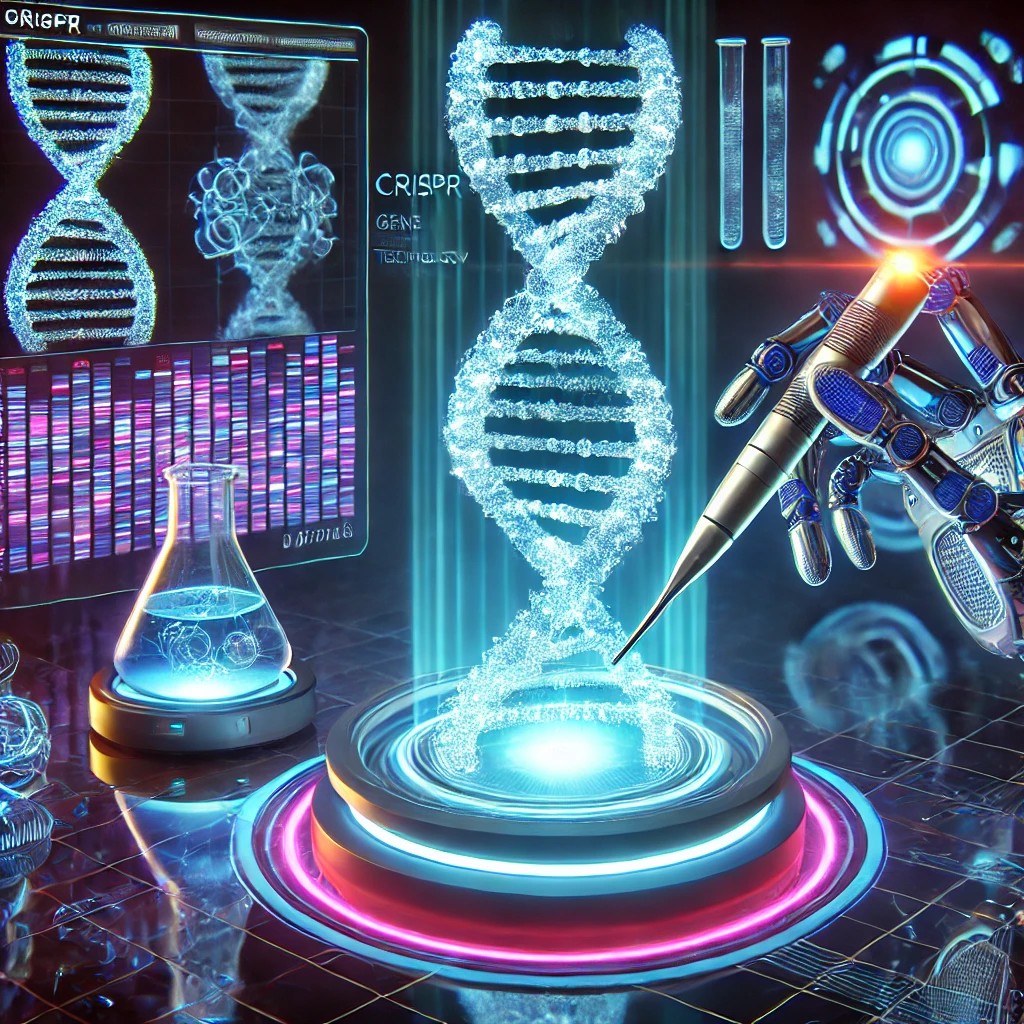
DNA helix being precisely edited by a high-tech robotic tool

Thursday, February 27, 2025

I’m reading more often about the gene-editing technology known as CRISPR. Its potential for manipulating every gene in living plants and animals (including humans) could complicate everything we have traditionally comprehended about life.

CRISPR technology has advantages: it could improve crop production and living beings’ health. It has serious disadvantages: it could introduce misuse, mistakes, and unwanted changes to everything we now understand chemically and socially.

Yesterday, I was thinking about CRISPR and initiated a “conversation” with AI about the technology. I hoped for more insight into its potential for producing good and evil. This “chat” lasted an hour because the AI produced lots of information to support each potential, often pausing and questioning my perceptions about the ideas it offered. I had to pause the discussion frequently to imagine and think before responding.

At its best, CRISPR technology could likely fix most, if not all, of the problems occurring on our planet. However, it has a high potential for misuse by “bad actors” and has too many unknowns about what future life might “look like” and “act like.” Eventually, CRISPR might create an Earth hosting only gorgeous, healthy, and relatively non-competitive human beings and animals. CRISPR could alter how plants grow in poor conditions, making them thrive and producing enough food for all living beings.

Right now, scientists aren’t necessarily envisioning a “perfect” world. They’re focusing on ways to overcome and eliminate inherited genetic flaws and make modifications to improve the overall health of living beings. All that’s okay starting off, but such technological capacity raises many doubts and fears of an altogether murky future.

Like everybody, I am influenced by technological advances. I never believed there would be anything like a workable AI, and now, I’m enjoying conversations with the technology. About CRISPR, I believe in the Darwinian theory of evolution and voting against gene editing’s massive capability of becoming widespread, creating who-knows-what alterations to every life form.

Last night, AI made me aware of the countless pros and cons either supporting or arguing against advancing with CRISPR. AI challenged me to imagine the potential “goods” and “bads” in a CRISPR-influenced future. There are many of both.

I’m opting for a more appealing (and human) way of achieving worthwhile outcomes without considering the possibility of over-modifying Earth’s living genetics.

On a large scale, more specific education and appropriate guidance (e.g., Leadership) would encourage humans to focus on and repair some of our planet’s key problems. A huge threat is global warming, which is now effectively challenging the well-being of all living creatures. Some of its worst effects are reversible—for example, revitalizing large and currently damaged areas of the earth to expand our food-producing capabilities.

Many current threats can be fixed to improve our overall quality of life. Those fixes require enlightened education and a leadership that comprehends the necessities and supports the fixing.

Dear Friends: Seductive technology, from everywhere, calls for caution. Diana

New Genetics

Wednesday, February 26, 2025

I enjoy trying to comprehend “complex” concepts and reducing them (as much as possible) to “simple.” It’s a way of comfortably moving on in my daily life.

I’m considering my affinity for Darwinian theories. I am not a geneticist, but Darwin’s concepts are logical, proven, and unarguable. I have learned to accept genetics as a very complex structure that’s always interesting. It’s a sort of simple understanding in my mind.

Nowadays, however, I’m learning more about the processes of CRISPR, a gene-editing process. That’s a groundbreaking shift in how genetic changes can occur. CRISPR can instantly create precise and intentional genetic modifications. That bypasses the Darwinian model of slow, natural mutation and selection processes.

In Darwin’s model, genetic variations arise randomly, and advantageous traits evolve over generations. In CRISPR, scientists directly edit genes to create desired traits in plants, animals, and potentially in humans. CRISPR has advantages. For instance, it can insert genes for disease resistance or increased intelligence. It’s “engineered” evolutionary outcomes instead of natural ones.

I am scared that CRISPR can let humans take control of the genetic code—something previously shaped by nature alone. To me, that crosses moral and existential boundaries. I prefer not to imagine a future where humans have the power to design plants, animals, and ourselves.

I can’t reduce the complexities CRISPR introduces to anything that resembles simplicity. New possibilities discomfort my relation to the here and now and complicate my daily life.

Dear Friends: The massive amount of information available influences thoughts. Diana

Clock Changes

Tuesday, February 25, 2025

I notice that Daylight Savings Time will start on March 9. I welcome the change.

Though any shift in time disrupts our internal rhythms, which are fundamentally tied to light and darkness, DST invites a sense of renewal. Longer days inspire our optimism by signaling the approach of warmer weather. The summer solstice becomes DST’s pinnacle as living moves outdoors and more activities flourish.

Opponents of clock-changing argue reasonably that the changes disrupt our sleep patterns. However, during DST months, the benefits of extra daylight in the evening overcome needing to adjust upon clock-changing. I agree with the folks wanting to make DST permanent instead of continuing to slip back and forth. DST is the best long-term solution.

Changing our clocks for DST and Standard Time is an outdated compromise between wanting morning and evening light. Changing to DST was introduced during WWI (1918) to reduce energy consumption. The idea was that less artificial lighting and heating in the evening would save fuel and electricity, and extending the morning light would help agri-workers.

Policymakers splitting the difference forced our biannual switching. Sure, standard time benefits farmers and early risers with maximized morning light. But DST benefits workers, businesses, and outdoor enthusiasts by keeping the evenings brighter for longer.

Many want our policymakers to choose one permanent system. I am on board with those who prefer DST.

Dear Friends: My semi-annual time-changing rant; there’ll be another on “the day.” Diana

Political Tension

Monday, February 24, 2025

I’m reading Walter Isaacson’s biography of Elon Musk to gain some insights into America’s current leadership. Musk apparently grew up in a savage environment—socially and within his immediate family. Isaacson doesn’t add that Musk might be on the autism spectrum, but it seems hinted at.

Some research informs me that Musk has publicly acknowledged having Asperger’s syndrome, which falls on the autism spectrum. People with Asperger’s may exhibit deeply-focused interests, social awkwardness (difficulty with emotional nuances), and literal (rigid) thinking–with a tendency toward blunt, direct communications.

That supports the common descriptions of Musk as being an obsessed individual, lacking emotional warmth or tact, pushing for extreme efficiency, and having a demanding, even harsh, leadership style. It also explains the blunt behaviors we are witnessing in his “armchair Presidential” role.

Trump seems forced to keep grappling, and highly noisily, as he attempts to prevent America’s center stage from being completely Musk-dominated.

Good luck, Donald.

In fact, good luck to us all. Our Governmental processes do need lots of cleaning up, but not by the savage actions and threats we are witnessing.

Dear Friends: Reminding me of a 1961 movie title, The Sky Above, The Mud Below. Diana

Keyed-Up

Sunday, February 23, 2025

Yesterday was supposed to be a day off, but I got called to work during the store’s opening shift. Before leaving home, I opened the drawer where my car keys are typically stored. Those I wanted were missing—misplaced. I hurried around looking and trying to recall when I last had the keys. I couldn’t find them, and luckily, other keys in the drawer let me drive to work.

Throughout the years, I have misplaced car keys often enough that doing so again isn’t surprising. I repeated routines by double-checking jacket pockets, the car’s inside, and other spots and areas, but now they’ve been lost for days.

Losing something as routine as car keys—especially when they’re usually carefully stored—suggests possibilities depending on the context. The cause could be an abstraction, a break in routine, a memory lapse, an outside interference (the “Cockatoo took ’em”), or something symbolic.

I lean toward symbolic meanings, which turns me toward uncertainties caused by this nation’s current political leadership. Losing my keys is a signal of my high discontent.

Keys are symbols likely related to access, control, and movement ideas. Misplacing my keys could reflect my increasing concerns about impending fallouts from “external instabilities.” I feel alarmed by the thought that I/we will face fewer reasonably predictable and reliable possibilities related to our preferences and choices ahead.

The inconvenience of lost keys is one thing, but anticipating insecurity in a broader sense is something else entirely. The signs of growing hostility, division, and extremism make it feel like we’re edging toward something ominous. I fear some sort of Kristallnacht event suddenly occurring–a terrifying point.

Maybe such concerns are making me do some things differently, such as adjusting routines, paying closer attention to new sources, or considering practical precautions. Sometimes, when uncertainty looms, small actions, like losing keys, can reveal a loss of personal control.

Staying informed, connecting with like-minded people, and having contingencies in place for unexpected shifts are helpful solutions. The disappearance of those keys is likely related to my stressful feelings about increasing uncertainty.

Dear Friends: Because “talking” always helps, those keys might turn up today. Diana

Trailblazer

Saturday, February 22, 2025

I will write about Nina Simone, who just had a birthday.

I still love hearing her voice; there’s never been anyone like her, a force in music and activism. Simone was a trained classical pianist who blended jazz, blues, classical, and soul. Her singing voice communicated raw emotions and solid convictions.

You’d never a’thought she’d evolve into a fantastic artist. She was born into an impoverished household in 1933–her mom was a preacher, her dad a laborer, and both loved music. Simone’s mother took the baby regularly to church. As the story goes, Simone was about three years old when she managed to climb onto the organ seat and toy with the keys. Soon, she actually taught herself to play a church song. Soon, parishioners recognized her prodigious talent; and later, affluent individuals in the community recognized and paid for her outside music lessons.

Simone became classically trained and an outstanding student. Although she wanted a career in classical music, the racial barriers of her time pushed her toward jazz and blues. She worked in that arena to support herself while making an indelible musical mark.

Her piano style wasn’t just melody and rhythm; it was her powerful expression of personal and political views. Her song compositions, like Mississippi Goddam, To Be Young, Gifted and Black, and Four Women, were unapologetic about racism and injustice in the Civil Rights era. She captured its pain and resilience.

I used to listen to Simone’s singing voice channeling her deep emotions—distinctively communicating, delicately or thunderously. Her adoring fans made her a revered figure—”High Priestess of Soul.” Her music isn’t easily categorized because it isn’t simply about love, loss, and revolution.

She had a complex personal life–mental health challenges, financial difficulties, and brutal husbands. Her volatile temper alienated some and endeared her to others. Eventually, Simone became a world citizen who lived in various countries: Liberia, Switzerland, and France. She always was an enigmatic figure.

Simone died in 2003. Her musical influence continually grows as young generations discover (and cheer) her fearless artistry, outstanding musicianship, and commitment to justice. Her legacy is a “voice of truth.”

Dear Friends: Simone, a musical genius, is still “an original.” Diana

Dining Event

Friday, February 21, 2025

Yesterday was my friend Susie’s birthday. She, her husband Dale, and I joined their son Ian and his new bride Christie at Bend Brewery. We celebrated both the birthday and the wedding over beers and burgers.

Ian and Christie are physically fit, very passionate rock climbers. Ian explained that he turned to rock climbing after realizing he felt somewhat distant from the team sports he had participated in. After enrolling in a rock climbing course, he found that activity better suited him.

Rock climbing led Ian to a social event in Mexico, where he met Christie. She began rock climbing at 9 years old, soon transferring her gymnastics skills to rock climbing. She developed high skills and climbed competitively. At the Mexican social event Ian attended, he and Christie “found” one another. Neither ever looked back.

They’re now active in HeliLadder–Dale and Susie’s thriving central Oregon business. When the two aren’t working at Heliladder, they rock climb at the local (huge!) Smith Rock. Over our burgers, they explained that Smith Rock is a world-class, famous climbing destination.

Speaking of HeliLadder, as we were en route to the Brewery, Dale and Susie described issues facing their business after the Trump Administration suddenly laid off government personnel. Current personnel shortages, without backup planning, are making it difficult for HeliLadder personnel to locate individuals who can answer business questions and follow up within business processes.

Susie’s birthday was a unique event. Earlier, I had presented her with a bright coral sweater. It matches one of mine, which I love. We quickly decided to go out for dinner one evening wearing our colorful sweaters and finest bling. Loving that idea, Dale said he’d buy the dinner!

In the interim, “their kids” got married. Our burger-sweater dinner idea quickly evolved into a multi-celebratory event–lovely and fun.

Dear Friends, An event with discussions, creativity, and camaraderie is the best. Diana