Tripping Through Time

Tuesday, July 30, 2019

I’ve been thinking about how it seems in early August that summer starts slipping away. This idea got boosted yesterday while I was in Costco, at my part-time job, and saw a new huge display of winter skiing gloves tucked neatly beside the remaining school supplies. I saw in the clothing stacks new warm-lined pullovers and vests, and now, lots of summer items on sale. I’ve been at Costco long enough to know that later this month, the store will introduce spooky skeletons, Christmas light-strings, and more varieties of winter gloves.

It’s always a bit astonishing in August and September to see carts rolling by with holiday gifts and associated knick knacks. Asking customers why they’re shopping so early for Christmas gets proud responses like, “I want to be prepared and ahead of the holidays,” Or, “So many bargains right now, they’re simply irresistible.” By the time December actually rolls around, the few remaining holiday items are marked down. That’s when we employees start buying.

In late November or early December, the store’s merchandise again starts changing. Then, it’s astonishing to see baskets hauling Speedos toward checkout stands. Over the years, Costco has helped many lose a sense of time by manipulating what’s around us. Our head-calendars shadow merchandising calendars. The rule at Costco is, if you spot something you like or just simply might enjoy using, get it now–for it might disappear in an eye-blink.

The store’s merchandising is amazing in that displayed items help to alter the calendar for many of us. After the store closes, nighttime workers move things around, forcing customers that return to travel aisle-by-aisle to find what they’re looking for. While watching closely for items they want, they spot wanted-others previously overlooked. As a food sample server, I enjoy assessing loaded shopping baskets. I try to calculate the percentages of purchases possibly-planned opposed to impulsive pickups.

Everybody inside the store learns to assess baskets this way. After getting to know Costco, this skill becomes second nature–and handy–for items tossed into carts communicates to insiders and shoppers alike what’s hot and what’s not.

Anyway, I digress from my thesis that summer might be slipping away. Despite signals in the universe, there’ll be no turns toward ski mittens or warm pullovers. I’ll hang onto a “summer-like reality”, sticking to a warm weather state of mind, for it’s early August and there’s still much to accomplish.

Dear Friends: Merchandisers are masters at manipulating perceptions. Diana

Evening Beer

Monday, July 29, 2019

Changes that mark summer’s ending: fully loaded horse trailers departing the big jumping show; sunflowers drooping on strong stalks and surrounded by dropped pedals; the strident screams of resident Ravens, now hushed, for their babies have become independent; hotter days but with cooler nights. Most significantly: my thoughts turning, from getting this place ready for action, toward preparing it for an off-season.

Yesterday afternoon and considering changes, I trudged uphill and into the house, grabbed a beer, and flipped on the TV for what’s new in the outer world. Just in time to catch the action in Gilmore with people desperately running from a shooter. I watched frozen, trying to reconcile this recurring obscenity, another sudden terror, destroying families and friends on a summer-day outing.

I remembered the previous day and the nearby horse show that had been packed with observers. I thought about the planned for musical and art venues, our big box stores crowded and without hiding places. For sure, this relatively small community has had shooters–deranged individuals who’ve murdered someone’s horse or horses, or shot wild horses in the Ochocos, or killed swans on the River, or destroyed household pets. Yes, some locals have murdered family members, too. These unhinged, obscene acts frustrate and frighten those of us who can enjoy and do appreciate life.

But an active shooter or shooters chasing people, to kill randomly those enjoying a summer day! It’s beyond comprehension, and yet, has become all too common. I cannot comprehend the degree of mental illness that can drive one to murder randomly, regardless of whether the goal is to achieve a single death or many.

Dear Friends: To this former Californian, the Garlic Festival is a gentle event. Diana

Never Say Quit

Sunday, July 28, 2019

Appropos to my frequent musing on the biological and social affects, and the influences of experience on aging minds, an article caught my eye in today’s Washington Post: “At age 101, this woman released her first collection of poems”. From this story, one who enjoys scribbling, ahem, me in this case, finds delight and inspiration.

First of all, the elderly author, Sarah Yerkes, is a woman with a creative, productive history and a trigger-sharp mind. We’re not meeting someone who awakened to talent in old age, suddenly and unexpectedly–like maybe Grandma Moses did before starting to wield a paintbrush.

Yerkes graduated from Harvard’s Graduate School of Design, and for years was a landscape architect using brick and stone, and later a sculpture creating abstract works in papier-mache. When her aging made physical work too challenging, she followed a fellow resident of her senior home into a poetry writing class that met monthly.

Last month, at age 101, she published her first book of poems–the latest output from a creative mind that for many years worked with form and style. Writing forced her to deal with a “WASPy past” that encouraged her while growing up to repress many feelings. She also learned the habit of diligence, until finally now, it forced her to continue to work at creating her poetry.

Samples of her poems highlight memorable private episodes in her life, and her perspectives past and current. She’s spot-on in describing memorable moments, her thoughts and feelings then, and later explorations about meaningfulness, or what-might-have-been.

Her story is an inspiration!

Dear Friends: Let me add, that her book already is on its way to me! Diana

Chicken Delight

Saturday, July 27, 2019

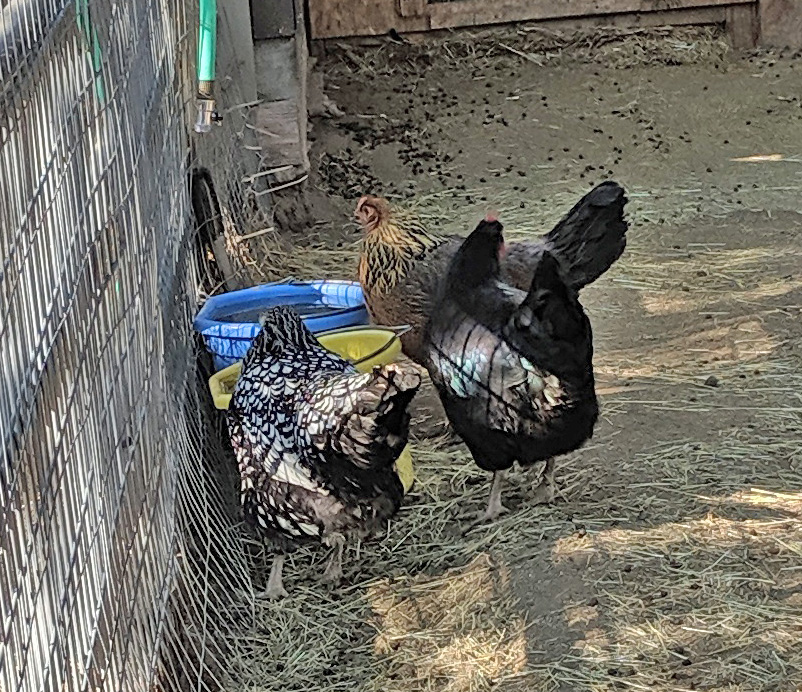
A sign (courtesy of Purina Feeds) affixed to my chicken enclosure gate announces that, “Happy hens live here!” In the above photo, my four (yes, four, this capture is poor) girls, clustered around water buckets, are what remains of the dozen day-old chicks that I carried home nearly 10 years ago. Having chickens has been a worthwhile and enjoyable experiment.

Not without trauma, for there’s little more brutal than normal action in the chicken house where they pick on one another. One’s always the group victim, ragged from missing feathers and bleeding from picked-on skin. I’ve used much purple-dye spray to try and hide the sight of “appealing red” from a poorest one’s more-dominant coop mates. As the flock gradually diminishes, usually because the most-picked-on fails, another falls into the role of group victim.

In observing this phenomenon, it became important to try and save a failing hen. Sometimes the purple dye helped but not enough. Even a most troubled chicken didn’t want to be parted from the others. Occasionally, I did separate a hen, bringing her into the house to heal skin and recover feathers; but it was complex to return her (now an outsider) to the flock. Even my little dwarf goats who live with the hens would lower their heads and charge “the newcomer”. Before long, she’d again be bleeding and featherless, but feeling as if she belonged, and I supposed, relatively happy.

Anyway, now there are four, presumably the strongest of that original dozen. Among these survivors, one appears a bit more ragged with missing feathers and spots of red skin (no bleeding) apparent. I observe her closely: weight is good and eating aggressively, comfortable among her mates. In evenings, all huddle together and roost, and that’s most likely when the vulnerable one looses some downy, protein rich feathers to one or another greedy sister.

If this weakest is next to go, it’ll probably be apparent in winter when all spend more time huddling, and by next spring she’ll be really ragged and weakest. I won’t intervene beyond applying purple spray. On the other hand, I can be hopeful that she’ll remain viable. My thought is that when a group becomes very reduced, it’s in everybody’s best interests to keep all members well and functioning.

Dear Friends: Chickens really are likeable, they give and teach so much. Diana

Midnight Studies

Friday, July 26, 2019

It happens too often that I awaken shortly after midnight, let the dogs outside for several moments, and afterwards, can’t return to sleep. In such early mornings, wide-eyed and awake for a couple of hours, I studied during my college years. It’s a great time for absorbing and learning. Back then, while working full time and attending college, I turned time around by hitting my bed soon after arriving home from work, awakening at midnight to study for about four hours, and then, grabbing one or two quick hours of sleep before the new workday. That midnight oil worked, and especially helped me absorb statistics, my most grueling course challenge.

Now many years later, in a typical sleepless couple of hours, I found a free online course from Yale University and associated to the PBS award-winning film, “Journey of the Universe.” The teachers are Mary Evelyn Tucker and John Grim. They teach at Yale and both are experts, she in the fields of religion and philosophy, and he in the fields of forestry and environmental studies. They moderate this course which starts at the beginning of time (as we perceive it) and weaves in subsequent discoveries of evolutionary sciences and the humanities (history, philosophy, art, and religion).

They are exploring evolution as a creative process rather than a series of facts separated by scientific disciplines. A viewer may enroll for free and audit the course, which I did, becoming interested in the moderators, their backgrounds, expertise, and am impressed with how they handle topics.

This opportunity popped up as I scrolled through Facebook. From my years as a long time student, I typically remember scientific and sociological events as a series of facts. This course is refreshing, by putting into an easy-to-follow narrative context the timing and impact of historical new ideas.

If your Facebook page doesn’t offer a link and you’re interested in the course, try this: https://www.coursera.org/learn/journey-of-the-universe?ranMID=40328&ranEAID=SAyYsTvLiGQ&ranSiteID=SAyYsTvLiGQ-b5AfIuafu0_HKhFR3aF8IQ&siteID=SAyYsTvLiGQ-b5AfIuafu0_HKhFR3aF8IQ&utm_content=10&utm_medium=partners&utm_source=linkshare&utm_campaign=SAyYsTvLiGQ

I’ll admit these days to increasing confusion about current social and political trends, local and worldwide. What do they suggest, where might they lead? There’s something reassuring about a review of environmental and human history reminding us of where we came from, and that the world we know changes constantly. Hopefully, while listening to these experts and how they’ve knitted together history and trends, I’ll find a renewal of reassurance in Mother Nature’s “never static” march.

Dear Friends: It’s okay to tell me to keep sleeplessness and worries to myself. Diana

Oh, Those Northern Eyes

Thursday, July 25, 2019

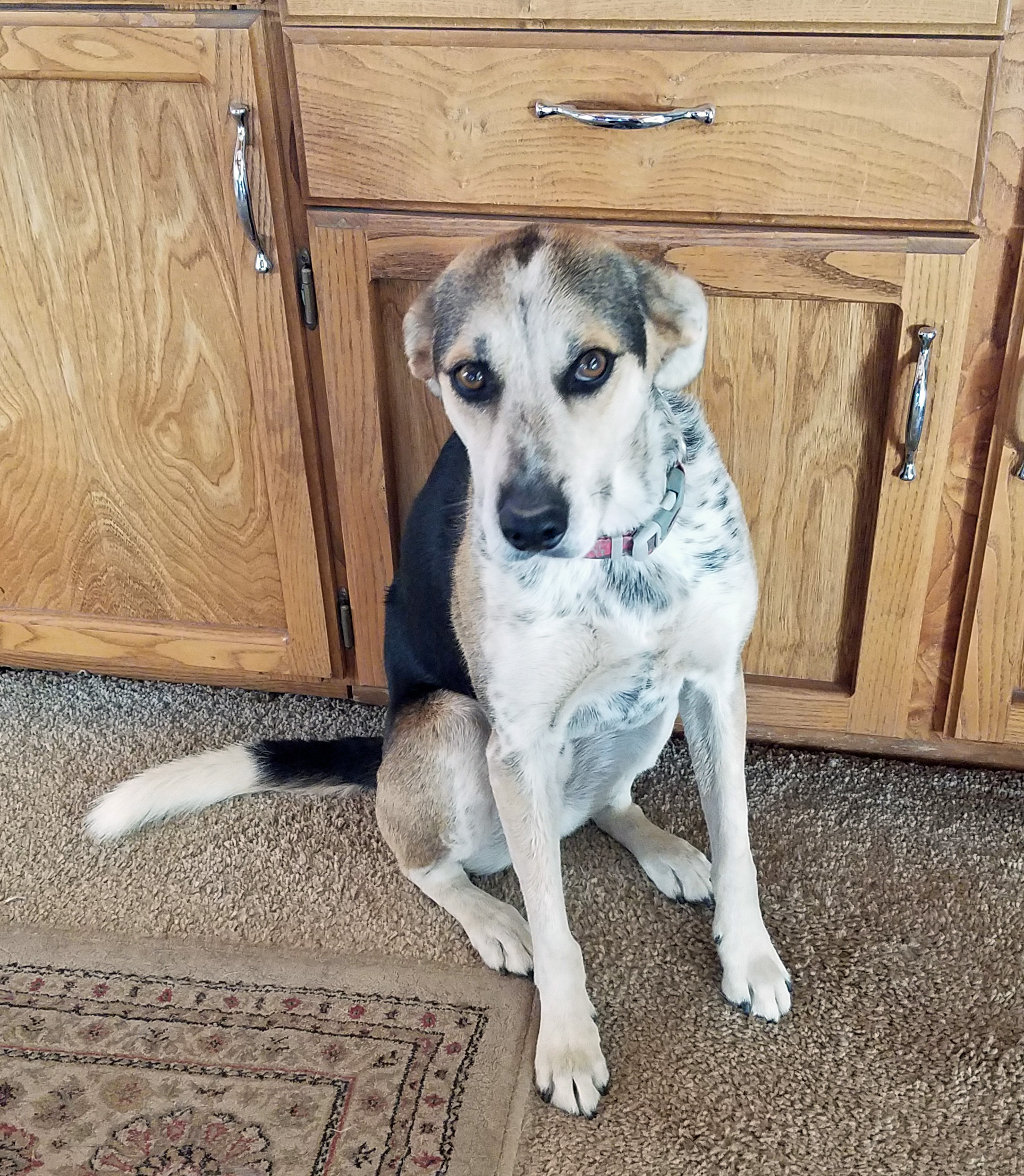
He’s just a mutt, I thought, while reaching down to pick up a stray puppy, who showed up on my street almost 10 years ago. He had been crawling toward me on his belly, frightened, timid, and needing a friend.

I didn’t want another dog, so put him into my car and headed to a veterinary to learn if he had a microchip, and of course, not. Well, I put an ad in the local newspaper and waited for someone to claim him. No takers.

When, at first, I finally could pause and examine him closely, and saw him looking intently back at me, something seemed to happen. It was all about his eyes. They didn’t move from me, followed wherever I went, were intense and telling. This puppy had decided that we belonged together.

Yes, he and his eyes got to me. And still to this day, communicate as effectively as long ago.

In the first place, his are “northern eyes”, with great eyeliner that seems appropriate to a sled-pulling-type of dog, but he’s no puller. Nor does he like to lag, like a Cattle Dog, which is another guess into his lineage. More about those eyes, in the second place, they don’t shift away from his human, but holding seem to plead.

Definitely, he’s a hound dog. He looks and sometimes can sound like one. My best guess is that he’s partly Walker Hound. And keeping that other notion, he’s probably also a bit of Cattle Dog.

His role among my three other dogs is confusing. He’s the biggest at nearly 50 pounds, but also is an underdog, the most picked-on. Conversely, when they’re all out and running, he’s a team leader.

Otherwise and normally, his main focus is on me. He’s totally my dog, with those incredible northern eyes that follow me everywhere.

Dear Friends: His name is Ranger, for showing up as a stray on the street. Diana

Maxwell & The Lizard

Wednesday, July 24, 2019

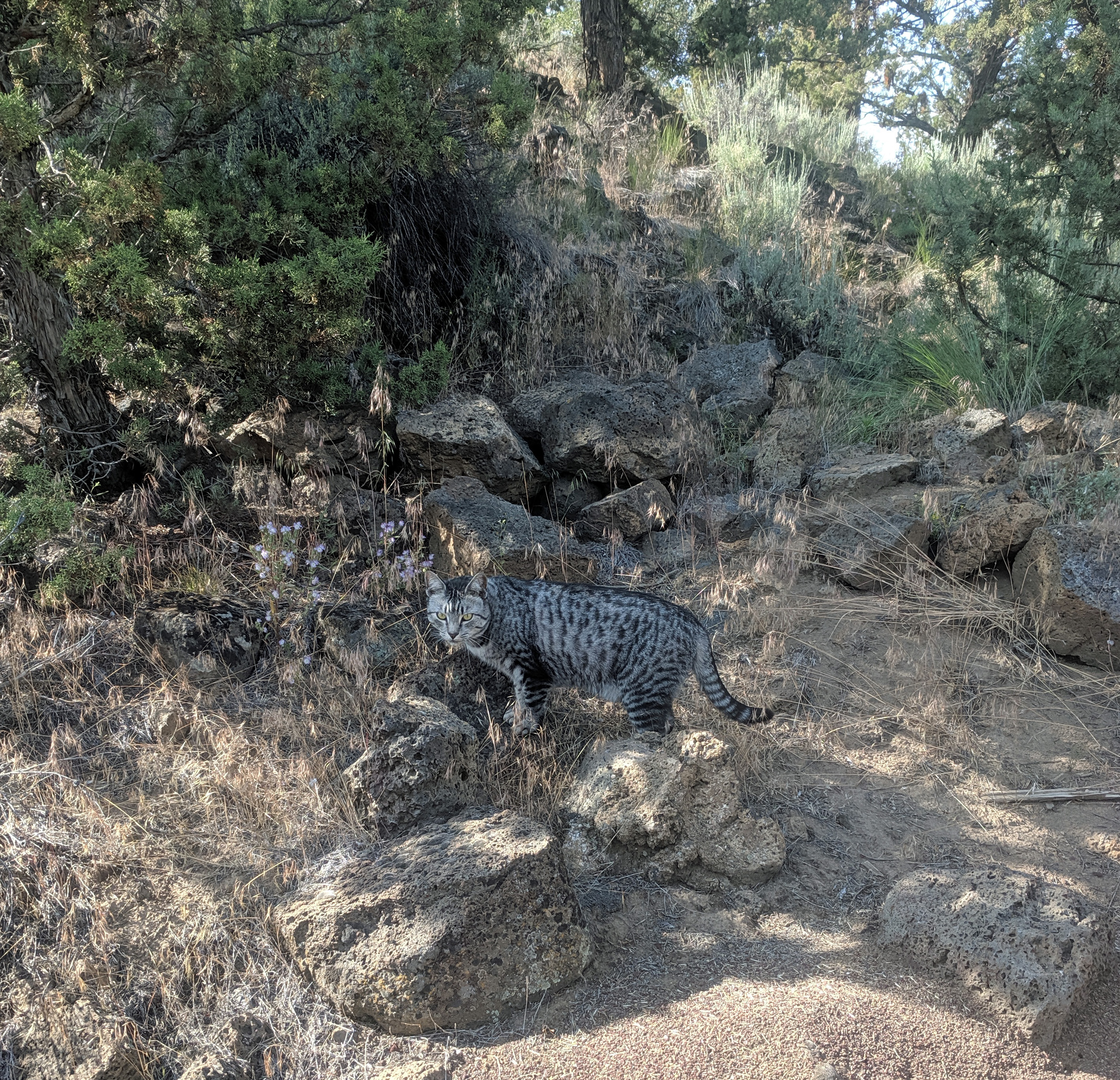
I paused my Gater while traveling on my neighbor’s property upon seeing my cat, Maxwell, perched on a small pile of rocks and staring at me. While I watched, he decided to ignore me and proceeded to examine the rocks around and under his feet. He carefully peered into and sniffed at each shadowy space. The little hunter then left those rocks and crossed my Gater’s path toward another pile he apparently knew well. He again proceeded to peer and sniff. So, I thought, that’s how Max searches for small prey!

I love my cat, and dislike that he’s an expert hunter and destroyer of small creatures. During his ten years as my inside-outside cat, this property has become devoid of some critters, like chipmunks and bunnies. Down by the barn, I don’t like seeing him chase the still numerous lizards. I resist feeding wild birds, except for hanging high feeders for hummingbirds, because Max is an expert bird killer.

His purpose is to control mice in the barn area and once-upon-a-time that’s where he focused, but on maturing turned his attentions elsewhere. He hunts in surrounding fields, and when he hauls catches home, it’s often too late for me to rescue them. Max knows to avoid me. He often leaves critter remains near my house.

Not long ago, while leaving the barn, I nearly stepped on a mature lizard. On its back was a large hematoma and the creature was missing a tail. It tried to scramble out of my way, obviously in pain, disoriented, and unable to move quickly. I captured and brought it to my garage, set it into a covered terrarium, with substrate, water, food, and a heat lamp. For me, that damaged lizard became the last straw, and Max became grounded to remain housebound for the rest of summer.

To summarize, my best efforts couldn’t help the lizard survive.

As a nearly-lifelong city dweller, I’m not from an environment that might have taught me to consider little creatures as relatively unimportant. Years ago, when I lived near Kansas and its populations of meadowlarks, a scientific research effort identified the reduction in fields and near-disappearance of songbirds. That research asserted that cats were responsible for the disappearing field birds.

Keeping Max inside isn’t easy, for he’s constantly underfoot and wants to be outside. I’ll see how continuing confinement goes, but meanwhile, it’s delightful to see lizards of all sizes scampering with energy and in health. Maybe even a chipmunk or two will show up again.

Dear Friends: Call me a “silly softie”, and it’s true, I do admire creatures. Diana

Handful Rosie

Tuesday, July 23, 2019

I loaded Rosie, by herself (never easy), and took off toward local public lands where folks ride horseback and enjoy other activities. My goal was to unload this complex mare, along with her cart also on board, and to harness and drive her. Although I’ve ridden for years in on those lands, I know the narrow and pick-your-way-through trails, not the wider, hopefully softer paths. But it was time to get Rosie out and test our relationship.

This 22-year-old mare is used to getting her way. She came to me six years ago and was different from any of my (very few) previous horses. She had an attitude, tended to be pushy, considered herself a lead mare and bullied my other horse, and often seemed overwhelming to this novice owner. I recognized that if she couldn’t get away with unwanted behaviors, she could be willing and sweet. Over time, I did learn to ride her, never imagining that someday I’d be driving her.

Now, we’re driving, and all by ourselves in 10,000 acres of wild outdoors. Rosie tried to resist being loaded without another horse along, stamped and yelled into her window most of the ride, but disembarked like a lamb once we were parked. There were challenges ahead. She had to stand stock still in this strange area while I hitched the cart to her harness; she’d had to avoid being spooky and remain in control while pulling me over strange paths with little (please, “little”!) wild creatures in surrounding brush. In fact, Rosie did everything perfectly.

What’s changed isn’t Rosie, but me. Her pushiness and size over the years was intimidating. Until I started learning to drive a horse–a sport with new dangers. A driver sits 5-6 feet behind the horse, and in a wheeled vehicle while exerting control through long reins. Rosie responds quickly, is fast-moving, and still intimidating. It took a year to learn my job enough to gain courage to drive her. Early on, I didn’t realize we were working toward an eventual test-outing together. Creating a partnership forced me to ignore fears and fantasies in order to meet and outwit the real challenges. In the end, our efforts revealed Bully Rosie as a big faker. One needs to manage her.

Dear Friends: This small win for a novice horse-person, like me, feels huge. Diana

A Wonder of Consciousness

Monday, July 22, 2019

Several months ago, a NYT article caught my attention. It described scientific research on octopus, their genetics and behaviors. It explained how recognition is growing among marine scientific and aquarium-care folks of the animal’s high intelligence. Octopus is a creature about which many have known little. At a glance, an octopus is different, perhaps unappealing, and also fearsome–because of common and awful myths about its powerful eagerness to strangle and drown prey.

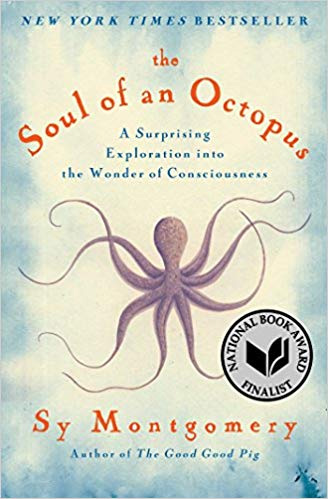
That’s all I knew about octopus before stumbling onto Sy Montgomery’s book (published in 2015). She made a point to learn first-hand about the species and can speak highly about octopus intelligence and behavior. She explains her own feelings and perceptions about octopus during hands-on contact and eye-to-eye interactions with them. She’s found the creatures to be physically complex, mentally perceptive, and often while interacting with humans, demonstrating appeal, fun, and aggression.

Besides the complex underwater behaviors scientists observe and document, they find that octopus in aquariums, interacting with humans, seem able to remember individuals, and also develop distinctive likes and dislikes toward individuals. They regularly spray jets of ink or water on people they dislike, dousing them accurately. On the other hand, octopus will hold, caress, and smell the limbs of people they like, and respond with pleasure to extended petting by preferred humans.

Besides being very clever escape artists, octopus can conjure up tricky ways to find food, and also, they do play–for example, by squirting through their jets to keep toys bouncing in the water. The book offers many examples of species specific and social behaviors that set these creatures as unique and wonderful.

Dear Friends: The world is incredibly more intelligent than many realize. Diana

Sunflower Summer

Sunday, July 21, 2019

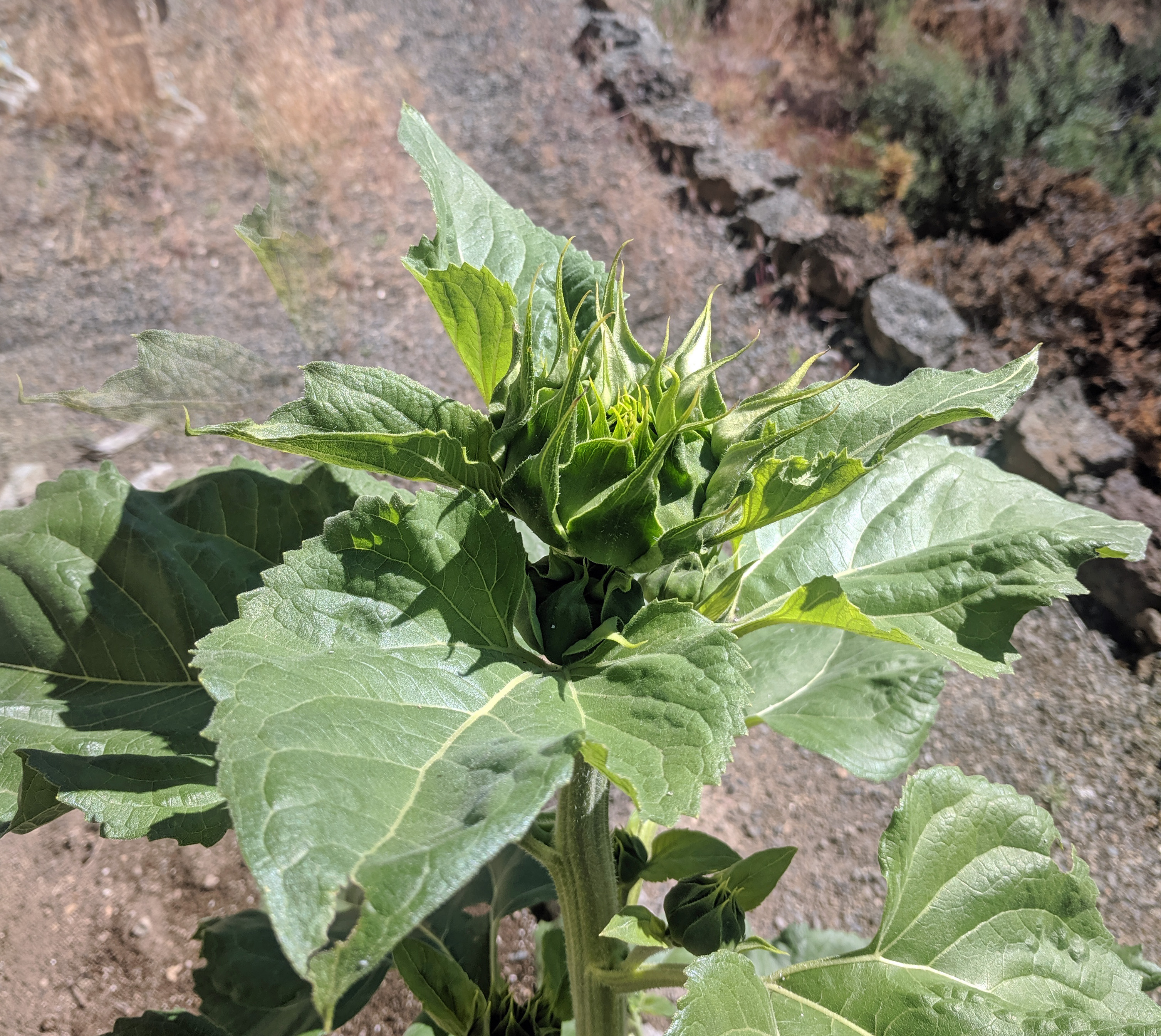
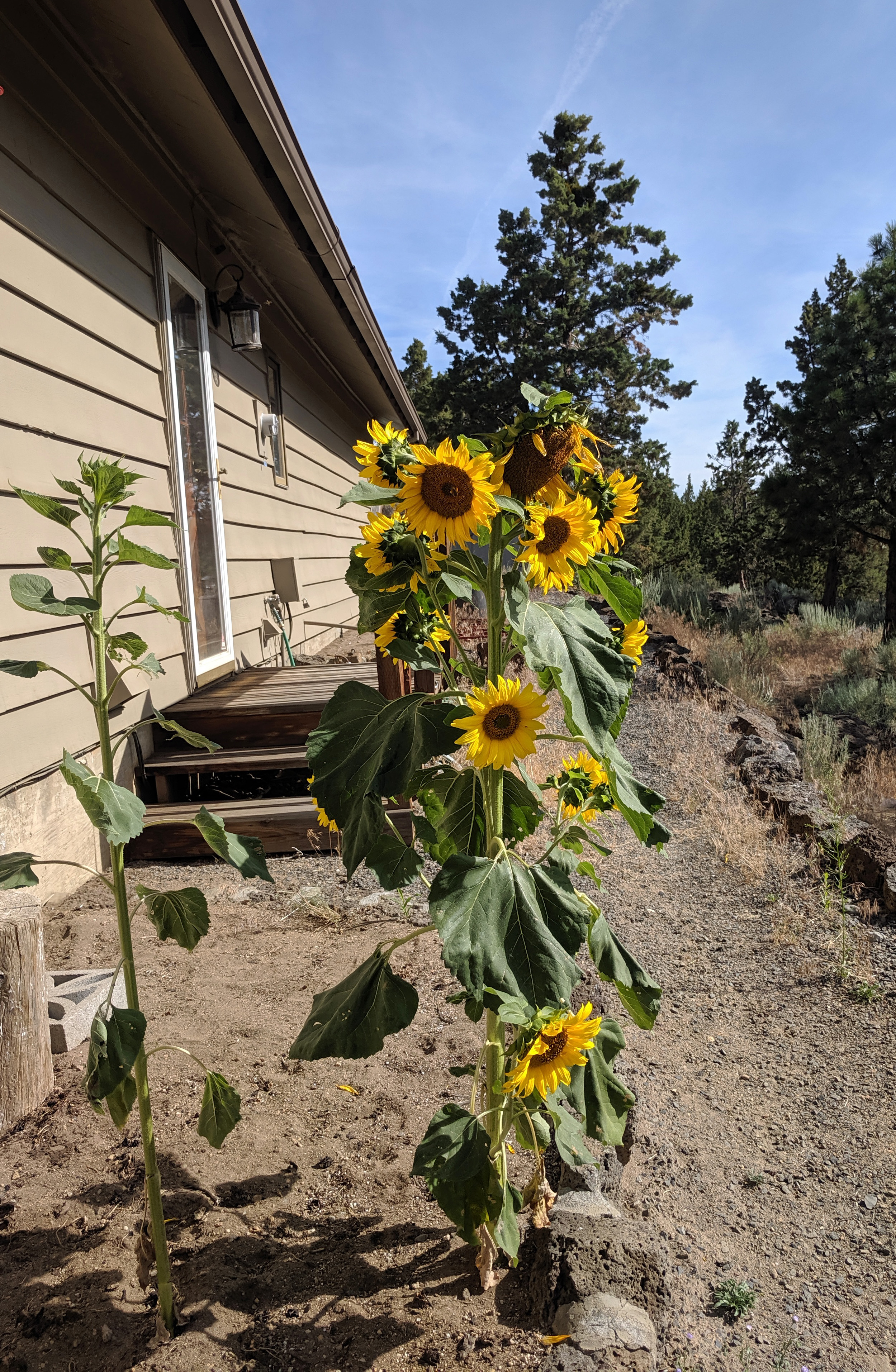
A couple of months ago, this sunflower plant appeared gratuitously on the sandy east side of my house. Beginning as two tiny leaves, probably gifted by a bird, it finally matured. Standing over five feet tall and laden with sunflowers, it’s drawn insects that pollinate, and likely, birds that love its seeds.

It’s a mighty symbol for me, a reminder of years when I resided on the Missouri side of a State Line that separated Kansas. Essentially, going physically to Kansas required crossing a dividing roadway. In America’s pre-high-tech days, Kansas was farm-like and cowboy-primitive. That began changing at the onset of the computer era which required lots of new development. In Kansas, industries found less costly and plentiful space for buildings and parking.

I moved away as Kansas began to explode, and so my memory of its side of that dividing state line is of a small town with surrounding farmlands. I’d drive along a two-lane highway passing spaced-out farms, with meadowlarks singing among tall sunflowers that grew in the constant, nearly overwhelming heat and humidity.

My Oregon sunflowers aren’t like those big Kansas sunflowers. To be sure, mine here are pleasantly nice and attractive in size. But those in my Kansas days seemed more huge. Their big smiling faces waving atop tall stalks somehow managed to wink and twink back toward an onlooker. Altogether, those Kansas sunflowers were most satisfying.

Locations and temperatures are support systems, they can redistribute and alter what lives. This fall, I’ll to go ahead and seed for sunflowers on my home’s east side but won’t expect these plants to grow into Kansas lookalikes. In all honesty, my sunflower memories start to beg questions about memory accuracy. But I wouldn’t travel back to Kansas to verify that those sunflowers still grow on tall stalks with huge faces that speak back to me.

Dear Readers: May your summer be another wonderful period of learning. Diana