Perspectives

Tuesday, December 23, 2025

There’s something uniquely grounding about reconnecting with long-time friends. The conversations are nostalgic, and often honest in ways that only shared time allows. By the time we reach old age, we’ve weathered unexpected challenges, made adjustments, and lost assumptions. We’ve quietly revised our earlier plans. Our gatherings feel open and rewarding—usually because we no longer feel the need to pretend.

Old age—spoken plainly—exerts a powerful influence. Especially when it’s allowed to surface not as a deficit, but as a lens shaped by experience. It reflects years of altered priorities, softened ambitions, and a growing clarity about what matters. Old age draws not from our younger decades—when we were busy projecting forward and planning futures—but from what we’ve learned, and continue to learn, after those early plans met reality.

The more I understand about human evolution and adaptation, the more I appreciate being in this stage of life known as old age. Recently, a minor car accident prompted me to visit urgent care—less out of alarm than out of prudence.

The physical evaluation itself was unremarkable. What surprised me instead were the reactions of the healthcare providers. Each commented on my high activity levels, absence of medications, and continued engagement in work outside the home—observations I had never considered notable before.

That attention lingered and raised unexpected questions. Would this new awareness be helpful—or might it subtly alter my internal balance?

When things once taken for granted are suddenly labeled “remarkable,” does ordinary confidence shift into something more like pressure? Does acknowledgment invite risk—physical or otherwise—where caution once lived comfortably?

These thoughts can easily spiral into philosophy. But they also point to something real. Over time, we learn that new knowledge recalibrates perspective. It changes posture—how we carry ourselves—not just outwardly and physically, but inwardly and psychologically as well.

Nothing dramatic emerged from that medical visit. We acknowledged the ordinary strains and stiffness of a well-used body. I sought the evaluation less out of fear than out of mindfulness—a desire to be attentive, and to have the incident documented should anything develop later.

Perhaps this, too, is part of aging well: not resisting uncertainty, but noticing it, holding it lightly, and then returning—more comfortably—to the quiet business of living.

Diana

The “Third Thirty”

Wednesday, November 26, 2025

My advanced age has me thinking a lot about our aging years—and not as times of decline, but as times of progression. They’re another movement—and a series of choices we can make about who we’re becoming.

Recently, I listened as an “old friend,” Jane Fonda, spoke about believing that our lives unfold in three acts—and emphasized that each act lasts 30 years. Her ideas struck me immediately, both for their simplicity and for their accuracy.

In Fonda’s model, our first thirty years are a period of discovery, in which we figure out how to live, work, love, and become thoughtful about ways to survive our mistakes. Our second thirty years are a period of responsibility, in which we build careers, raise families, create homes, deepen commitments, and steady ourselves. And then—if we’re fortunate—we enter our third thirty years. Then, after sixty, we can finally look backward with clarity and also look forward with intention.

I am adopting Fonda’s view. She’s refusing to “get old” in any traditional sense. She doesn’t deny the body’s changes or the brevity of time ahead, but instead, suggests that by sixty, we’ve gathered enough wisdom to see our remaining years as something like a design project. That’s a new span of years for us to use, to edit, refresh, and refine—much like a cherished home or garden—which we finally have time to tend properly.

I agree with her, and I get her point—that each of us arrives at our third thirty carrying the sum of our experiences. She says that point represents our lessons learned: the habits that kept us going, the relationships that shaped us, and the courage we’ve gained the hard way.

What’s remarkable about our third stage is the sense that we’re not simply living out our remaining years—but actively shaping them. We’re deciding who we want to be in our third act. We might want to be identifiable—and thus, stylish or invisible, curious or complacent, engaged or withdrawn.

The old ideas about “not getting old” harken back to times when people tried to pretend they were younger than they were. Instead, new ideas about getting old have everything to do with staying current, interested, and actively in one’s own life.

Like Fonda, I want my style to say I’m still here. I want my choices to reflect a mind that’s awake. I want to use what I’ve learned from my first sixty—or eighty—years in ways that open and make my third stretch feel richer and more spacious—and maybe even more joyful.

It’s a relief to find myself thinking this way! To be imagining my third-thirty as not needing to be a “fading-out,” but instead be a revision—a reinvention—and a “creative third act.”

How extraordinary that the cycles of aging can lead to and allow us this—a moment when we have finally shed enough expectations to become more fully ourselves.

I sense others around my age feel similar rumblings. A sense of not being finished—not even close. Jane’s view captures what our third-thirties are meant to be—a time to show up dressed, interested, and ready to be the next version of ourselves.

— Diana

A “New Aging” Conversation Circle

Saturday, November 22, 2025

Imagining The Circle

In my mind, the group isn’t large. Maybe six to twelve people—enough for richness, but small.

I’ve written recently that those of us in our 70s, 80s, and 90s may be discovering that we’re living in moments no one could ever have prepared us for. These days, we find ourselves living healthier longer, staying mentally alert longer, and remaining deeply engaged with the world longer—way beyond what earlier generations ever imagined. Our younger society hasn’t yet recognized all the changes affecting its oldest population. These changes are personal, complex, sometimes isolating, and often surprisingly similar among people of advanced ages.

Writing has made me consider such “elderly biological and cultural shifts” more deeply. I’m even imagining what it might “look like” to gather with others also navigating the new territories of aging. I’m not visualizing a formal club or a structured workshop—just a thoughtful, recurring space to talk about our “inner lives of growing older” in today’s world.

What A Group Might Feel Like

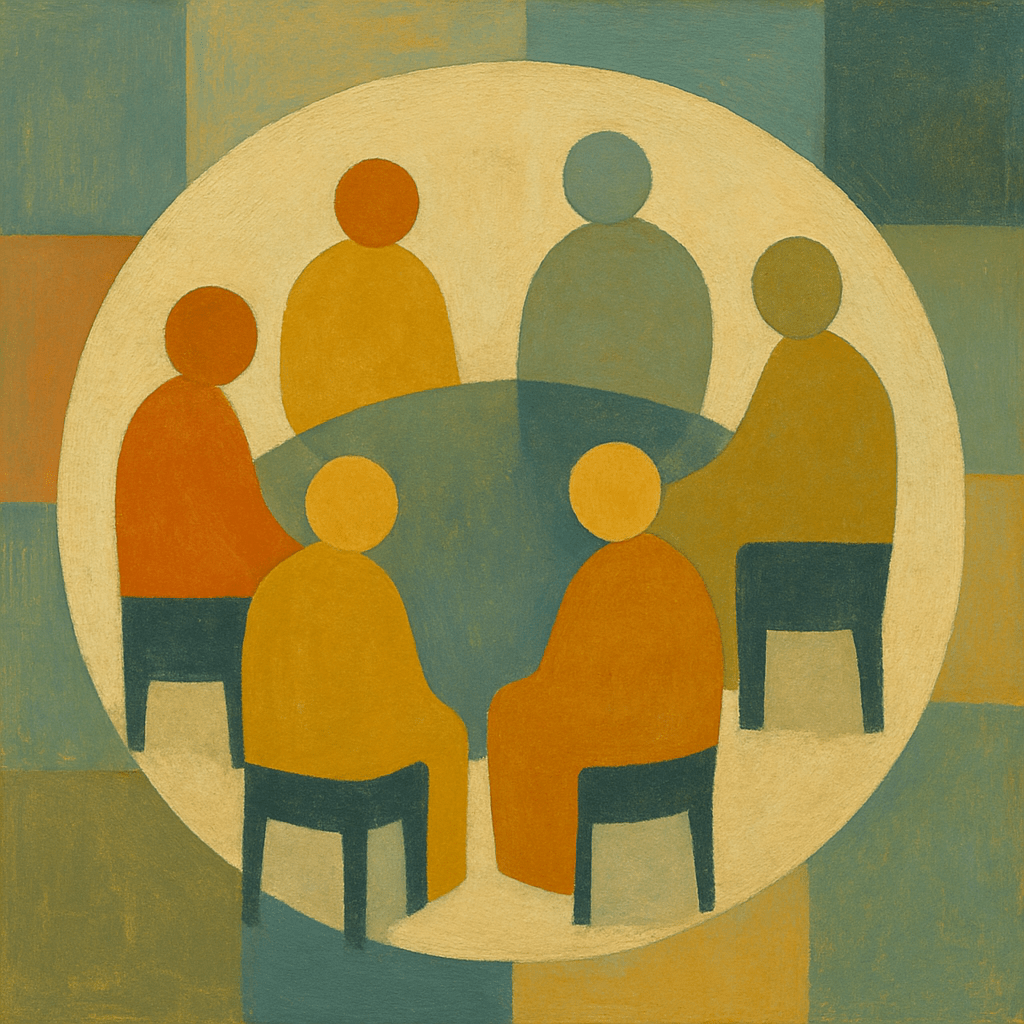
In my mind, such a group isn’t large. Maybe six to twelve people—enough for richness, but small enough for real conversation. A circle of chairs, not rows. A living-room feel, not a classroom. Perhaps it would meet monthly or every few weeks, with no obligation beyond showing up and being oneself.

There needn’t be a leader in the traditional sense—it’s more of a shared stewardship. A group that could gently guide itself, the way good conversations naturally do. Meetings might center on topics. One might be the surprise of still feeling young inside. Others might explore purpose, or changing friendships, or the odd friction between staying capable and being treated as fragile.

The group wouldn’t represent therapy, nor serve as a complaint circle. It’d be a place to name what today’s aging really feels like—and to hear others say, “I’ve felt that too.”

This Matters Because

We’re the first aging generation to find that, while living this chapter of life, we’re also having to invent this chapter. We’re the first generation to be alive for decades of healthy years beyond traditional retirement. And we’re the first generation needing to reconcile our longer lives against an outdated cultural script that still imagines “old age” as it looked fifty years ago.

Our task—to pioneer and modernize the aging experience, may feel easier—and richer—when it’s shared.

This is a suggested “conversation circle” of elderly participants—not a way to solve the larger social issues of aging. It could, however, illuminate them, while also offering grounding, connection, humor, and clarity. It could help participants understand ourselves in ways we don’t always get to while navigating the advanced years alone.

For now, it’s just an idea I am sketching—an outline—a possibility. If others feel the same pull, perhaps it will take shape. As with most meaningful things in life, maybe energy will start to gather around it.


For The “Interested Some”


What’s this group about?

It’s a small, recurring conversation circle for people in their 70s, 80s, and 90s who want to talk about the inner experience of aging in today’s world—identity, purpose, vitality, ageism, relationships, curiosity, and what it means to be living longer and healthier than previous generations. (Okay, too, if people in their 60s wish to participate.)

Is this a support group or therapy?

No. It’s not a therapy or counseling group. It’s a thoughtful discussion circle—more like a gathering of peers who want to explore life’s later years with honesty, humor, and insight.

How big will the group be?

Small—ideally 6–12 participants. Big enough for varied perspectives, small enough for everyone to speak and feel comfortable.

Who leads the group?

There is no formal “leader.” The group guides itself. One person may help keep time or open the meeting, but the conversation belongs to everyone.

What kinds of topics will we discuss?

Topics may include:

  • staying healthy and active
  • experiences with ageism
  • identity shifts and reinvention
  • loneliness, friendship, connection
  • unexpected confidence or creativity
  • memories that take on new meaning
  • the realities of energy, motivation, and purpose
  • navigating losses while also discovering new growth

Every meeting may have a theme, but there will always be room for whatever people bring that day.

How often will the group meet?

Most likely once a month or every few weeks, depending on what the group decides.

Is there a cost or commitment?

No cost. No long-term commitment. Just come when you feel drawn to the conversation.

Do I have to talk?

You’re welcome to speak as much or as little as you wish. Listening is also a valuable form of participation.

What would the atmosphere be like?

Warm, respectful, curious, confidential, and welcoming. A place where no one is judged for aging in their own way. A place where humor is welcome and honesty is valued.

I’m interested and a Central Oregonian; so, what now?

Simply share your name and contact information to let me know you’d like to be included as the idea takes shape. Once enough people express interest, we’ll choose a meeting time and place.

— Diana

In My 80s: A New Kind of Frontier

Thursday, November 20, 2925

I’ve been thinking about what it means to be in my mid-80s—healthy, clear-minded, deeply involved in daily life—and how strange and surprising this stage feels compared to what I imagined many years ago.

The truth is, I never pictured myself “here.” Growing up, I didn’t know a single person in their 80s who was still vibrant, working, and engaged. Most older people I saw (even in their 60s) were frail or withdrawn, already living in the narrow, expected lane that society has quietly painted for “seniors.”

But today’s medicine has changed dramatically. So has nutrition, lifestyle science, and our understanding of the mind. Something new is happening: people are living longer and staying healthier. We’re extending not just lifespan, but healthspan. And those of us who find ourselves active and well in our 80s are, in a way, pioneers. We’re the first generation who must learn how to inhabit this expanded stage of life—because there is no blueprint yet.

The Question I Keep Getting

In my retail work, where I interact with countless customers, I am asked about my age more than ever. And I don’t answer. Not because I’m ashamed—far from it—but because the question usually comes with something else: an immediate rush of unsolicited expectations.

People seem eager to explain what they think someone my age should be doing. Resting. Retiring. Slowing down. Disappearing from the working world.

What they’re really telling me is that they can’t imagine being my age any more than I once could. They’re trying to match the person they see—present, engaged, competent, and curious—with the outdated stereotype of an “elder” that they still carry. That mismatch unsettles them, and age questions become a way to resolve the puzzle.

I’ve come to understand this as a soft, reflexive form of ageism. Not cruel or intentional—just unexamined. A product of our culture’s old mental images about aging, images that many people haven’t updated yet.

A Quiet but Powerful Shift

But here’s the interesting part: every time someone encounters a healthy, active, eighty-something, their internal map of aging shifts—just a little. They’re being stretched into acknowledging a new possibility: that older age can look very different from the images they grew up with.

When I decline to answer age questions, I’m setting a boundary, but I’m also doing something else. I’m reminding people that age is neither a credential nor a limitation. My value—in work, in conversation, in life—comes from who I am right now, not the number attached to my birth year.

What Comes Next

Lately, I’ve been reflecting on how many people around my age are experiencing these same shifts, these same mismatches between who we are and how the world imagines us. Our generation is living through an evolution that society hasn’t fully named.

There’s a bigger conversation to be had about aging today—about identity, purpose, mental and physical vitality, boundaries, curiosity, and what it means to live longer and healthier than we ever expected.

That conversation is brewing inside me. Perhaps it will grow into something more structured—a regular discussion, a gathering, a community space for people in their seventies and eighties to share experiences and observations. Perhaps it will simply unfold one piece at a time.

For now, this is just the beginning.

And I’m curious where it will lead.

— Diana