
Friday, July 17, 2026
An old and stubborn myth in the classical music world goes like this: “Men are better pianists because they have more physical strength and can draw more from the instrument.” That outdated sexist notion has made many brilliant female musicians roll their eyes.
A few days ago, I remembered the myth while watching the new movie Tuner. As its final credits rolled, I knew the film had brilliantly sidestepped tired clichés about gender and power—and its climax had magnificently revealed things much deeper about its characters.
Tuner is a fine film that, above all, meticulously prepares us for its ending. The story’s development and climax are designed to reveal the intricate anatomy of a genius, and they do so successfully.
From its very beginning, we learn about the male lead’s relationship with music. For him, it’s not only a learned skill—music is a fundamental part of his wiring. The script gradually establishes his genius. At first, it lets us witness his extreme sensitivity to sound from his earliest childhood, and soon we start recognizing his photographic memory for all musical elements.
And then there’s the film’s climax, when for the first time he plays the piano–doing so with immense and passionate force. His performance doesn’t feel like a cheap movie gimmick or an act asserting “male physical dominance.” Instead, it’s letting us understand that his playing is the earned, logical explosion of a lifetime of intense sensory experiences.
Tuner avoids falling into gender stereotypes by creating a stunning dynamic between the two leads. The thundering piece he performs has been composed by his love interest, a woman with a profound passion for her art. And their shared passion creates a beautiful, tense contrast:
- She’s the intellect: The creator and architect, having the deep, complex genius required to compose the piece.
- He’s the physical conduit: The one having the raw, hyper-sensitive, and physical tools to translate her creation into a thundering reality.
The film gets immense credit for not being a statement about “who’s better.” Instead, it’s an excellent synthesis of two distinct gifts—her intellectual creation, meeting his sensory and physical execution.
This movie made me think about what “true power” at the piano actually looks like. Any notion that brute force makes a piano sing better is a fundamental misunderstanding of the instrument. I’m someone who works out to increase my personal physical strength, and I don’t see playing the piano with power as a bench-press competition. Instead, I see it as a masterclass in physics.
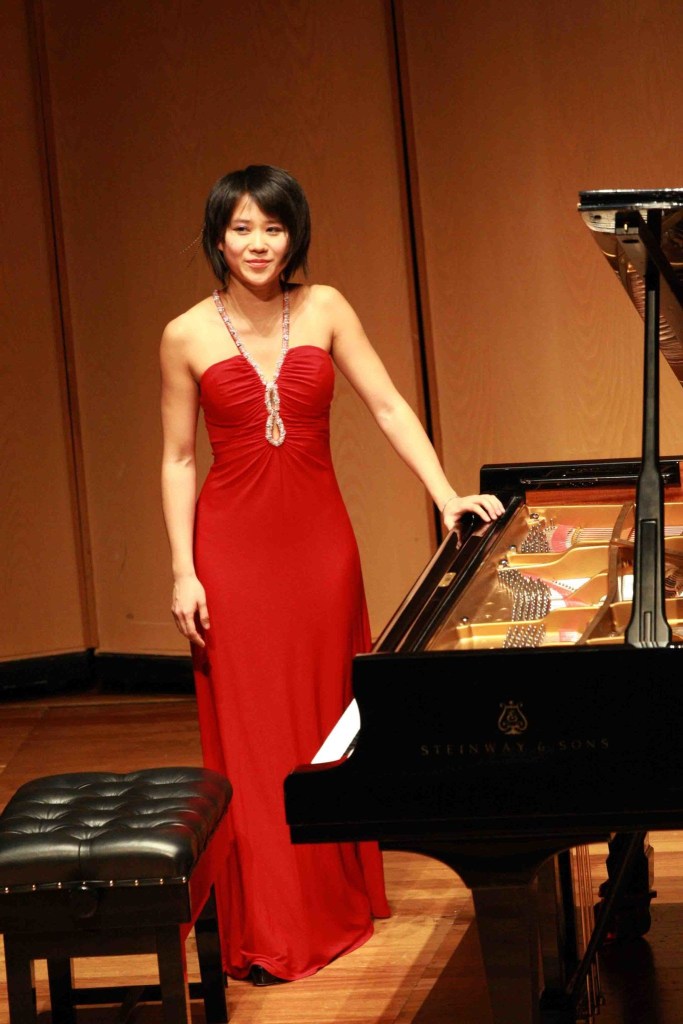
That’s because true power comes from core strength, leverage, and weight transfer—using gravity and the natural weight of the arms instead of tensed muscles. Thinking this brought to mind one of my favorite artists, the classical pianist Yuja Wang. Wang is a real-world refutation of the “common power myth”—and is a living antidote to stereotypes of the physically dominant male pianist.
Wang is a global classical phenomenon—a superb artist who completely dispels any notion of the “less powerful female pianist.” She’s physically fit, incredibly bold, and completely commanding on stage, performing with her entire being. She’s unafraid of tackling the most punishingly difficult, heavy, and physically demanding concertos in the classical canon. And she executes them with absolute, explosive authority.
Wang magnificently claims her space in a classical music industry historically dominated by conservative, often rigid expectations. She modernizes classical performances by performing flawlessly while dressed in striking, attention-grabbing attire and high heels. She refuses to diminish her femininity and is taken seriously as a powerhouse. Wang proves that physical power at the piano isn’t about size; it’s about technique, athletic efficiency, and fearless artistry.
Identifying great art is easy—whether on a cinema screen or a concert stage—especially the kind that moves beyond tired stereotypes in reaching toward its peak. Tuner does this successfully by treating its characters as individuals with distinct minds and unique sensory worlds, and not as stand-ins for outdated gender roles. Real-world artists like Yuja Wang show that the true power of the piano doesn’t belong to any one gender—it belongs to anyone with the dedication, technique, and soul to unlock it.
It’s easy to experience Wang’s magic and physical mastery in action. There are many YouTube videos of her performing complex pieces, each showing the petite performer using her entire body to command immense, thunderous power from a grand piano.
For those reasons and more, I recommend Tuner. This great movie is backed by skilled direction and fine acting. Its brilliant script has excellent foreshadowing. Its story deeply focuses on great loves—for sounds, for music, and for relationships. And its passionate, deeply human characters cope with real-life foibles.
— Diana


