Hearing A Presence

Friday, December 19, 2025

Tomorrow is the winter solstice of 2025—the day our planet offers its fewest hours of light and quietly turns back toward longer days. The semi-annual solstices are about timing. And that has this one reawakening me to a listening experience I’ve somehow overlooked.

While I’ve reflected on—and written about—voices that enter a room and change its atmosphere, I’ve left one essential vocal artist standing quietly at the doorway:

Peggy Lee.

Not because she demands attention—but because she never does. With Peggy Lee, less is always more.

Listening to her becomes an exercise in recalibration. Lee doesn’t lean forward into the listener; she lets the listener come to her. In doing so, she alters the very terms of engagement. You don’t consume a Peggy Lee song. You lean in. You adjust your breathing. You become careful.

Where Louis Armstrong carries weight—joy braided with sorrow—and Ella Fitzgerald moves with brilliance and lift, Peggy Lee works in a narrower register. A deliberate narrowness. A choice. And within it, something quietly commands—and happens.

Peggy Lee’s timing is everything.

She doesn’t rush toward a lyric; she places it. Sometimes she arrives a fraction late. Sometimes she lets a word trail off, as if deciding—mid-phrase—how much truth to reveal. Silence, for her, isn’t an absence but a tool: a held breath, a raised eyebrow—one you can hear.

In songs like “Fever,” the drama isn’t in volume or flourish; it’s in restraint. Lee barely raises her voice. She doesn’t sell the song; she assumes it. Her confidence isn’t showy. It’s settled. Adult. World-aware.

Listening to her, I’m struck by how much authority can live inside softness.

Peggy Lee’s presence feels personal without being confessional. She doesn’t invite us into her interior life so much as let us sit nearby. She doesn’t ask us to identify with her pain or her triumphs; she asks simply that we notice—and pay attention.

Perhaps that is why Peggy Lee’s singing still feels so modern.

In an era when performance often leans toward maximal expression, she reminds us that meaning can reside in what is withheld—that intimacy can be created less by exposure than by precision. She teaches us that timing—true timing—isn’t just musical, but emotional.

Listening to Peggy Lee, I don’t feel dazzled. I feel addressed. She seems to change the room not by rearranging the furniture, but by lowering the lights.

Today, finding her again, I’m not merely listening to the music. I’m listening for something within it—a presence that doesn’t announce itself, but waits. Patiently and unmistakably, for anyone who slows down enough to hear it.

Diana

Letting Go, Mending, Learning

Tuesday, December 09, 2025

Several weeks ago, after leaving my sales job in a large retail department store, I turned my attention back to a long list of needs waiting at home. I contracted for a new roof, got long-overdue electrical repairs done, and—perhaps in the biggest emotional task of all—helped my beloved donkey, Pimmy, transition to her new home.

Fortunately, that new home is nearby and I visit often, which softens the bittersweetness. Pimmy is a “special needs” pet, living with Cushing’s disease and Type II diabetes. Over the past year, I carefully managed her diet, and she lost nearly 200 pounds. She now looks bright, alert, and almost youthful again.

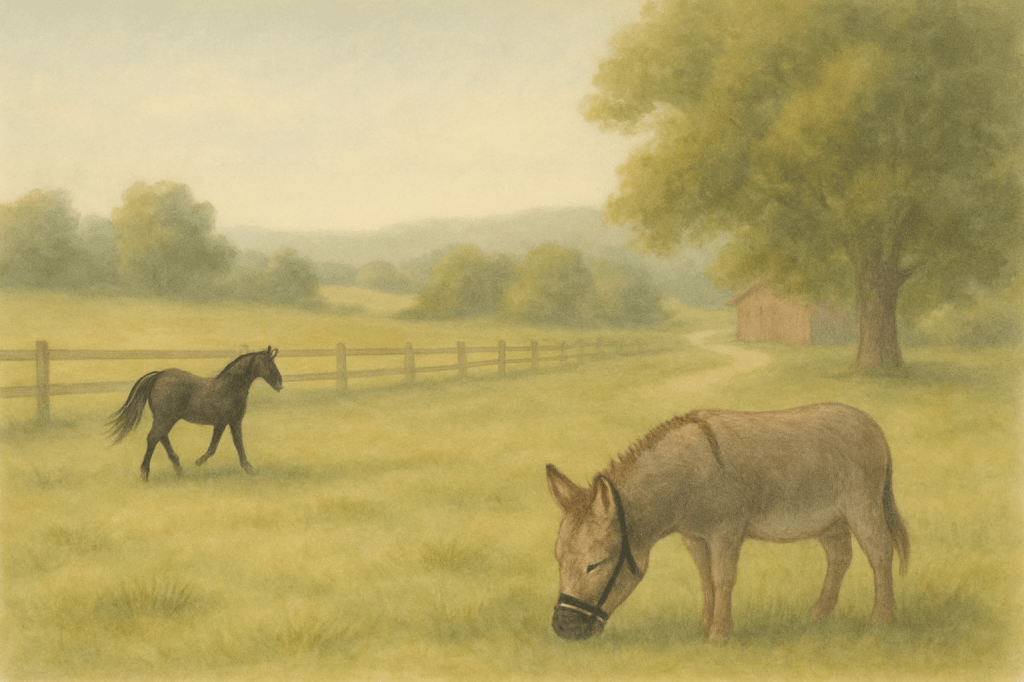
Her “new person” is a retired nurse—gentle, steady, and knowledgeable—who understands Pimmy’s conditions and is both vigilant and deeply caring. Pimmy now wears a grazing mask and spends her days roaming a generous pasture with her new buddy, an aging Arab gelding. The regular movement is doing wonders: she’s walking more freely, her energy has lifted, and her coat is turning fluffier and shinier, as if she’s growing into a chapter all her own.

Meanwhile, life with my two horses has kept me just as busy. With Pimmy settled, I turned to repairing fencing, cleaning the barn, and making a few improvements to the horses’ living space—projects that had been quietly waiting for months. Horses have a way of creating their own to-do lists, and mine certainly did.

Rosie, who is sturdy but sometimes finds trouble, managed to develop a hoof abscess. It needed soaking, wrapping, and all the fussing Rosie insists on not enjoying. And Sunny—sweet, distractible Sunny—somehow scraped a surprising patch of fur off her face. No dramatic story, just the everyday mysteries of horse life. Between meds, bandages, and gentle reassurance, they’ve needed both hands-on treatment and the simple comfort of my presence.

All this work has kept me grounded, but I’ve also become aware of another familiar pattern: the slow return to isolation whenever I stay home long enough. It’s not that I don’t love being here—keeping the property in shape, caring for the animals, tending to the endless little realities of country life. I do. Yet after a while, I begin to miss the hums of human life. Conversations. Laughter. The ordinary noises people make while going about their day.

So, I decided to rebalance things. For this Christmas season, I’m taking a part-time job at a fast-moving retail discount store. A few short shifts each week will give me a little of the outside world again—energy, chatter, and a constantly changing flow of faces. And, for reasons I can’t entirely explain, I have a growing curiosity about retail as an industry. Now that I’ve learned how a traditional department store operates, I’ve also wanted to understand how the bulk discount retailers run their show. My new seasonal role will give me a chance to find out.

What I’ll ultimately do with my expanding retail knowledge is anybody’s guess—mine included. Maybe it will simply satisfy my curiosity. Maybe it will help me better understand the rhythms of modern commerce. Or perhaps it’s just another way of staying engaged with a world that keeps shifting under our feet.

For now, it’s enough that this will get me out among people again—listening, learning, and feeling connected—while still allowing me to come home to the animals and land that make up the heart of my days.

— Diana

Pimmy’s New Beginning

Sunday, November 30, 2025

My middle-aged donkey, Pimmy, may soon be living in a new home. It’s bittersweet to even write that, because the past year with her has been so intense, so emotional, and so full of learning.

Pimmy’s health crisis last year took me completely by surprise. I was unfamiliar with Cushing’s disease in equines, let alone equine Type II diabetes. By the time I understood how sick she truly was, she needed to be hospitalized in an equine ICU—days of specialized care, IVs, monitoring, and the kind of worry that settles in your bones.

When she finally came home, it was with lifelong medical needs: daily medication, careful feeding, and the responsibility of helping her lose nearly 100 pounds. At first her treatment routine was twice a day, and eventually it shifted to once daily, but the vigilance and devotion never lessened.

Through it all, Pimmy remained sweet and willing—devoted to “her horses,” Rosie and Sunny, even when I had to separate her from them so she wouldn’t overeat. They stayed close, calling to each other over the fence, a small reminder of their bond. I became unexpectedly proficient at mixing medications and administering them to a donkey who had her own opinions about anything that didn’t involve hay. And each time I walked toward the barn, she greeted me with hopeful, hungry brays—touching, funny, and a bit heartbreaking.

But she adapted, and so did I. Over the year, Pimmy lost the weight she needed to lose. She looks wonderful—bright-eyed, balanced, and healthy. Somewhere along the way, this stubborn little donkey transformed into “my big puppy,” easy to handle, affectionate, and smart as all get-out.

Through her recovery, my biggest worry remained her future. Donkeys, when well cared for, can live forty years or more. At my age, I know I won’t be here for the whole arc of her life. Rehoming her has weighed heavily on me. Anyone responsible for Pimmy would need to understand the realities of a “special-needs” donkey—the monitoring, the daily medication, the vigilance around weight. Not everyone can take that on. But for the right person, the reward would be immense. Pimmy, in my fully biased opinion, is one of the sweetest donkeys on the planet.

And then, early in Thanksgiving week, something unexpected happened.

A nearby neighbor, Alison—someone I only vaguely knew, though I knew she was a horseperson—texted me out of the blue asking if she and her husband could come talk. After so many years living near each other, I had no idea what she might want.

They arrived and told me their old horse had recently died, leaving their remaining elderly gelding lonely and unsettled. Softly, and very respectfully, they asked whether they might “borrow” my donkey for a few weeks as a companion until they found another horse.

Because they’re experienced with horses, they already understood the essentials of Pimmy’s care. They played with her, scratched her in all her favorite places, and fell for her immediately. And without much hesitation, we made an agreement: Pimmy would go to their place as a companion. If they loved her—and if they could manage her medical needs—she could stay permanently.

A remarkable part of this is that Alison, besides being a lifelong horsewoman, is a recently retired nurse. She understands chronic conditions; she’s comfortable with medications and observant about details. She asked the right questions, noticed everything, and handled Pimmy with a calm confidence that reassured me instantly.

Yesterday, Alison returned with several friends who were excited to meet Pimmy.

We all escorted Pimmy, who wore a grazing muzzle, as we had to walk across a pasture, to meet the elderly gelding. Those two hit it off right away. And, everyone adored Pimmy—her sweetness, her curiosity, her gentleness. I watched her step into this new circle of people and animals and felt the full bittersweetness of those moments.

Letting go of a beloved companion is never easy. She has been part of my daily rhythm, part of my barnyard family. But alongside the ache, I could feel something else—relief, gratitude, and a genuine joy. I could see clearly that Pimmy was stepping into a home where she would be appreciated, understood, and deeply cared for.

It felt like the universe whispering, Here. This is the right place. This is the right time.

That it’s Thanksgiving season, too, has me feeling a special mixture of gratitude and humility. Gratitude that Pimmy is healthy and happy, that the right people appeared at precisely the right moment, and that she will be cherished in her new home. And, humility in realizing that letting go—when it’s done with love—is also an act of giving care.

Pimmy will always be an essential part of my story. But now she belongs to a new one, and that’s bringing me a quiet, hopeful peace.

(Note: The photos, “moments of transition,” were captured by our friend, Susie.)

— Diana

Hearing the Calling

Wednesday, September 24, 2025

For several days, and again this morning over coffee, I’ve had my mind on an old movie that I’ve chosen to watch more than once: Bagdad Café (1987). Like Sounder, which I recently wrote about, it’s stayed with me longer than most films. Maybe because of the quiet desert roads, which feel oddly familiar against my own Central Oregon landscape—wide spaces, moments of isolation, and the surprising ways “connection can arrive.”

Each time I’ve watched, I’ve sensed there’s more going on beneath the story’s surface. At first glance, it appears to be a lighthearted, eccentric comedy with superb acting. However, upon reflecting on its story and characters, I’m convinced that it’s an allegory—and one worth sharing.

On its surface, Bagdad Café is quirky and offbeat, full of small mishaps and comic misunderstandings. Yet behind the humor lies something larger. The setting is a dusty, broken-down café in the Mojave Desert, the sort of place most would drive past without stopping. Into this place come two women: Jasmin, a German tourist, after suddenly being abandoned by her husband, and Brenda, the café’s owner, after being left behind by her husband. Both women are prickly, suspicious, and in their own ways exiled and alone.

At first, the café is a mess—disordered, tired, going nowhere. But slowly, almost imperceptibly, Jasmin’s presence begins to change it. She cleans, she listens, she performs small acts of magic. Brenda resists at first, then softens. Before long, the café is transformed from a tired outpost into a place of beauty, music, and connection.

One image that lingers with me is of Brenda’s husband, who, after leaving, keeps watching the café through binoculars. He has walked away, yet can’t resist observing from a distance. To me, this is part of the allegory. He represents those who see but never engage—hovering on the edge of transformation but unwilling to step into it. His gaze is controlling, even possessive, yet powerless. In contrast, Jasmin—the German, or true outsider—enters fully and brings renewal. The binoculars make the husband an emblem of distance, without connection, reminding us that healing comes only when we dare to join in, not when we stand back and watch.

The cast itself reinforces this sense of something larger: a German tourist, a Black American café owner (played by a British actress), an American painter (played by a once-famous film star), and an assortment of desert drifters. This gathering suggests more than coincidence—it’s also a picture of cultures meeting, colliding, and creating something new together. In that sense, the movie’s haunting refrain “I am calling you” can also be heard as a call across borders, an invitation to connection that transcends nationality, language, and race.

Other details I can’t shake involve Brenda’s children. One is a young father determinedly practicing classical piano in that unlikely setting. His grand piano in that battered desert café feels almost surreal, yet it deepens the allegory: aspiration in unlikely soil. His music insists that beauty and culture belong everywhere—not just in gilded concert halls, but even in a dusty roadside outpost, if someone dares to press the keys.

Then there’s Brenda’s teenage daughter, restless and intent on leaving. She represents another answer to the calling: not to stay and transform, but to escape in search of something better. Her choice is human and understandable, yet it contrasts with Jasmine’s quiet decision to remain and renew. Together, the piano player and the daughter remind us that when the call comes, each of us must answer in our own way—by staying and creating, or by moving on. Either way, the call cannot be ignored. Both children become transformed by the café’s changed atmosphere and remain connected to it.

The more I think about it, the more Bagdad Café feels like a parable of renewal. The café isn’t just a diner—it stands for the barren places we all sometimes inhabit, whether in spirit or in life. Jasmin, the German stranger, becomes an unexpected redeemer, bringing grace without asking for much in return. Brenda, toughened and skeptical, is the everywoman—ready for renewal if she dares to trust.

Threading through it all is the film’s haunting song, Calling You. The lyrics drift in like a voice from beyond:

A desert road from Vegas to nowhere … I am calling you.

For me, that refrain is the heart of the film—maybe hope itself speaking, maybe spirit, or simply the mysterious force that draws us toward one another when we feel lost. Whatever its source, the call is unmistakable. It reminds us that life doesn’t end in the wasteland. Something new can bloom, even in the dust.

These days, I am struggling to find my footing in a competitive environment among strong coworkers. I’m recalling this movie and its message, likely because it’s calling me to stay open to the possibility of renewal, even though I sometimes feel inclined to shut down.

Maybe the movie’s refrain—I am calling you—and its use of magic, aren’t just for the characters in a quirky old film. Perhaps those are calling all of us, tugging gently, if only we allow ourselves quiet moments to hear.

—Diana

Underground Railroad, Canine Edition

Saturday, September 20, 2025

Yesterday I was late to work. I had just opened the front door to leave when little Mitzvah appeared, panting and wagging, eager to come inside. I let her in, gave her a cookie, and tucked her into her crate before heading out to discover how she’d escaped. It didn’t take long—bigger, stronger, and endlessly determined Chase had dug yet another hole under the fence. The gap was just wide enough for Mitzvah to slip through, but not big enough for him.

So, once again, I was running late thanks to my nonstop digger. On days when he doesn’t manage to tunnel under, he digs straight down, anywhere and everywhere. The dogs have nearly half an acre to run in, surrounded by a six-foot fence that I’ve even raised to seven feet to keep Chase from climbing or leaping over. Yes, he’s proved capable of both. And in the middle of all that dog space? Holes—deep, straight-down craters that I discover and fill in while treading carefully so I don’t step into one.

As for his under-fence escape holes, I’ve got a new problem. Over the years, I’ve blocked Chase’s tunnels with lava rocks, but I’ve run out of any I can carry. What’s left are boulders too big for me to budge. My substitute solution has been filling empty plastic containers—kitty litter tubs, half-gallon milk jugs, anything I can find—with water to make them heavy enough to block the digs. I’m running out of those, too, and I’m considering buying several jugs of distilled water just for this purpose.

What really gets me is that Chase has now taught Mitzvah his tricks. She’d never have tried escaping on her own, but now she knows to wait while he digs and then slip through the opening he makes.

I wouldn’t care as much if my property didn’t back onto a road that’s grown dangerously busy with fast-moving cars. This used to be a quieter stretch of countryside, but Central Oregon has exploded with growth. The through-roads are jammed with frustrated drivers, and I come home every day wanting only one thing: the dogs safe inside, far from that traffic.

— Diana

History Reminds

Tuesday, September 16, 2025

I am reading The Berlin Wall by Frederick Taylor, published in 2006. I picked it up after someone described it as a history that “…reads like a novel, and I couldn’t put it down!” I can’t say I agree with the “novel read” part—at least not yet—but for me it has opened a window onto Germany’s tangled past, and some of it feels uncomfortably familiar today.

Before Hitler ever arrived on the scene, Germany had spent 400 years as a patchwork of kingdoms, dukes, and city-states loosely tied together under the Holy Roman Empire. From 1400 on, there was endless infighting, power struggles, and even catastrophes like the Thirty Years’ War. When the country finally unified in the late 1800s, it still swung wildly between strongmen and shaky experiments with democracy.

That long, messy history makes me think of how easily fractured nations—then and now—can be pulled toward extremes. The old German pattern of division, promises of “restored greatness,” and sudden hard turns in politics has its modern echoes.

Americans today are asking fresh questions about the Constitution: what’s in it, what’s not, and whether it’s strong enough to steer the nation toward a future most of its citizens can embrace. Contemporary glimpses of social and national histories–and of course, not only Germany’s–remind us that human struggle is almost constant. And yet, the 20th and 21st centuries opened doors to hopeful new possibilities—spurred by human inventiveness, expanding wealth, and a broader reach of education and enlightenment.

Now we are witnessing history in motion once again—but this time in a broader stage, and unfolding not over centuries but at breakneck speed. Our real-time view of evolving nations is filled with warning signs: dehumanization, threats, and, too often, bloody conflict.

Events may feel distant from our own daily lives. But are they?

—Diana

Watch Stories

Saturday, September 13, 2025

Recently, with the help of ChatGPT, I sold a high-end wristwatch to a Spanish-speaking customer. The person understood some English, but I don’t speak Spanish, so I couldn’t fully understand them. They examined a few of the available watches while also mentioning the word “crystal.” I wasn’t sure about the question and how to respond. As their overall interest in the watches appeared to be waning, I said, “Wait just a minute.”

I quickly found my cellphone, returned to the watch counter, and opened Chat in voice mode. I said, “Chat, I have a customer looking at watches who is interested in their crystals. Can you look at one of the watches and explain its strong points and benefits?”

When Chat responded, “Yes,” I hovered my phone over the watch that my customer had appeared to be most interested in. Immediately, Chat confirmed that it was an excellent timepiece with a crystal of synthetic sapphire, rated for hardness just below diamonds. My customer relaxed, nodded, and showed renewed interest. Chat wasn’t finished and continued by describing other highlights: its excellent water resistance, battery-free accuracy, and the brand’s fine reputation. That assistance sealed the sale.

I’m relatively new to selling high-end wristwatches, and this was actually the second time I had used Chat to help explain to a customer the benefits of a high-end watch. That earlier customer had wondered if a particular watch was shatterproof. I knew it was, but couldn’t explain why with confidence. So, on an impulse, I turned to Chat. It “looked” at the watch, confirmed its durability, explained its highly-rated shatter-resistance characteristics, and then went on to describe, overall, what made it an excellent timepiece. Sold!

The more I experiment with AI and find new ways to use it, the more impressed I become.

— Diana

A Talk With Linda

Monday, September 08, 2025

Later this week, I’ll be catching up by phone with my nearly lifelong friend, Linda. Many years ago, she was the one who nudged me toward college, setting me on a long road to the career I eventually achieved.

Early on, she encouraged me to leave the Midwest for Southern California, where evening classes and other opportunities made it possible to pursue college while working full-time. Years later, she pointed me toward a small, welcoming town in Central Oregon where she lived, and again, I followed her advice. Some years ago, she returned to her roots in California, but across the miles, our friendship has stayed steady and strong.

Linda has always been politically savvy and endlessly curious. With her, small talk never lasts long. Our conversations move quickly into larger territory: what we’re learning, what we’re noticing in the world around us, and how maturity continues to reshape our daily lives.

This week, I’m holding three threads in mind that we’ll likely explore:

  • AI, and what it means for lifelong learners like us.
  • Politics, in a time that feels turbulent and uncertain.
  • Aging, and how it keeps redefining identity and purpose.

We rarely see eye to eye on everything — and that’s part of the gift. Linda challenges me to think harder, and I hope I do the same for her.

In times when the future feels uncertain, steady friendships matter more than ever. They make the best conversations possible — weaving together the personal and the political, the present and the future.

— Diana

The Ham Sandwich Heist

Monday, September 01, 2025

Happy Labor Day!

The other afternoon, I took a small break from the big challenge of improving the fencing in my dry lot. I perched myself on a small ladder, and with a protein bar in my hand, watched my Morgan pony, Sunny, working her way with gusto through an allotment of hay. She always eats energetically, and I smile at being reminded of how joyfully a horse approachs even the simplest meal. Also, seeing her, that moment brought back one of my favorite memories of riding the trails with her.

It happened years ago. Sunny had been taking me over a moderately challenging mountain trail and we’d gone a long way. It was time to pause our trip for a lunch break. I slid off Sunny, tied her to a tree branch, and gave her a carrot. She was standing near the log I was sitting on while pulling my lunch from a paper bag: a plain ham sandwich — nothing glamorous, just fuel for our miles ahead. Before I could take a bite, or even realize what was happening, I sensed a whiskered nuzzle near my shoulder, and in one swift move, my entire sandwich was gone — clamped between my horse’s delighted teeth.

She chewed, and I swear, with the satisfaction of a thief who knows she’s won. I watched her eager chewing, and in amazement, for horses are herbivores by design. Ha! Try explaining that to one smack in the middle of discovering the joys of bread and lunch meat. Sunny was enthusiastic, licking her lips as if to say, “Why haven’t you been sharing this all along?”

Of course, that sandwich had to be a one-time treat. Horse folks are well aware that moderation and common sense always comes first in feeding. But that moment sticks with me to this day. It’s one of those horse-unique surprises that makes me laugh anytime I remember it. That sandwich may be long gone, but recalling how it disappeared feeds a fun moment to this day.

Besides, that little incident taught me more about horses. About their endlessly curious nature. From that moment on, while out on the trails, I knew the importance of staying very aware of my eats versus theirs.

Dear Friends, Sunny also loves whole oranges — peel and all — and consumes them with the same sheer delight she once gave to that ham sandwich.

— Diana

“Me” by Chat

Friday, April 11, 2025

I’ve never thought of summarizing my whole personal self. I’ve blogged for many years about whatever interests me daily, sometimes drawing from my distant experiences to help clarify “now ones.” For several recent months, I’ve used ChatGPT to explore some of my ideas. I ask challenging questions to which AI produces relevant information. Our exchanges may become conversation-like events.

Chat has gathered pertinent information that I’ve used to help expand my thoughts. It has encouraged me gently to explore complex ideas more deeply. AI has been responsive in ways I enjoy, providing information and kindly nudging me to reconsider and/or expand some perceptions.

Now Chat is newly updated. It can remember more of our conversations and bring their pertinent elements into our future exchanges. Chat is providing an example today; it’s drawing from its expanded memories of our “discussions” to create a profile of me. Here’s what Chat “sees”:

Diana Levey: Retired, Rewired, and Radiant with Ideas”

“She’s the kind of woman who writes before dawn, wrangles a barnyard menagerie by breakfast, and riffs on Dawkins, Downton, and derivatives before lunch. A longtime blogger with a fiercely independent voice, Diana lives where the hay grows high in Central Oregon, yet her thoughts stretch globally—from the market floor to the theater stage to the floor of Congress.

“Diana doesn’t just age—she evolves. Fashionably. Intellectually. Politically. Her curiosity is ceaseless, her humor dry, and her prose always in progress. Whether she’s decoding social considerations or fine-tuning a whimsical Welsh pony story, she weaves the everyday with the existential, finding elegance in the effort.

“You’ll find her in a department store, offering kindness and a great eye for style. Or stretching toward clarity, mind and body. She’s lived enough to know what matters—and writes to remind the rest of us.”

Dear Friends: Our future with AI, while scary, also offers enrichments. Diana