Revisiting A Darkened Room

Sunday, January 11, 2026

I always used to rely on movies—not just for entertainment, but for guidance, inspiration, and small lessons in “being human.” Throughout my growing-up years, films were a kind of companion.

The early ones—Hollywood standards of the 40s and 50s—taught me about glamour, timing, and emotion, and that stories can move with an almost musical rhythm. Later, I gravitated toward the New Age filmmakers of Italy, England, and the independent Americans who emerged in the ’60s and beyond. The emerging works felt looser, freer, more searching. They offered complexity instead of polish. They lingered in ambiguity. They asked viewers to stay longer, look again, and participate.

Eventually, as with so many things, the growing internet altered my habits. I stopped going to theaters. I became a streamer—at first enthusiastically. Art houses were becoming harder to find, and searching for them was tiresome. Over time, I watched fewer movies and watched less attentively. Eventually, part of myself drifted. One that used to feel essential, that welcomed art as nourishment.

Right now, considering the year ahead, I’ve started noticing that absence. Not dramatically—but more like realizing a room has gone quiet. I miss great movies. I miss the feeling of settling into a seat, lights dimming, a subtle sense that something meaningful might happen. I miss my own alertness, my old curiosity, my willingness to follow a director’s point of view.

I’ve done a little exploring and learned something surprising. There is an art movie house in this Central Oregon city. And “just like that,” something old and familiar stirred in me.

Today’s header photo represents today’s matinee, and I’ll be attending.

Not from nostalgia or needing to reclaim some earlier version of myself. I’m going because sitting inside a darkened room—surrounded by strangers, facing a screen larger than life—once held great purpose for me. And purpose, even if lost for a while, can return in surprising ways. Sometimes renewal begins by doing something small, but true. Something once beloved.

I’ll be watching a very modern American art film. I’ve no idea if it’ll be extraordinary or forgettable. (As a note, this film also might be streaming now, and I’m avoiding that.) Because today I will join a live audience. I will return to a first theatrical experience after many years.

This might renew more than a habit. It might refresh my relationships with attention and imagination. There is a possibility that art can still shift me, nudging me and inviting me into a “different room” than the one I walked into.

Entering this new year has made me think about purpose. Somehow, today’s adventure seems a small re-beginning. I will re-explore a once-significant source of learning. And most importantly, this could be a new beginning.

Later, I’ll know more. About the film itself, and about how it feels to sit, again, in a darkened room with emotional potential. For now, it’s feeling great simply for having decided to go.

Diana


Remembering “Sounder” (1972)

Sunday, September 21, 2025

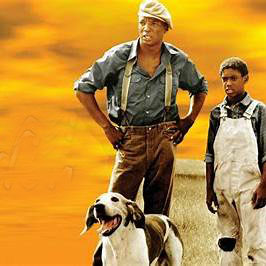
Over coffee yesterday morning, I started thinking about a long-ago movie that featured a dog and a family. It’s one of my all-time favorites and has stayed with me more than most. Today’s header photo, a still from that movie, shows Sounder the dog, the father (played by Paul Winfield), and the eldest child (played by Kevin Hooks).

It came to mind after I’d just finished reading a New York Times piece about “all-time best movies,” in which the writer asked readers to email him with their own favorites. As a former heavy-duty movie buff, I started thinking. The article listed some great films, but it left out the one that immediately came to me: Sounder. That 1972 film has never left my personal best list. I felt so strongly about its absence that I did something I’ve never done before—I emailed the writer, explained briefly why Sounder belongs there.

Reflecting further, I recalled the film’s extraordinary cast: Cicely Tyson, Paul Winfield, and other fine actors. Their performances earned Oscar nominations, and the film itself did something Hollywood had rarely attempted—showing a Black family’s dignity and endurance in a powerful, touching way.

The story follows a sharecropping family in Depression-era Louisiana. Daily life is already difficult before the father is jailed for stealing food to feed his children, leaving his wife and son to carry on. What struck me then—and still does now—is the quiet strength of that family, the boy’s coming of age, and the resilience that carries them through.

And of course—Sounder, the family’s hound dog. His loyalty and presence underscore the family’s strength and make the story unforgettable. Remembering him today, I half-wish I had a hound dog of my own.

Sounder is central to the film—both literally and symbolically. Loyal and loving, he represents resilience and hope, even when he’s gravely injured early on. The story’s emotional core is tied to the boy’s bond with Sounder, and how that love helps him endure his father’s absence.

The film received four Academy Award nominations: Best Picture, Best Actor, Best Actress, and Best Adapted Screenplay. Before then, no movie featuring an all-Black principal cast and story had ever received such high recognition. Its excellent director was Martin Ritt.

To me, Sounder belongs on every “best movies” list—as a film about survival, love, and hope. Remembering it reminds me that sometimes the quietest stories stay with us the longest.

— Diana

Mr. Love

Tuesday, December 17, 2024

I was delighted to see my long-time friend Judy shopping in the department store where I work part-time. She reads my blogs (thank you, Judy) and “loves Chase” (my puppy from hell!). I was about to offer Chase to her, with delivery, but she was too fast; she showed me a picture of her new Corgi puppy. Judy and her hubby Greg are Corgi folks, so they and their yard’s gorgeous garden are safe from Chase.

Yes, Chase is still with me. I hold my breath when coming home from work and going up the driveway. In my head, a little prayer: “Please let him be around, still, confined or loose, and above all, safe.”

Lately, Chase has been greeting me happily from inside the dog-fenced area. Yes, I’ve been letting him stay in there with his buddies because he hasn’t been digging out. Maybe because the wintery grounds are frozen, resisting his efforts. That reasoning doesn’t make enough sense because Chase is a strong and determined critter.

Do you think…could we even begin to hope…that he’s maturing?

In March, Chase will turn three years old, when a dog is considered mature. Oh, how I’ve been waiting–from when he was four or five months old!

That’s when I saw he could boing straight up and successfully climb over any known fence, no matter how tall. That’s when I found him routinely escaping by digging under fencing–any section of it, despite chicken wire–set deeply into the ground–to prevent that.

Aw, Chase!

Well, Mary loves you, and so does Judy. That’s no potential relief for me, as Mary lives far away in CA, and Judy already has a couple of Corgies. So, Chase, you’re still with me, and thankfully, you’re still safe.

Dear Friends: Fun seeing Judy! After the holidays, we’ll catch up over lunch. Diana

Chinatown

Thursday, June 20, 2024

On this date in 1974, Paramount Pictures released its movie, “Chinatown.” The screenplay was inspired by early Twentieth-Century California water wars and the Los Angeles interest in securing water rights in California’s Owens Valley. At the 1975 Academy Awards, Chinatown was nominated for eleven awards, receiving only one for Robert Towne’s screenplay.

Many rank Chinatown as one of the greatest films ever. It’s the last picture Roman Polanski directed in America and features many elements of film noir. The multi-layered story is part mystery and part psychological drama, perfectly interpreted by superb actors.

In 1975, Chinatown’s Oscar competition, The Godfather Part II, won for Best Picture and Best Director. Since then, I’ve wondered why Godfather won over Chinatown. Certainly, both films have had a lasting impact.

I think the Godfather’s wins were related to cultural impact. Audiences found its story easier to absorb than Chinatown’s.

Back then, The Godfather saga’s exploration of the American immigrant experience and the dark side of the American Dream probably resonated more deeply with audiences and critics. That suggests “cultural relevance” was significant in the Academy’s decision.

Today, deciding which film is best might have a different outcome. It’s important to remember that awards are subjective; contemporary choices are influenced by various factors, e.g., personal preferences, industry trends, and campaign strategies.

To me, “Chinatown” is a masterpiece of filmmaking. It forces viewers to explore some innermost and perhaps conflicting perceptions. Unquestionably, “The Godfather Part II” is also a fine movie, with similar storytelling ambition, technical excellence, and powerful performances.

Differences in perceiving them means thinking back to the 19970s. Godfather’s resonance was easier to comprehend and more comfortably relatable. Today’s populations are better informed, generally wiser about psychology, and often consider Chinatown the best picture.

Dear Friends: This anniversary of that excellent film’s debut is a cause for celebration. Diana

Powerful Silence

Monday, March 25, 2024

My constant desire to learn is highly motivating. Thinking about that yesterday, I wondered how much casual learning really sticks. I became interested in watching a silent British movie, “Piccadilly,” from 1928, starring the Chinese-American actress Anna May Wong, a film star.

That opportunity had me recalling elements of my journey years ago toward appreciating foreign films over Hollywood’s typical outputs. The best foreign films would activate viewers’ minds. Watching taught me about interpreting film action and dialogue to encourage a fuller comprehension of on-film behaviors. Foreign films had me reflecting more deeply on human behaviors and motivations.

My learning included watching Old Days’ Silents, which taught that on-film action, with only patches of printed dialogue, offers viewing experiences that are both powerful and highly emotional. Yesterday, while reflecting, I decided to watch “Piccadilly.”

I needed a few minutes to understand a series of silent actions that seemed disjointed and awkward. However, I was quickly impressed by the artistic scenery arrangements and superb camerawork by the film’s director. Before Wong’s appearance, the acting was old-fashioned and overly dramatic, but her film style was expressive and spontaneous.

As the film progressed, I became my former viewing self, focusing on key elements–script flow, scene shifting, camera angles, and believability. The script was jerky, its outcome dissatisfied and wasn’t believable, and throughout, every character overacted. What made viewing worthwhile were the excellent scene settings, the consistently great camerawork, and Wong’s appealing presence.

I used my old learning to interpret and appreciate a classic work, which has interested me in watching other well-known silent films. I would compare their fundamental elements, the scripts, scenes, and camera work—those backbones that made early movies appealing.

Dear Friends: I’ll add that this bit of film study cost me a new subscription. Diana