Scattering Seeds, Rebalancing

Thursday, September 25, 2025

This fall, I can’t seem to get flowers, bees, and butterflies out of my mind. These days are shortening, and there’s more chill creeping in, yet my mind keeps circling around things like nectar-rich blooms and winged visitors returning to them one day.

It’s probably due to the pressures in my outside retail job. The store is busier this time of year — new displays, seasonal merchandise, constantly shifting schedules, and the steady press of customer interactions. Additionally, leadership weighs on me. I cringe at being micromanaged and pushed toward difficult-to-achieve sales goals. These leave me off-balance, make me want to establish my own pace and direction. At home, my mind keeps wandering toward slower, more sustaining rhythms.

Now, here in Central Oregon, fall is sharpening the air. Mornings begin with thin frost, afternoons flash with sudden sun, and evenings drift early toward darkness. The horses’ and my donkey’s coats are thickening; my dogs race across grasses that crunch under their paws; and a more expansive sky above the Cascades creates dramatic clarity.

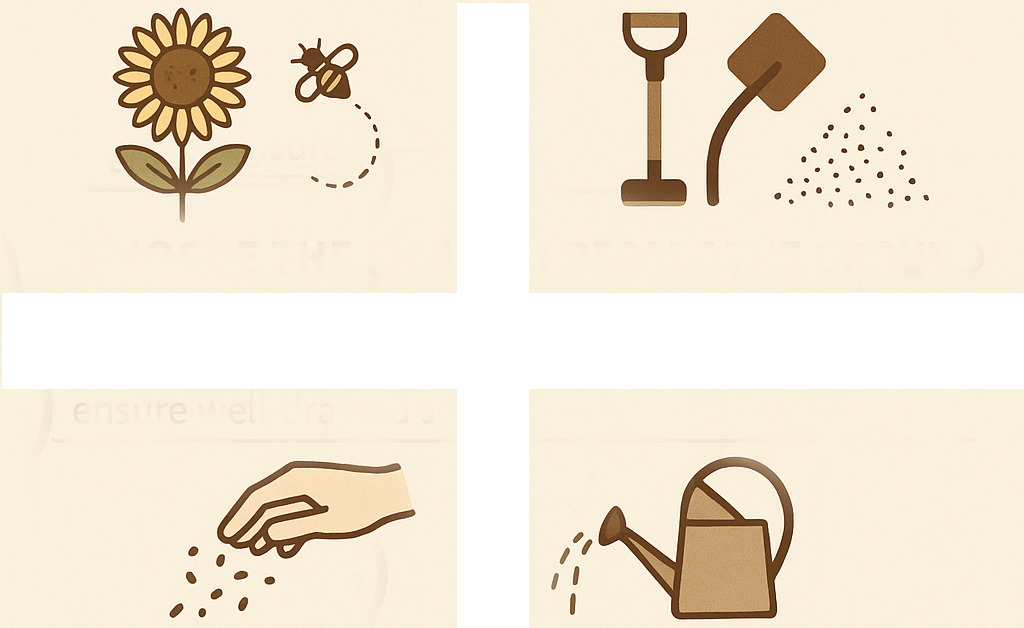
In these everyday seasonal scenes, I find myself searching for emotional balance. My thoughts aren’t just passing, but they’re pulls–to scatter wildflower seeds, to trust the earth to hold and protect them through winter, and then, see blooms rising with bees and butterflies dancing among them again in spring.

It’s a way of offsetting the grind — those hours measured in transactions, sales goals, and schedules. I yearn, instead, for another continuity — the hum of bees, the shimmer of butterfly wings, the quiet return of flowers after their winter’s sleep.

And besides, there’s a larger picture. Planting seeds for pollinators is also planting seeds for myself — a reminder of beauty’s return after seasons of dormancy. Renewal doesn’t require much — just clearing a patch of ground, scattering seeds, and trusting in nature’s quiet magic.

Maybe my fall thoughts aren’t only about flowers and creatures. They might also be pointing me toward deeper needs, like toward balancing the seasons of my own life. What I’m sure of right now is that scattering seeds feels like an excellent step forward.

These small actions will matter — for bees, for butterflies, and, in many quiet ways, for me too.

— Diana

Enlightenment

Monday, January 20, 2025

This is Martin Luther King Day. Yesterday’s weather prevued this chilly but beautiful new day. I was outside several times to feed my animals. My gloved hands tended to become freezy, a signal to stay inside as much as possible. So, I did: cleaned the house, fed a sourdough starter, baked bread (machine), organized spaces, studied algebra online (Kahn Academy), and read more of Amy Tan’s bird book.

The more I learn about genetics, the more I appreciate that various beings, existing commonly alongside humans, may also “have intelligence.” Studies have revealed vast underground networks of tree and plant roots–intertwined, communicating, and exchanging nutrients. Researchers have learned more about how plants communicate with each other, respond to touch, store memories, and deceive animals for their own benefit.

A recently published book adds to such learning. It’s The Light Eaters: How the Unseen World of Plant Intelligence Offers a New Understanding of Life on Earth. Its author, Zoë Schlanger, covers climate change and here explores the contemporary world of botany.

In the past twenty years, ideas of plants communicating are more broadly accepted. Research shows examples. Lima beans protect themselves by synthesizing and releasing chemicals to summon predators of the insects that eat them. Lab-grown pea shoots navigate and respond to the sounds of running water. In Chile, a chameleonic jungle vine mimics the shape and color of nearby plants.

Those behavioral mechanisms aren’t fully understood, and scientists have different opinions about whether plants can sense the world and communicate. I’m eager to start reading this book and thinking about possibilities.

Dear Friends: Are humans possibly less supreme among organisms? Diana

Sidetracked

Saturday, June 08, 2024

Yesterday, I forgot everything, including that it was National Donut Day and that I was scheduled to work. In the afternoon, a manager phoned, and I leaped into action, tossing on some working-style wear and hurrying away to work for a few hours. That forgetting prompted me to worry about my brain’s ongoing capacity to perform. My friend Julie says it’s more likely I didn’t sleep well enough the night before; thanks, Julie; I’ll take that one.

Actually, I became sidetracked early by a delivery the day before that wasn’t right. Arriving home from work, a riding lawn mower ordered online from Walmart had been delivered in my absence. The machine was in a large wooden crate and sitting on a pallet. Its wheels were in cavities to hold the mower in place during transport. Without a hydraulic lift capable of freeing the heavy machine’s wheels, I had no way to remove it from the packaging and pallet.

The next morning, after a long struggle to determine the delivery company and find a phone number, I managed to contact it. A sympathetic person said the organization didn’t have lifting capabilities and that its delivery workers never unpackage products. She suggested I ask a neighbor to help me unpackage and unload, but that job seemed too big. Finally, I called Walmart and had long discussions with several customer service types. Their simple solution was to return that whole package.

What a waste of time, of shipping, and of labor! Anyway, everything is going back to Walmart.

Right away, I did what should have happened in the first place and called Home Depot, where I used to work and know how the store handles deliveries. I ordered a riding mower and asked that it arrive fully assembled and unpackaged; no problem. HD will have the mower soon at my home and immediately driveable.

Those complicated negotiations consumed at least a couple of hours. Immediately afterward, I got busy handling chores and never thought about going to work. Nonetheless, I became unhappy about the forgetting, because it might signal an unlikeable.

There’s something welcome about blogging relative to comprehending the electrical and chemical processes happening within a brain. As long as I can string together ideas and concepts clearly enough and with logical flows, I may assume brain activities are functioning properly.

Still, how can one simply forget to go to work, and on a scheduled day?

Dear Friends: ‘Tis a puzzlement, mixes of stress, anxiety, and emotions in a single brain. Diana