
Friday, November 28, 2025
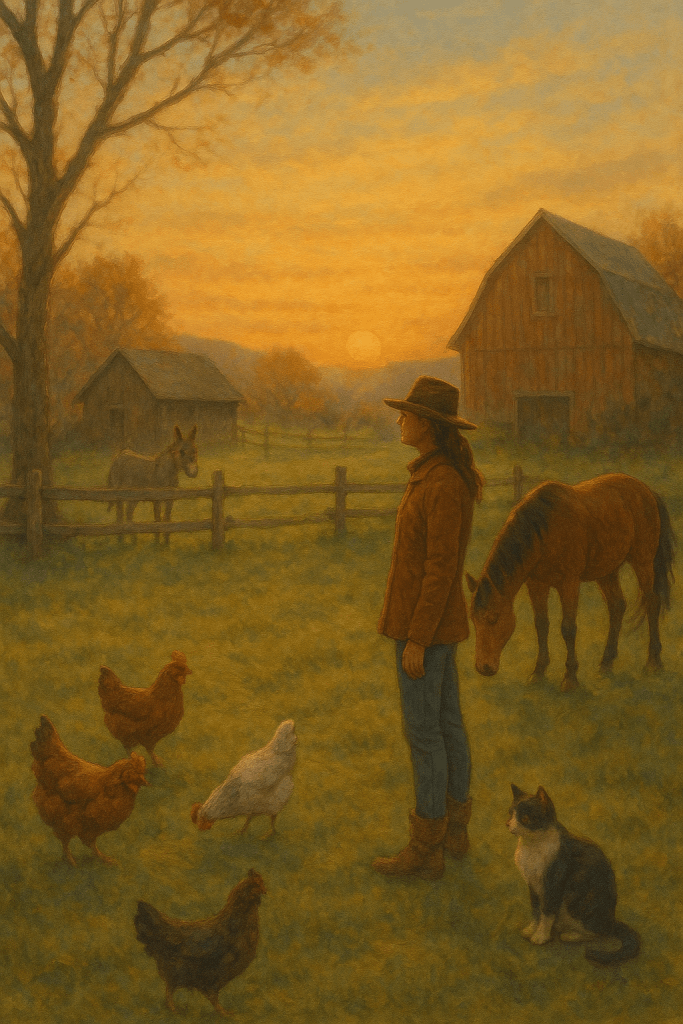
The day after Thanksgiving always feels like a quiet pause to me—a soft in-between moment, when the holiday glow hasn’t yet faded, though the world is slowly retilting toward ordinary life. This morning, as I stepped out into the crisp air to feed my animals, I felt a sudden, familiar tug of gratitude. It was rising up, yet again—surprising me—not because I didn’t feel unthankful. It was reassuring to know that I’m still thankful, beyond Thanksgiving-thankfulness. I’m comforted that simple gratitude stays alive in me—it’s the opposite of a simultaneous oppressive sense of living in a larger world that increasingly feels unpredictable.
It’s reassuring that I am carrying a deep sense of optimism—stubborn, maybe, but steady. And yet, like everyone else, I’m not immune to the fears that come with living in this era. National and international politics grow more erratic by the day. Frightening outbursts from stressed or unstable individuals appear with little warning. The world is saturated with weaponry capable of unthinkable harm. And then there’s the oldest fear of all: the mistrust or dislike of those who look, believe, or live differently than we do.
All those exist. And at the very same time, so does my small acreage. My few animals. Their gentle needs. Their steady rhythms. Those are humbler demands of daily life, asking only for care and presence. Those pull me back, from the broader and more alarming world, into the close-at-hand—the near, familiar, and embraceable.
I’m struck, too, by knowing that this tension between the “large and terrifying” and the “small and meaningful” is nothing new. Human beings have lived inside this duality for as long as there has been history. Ancient communities survived droughts, wars, invasions, plagues—yet they also tended goats, built fires, baked bread, raised children, and cherished simple comforts. They, too, woke each morning into a balancing between danger and devotion.
What comforts me is knowing that the near-at-hand, like my little acreage, has always offered refuge. Even when the world has tilted toward chaos, everyday life has provided continuity. And maybe why gratitude feels so alive in me today—is because of its roots in the immediate, the tangible, the living. A warm animal’s breath, steaming in the cold. The sounds of wings in a low, wintry sky. The follow-on, small task that needs doing.
Still, I can’t help wondering what tomorrow might look like. Our medical and technological advances seem to press forward at astonishing speeds. We’re living in an age of breakthroughs—diseases treated more effectively, bodies and minds understood more deeply, tools that allow us to connect, to create, and even to imagine futures that once belonged only to science fiction.
What might it mean when technology and medicine evolve even further? When we understand the human brain with new clarity? When we treat illness with methods we can’t yet envision? When systems become smarter, perhaps even gentler?
Might our fears shrink in proportion to our capabilities? Or will the same old human conflicts require the same old human responses—patience, connection, compassion, and community?
I don’t know the answers. But I do sense that feelings of gratitude, oddly enough, are among the most forward-looking emotions. Gratitude that anchors us to the present while giving us courage for what’s ahead.
And on this day after Thanksgiving, that feels like enough.
— Diana

 Diana's Morning Blog