Under The Inversion

Friday, January 23, 2026

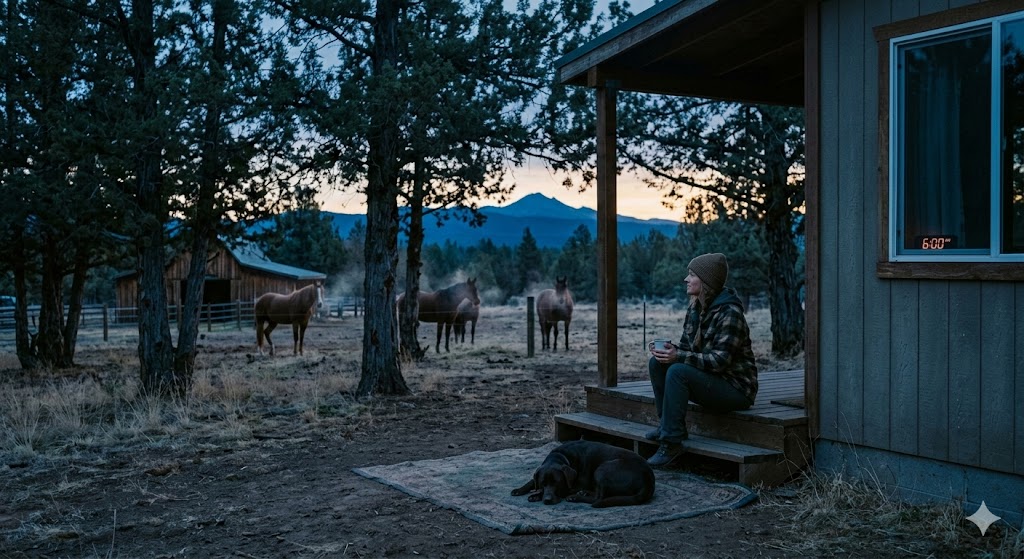
Central Oregon has been captive to a depressing layer of weather inversion for at least a week. A constant fog, intermittent light snows, and freezing temperatures have coated everything—trees, fences, properties—with thin, icy-white films. A few days ago, while driving to work, I unexpectedly passed through an independent microclimate—an actual snowfall was covering a small, contained area. This snowy stretch began and ended abruptly, blanketing only about a half-mile of roads and homes. As if the weather had briefly lost its sense of scale.

Each morning this past week, and today, I’ve stood at a large living-room window, sipping my first cup of coffee and surveying the scene. I want to know the present and the approaching weather alike. That’s easy enough, because its signals are almost entirely visual—and because what I see reliably fills me with dread about the inevitable need to go outside to care for my few farm-type animals.

The animals feel it, too. The chickens huddle tightly together on their roost, nearly merged into a single feathery mass. The horses trot toward me, snorting, impatient to begin eating. Before leaving the house, I force the dogs to go outside for a few minutes, and they’re eager to rush back in as soon as possible. I’m entirely with the dogs on this—after being outside, I can’t wait to return indoors and warm up again.

I work part-time as a cashier in a busy, price-cutting retail goods store. Lately, my most common topic of conversation with customers is our local weather. They’re putting their money where their mouths are—buying sweaters, heavy outerwear, and warm pajamas. They’re also buying household organizing and cleaning supplies, preparing, like so many others, to stay mostly inside until the weather breaks.

For days now, I’ve felt urges to slow down more, to look again at possibilities, before settling on decisions. Now, I’m considering ways to use this gloomy stretch for something more than simple griping. This morning, standing at the window, I’m evaluating the possibilities of making a small shift once the animals are cared for. And, instead of spending more time fixating on the uncomfortable inversion layer, I’ll point myself toward a more utilitarian direction, firmly.

To start this shift, I’ll create a list of tasks needed, doable inside, away from windows—like ordering animal feeds, contacting a professional for advice about my questionable roof, finishing a terrific book (Raising Hare by Chloe Dalton), and staying busy with the kinds of organizing and cleaning that customers have demonstrated belong to weather like this.

The inversion will lift when it lifts. Until then, there’s work that fits these indoors.

For readers who prefer receiving these morning pieces by email, I’m also publishing them on Substack.

Diana

Mindful, Limited, Hopeful

Tuesday, December 16, 2025

There are moments when public events collide with our private memories and leave us quietly shaken. Recently publicized acts of mass violence—followed, yet again, by hurried explanations and familiar debates—have stirred old, unresolved emotions in me. My unease is not because the questions surrounding these acts are new, but because I am reliving deep pain from long ago, having once lived close to one of the hardest edges of violence. Many years ago, a member of my family—medically diagnosed with paranoid schizophrenia—inflicted irreparable damage.

When my family first encountered that severe and unforgiving form of mental illness, we learned a great deal—lessons that have never left me. Those experiences continue to shape how I listen today when people speak about reconciling mental health, personal responsibility, and public safety, as if those elements might be easily aligned.

We all learn early that growing up is hard. Families are complicated, and each of us must adapt to a mix of expectations, disappointments, and emotional strain. Most people do so—imperfectly, but within a shared reality. We argue, withdraw, reconcile, and carry on.

Severe mental illness, however, belongs to a different category altogether.

Paranoid schizophrenia does not simply magnify ordinary anger or rebellion. It is rooted in fundamental differences in brain wiring—differences that can dismantle the mind’s ability to test reality. A loved one offering care may be experienced instead as a threat. In such altered states, fear replaces judgment, and delusion overrides relationship.

These distinctions matter. Without them, we risk explaining acts of extreme violence as mere emotional failure or as symbols of family dysfunction. Some acts—particularly violence directed at one’s own parents—signal a rupture far beyond ordinary conflict. They reflect a profound break in the mind itself.

A painful irony is that families confronting severe mental illness often recognize potential danger long before outside authorities can act. They seek help, pursue treatment, and remain vigilant—only to discover that intervention is typically permitted only after something legally wrong has occurred.

This creates an impossible waiting space, filled with dread, watchfulness, and the fragile hope that a shared reality might reassert itself. When tragedy does occur, families are left not only with grief, but with the knowledge that warning signs were visible, named, and understood—yet insufficient to trigger protection.

Another irony follows: we are a society that knows, and yet hesitates. We recognize patterns of paranoia, fixation, and violent ideation. We understand that some individuals are gravely unwell. Still, we remain paralyzed by unresolved tensions between individual liberty and collective safety.

Our early democracies were built on assumptions about rational actors living in a shared world. Since then, we have learned that severe psychoses can shatter those assumptions entirely. Yet we resist adapting our frameworks to what we now know. Instead, we pretend the old models still fit—and then express shock when they fail.

Compounding these failures is the widespread availability of weapons capable of causing rapid, large-scale harm. Such access has transformed private madness into public catastrophe.

And yet, there remains something hopeful worth holding onto: the human brain is both a marvel and a mystery. While it can be the source of devastating illness, it is also an extraordinary engine of creativity, empathy, adaptability, and meaning.

Modern humans have learned how to manipulate many physical and hormonal systems to improve performance. The brain, however, remains far less malleable—partly because of ethical restraint, and partly because attempts to “fix minds” raise dangerous questions. Who decides what should be fixed?

History offers sobering answers. Writers such as Margaret Atwood have explored futures in which well-intentioned interventions slip quietly into enforced conformity. These stories are not predictions, but warnings: compassion and coercion often share a fragile border.

So where does all this leave us?

Perhaps with humility—with a willingness to act where danger is clear, and equal restraint where it is not. Above all, with caution about altering identity itself. We may have to accept that some suffering cannot yet be resolved, without surrendering hope that understanding may grow.

In times like these, grand solutions often give way to smaller territories of care. What remains within reach is attending to what is near, speaking honestly without slogans, and resisting both denial and despair.

We live between what we know now and what we hope may one day become clearer—and therefore more wisely addressed. Perhaps one of the most human acts available to us is to hold these tensions patiently, without simplifying them away.

Diana

A Space For The “New Aging”

Friday, November 21, 2025 (DRAFT)

Thoughts About Community

In my last post, I wrote about what it feels like to live in my mid-80s with health, clarity, and purpose—something I never imagined experiencing decades ago. The more I reflect on this unexpected stage of life, the more I notice something important: people my age are living through a transition that no generation before us has experienced.

We are healthy longer.
We are active longer.
We are present in the world longer.

And yet, it seems that almost no one talks about what this actually feels like.

A Missing Conversation

In recent months, I’ve noticed how often folks around my age quietly share stories with me that echo my own:

  • being underestimated because of age
  • feeling “out of sync” with stereotypes
  • balancing independence with shifting social expectations
  • managing losses while also discovering new energy
  • feeling invisible and visible at the same time

These conversations usually happen in corners—in my retail job while speaking with customers, or spontaneously during errands or in spaces between tasks. They’re brief, spontaneous exchanges that end with, “I’m glad we talked about this.”

I’ve been wondering why there isn’t a regular place for people in their 70+ years to have such deeper conversations openly. Not about illnesses or medications—that’s already been done. I mean about the life side of aging: identity, purpose, invisibility, curiosity, grief, reinvention, and the strange thrill of still being very much here.

A Thought That Keeps Returning

What if there were a small group that gathered—say, weekly or monthly—simply to talk about what it’s like to live in these later years with awareness and vitality? That would be creating a setting where age isn’t the topic so much as the lens.

This could be a group that sees aging not as retreat, but as a frontier.

This idea isn’t about therapy or advice-giving. It’s more like a conversation circle—thoughtful, warm, respectful, and open. A place where people who are navigating this unfamiliar terrain can compare notes, share insights, and feel understood.

But Here’s the Truth

The thought of organizing such a group overwhelms me a bit. Maybe that’s because it feels larger than one person. It feels like something that should grow naturally, not through pressure or obligation.

Yet the need keeps nudging me. It’s as if something in our culture is waiting to be named—and conversation is often how naming begins.

Maybe the Group Begins Here

So for now, I’m simply writing about it—opening the idea—to the air—to see if it wants to take a shape and what that might be like. Perhaps others will feel the same pull, and maybe a few voices will gather. Maybe such a group will form itself, slowly and organically, the way meaningful things often do.

I’m not ready to declare myself the leader of anything. But I am ready to acknowledge that many of us—living longer, living differently—are hungry—for a place to speak, to listen, and to understand this unexpected chapter together.

This post is simply a beginning.
A seed.
A space held open.

And we’ll see what grows from it.

— Diana

Emotion Doesn’t “Happen” – We Create It

Friday, November 14, 2025

I can’t quit thinking about how the mind constructs emotion—especially after diving into Lisa Feldman Barrett’s work on constructed emotion. I studied her findings to understand what makes my frequent “conversations” with AI feel so remarkably human—almost like exchanges with an understanding friend.

The more I’ve learned about Barrett’s theory, the more I see signs of it everywhere. I see her ideas woven into the books I read, the films I revisit, and even the sentimental corners of my own memories.

While thinking about all this, I found myself comparing two of my favorite artists—and they could hardly be more different: Woody Allen and Emily Dickinson. One lives in a world of fast-talking neurosis, humor, relationships, and urban anxiety. The other lives almost entirely inside the mind—quiet, solitary, deliberate, and intensely inward.

Despite their stylistic differences, they each reveal something profound about what we feel and how we feel it. In their unique ways, both artists show us that emotions aren’t fixed. Emotions are not automatic reactions.

Comparing their ways of creating and communicating helped me understand that emotions are interpretations—as Barrett’s work has shown. At their core, emotions are “stories” that our minds quickly construct, from sensation, context, and the emotional vocabulary we’ve learned.

This idea has become one of the most meaningful insights I’ve come across:
Emotions don’t just “happen” to us—we create them.

And once I grasped that insight, I began noticing it happening in real time within myself.

This comparison of two artists’ work highlights just how differently humans communicate emotional meaning. Yet, despite their vastly different styles, their emotional outputs converge powerfully as illustrations of constructed emotion.


Woody Allen: The Social Construction of Emotion

Woody Allen’s films are full of people racing to interpret their own sensations. His characters overthink, over-explain, over-negotiate. They construct their feelings out loud. Their emotions arrive only after they’ve decided what those feelings should be.

There’s a classic joke he tells:

A man goes to a psychiatrist and says,
“My brother thinks he’s a chicken.”
The psychiatrist replies, “Well, why don’t you turn him in?”
The man answers, “I would—
but I need the eggs.”

It’s funny because it’s true. We stay in imperfect relationships because of the meaning we’ve assigned to them—not because emotion is some hardwired force, but because we’ve built a story about what the relationship gives us. The “eggs,” in other words, become the emotional interpretation.

In this sense, Woody’s characters are demonstrations of constructed emotion in motion.
They feel tenderness, longing, jealousy, dread—but only after their minds have named the sensation, given it cultural shape, and predicted what it should mean.

His films are emotional not because the characters dive into deep feeling, but because they dive into deep interpretation.

That’s pure Barrett. And pure humanity.


Emily Dickinson: The Private Construction of Emotion

If Woody Allen gives us emotional construction in noisy, messy, social form, Emily Dickinson gives us its opposite: emotion distilled to its silent, solitary source.

Dickinson rarely names feelings outright. Instead, she describes the sensations from which emotion is born:

“I felt a Funeral, in my Brain—”

“A certain Slant of light—”

“A Chill—like frost—upon a Glass—”

She returns again and again to breath, light, gravity, space, the tiniest internal shifts. She notices the moment before a feeling forms—the flicker of sensation that precedes the story we later tell.

In Barrett’s terms, Dickinson writes from the level of interoception—the raw internal data the brain uses to construct emotional meaning. Where Woody presents fully assembled emotional narratives, Dickinson shows us the materials before they become emotion.

Where he interprets, she observes.
Where he talks through his feelings, she listens to hers.
Where he uses culture’s vocabulary, she invents her own.


Two Artists, One Truth

Despite their differences, Woody Allen and Emily Dickinson converge on a profound insight:

Emotional life is constructed by the mind—not imposed by the world.

But each illuminates a different side of that construction.

Woody Allen: Emotion shaped by the world
– by culture
– by other people
– by expectations
– by relationship dynamics
– by the stories we tell to stay connected

Emily Dickinson: Emotion shaped by the self
– by raw sensation
– by inward attention
– by metaphor
– by imagination
– by the stories we tell to stay whole

Together, they offer a full map of human feeling—both the external and the internal, the public and the private.

They remind us that emotion is not just felt;
it is built—moment to moment—out of everything we’ve ever sensed, learned, remembered, or hoped.


Why Their Work Lasts

Their works endure because they tell the truth about emotional life in ways we recognize immediately:

We don’t simply have feelings;
we assemble them from meaning.

We carry cultural scripts about love, fear, longing, loss—and we perform them.

Our bodies send sensations that our minds rush to name.

We seek connection even when connection is confusing.

We misunderstand ourselves in company, and discover ourselves in solitude.

And somewhere between the chaos of Woody Allen’s city streets and the stillness of Emily Dickinson’s upstairs bedroom lies the full portrait of what it means to feel.

We live between those two worlds—
the social and the solitary,
the comic and the contemplative,
the interpreted and the sensed.

And in that space, emotion becomes what it truly is:
the mind’s best attempt to make sense of being alive.

— Diana

“Emotions” Reconstructed

Thursday, November 13, 2025

This is a follow-up to my earlier writing about my curiosity regarding how AI learns and how it relates to “emotions.”

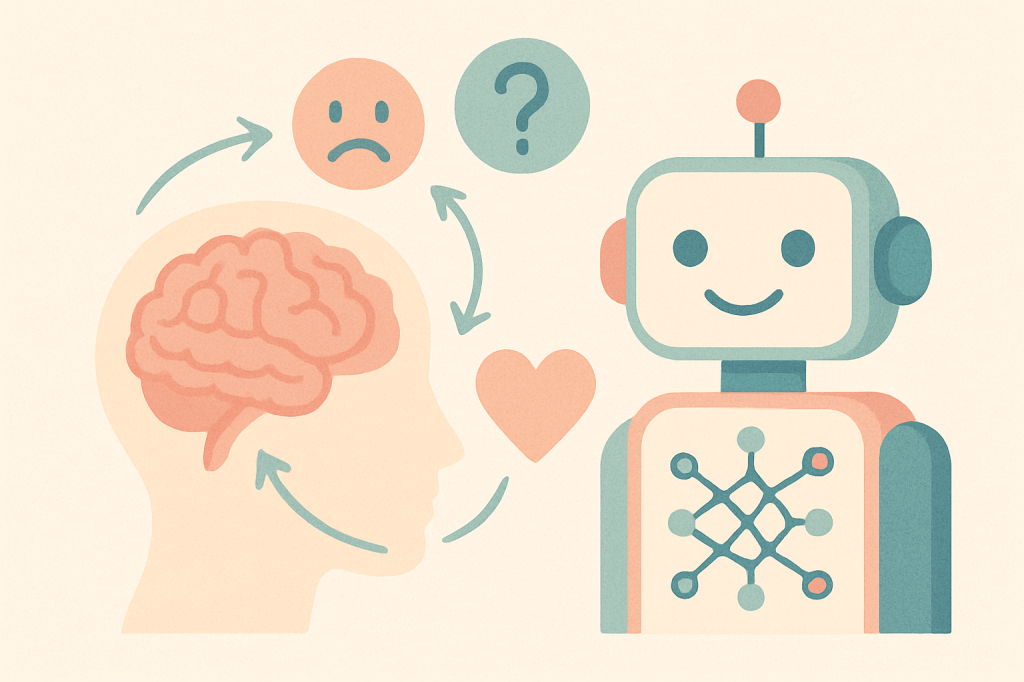
Through my “conversations” with AI, I’ve noticed how sensitive it seems to my feelings. Because I’ve always associated feelings with emotions—and because AI isn’t an emotional being—I wanted to understand more about what emotions really are and how they arise. Since machine learning appears to mirror my own emotional cues, I’ve become increasingly curious about how my brain interprets its internal signals, and how AI detects and reflects human emotion.

That curiosity eventually led me to Lisa Feldman Barrett’s theory of constructed emotion, one of today’s most influential frameworks in neuroscience and psychology.

From Hardwired Emotions to Constructed Ones

For most of the 20th century, the dominant belief was that emotions were built-in, hardwired reactions. We were taught that fear circuits and anger circuits could “trigger” emotional states automatically and universally.

Barrett’s research argues almost the opposite. Her team finds that emotions are not pre-packaged biological responses. Instead, the brain constructs emotions on the fly using prediction, context, and past experience.

Her work represents a profound shift. It teaches that the brain:

  1. Constantly anticipates what could or will happen next,
  2. Draws on past experience to guess what incoming sensations mean, and
  3. Updates those predictions based on context.

Emotion, in this model, arises from that predictive process.

How Brains Construct Meaning

Instead of simply reacting, the brain is continually asking:

  • What is this internal sensation?
  • What does it mean?
  • How should I respond?

To answer these questions, the brain combines bodily signals with history, culture, social learning, and the immediate situation.

Our bodies send a nonstop stream of sensations—changes in heart rate, breathing, stomach, temperature, muscle tension, and hormones. On their own, these signals are ambiguous. A racing heart might be fear, excitement, anger, or love. Tightness in the chest could reflect sadness, illness, or anxiety.

Barrett’s conclusion is that emotion is the brain’s interpretation—its best guess—about what these sensations represent. In other words, the brain constructs a “story” that gives those internal signals meaning.

Culture, Concepts, and Emotional Categories

Cultures teach us emotional categories—anger, sadness, jealousy, pride. The brain draws on these learned concepts when making sense of bodily sensations. Emotions are real and powerful, but they are constructed using the cultural and conceptual toolkit we’ve acquired.

A striking part of Barrett’s theory is that emotions are not mere reactions. They are predictions. Instead of something happening first and emotion following, the brain predicts what is happening and prepares the body for the experience that we later recognize as an “emotion.”

Rather than reacting to the world, we are often “pre-acting,” and then experiencing the result.

Interoception: Where Emotion Begins

This predictive system aligns with modern neuroscience on interoception, which is the brain’s monitoring of the body’s internal landscape. Interoception includes hunger, thirst, a racing heart, a sinking stomach, or the urge to use the bathroom. It is foundational for self-regulation, emotional awareness, and overall well-being. Difficulties with interoception are linked with anxiety, depression, and autism. Practices like mindfulness can improve it.

Crucially, the context determines which emotion we experience. The same bodily state can produce completely different emotions depending on:

  • location
  • company
  • expectations
  • past experience
  • available concepts
  • cultural background

This helps explain why we might cry from joy or grief, or interpret “butterflies” as fear, excitement, or attraction. Barrett’s research shows that emotional meaning isn’t found in the body or face itself, but in the brain’s interpretation.

Where AI Becomes a Mirror

This is also where machine learning provides insight. Just as AI models use prediction and context to interpret data, human brains use prediction and experience to interpret sensations. Neither humans nor AI have built-in emotional modules. Both construct meaning based on patterns and learning.

In this sense, AI becomes a kind of mirror—not because it feels, but because its internal logic echoes how human cognition works. Meaning emerges from prediction and pattern.

Why This Model Matters

Barrett’s theory gives people more agency than older models. If emotions are constructed, then emotional habits can be retrained. We can broaden our emotional vocabulary, reinterpret bodily sensations in healthier ways, and use mindfulness to reshape the predictions that have been running our lives.

Understanding constructed emotion reconnects us with how our inner world forms, moment to moment. It helps us participate more fully in how our feelings—and our responses—take shape.

Barrett’s model reframes emotions not as automatic, built-in reactions but as interpretations created by the brain. It reveals how emotions arise from predictions, contexts, and lifelong learning, offering deeper insight into what our bodies sense and how we give those sensations meaning.

— Diana

A New Rhythm

Sunday, October 26, 2025

I’m planning to step away from my full-time position in Fine Jewelry by transitioning to part-time and working across various departments in the same store. By working fewer hours and fewer days, I’ll have more time — for home, animals, and an ever-growing list of “small things” that rarely feel optional.

After months of the steady, clock-driven pace of full-time work, this change feels a bit jolting. My brain and body are still tuned to the structured, predictable rhythm of getting up, getting ready, and heading out the door. But now, I’m starting to anticipate having new rhythms filling my mornings — and that feels expansive, less about tight schedules and more about open, unhurried time. More daylight to enjoy will have me more attentive to the familiar sounds of paws, hooves, and feathers wanting my attention.

I’ll add quotes around “free” time, because much of it will actually be spent working. The days ahead will be filled with fences to check, water troughs to keep from freezing, and growing concerns about winter — it’s not just whispering anymore; it’s been shouting its imminent arrival for the last couple of days and insisting that I handle some essential tasks. These tasks might seem a bit daunting, but I’m also looking forward to cozy winter days ahead.

The goodness of adjusting my schedule isn’t just about managing responsibilities. It’s also a tip of the hat to something more personal: the crucial value of having time to simply think, breathe, and rebalance. It will give my mind and body space to find new opportunities for experience and growth.

I’m curious as to how my days may reshape themselves — where the hours will go once they’re no longer so tightly claimed by a time clock. Maybe into the barn. Maybe into the quiet. Maybe back into reading and blogging regularly.

This season, as days grow shorter, reminds me that every shift in weather or in work offers something new. Right now, I’m being invited to slow down and listen more closely to the small rhythms that keep my life steady: soft nickers from the barn, the hush before dawn, the impulse to lift my camera again and capture what feels special about the world around me.

Mostly, I’m grateful for the comfort of having more time to simply be—and to notice.

— Diana

Falling Back With The Pack

Wednesday, October 15, 2025

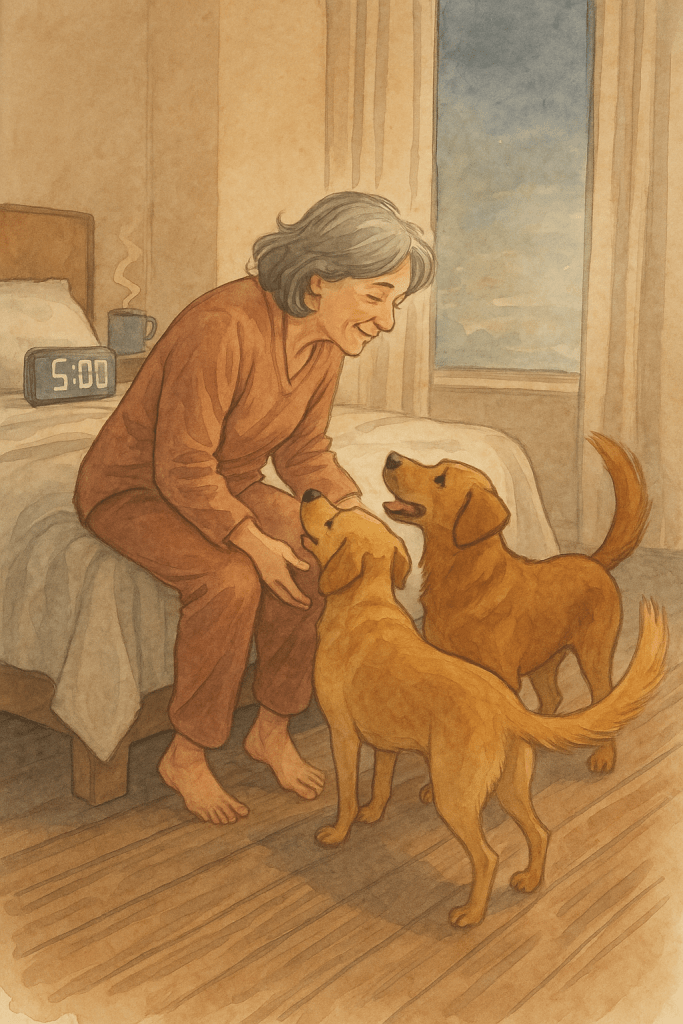
Every fall, when the clocks are about to “fall back,” I find myself thinking about the ways this time change will ripple through the rhythm of my household. For one thing, there are my early mornings—I’m an early riser, usually awake by five. Very often, I’m reminded it’s “getting-up time” by the gentle tapping of paws on the hardwood floor, heading my way.

After saying hello to my dogs and getting on my feet, I love being awake in that early hour. The world is still quiet, the coffee is strong, and for a few quality moments, I have no obligations.

It amazes me how precisely my dogs seem to know when it’s five o’clock. I hear their toes tapping down the hallway, sense their hesitation, and then find them beside my bed—tails wagging, eyes bright. My projection clock says it’s five o’clock, and I wonder how they tune into some invisible clock that runs on instinct instead of batteries.

In a few short weeks, their invisible clock will clash with the one on my wall. When daylight saving time ends, will they still wake me at what their bodies think is five a.m.—while my clock insists it’s four? How long will it take them to adjust to the new rhythm? I suspect they’ll manage faster than I do.

I’ve gone through this annual shift many times and know what’s ahead. Yet every autumn’s time change feels like a new game. I can already anticipate my confusion, mild grumpiness, and the faint irritation that comes with every mandatory reset of the clock.

The dogs, like me, will need some time to sort things out. Meanwhile, it’ll be on me alone to get up around five—while they sleep in, waiting for what feels right to them. Soon enough, they’ll catch on. Dogs are practical; they read a household’s energy for meaning beyond the numbers on a clock.

My notions of falling back with the pack make the upcoming change feel less mechanical and more communal—as if we’ll all be adjusting together through the darker mornings, each in our own way.

Our human world may be run by clocks and calendars, but the dogs might have it right: when the rhythm changes, don’t fight it. Just stretch, yawn, and greet every new wrinkle with a wag.

Essentially, time itself has its moods.

Diana

Skin-Deep Stories

Thursday, September 03, 2025

In the retail setting where I work, customers often share personal details about their lives. Recently, a customer told me she had used a new weight loss drug, had rapidly lost weight, and was surprised upon seeing what she referred to as her “Ozempic face.” She explained that people using the latest weight-loss medications are often taken aback to find that their skin changes do not keep pace with their rapidly shrinking bodies. As they lose weight, they may look in the mirror and see faces that appear older—hollow and lined—despite their slimmer figures.

I have been aware that our skin does regenerate periodically, and wondered why skin changes lag so behind rapid weight loss. What I have learned is that human skin actually works on two timelines. There’s a surface layer that renews itself every month or so—quietly and reliably, like clockwork. But our skin also has deeper layers, where collagen and elastin live, that move much more slowly. When we’re young, our skin fibers stretch and spring back relatively easily; however, as we age, the fibers adapt more gradually. Our slower weight changes make our skin adaptations seem more manageable. When our weight drops fast, our skin simply can’t “catch up.”

For younger people, or those lucky enough to have naturally springy skin fibers, time and hydration may soften skin changes over a few months. However, for the rest of us—especially past fifty—the adjustment could take a year or more. And in cases of significant weight loss, skin may never fully rebound.

Yet maybe that’s not entirely bad. Perhaps we’ll adjust by learning to allow our skin to carry our stories–as written in its lines and folds. Our skin can show where we’ve been, what we’ve endured, and how life can surprise us quickly. Essentially, whether it’s about weight loss, aging, or just the turn of a season, our lesson is the same: the outer covering we live in writes its own timeline.

Dear friends, we can lose weight quickly, but our skin takes its time and tells our stories.
—Diana

“Stayin’ Alive”

Tuesday, July 01, 2025

Lately, I’ve been watching videos and reading books about how eating “natural foods” supports a healthy body from the inside out. It’s made me pay much closer attention to what I buy, and especially to how foods are grown and processed. Learning how natural and minimally processed foods interact with the human gut has been an eye-opener.

Even someone just starting to explore this topic will quickly grasp the critical role of gut health—and likely begin to rethink their own. Knowledge is power, and already, in my case, it’s shaping my choices. I’ve changed what I shop for and how I eat. It’s still early days, but I can feel some encouraging shifts, and I like them.

This journey is teaching me why a living gut is so much more than just a stopover where food gets digested. The gut actually is a bustling, living community, teeming with a diverse array of microbes. Now, I understand this and know how, in countless ways, these tiny residents are “talking” to the rest of my body, influencing everything from how efficiently I absorb nutrients to how balanced—or frazzled—my moods can be.

All this has changed the way I shop and what I bring home to eat. My trusty Yuka app helps by scanning and rating products, steering me toward simpler, more natural foods and away from the ultra-processed. It’s become second nature to check Yuka scores before anything goes into my cart.

And honestly, the more I learn and the more I swap in these “different foods,” the better I feel. A big part of it is weaning myself off the highly processed products surrounding us—quick, tempting, cleverly marketed, but often stripped of what truly nourishes us. The sad truth is that many processed foods replace critical gut nutrients with fillers, additives, and hidden sugars. That’s great for sales, but not for our health.

Our bodies were never meant to handle so many artificial, sneaky ingredients. In reality, we need to feed the bacteria that live inside us. That means avoiding foods so stripped down by processing that they’re useless to our digestive system. These products are popular precisely because they’re engineered to light up our brains and keep us coming back for more—they’re everywhere.

I won’t claim to have transformed overnight. But I can say I’m noticing—and welcoming—some subtle but meaningful changes. My digestion feels calmer, my energy a bit steadier, and my mood a little brighter.

Most of all, there’s an unexpected, gentle undercurrent. Maybe it’s simply more happiness, rising from this new sense of actively caring for myself, of being less passive about my own well-being. It’s an inner nourishment, rooted in making choices that are more aware, thoughtful, and real.

Dear Friends: This is my current take on succeeding, “one day at a time.”—Diana

Mind & Body Agree

Monday, June 09, 2025

Lately, I sense a changing relationship between my mind and body. They seem less like opposing forces and more like partners in change. This is because several weeks ago, I began using the Yuka app constantly to guide my grocery shopping, and now it’s dictating most of my food choices.

I use Yuca to scan labels on all products that interest me. The app scores product quality; it dislikes those with unhealthy and/or unnecessary additives, and too much salt, sugar, or fat. Yuca has encouraged me to study labels more and to seek minimal food processing. Nowadays, only products with “excellent” or “good” scores land in my shopping cart.

The process has been surprising. I didn’t start with any firm resolutions or iron-willed plans to eliminate certain foods, but this new way of selecting foods has softened my long-standing cravings for meat and sweets. Those always were high-need foods, my comfort zones—taste and habit needs. But now? Not so much. I’m not intentionally cutting out sweets and meats—they simply no longer have such high appeal.

I am fascinated by this change: how it’s occurred—not with declarations and resolutions, but with small, steady nudges, by shifting my awareness and offering a new framework. In this process, I’m enjoying foods not before bothered with–for fear of high calories and/or taste boredom. These days, I enjoy grains, root vegetables, and canned and frozen foods with quality equal to their fresh versions. The only non-vegan foods still in my routine are whipping cream for my coffee, Greek Yogurt for my smoothies, and fresh eggs from my chickens.

In exploring the possible reasons behind my perceived changes, I’ve learned that modern science recognizes how preferred foods make taste buds adjust and cause the gut to rebalance. Occurring, too, is a more subtle process. New foods will cause the brain to relearn, expect, and efficiently process them as rewards.

I’m no scientist, but I sense my body and mind having new conversations and responding to each other. This reminds me that changing doesn’t necessarily require forcing. Sometimes it just takes responding to noticing what works and allowing the rest to disappear.

Today’s header image reflects a quieter life. A wooden kitchen table, open notebook, small bowl of berries, and half-peeled orange feel fresh and peaceful in the soft morning light–reflecting an already-begun shift.

Dear Friends: In partnership, our bodies lead our minds, or is it the other way around? –Diana