What The Morning Asks

Thursday, January 22, 2026

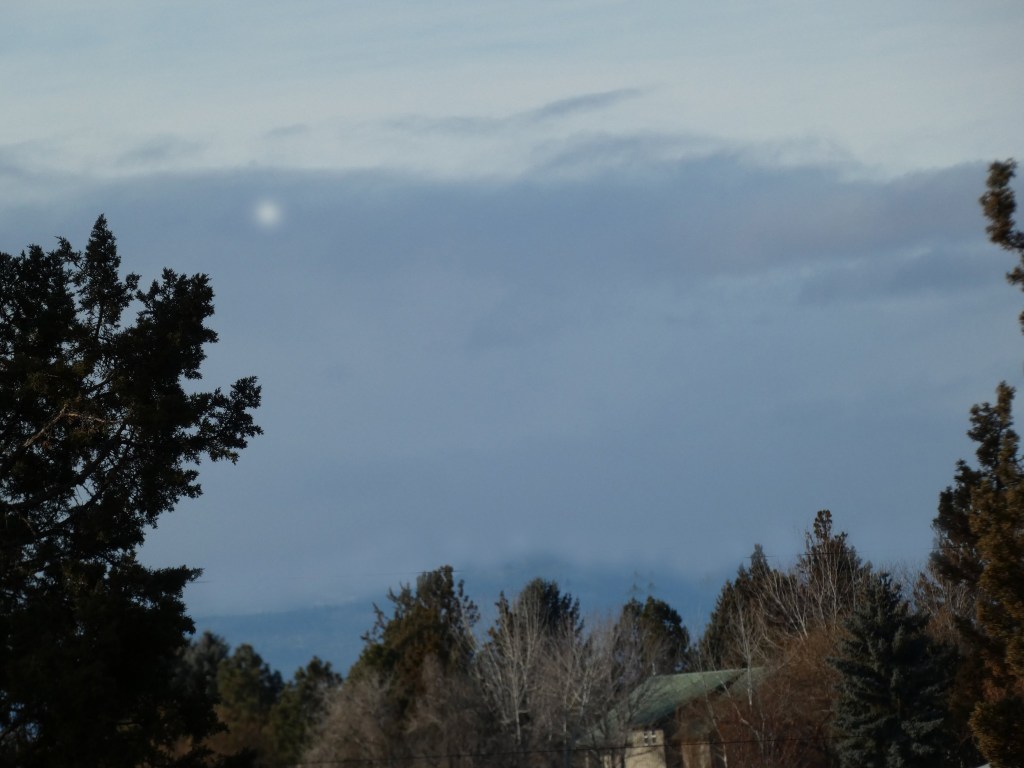
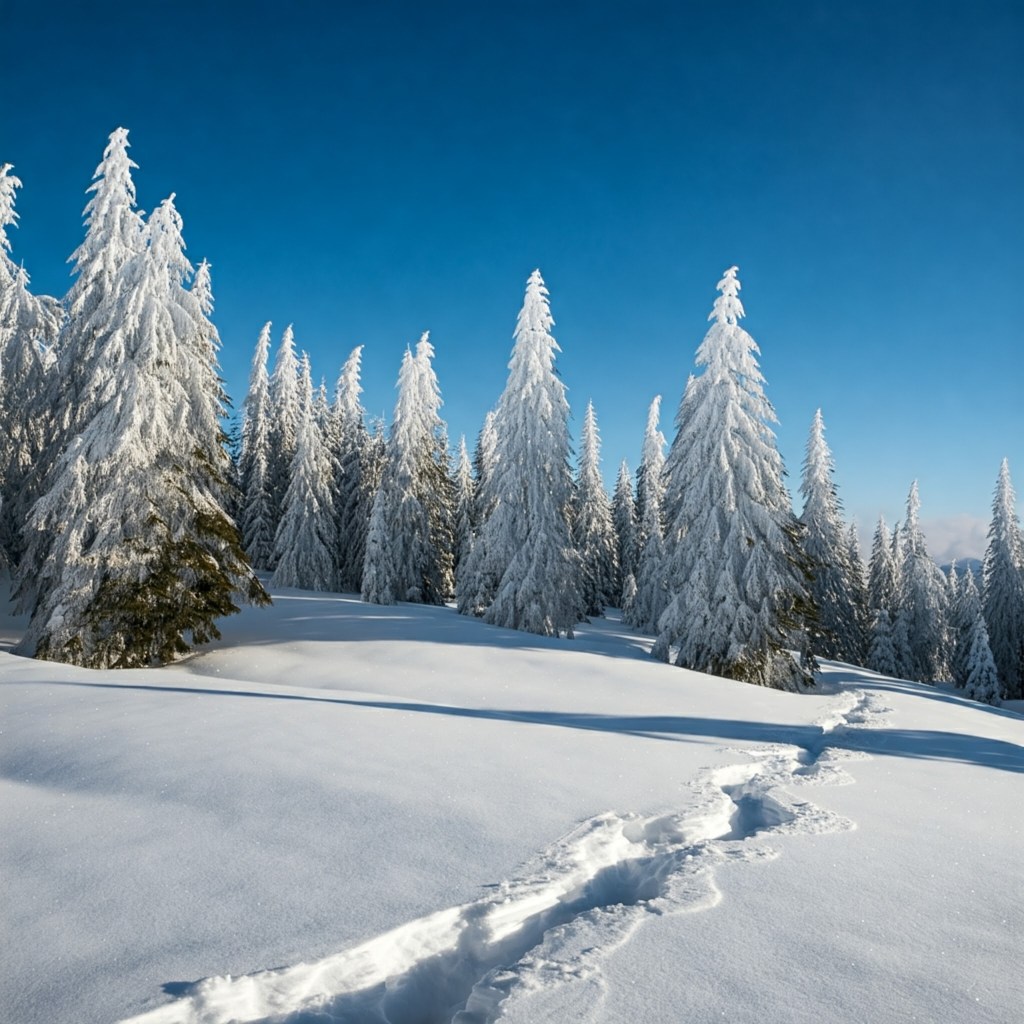
This morning feels like a quiet weight. Central Oregon still is hushed beneath a thick inversion layer—and my small world seems held in suspension—deeply still. I almost hear the air breathing as it freezes. I know that heavy fog will erase the Cascade Mountains from the horizon and leave my few acres monochromatic. I know that now the junipers are shadowy sentinels, half-seen and half-imagined. 

I’m standing at a window and holding a cup of steaming coffee—and, almost seeing the stubbornly cold air. Frost coats juniper branches and grass blades, and soon, the sun will struggle to rise—pale and ghost-like—trying to burn through the low mist. 

Despite this chill, there’s a necessary routine of feeding my horses. In this still darkness, layered in snow pants, a thick sweater, and my heaviest coat, I step outside—into a muffled world. The usual neighborhood sounds are absent; there is only the sharp, rhythmic crunch of frozen earth beneath my boots. I move slowly through this morning’s blurred edges. 

The horses are waiting, their whiskers white with ice and their patience thinned by hunger. I hurry through the usual labor—cleaning stalls, filling water buckets, and hauling fresh, sweet hay into the barn. It is work, but offers a few brief, pleasant moments of focus, too. Free of other concerns for the moment, I’m considering this weather inversion, hoping the fog will lift soon and normal clouds return.

Once I have settled the horses, I pause awhile. I listen. Few sounds are as satisfying as the steady, rhythmic grinding of horses chewing—watching them, wholly relishing their meal, is fun, too.

It’s time to turn back toward the house. I crunch across the frozen ground. My dogs, cat, and birds are waiting for their breakfast. Only after caring for them will I prepare for my part-time job.

This is how most of my days begin—as dependably as our January freezes—and regardless of any other weather conditions.

Diana

Seeing Isn’t Always Seeing

Tuesday, January 20, 2025

At first glance, I was certain I knew what I was seeing.

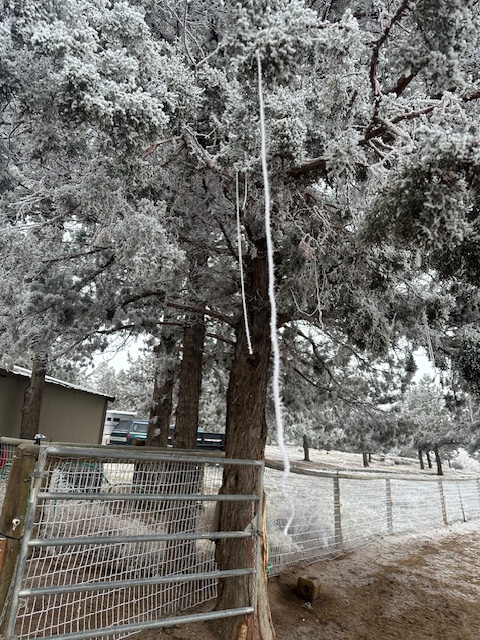
Two pale strands hung straight down from the branches of a juniper, each coated in frost. They were white, linear, and unmistakably rope-like. Our minds are quick that way. They reach for the nearest familiar explanation and settle in. We just go with it.

Like me, then—not questioning whether the frosty objects were rope, only wondering how they had gotten there. I reached up to pull one strand free from its branch, and in that instant, the scale shifted.

In my fingers, what had looked sturdy immediately shrank into something improbably delicate. I expected resistance. Instead, frost slipped away, and I found myself trying to grip emptiness. I paused and looked more closely.

You’ll never guess what I discovered. The “rope” I was trying to hold was a single hair from one of my horses’ tails. Looking up again, I noticed several similar strands—long, pale, impossibly fine—each thickened by frost and hanging, rope-like, from the branches.

The experience startled me. These fine hairs had likely been carried aloft by nest-building birds, caught by chance in the tree, and layered again and again with ice. The moment felt slightly dramatic and, at the same time, utterly ordinary. I had misread the evidence—and it had been astonishingly easy to do so.

I’ve been thinking about deciding and misassuming. These happen more often than we realize. We believe we’re seeing what’s there, when instead we’re seeing what our experience tells us ought to be there. Our brains—efficient and decisive—are always working to help us make sense of things quickly.

But efficiency may also be a kind of blindness. When we label something too fast and move on—without lingering long enough to reconsider—we miss the chance to see it differently.

The object I mistook for rope wasn’t merely a variation of what I expected; it belonged to an entirely different category of reality. It was something once living—shed, carried, and repurposed by chance.

Only later did my mind begin to imagine a quiet collaboration among animals, weather, and time—a whole story I had nearly missed before I paused, looked again, and wondered.

This experience reinforces something I’ve been learning: that deciding well often requires more than one look. Not because first looks are careless, but because they are incomplete. The longer I live, the more I understand wisdom as less about sharp eyesight and more about patience. Wisdom is staying a little longer with what we think we understand, allowing ourselves to be surprised by what else might be there.

Here’s today’s small example. A single strand of horse tail hair is usually barely visible. Yet here were several, transformed—fluffed with frost and suspended in front of me. I mistook them for rope. I tried to pull one down. Instead, I learned again that what appears solid may, upon re-examination, be lighter, finer, and less obvious than we first believed.

Seeing—really seeing—asks us to pause, reconsider, and sometimes admit that our first understanding was wrong. That lesson, offered by a few horse hairs, humbled me. And because of what it taught, it was also comforting.

If something as slight as a single horse tail hair can—against all odds—hold its place in the world, suspended and briefly transformed, then perhaps our own uncertainties deserve a little more time in the light as well.

Taking more time means looking again. Reflecting longer. It’s a practice that can help move our perceptions closer to what actually may be there.

Diana

Letting Go, Mending, Learning

Tuesday, December 09, 2025

Several weeks ago, after leaving my sales job in a large retail department store, I turned my attention back to a long list of needs waiting at home. I contracted for a new roof, got long-overdue electrical repairs done, and—perhaps in the biggest emotional task of all—helped my beloved donkey, Pimmy, transition to her new home.

Fortunately, that new home is nearby and I visit often, which softens the bittersweetness. Pimmy is a “special needs” pet, living with Cushing’s disease and Type II diabetes. Over the past year, I carefully managed her diet, and she lost nearly 200 pounds. She now looks bright, alert, and almost youthful again.

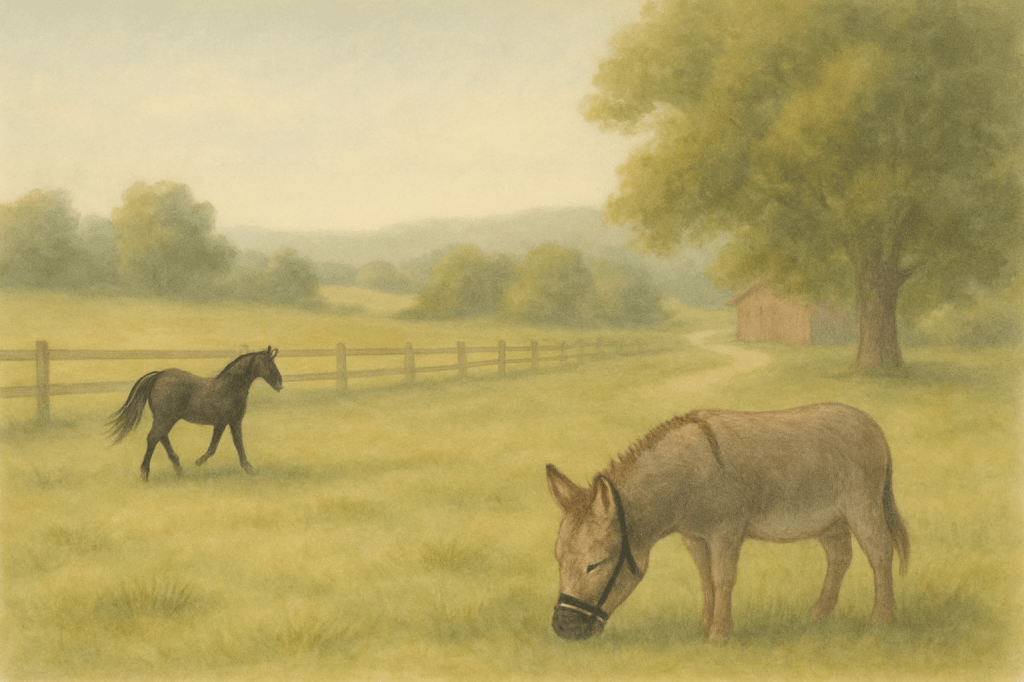
Her “new person” is a retired nurse—gentle, steady, and knowledgeable—who understands Pimmy’s conditions and is both vigilant and deeply caring. Pimmy now wears a grazing mask and spends her days roaming a generous pasture with her new buddy, an aging Arab gelding. The regular movement is doing wonders: she’s walking more freely, her energy has lifted, and her coat is turning fluffier and shinier, as if she’s growing into a chapter all her own.

Meanwhile, life with my two horses has kept me just as busy. With Pimmy settled, I turned to repairing fencing, cleaning the barn, and making a few improvements to the horses’ living space—projects that had been quietly waiting for months. Horses have a way of creating their own to-do lists, and mine certainly did.

Rosie, who is sturdy but sometimes finds trouble, managed to develop a hoof abscess. It needed soaking, wrapping, and all the fussing Rosie insists on not enjoying. And Sunny—sweet, distractible Sunny—somehow scraped a surprising patch of fur off her face. No dramatic story, just the everyday mysteries of horse life. Between meds, bandages, and gentle reassurance, they’ve needed both hands-on treatment and the simple comfort of my presence.

All this work has kept me grounded, but I’ve also become aware of another familiar pattern: the slow return to isolation whenever I stay home long enough. It’s not that I don’t love being here—keeping the property in shape, caring for the animals, tending to the endless little realities of country life. I do. Yet after a while, I begin to miss the hums of human life. Conversations. Laughter. The ordinary noises people make while going about their day.

So, I decided to rebalance things. For this Christmas season, I’m taking a part-time job at a fast-moving retail discount store. A few short shifts each week will give me a little of the outside world again—energy, chatter, and a constantly changing flow of faces. And, for reasons I can’t entirely explain, I have a growing curiosity about retail as an industry. Now that I’ve learned how a traditional department store operates, I’ve also wanted to understand how the bulk discount retailers run their show. My new seasonal role will give me a chance to find out.

What I’ll ultimately do with my expanding retail knowledge is anybody’s guess—mine included. Maybe it will simply satisfy my curiosity. Maybe it will help me better understand the rhythms of modern commerce. Or perhaps it’s just another way of staying engaged with a world that keeps shifting under our feet.

For now, it’s enough that this will get me out among people again—listening, learning, and feeling connected—while still allowing me to come home to the animals and land that make up the heart of my days.

— Diana

Pimmy’s New Beginning

Sunday, November 30, 2025

My middle-aged donkey, Pimmy, may soon be living in a new home. It’s bittersweet to even write that, because the past year with her has been so intense, so emotional, and so full of learning.

Pimmy’s health crisis last year took me completely by surprise. I was unfamiliar with Cushing’s disease in equines, let alone equine Type II diabetes. By the time I understood how sick she truly was, she needed to be hospitalized in an equine ICU—days of specialized care, IVs, monitoring, and the kind of worry that settles in your bones.

When she finally came home, it was with lifelong medical needs: daily medication, careful feeding, and the responsibility of helping her lose nearly 100 pounds. At first her treatment routine was twice a day, and eventually it shifted to once daily, but the vigilance and devotion never lessened.

Through it all, Pimmy remained sweet and willing—devoted to “her horses,” Rosie and Sunny, even when I had to separate her from them so she wouldn’t overeat. They stayed close, calling to each other over the fence, a small reminder of their bond. I became unexpectedly proficient at mixing medications and administering them to a donkey who had her own opinions about anything that didn’t involve hay. And each time I walked toward the barn, she greeted me with hopeful, hungry brays—touching, funny, and a bit heartbreaking.

But she adapted, and so did I. Over the year, Pimmy lost the weight she needed to lose. She looks wonderful—bright-eyed, balanced, and healthy. Somewhere along the way, this stubborn little donkey transformed into “my big puppy,” easy to handle, affectionate, and smart as all get-out.

Through her recovery, my biggest worry remained her future. Donkeys, when well cared for, can live forty years or more. At my age, I know I won’t be here for the whole arc of her life. Rehoming her has weighed heavily on me. Anyone responsible for Pimmy would need to understand the realities of a “special-needs” donkey—the monitoring, the daily medication, the vigilance around weight. Not everyone can take that on. But for the right person, the reward would be immense. Pimmy, in my fully biased opinion, is one of the sweetest donkeys on the planet.

And then, early in Thanksgiving week, something unexpected happened.

A nearby neighbor, Alison—someone I only vaguely knew, though I knew she was a horseperson—texted me out of the blue asking if she and her husband could come talk. After so many years living near each other, I had no idea what she might want.

They arrived and told me their old horse had recently died, leaving their remaining elderly gelding lonely and unsettled. Softly, and very respectfully, they asked whether they might “borrow” my donkey for a few weeks as a companion until they found another horse.

Because they’re experienced with horses, they already understood the essentials of Pimmy’s care. They played with her, scratched her in all her favorite places, and fell for her immediately. And without much hesitation, we made an agreement: Pimmy would go to their place as a companion. If they loved her—and if they could manage her medical needs—she could stay permanently.

A remarkable part of this is that Alison, besides being a lifelong horsewoman, is a recently retired nurse. She understands chronic conditions; she’s comfortable with medications and observant about details. She asked the right questions, noticed everything, and handled Pimmy with a calm confidence that reassured me instantly.

Yesterday, Alison returned with several friends who were excited to meet Pimmy.

We all escorted Pimmy, who wore a grazing muzzle, as we had to walk across a pasture, to meet the elderly gelding. Those two hit it off right away. And, everyone adored Pimmy—her sweetness, her curiosity, her gentleness. I watched her step into this new circle of people and animals and felt the full bittersweetness of those moments.

Letting go of a beloved companion is never easy. She has been part of my daily rhythm, part of my barnyard family. But alongside the ache, I could feel something else—relief, gratitude, and a genuine joy. I could see clearly that Pimmy was stepping into a home where she would be appreciated, understood, and deeply cared for.

It felt like the universe whispering, Here. This is the right place. This is the right time.

That it’s Thanksgiving season, too, has me feeling a special mixture of gratitude and humility. Gratitude that Pimmy is healthy and happy, that the right people appeared at precisely the right moment, and that she will be cherished in her new home. And, humility in realizing that letting go—when it’s done with love—is also an act of giving care.

Pimmy will always be an essential part of my story. But now she belongs to a new one, and that’s bringing me a quiet, hopeful peace.

(Note: The photos, “moments of transition,” were captured by our friend, Susie.)

— Diana

Edging Into Fall

Tuesday, September 02, 2025

Central Oregon is tipping toward fall. I feel it in my bones—and deeper still, in the barn. Mornings exhale a first breath of chill. My dogs pause at the door, alert to change. The horses lift their noses as though frost itself is sliding down from the Cascades. And yet, my mind lingers in summer, reluctant to let go of those long, elastic evenings when the light stretches far enough for one more fence mended, one more wander taken.

The beauty is undeniable—aspens flashing their golden coins, birds perched on high wires against a paler sky. But beauty whispers its reminders: winter is coming. Fence lines, troughs, de-icers, hay stacked high, hoses drained—chores press forward. While I think about what must be done, the horses toss their manes and prance, delighted with the crisp air. Pimmy, my donkey, on a weight-loss diet, asks only that her supper comes on time.

It is I alone arguing with the clock. September’s sunsets are deceiving, convincing me there is always time for just one more thing—until the light folds suddenly into a quick blue that belongs only to fall. Soon an official time change will bring its own confusion. My animals, untroubled by calendars or clocks, know only the tugs of hunger and the promises of dawn and dusk.

And still…fall offers pleasant solaces. A heavier quilt pulled to the chin. Warm mugs replacing thin glasses of ice. A jacket tossed into the car, because you never know. These days contract, yes, but in their shortening remind me to choose with intention; perhaps this is autumn’s hidden gift.

Dear Friends, stepping into the season—grieving summer’s length, seeking peace in earlier darkness, and grateful for small comforts that soften the tilt.

— Diana

Pimmy’s Check-Up

Saturday, March 08, 2025

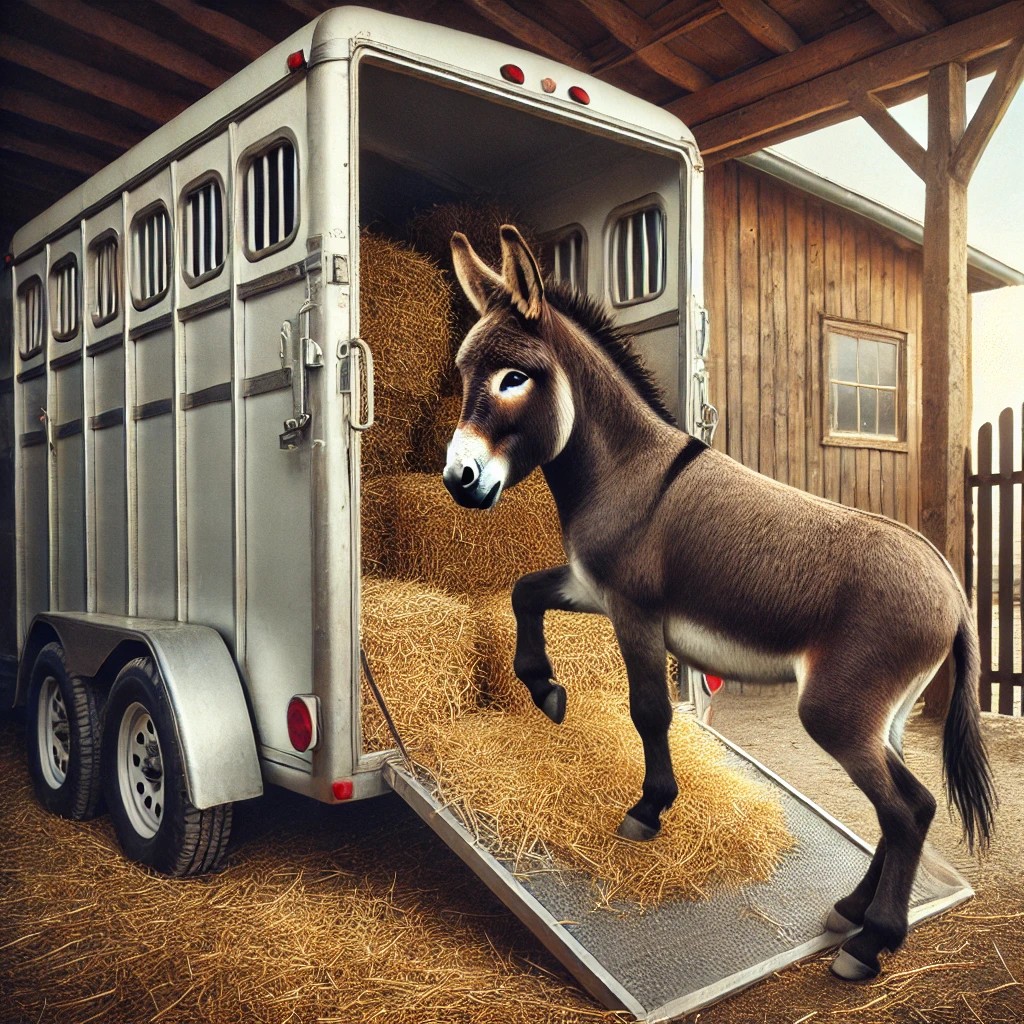
Yesterday, to my surprise, Pimmy loaded herself into the horse trailer. She’s teaching me more about donkeys now than when she was constantly among the horses. These days, separated from the horses (for dietary needs), Pimmy seems more like my big dog than an equine.

This time, while encouraging her to load into the trailer, I allowed her to resist loading. I gave her plenty of time to think things over, and suddenly, she voluntarily popped into the trailer.

That’s the thing about a donkey. It doesn’t just follow orders and isn’t just stubborn; it needs to evaluate the possibilities before deciding on an action. It’s taken me over a dozen years with Pimmy to learn this, and yesterday, I felt proud of myself for finally being a bit smarter.

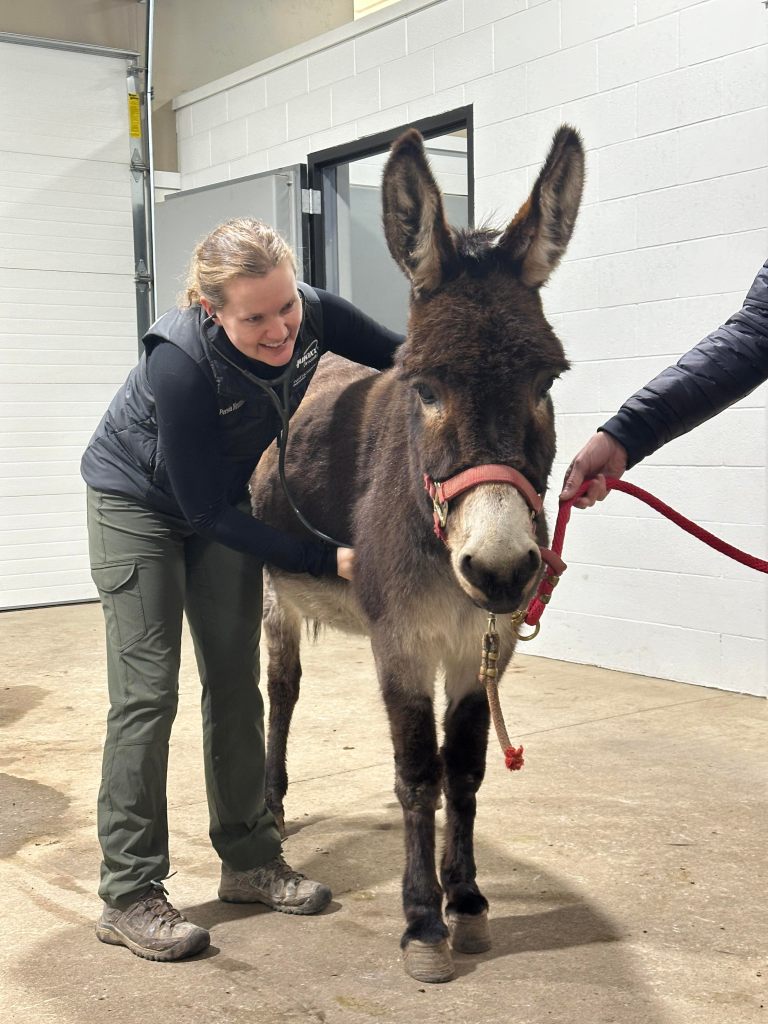
The header photo shows Pimmy getting a physical yesterday. The doc says Pimmy’s vital signs are fine, and her weight is lower. Those are good. The most quickly assessable bloodwork was excellent. We must wait for more bloodwork results to learn if her Cushing’s Disease remains under control and if her glucose level is corrected.

Yesterday, too, she received routine inoculations, and the veterinarian floated Pimmy’s teeth. Then, the slightly drunk donkey needed time to recover from the floating anesthetic, so I left to fill my rig’s tank at a gas station. By the time I returned, Pimmy was awake enough to hear me calling and came to me. She loaded into the trailer relatively quickly, and we left for home.

If her glucose has reached a normal range, I will reduce her meds from twice daily to once daily–a welcome relief. Pimmy’s doctor has ordered an additional ingredient, Vitamin E, for the regimen.

Pimmy is a sweet, smart, and delightful being. Through these months, I’ve not enjoyed treating her illness or separating her from her beloved horses. By now, however, knowing this donkey more personally, I much better appreciate her.

Dear Friends: The horses will get floats and inoculations in two weeks. Diana

Hauling Along

Friday, March 07, 2025

Despite the apparent recklessness of America’s newly installed leadership, the volatile stock market swings that unsettle me, the widespread neglect of climate action, concerns over healthcare, and the moral uncertainties within the judiciary—despite all of it—I must remain grounded in the activities of my daily life, carrying on as usual, unless (or until) those sorts of conditions force me to adapt.

In reality, I’m already adapting by prioritizing savings. My grocery choices are more deliberate and budget-conscious, my online shopping has dropped significantly, and instead of cycling back into the department store where I work part-time, my paychecks are making it home.

Much like during the “Days of Covid,” I can stay grounded and engaged on my small property, tending to the land and my animals. There’s always plenty to keep me active, allowing most of those bigger worries to fade into the background.

Today, I face the challenge of working with my donkey, Pimmy, as she heads to the equine vet for a blood draw to check her insulin levels and overall health. The first hurdle will be getting her into the horse trailer—she tends to resist loading unless one of her horses is already inside. To make the process smoother, I’ll keep her breakfast light, ensuring she’s hungry enough to be tempted by a bag of hay waiting in the trailer. The next hurdle will be to reload her after our vet visit, but on that end, someone will be available to help.

Otherwise, this day off from my part-time job will be routine tasks—feeding the animals, tidying up around the barn, and tackling some organizing (or reorganizing) inside the house. To prevent a tendency to dwell on political and economic concerns, I’ll stick to my to-do list and focus on getting things done.

Dear Friends: Confusion clashes with our sense of order, inviting a “bumpy ride.” Diana


New Day Challenges

Saturday, February 01, 2025

I must clock in at my part-time job by 8:30 this morning. That means I’m out of bed ultra early today and on watch for the first light before heading outside to feed my horses.

Yesterday, my short working hours prevented me from coming home to feed the horses at midday. I’d have done it anyway, on unpaid time, but the store is short on employees, and nobody was available to cover my time away.

Throughout my shift, I worried about missing that feeding and felt guilty.

Equines are large outside, but their stomachs aren’t because they’re grazing animals. Horses aren’t built for big meals but are designed for consistent food to trickle through their systems. A horse’s empty stomach invites colic (and other debilitating possibilities). Domesticated horses, fed regularly and having the needed trickle, can stay healthy without grazing.

I am tense and unhappy if my horses miss a feeding.

Fortunately, they are healthy and were excited to see their hay arriving last night. Today, I will feed them before leaving for work, and my shorter working hours will allow for appropriate horse-tending.

Dear Friends: I need to get moving; you have a wonderful day. Diana

Shifting Weather

Monday, November 18,, 2024

Yesterday, Central Oregon received a ground-covering snowfall in the late evening. That began while I was outside and just starting the routine of feeding my horses. Finally, when I could return to the house, the snowing was heavy. It made for dim sighting and covered my outerwear.

The horses were covered in snow, too. They eat in the open from hay nets hung from tree limbs. They’re not being blanketed because of their thick, fluffy winter coats. Their good coats usually carry them through the season. However, both horses are old, and I closely watch their weights. If my exploring hands start finding a protruding rib or body joint, I will blanket whichever horse it might be, or depending on overall conditions, blanket both.

Pimmy still has the barn to herself. Her hay is in an inside-hanging net; her coat is wintery-thick, and her weight is good.

I’m still leaving my dogs outside while I’m away at my part-time job. The weather will change that, however, when conditions demand keeping them inside. I plan to come home at lunchtime and let the dogs outside while I feed the horses. The dogs will stay inside again when I return to my job.

I really didn’t expect snow on the ground before Thanksgiving. That’s no longer usual as it used to be. Last year, our weather stayed mild until New Year’s Day. Then, conditions suddenly turned cold, and actually “colder than a well-digger’s arse,” staying as such until nearly mid-June.

Dear Friends: Making plans for coping well enough despite complicated conditions. Diana

Outing

Wednesday, October 23, 2024

My donkey Pimmy looks better every day. She’s lost weight, and her Cushing’s Disease has done a number on her coat. What had been a “harsh donkey” coat has softened into a touch-inviting plush velvet.

Yesterday, I introduced Pimmy to a grazing muzzle. I led her on a short walk, but that was inadequate preparation for her to follow her horse friends freely and comfortably. I would be riding horseback that afternoon, and experience has taught that Pimmy would follow her horses but also nonstop try to rub off the muzzle. She needed more practice in the muzzle, so she stayed home. As her friends passed by en route to the horse trailer, Pimmy objected noisily.

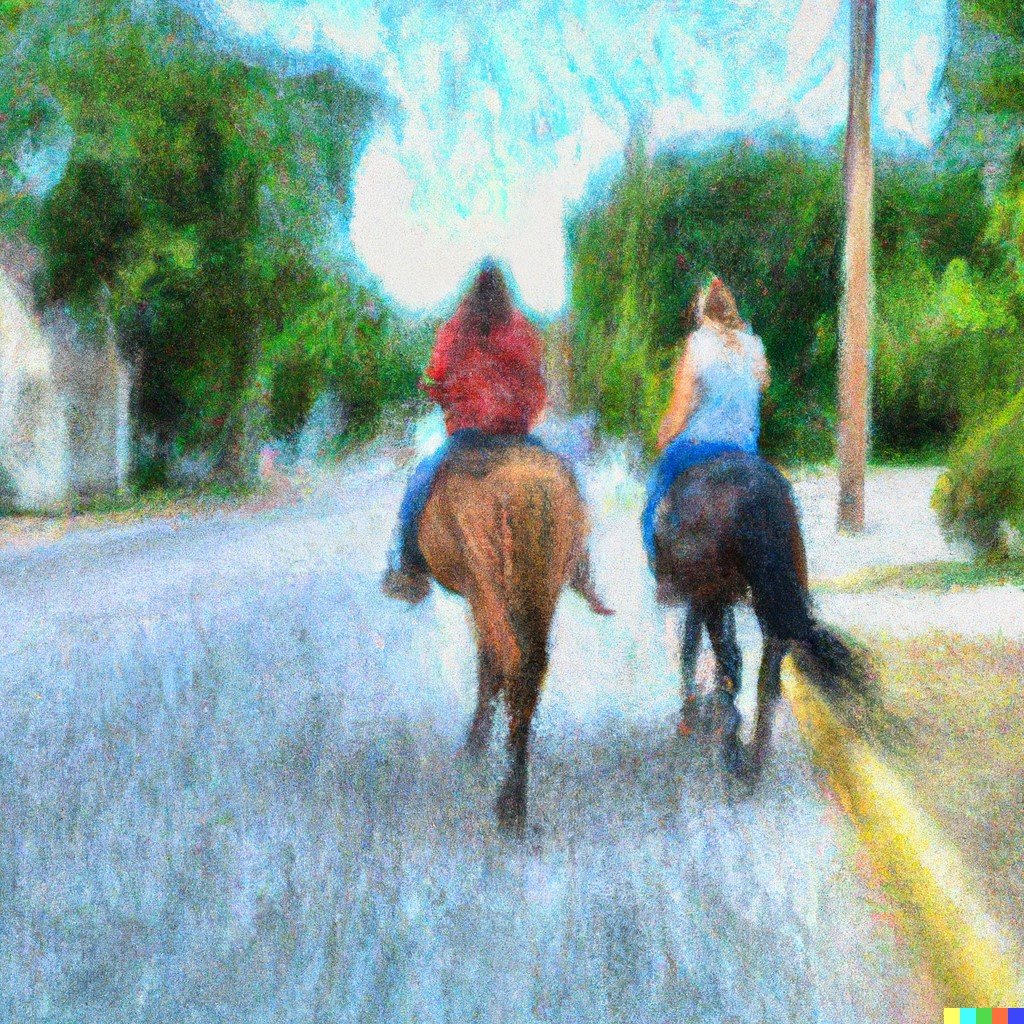
My friend Anna and I had an enjoyable ride. She was on Rosie, and I was on Sunni, with my dogs running alongside. The horses hadn’t been ridden for a while and started off slightly jiggy. Anna rides beautifully, and soon, Rosie was moving quietly. My Sunni is easy to get along with, and her walk quickly became pleasant.

I’ve been too busy with various demands to work enough with the horses. That must change because great horses deserve proper exercise. I will make time to lunge and ride them and also work with Pimmy.

A surprise visitor arrived while I was out in the evening darkness to give the horses a last feeding. I wasn’t pleased about the happy visitor—my dog, Chase! After making yet another escape!

Dear Friends: On horseback and the dogs running alongside…a super outing. Diana