Creative Longing

Saturday, November 29, 2025

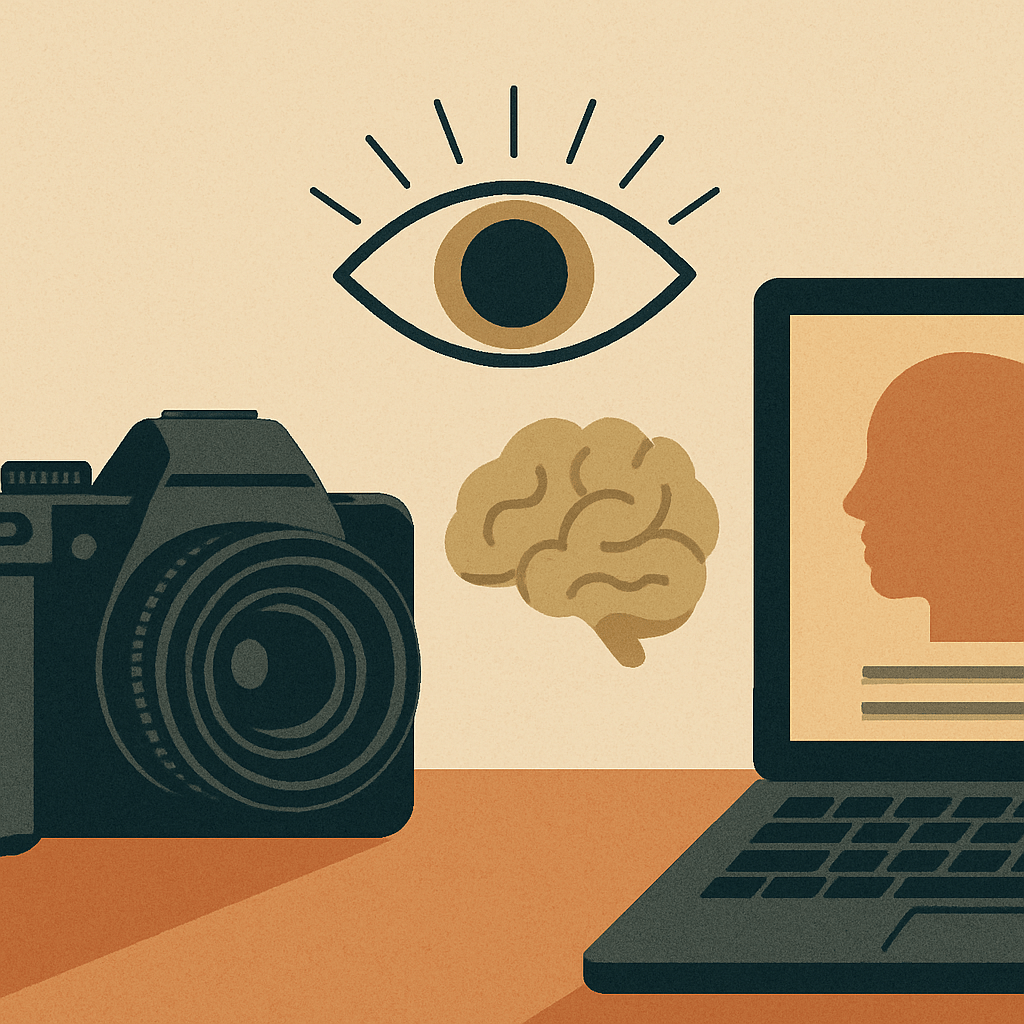
I keep wondering why certain objects can hold such power over me. They’re not things that glitter or impress. But cameras. And computers. Tools that can capture images or help me shape words. Tools that let me look more closely and think more deeply.

Yesterday, on Black Friday, I impulsively purchased a lightweight laptop—an extravagance I can’t quite justify, and one I’ve argued with myself about since clicking “Buy.” At the same time, I felt a strong tug toward using my camera more often. Something is dawning on me: I’m not really longing for the gadgets themselves. I’m longing for what they represent—seeing and understanding.

For as long as I can remember, I’ve been drawn to anything that helped me make sense of the world. I was a confused, unhappy youngster who studied people’s faces, their gestures, the tiny habits that revealed who they were. I was always searching for clarity.

My adulthood carried the same pattern—observing and learning through books, conversations, history, and the complicated turns of human nature. And for many years now, I’ve written almost daily, using words as a way to understand the world around me.

Underneath all of this—beneath the reading, the writing, the curiosity, the endless blog posts—is a quiet truth: I look because I want to see. I write because I want to understand.

So when that high-end laptop appeared in the Black Friday ads, something in me stirred. Something hopeful, almost childlike. I brushed aside my doubts and ordered it—not because I needed a new computer, but because I wanted the possibility it represents: mobility, clarity, freedom to explore ideas wherever I happen to be.

In realizing this, my doubts have softened. The laptop has even renewed my interest in photography. Not in “taking pictures,” but in pausing long enough to truly notice something—
a slant of morning light,
frost edging a fence board,
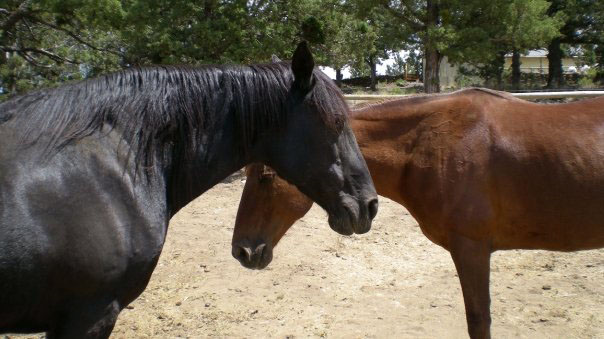
the expression on a horse’s face.

A camera grants permission to look a little longer, to silently declare that this moment matters.

The new laptop is on its way, and the battery for my camera is charging. Yes, the laptop is a luxury—I already have a perfectly good one—but it isn’t lightweight enough to carry with me. And at this stage in life, I’m finally admitting something simple: some people crave adventure or entertainment; I crave clarity.

It’s no surprise, really. Part of it comes from where I began, still seeking the clarity I never had as a child. That clarity now comes from noticing, reflecting, and catching the fleeting things that daily responsibilities make easy to miss. It grows as I put words to feelings and capture images that echo something within me.

These yearnings aren’t weaknesses or indulgences. They’re my learned way of staying awake to the world—choosing what my mature eyes and mind want to truly see.

Yes, I’m “wasting” money in a sense. Tools come and go. Cameras break. Laptops age. But the more profound desire—to see, to understand, to express—has never faded. These threads have run through my life for decades, woven into my work, shaping my aging years, and helping me rebuild after losses. They’ve colored every blog post I’ve written.

I keep reaching for creative tools not because I want more possessions, but because I need ways to follow the parts of myself that still want to grow.

So my impulsive purchase isn’t wasteful after all.
It’s a way of keeping my inner world alive and bright—
one image, one insight, one small moment at a time.

Diana

A Space For The “New Aging”

Friday, November 21, 2025 (DRAFT)

Thoughts About Community

In my last post, I wrote about what it feels like to live in my mid-80s with health, clarity, and purpose—something I never imagined experiencing decades ago. The more I reflect on this unexpected stage of life, the more I notice something important: people my age are living through a transition that no generation before us has experienced.

We are healthy longer.
We are active longer.
We are present in the world longer.

And yet, it seems that almost no one talks about what this actually feels like.

A Missing Conversation

In recent months, I’ve noticed how often folks around my age quietly share stories with me that echo my own:

  • being underestimated because of age
  • feeling “out of sync” with stereotypes
  • balancing independence with shifting social expectations
  • managing losses while also discovering new energy
  • feeling invisible and visible at the same time

These conversations usually happen in corners—in my retail job while speaking with customers, or spontaneously during errands or in spaces between tasks. They’re brief, spontaneous exchanges that end with, “I’m glad we talked about this.”

I’ve been wondering why there isn’t a regular place for people in their 70+ years to have such deeper conversations openly. Not about illnesses or medications—that’s already been done. I mean about the life side of aging: identity, purpose, invisibility, curiosity, grief, reinvention, and the strange thrill of still being very much here.

A Thought That Keeps Returning

What if there were a small group that gathered—say, weekly or monthly—simply to talk about what it’s like to live in these later years with awareness and vitality? That would be creating a setting where age isn’t the topic so much as the lens.

This could be a group that sees aging not as retreat, but as a frontier.

This idea isn’t about therapy or advice-giving. It’s more like a conversation circle—thoughtful, warm, respectful, and open. A place where people who are navigating this unfamiliar terrain can compare notes, share insights, and feel understood.

But Here’s the Truth

The thought of organizing such a group overwhelms me a bit. Maybe that’s because it feels larger than one person. It feels like something that should grow naturally, not through pressure or obligation.

Yet the need keeps nudging me. It’s as if something in our culture is waiting to be named—and conversation is often how naming begins.

Maybe the Group Begins Here

So for now, I’m simply writing about it—opening the idea—to the air—to see if it wants to take a shape and what that might be like. Perhaps others will feel the same pull, and maybe a few voices will gather. Maybe such a group will form itself, slowly and organically, the way meaningful things often do.

I’m not ready to declare myself the leader of anything. But I am ready to acknowledge that many of us—living longer, living differently—are hungry—for a place to speak, to listen, and to understand this unexpected chapter together.

This post is simply a beginning.
A seed.
A space held open.

And we’ll see what grows from it.

— Diana

In My 80s: A New Kind of Frontier

Thursday, November 20, 2925

I’ve been thinking about what it means to be in my mid-80s—healthy, clear-minded, deeply involved in daily life—and how strange and surprising this stage feels compared to what I imagined many years ago.

The truth is, I never pictured myself “here.” Growing up, I didn’t know a single person in their 80s who was still vibrant, working, and engaged. Most older people I saw (even in their 60s) were frail or withdrawn, already living in the narrow, expected lane that society has quietly painted for “seniors.”

But today’s medicine has changed dramatically. So has nutrition, lifestyle science, and our understanding of the mind. Something new is happening: people are living longer and staying healthier. We’re extending not just lifespan, but healthspan. And those of us who find ourselves active and well in our 80s are, in a way, pioneers. We’re the first generation who must learn how to inhabit this expanded stage of life—because there is no blueprint yet.

The Question I Keep Getting

In my retail work, where I interact with countless customers, I am asked about my age more than ever. And I don’t answer. Not because I’m ashamed—far from it—but because the question usually comes with something else: an immediate rush of unsolicited expectations.

People seem eager to explain what they think someone my age should be doing. Resting. Retiring. Slowing down. Disappearing from the working world.

What they’re really telling me is that they can’t imagine being my age any more than I once could. They’re trying to match the person they see—present, engaged, competent, and curious—with the outdated stereotype of an “elder” that they still carry. That mismatch unsettles them, and age questions become a way to resolve the puzzle.

I’ve come to understand this as a soft, reflexive form of ageism. Not cruel or intentional—just unexamined. A product of our culture’s old mental images about aging, images that many people haven’t updated yet.

A Quiet but Powerful Shift

But here’s the interesting part: every time someone encounters a healthy, active, eighty-something, their internal map of aging shifts—just a little. They’re being stretched into acknowledging a new possibility: that older age can look very different from the images they grew up with.

When I decline to answer age questions, I’m setting a boundary, but I’m also doing something else. I’m reminding people that age is neither a credential nor a limitation. My value—in work, in conversation, in life—comes from who I am right now, not the number attached to my birth year.

What Comes Next

Lately, I’ve been reflecting on how many people around my age are experiencing these same shifts, these same mismatches between who we are and how the world imagines us. Our generation is living through an evolution that society hasn’t fully named.

There’s a bigger conversation to be had about aging today—about identity, purpose, mental and physical vitality, boundaries, curiosity, and what it means to live longer and healthier than we ever expected.

That conversation is brewing inside me. Perhaps it will grow into something more structured—a regular discussion, a gathering, a community space for people in their seventies and eighties to share experiences and observations. Perhaps it will simply unfold one piece at a time.

For now, this is just the beginning.

And I’m curious where it will lead.

— Diana

Different Realities

Friday, October 17, 2025

I grew up in a small Oklahoma town during a time when social norms encouraged people to reconcile their differing versions of the world by searching for and settling on common viewpoints. The best solution for conflicting opinions was usually to satisfy the “commonly held” middle ground. Such viewpoints tended to reflect the widely accepted and “popular truths” that most people—before the internet and modern technology—generally agreed upon.

As a young person, I found the differing versions of reality unsettling. I struggled to make sense of them before eventually realizing that many forces shape people’s perceptions—one’s upbringing, information sources, fears, hopes, and fatigue. Other influences too—culture, personal experience, and cognitive biases—play powerful roles in shaping how we each perceive truth and reality.

Even now, I’m sometimes taken aback when long-time or new friends express opinions or wishes that seem to belong to an alternate reality. Some might find such moments reassuring, as evidence of progress, while others might see them as signs of decline. I’ve come to sense that some people find comfort in tradition while others draw inspiration from innovation. Recognizing that helps me accept our differing realities.

I often imagine us all standing in the same landscape, each looking up at the same vast sky but through different filters—some perhaps tinting it with unusual colors. Each of us navigates life through a private, learned lens, one that has either been refined over time or obscured by it.

In my more mature years, I try to respond gently to others’ realities. I no longer attempt to reconcile their perspectives with mine—or mine with theirs. As others speak from their own worlds, sometimes so different from my own, I try to listen for the heartbeat beneath their words—for the universal emotions of worry, pride, love, or loss. It’s there, in those shared emotional spaces, that our realities overlap and understanding becomes possible.

These days, I keep my focus on what’s directly before me—my own, very real world. That includes my dogs at dawn, the fall season’s newly chilled air, and the always-marvelous scent of early morning coffee. These rhythms mark the beginning of my days; they are among my certain truths.

We often hear that our shared world is fracturing. That notion is open to many interpretations. Yet despite our differences, many of us still believe in shared ground—the small, tangible things we can all see and touch.

We may never fully align others’ realities with our own, but we can remain faithful to the core values that most people strive to live by and nurture in their daily lives.

After all, we are remarkable beings—capable of rising to the challenges of caring for one another.

Diana

In The Story

Saturday, October 04, 2025

I grew up in the 1950s and ’60s, when life expectancies were shorter than they are today. Back then, reaching eighty-five seemed almost mythical — something that happened to “very old people,” but not to all of them.

Yet here I am, at eighty-five, still alive, active, and managing the daily demands of home life while also working a full-time job outside my home. Over the past few years, as I’ve learned how to work in retail environments, I’ve encountered ageism — sometimes subtle, sometimes not. People have told me outright: “You shouldn’t be working, you should be enjoying your twilight years!” or “You’ve earned your rest — why are you here working?”

My life lessons and learning are that staying engaged, helpful, and connected is my way of enjoying and making the most of them.

After experiencing uninvited confrontations related to aging, I have elected not to answer when people ask about my age. Let them look. Let them guess. I’ll let my energy and presence speak for me. Age is only a number; contribution is a choice.

I’m now rethinking somewhat, for Jane Fonda has begun resurfacing in the public eye again. And, I find myself noticing her with renewed interest. She has always been bold — both in her career and in her willingness to age openly, in plain view of the world. Now, while approaching eighty-eight, she is again speaking out, supporting free speech and democracy — still active, still fearless, still herself.

Her appearance has changed, naturally, but not in ways that erase her. She’s slender, stylish, and poised. If she’s had work done, it’s subtle. She lets her neck, however, tell the truth of her years — and to me, that’s oddly comforting. I see her as not hiding from the passage of time.

To me, Jane Fonda has become more than just an actress or an activist. She is a symbol of endurance. Her journey, which we have witnessed growing up alongside her, is a testament to her resilience and strength. She symbolizes the permission to remain visible, to express opinions, to care deeply, and to stay part of the ongoing conversation. She shows that relevance is not confined to youth.

At eighty-five, my private reality is a testament to the meaningfulness that comes with caring for animals and responsibilities. I never expected to live this long, feel this alive, or be this responsible. The unexpectedness of my current situation keeps life interesting. Yet, I still work full-time, on my feet, solving problems and engaging with people. And when the day is done, I return home to care for my animals and keep my world running. It’s not easy, but it brings a profound sense of purpose.

To people who suggest I should slow down, relax, and “enjoy life,” it’s my work and routines that bring me joy — they give shape and purpose to my days. I’ve never had cosmetic surgery and don’t want it. Instead, I take pride in how I present myself: in my clothing, my interests, my energy. My mind is clear, my curiosity intact.

Without family nearby, my workplace provides me a sense of belonging — through friendly interactions, shared goals, and the simple recognition that I am still making a contribution. Those exchanges keep me grounded.

And now, to my surprise, Jane Fonda is becoming a role model, not for her fame or glamour, but for her persistence and grace. She reminds me that aging isn’t about looking young — it’s about staying in the story.

Maybe that’s what aging is teaching us: not how to fade away, but how to keep showing up. Jane Fonda illustrates that we can grow into our later selves with intention, not apology. She is still visible, still learning, still engaged — and so am I, in my own way.

Inside, I don’t feel old. I think seasoned — aware, shaped, and, in many ways, more certain than ever. My work keeps me connected; my mind keeps me company. And if I find a mirror in Jane Fonda, it isn’t in her polish or fame — it’s in her refusal to disappear.

At eighty-five, I’m not winding down. I’m still becoming — quieter, perhaps, but clearer. Still part of the conversation. Still in the story.

Diana

Discovering Wristwatches Anew

Friday, September 19, 2025

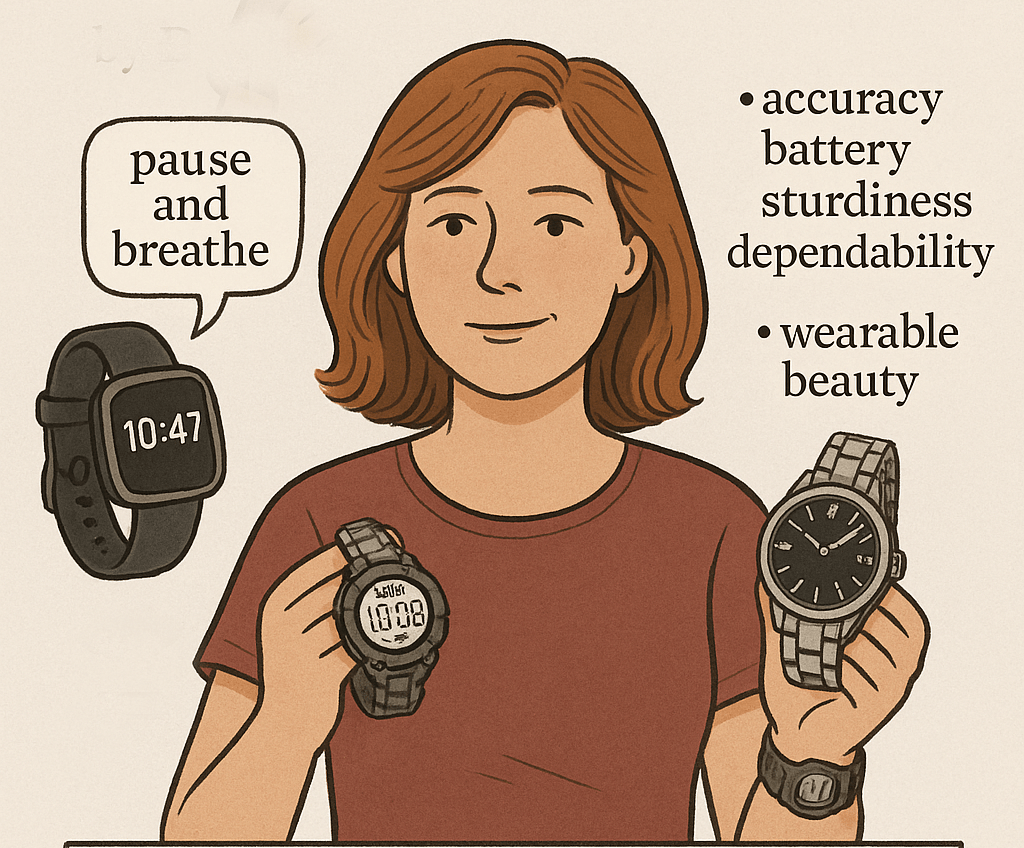
In my outside job, I work in a department where I frequently sell high-end watches. At first, I was fascinated to discover how many customers still enjoy studying and wearing traditional wristwatches. I wondered why they bothered with conventional styles when smart watches can do so much more—letting us know when a phone call or text arrives, reminding us to pause, breathe, and reflect, and so on. I’d been almost satisfied with my smart watch.

Almost—because I’ll admit, those sudden prompts to “pause and breathe” or “note your feelings” often left me annoyed. Meanwhile, through the process of presenting and selling traditionally styled watches, I became intrigued by their strong points: accuracy, battery technology, sturdiness, dependability, and, not least, their wearable beauty.

On impulse, I ordered two wristwatches online. One is a refurbished brand I’ve been selling—a high-end, good-looking piece that is fashionable, accurate, and reliable. The other is a $9 rugged-style timepiece that has unexpectedly become my favorite. Sporty and lightweight, it offers day, date, time, alarm, seconds, and stopwatch functions. My only concern is whether its “crystal” (likely hardened plastic) will scratch easily. But at $9, if it does—who cares?

So, I’ve retired my smart watch. No more charging, no more unwanted nudges. I’ll miss alerts to incoming calls, but my phone is usually in my pocket with a ringtone I can hear. I might miss step counting, but I know my daily steps already run into the thousands.

Reflecting on this change, I’m reminded again how learning shifts perspective. For years, I never once considered wanting a traditional wristwatch. Now, understanding their dependability, durability, and sheer beauty has made them alluring—and even a “heapy-cheepy” rugged model proves that simple technology can be capable and cool.

Perhaps best of all, my own experiment gives me more insight—and more articulate ways to share the appeal of high-end wristwatches with customers.

— Diana

Finding Balance in a Competitive Workplace

Thursday, September 18, 2025

Sometimes my outside job feels overwhelming. This past week included incidents that upset me enough to wonder if I should quit. In a different retail department store, I might have started the process, but my current workplace is so family-like most of the time that I genuinely enjoy being there.

I work in one of the store’s few departments where sales earn commissions. That naturally creates a competitive environment, and my struggles stem from a long-time employee—my co-worker—who, in my view, crossed a line. That left me feeling discouraged and out of balance.

I’m not easily intimidated, but I do prefer to avoid conflict. My goal is simple: show up, do my job as well as I can, and feel supported by management. Most days, that’s exactly what happens.

This time, however, upper managers recognized what had occurred. They spoke with both my co-worker and me, and I felt they truly understood my concerns. They reminded me that competition in sales is never easily solved, but they also reassured me of their support. Their advice was that I learn to defend myself—something easier said than done by one who’s new to a competitive workplace.

Still, knowing management stands behind me eased the anger enough for me to stay and focus on how I can adapt. For me, it isn’t about commissions. It’s about fairness. What makes staying and working on the problem worthwhile is the fairness of being listened to, heard, supported, and encouraged.

At the end of the day, my workplace feels like a genuine family, and I find myself wanting to stay more than I want to leave.

— Diana

Lunch with Judy and Candy

Computer-generated Image–surprisingly close to reality

Monday, June 02, 2025

I had lunch yesterday with long-time friends I hadn’t seen in years. We first met during a pivotal chapter in my life, when I was a breast cancer patient participating in a support group. They were the group’s unofficial leaders—steady and compassionate, offering wise listening and unwavering kindness. The connections forged in that group felt deep and enduring. Despite years and distance, our shared strengths and vulnerabilities still feel familiar.

It had been a long time since we’d laid eyes on one another, but recently, they wandered separately into the department store where I work. We recognized each other immediately—like “old friends,” which we are—and promised to meet for lunch soon.

Judy and Candy are continuing to nurture the cancer support group–welcoming women facing breast cancer and other illnesses. Their dedication says much about their character, and just as much about our deep human need for community when we’re navigating illness. Sitting with them again felt comforting as they shared how the group continues to evolve.

Conversation came easily. We didn’t need to fill in every gap—we simply slipped into the familiarities of our old connection: talking about our lives now, the realities of aging, fond memories, and the ever-present question: What may come next? There was laughter, warmth, and a few comfortable silences. Our lunch felt less like a reunion and more like a quiet rekindling—an affirmation of ties built during significant uncertainties and shared strengths.

They spoke of their early lives—how, as young women, they each bravely moved to Alaska during its formative days, just as it prepared for Statehood. They met there, in a time when its cities were small and its spirit was wide open. Those were the early days of loosening social constraints for women, and they embraced the freedom and opportunity. Eventually, each moved—independently but around the same time—to Central Oregon, where they reconnected.

They asked after my donkey, Pimmy, who is doing well—her illnesses are stable and under control. They asked about my other critters: sweet turkey Lacey, noisy Cockatoo Peaches, and Chase (yes, that Puppy-from-Hell, Chase, who still lives with me).

The best part of our lunch was simply knowing—knowing one another well and knowing where we’ve been. We didn’t just share memories; we shared something more enduring–a kind of bond formed while at our most human, our most open. That’s what has made the cancer group so special, and it’s what made our lunch such a gift.

Dear Friends: Like Alaska in its frontier days, Central Oregon is an “honest place.”—Diana

On Her Birthday

“Magical Mommy”

Wednesday, March 05, 2025

If genetic advancements had been available during my mother’s lifetime—capable of extending health and longevity—I might be celebrating her birthday with her today. I’ve long wished for at least one more conversation, a chance to ask the many questions that could fill the blank spaces of her early life.

Reflecting on why I never asked more about her life brings back memories of my own trials and tribulations growing up. Each day was a lesson in adaptation, filled with new challenges and shifting realities. I naturally focused on myself—learning, adjusting, and figuring out how to navigate life one step at a time.

Back then, I felt an urgent need to escape a past that seemed confining; I needed to step into a future that was broader, more inviting, and yet daunting. All that forgotten past included both my parents and grandparents. I might never have seriously reconsidered all of them if not for the rise of DNA and its profound ability to connect one’s history with one’s future.

I give deep nods to technology and genetics and to an equally powerful force—the unbreakable connection between parent and child. Its hold isn’t always smooth but shapes and defines us in enduring ways.

Today, on my mom’s birthday, I’ll hold her in my thoughts. A sudden memory might surface, filling in a blank or two about her life. I like to imagine that she can somehow “hear” my thoughts—so I’ll share a few, letting her know how I’ve grown and changed, shaped in no small part by her insight and encouragement.

Dear Friends: Science fundamentally reshapes how we perceive and evaluate ourselves. Diana

Eventing

Saturday, September 28, 2024

In today’s header photo, my dinner partner Adrain captures me and my dinner at the restaurant, Spork. This is a mirror image of the one I took that evening of him and his meal. I used my photo (a little blurry and fun) as yesterday’s blog header.

Adrain’s photos are good. He loves photographing with his phone and sharing images. Today, I’m using his photos as reminders of our enjoyable event.

The restaurant was fun. Our event is one I’ll remember more after having become lost on the westside while trying to find Spork; Adrain came to my rescue.

I’m a carb counter and didn’t recognize anything related to my preferences on Spork’s Asian-style menu, so I ordered what Adrain loves: crispy chicken on rice and salad. He’s right, a tasty dish.

Today’s header photo beer!

Writing about my dinner with Adrain has reminded me of “My Dinner With Andre,” a popular 1981 movie directed by Louis Malle. After the experience of “Spork,” I could write more about atmosphere and conversation while dining out with a friend. Now, I discover myself wishing to recall that old movie better and will try to find and watch it again.

Dear Friends: Each experience is an event. Diana