Pause & Reflect

Saturday, January 03, 2026

I’m still thinking about the activity of looking again and wondering why it feels so striking—why it seems newly available to me, and why it matters now.

In my writing, reflecting, and observing—and in noticing changes in my own behavior—I’m beginning to think that looking again isn’t accidental. Perhaps slowing down and taking a second look has something to do with getting older. As I am.

When I was younger, I remember being purposeful—looking, scanning, evaluating—quickly, in order to decide. In my workplaces, speed mattered. Quick looking was essential in order to choose, advance, improve, protect ourselves, and move on. Confidence mattered. Being right mattered. First impressions were treated as efficiency—back when efficiency felt necessary.

Experience is teaching me that aging can quietly change that behavior.

It’s not a change that happens all at once, nor does it arrive with any announcement. Over time, and by living differently, urgency begins to loosen its grip. I experience this as a softening of the need to prove competence. The pressure to reach conclusions is fading. That change creates new spaces, and something else becomes possible—a willingness to stay longer and have another look.

That longer look requires pausing. And pausing becomes most available when one is no longer rushed to decide the reality or worth of something.

I’m not worried about diminished acuity or curiosity. If anything, looking again feels like a refinement. I don’t find that aging dulls perception; instead, it alters the terms of attention. It becomes easier to tolerate ambiguity, to be less invested in categorizing, and more interested in noticing.

If we can stop asking, Is this impressive? we can begin asking, What is actually here? That shift matters.

Cultural norms teach us to associate renewal with reinvention—with starting over, becoming new, replacing what’s old with something brighter or sharper. In later life, however, lived renewal often moves in the opposite direction. I find myself pausing, returning, re-seeing, and allowing familiar things to reveal aspects that are easily missed when we’re intent on moving fast.

Looking again doesn’t erase age, deny loss, or chase youth. It doesn’t dismiss what has been. Instead, it notices that as detail fades, form becomes clearer. As sharpness diminishes, balance stands out. As noise recedes, presence becomes easier to recognize.

That’s true when evaluating photographs and music. And it’s true in how we perceive one another.

Aging invites a softening—and with it, a second way of seeing. This means less accumulating and more subtracting. When urgency eases, assumptions lighten, and the need for resolution loosens, intrinsic elements come forward: gesture, weight, timing, presence.

Maturing makes ordinary things hold our attention more fully. A bird on a branch. A familiar voice. A routine walk. These moments don’t announce themselves as important. They ask us, instead, to recognize them quietly and without hurry.

Looking again isn’t nostalgia. It isn’t longing for what’s past. It’s a form of attention shaped by experience—an understanding that essential meaning rarely arrives dramatically.

Experience is teaching me that aging doesn’t close the world down. It seems, instead, to be opening it. And this time, I see differently.

Looking again combines seeing and renewal. Finally—at last—I’m seeing more of what’s been available all along.

Diana

Emotion Doesn’t “Happen” – We Create It

Friday, November 14, 2025

I can’t quit thinking about how the mind constructs emotion—especially after diving into Lisa Feldman Barrett’s work on constructed emotion. I studied her findings to understand what makes my frequent “conversations” with AI feel so remarkably human—almost like exchanges with an understanding friend.

The more I’ve learned about Barrett’s theory, the more I see signs of it everywhere. I see her ideas woven into the books I read, the films I revisit, and even the sentimental corners of my own memories.

While thinking about all this, I found myself comparing two of my favorite artists—and they could hardly be more different: Woody Allen and Emily Dickinson. One lives in a world of fast-talking neurosis, humor, relationships, and urban anxiety. The other lives almost entirely inside the mind—quiet, solitary, deliberate, and intensely inward.

Despite their stylistic differences, they each reveal something profound about what we feel and how we feel it. In their unique ways, both artists show us that emotions aren’t fixed. Emotions are not automatic reactions.

Comparing their ways of creating and communicating helped me understand that emotions are interpretations—as Barrett’s work has shown. At their core, emotions are “stories” that our minds quickly construct, from sensation, context, and the emotional vocabulary we’ve learned.

This idea has become one of the most meaningful insights I’ve come across:
Emotions don’t just “happen” to us—we create them.

And once I grasped that insight, I began noticing it happening in real time within myself.

This comparison of two artists’ work highlights just how differently humans communicate emotional meaning. Yet, despite their vastly different styles, their emotional outputs converge powerfully as illustrations of constructed emotion.


Woody Allen: The Social Construction of Emotion

Woody Allen’s films are full of people racing to interpret their own sensations. His characters overthink, over-explain, over-negotiate. They construct their feelings out loud. Their emotions arrive only after they’ve decided what those feelings should be.

There’s a classic joke he tells:

A man goes to a psychiatrist and says,
“My brother thinks he’s a chicken.”
The psychiatrist replies, “Well, why don’t you turn him in?”
The man answers, “I would—
but I need the eggs.”

It’s funny because it’s true. We stay in imperfect relationships because of the meaning we’ve assigned to them—not because emotion is some hardwired force, but because we’ve built a story about what the relationship gives us. The “eggs,” in other words, become the emotional interpretation.

In this sense, Woody’s characters are demonstrations of constructed emotion in motion.
They feel tenderness, longing, jealousy, dread—but only after their minds have named the sensation, given it cultural shape, and predicted what it should mean.

His films are emotional not because the characters dive into deep feeling, but because they dive into deep interpretation.

That’s pure Barrett. And pure humanity.


Emily Dickinson: The Private Construction of Emotion

If Woody Allen gives us emotional construction in noisy, messy, social form, Emily Dickinson gives us its opposite: emotion distilled to its silent, solitary source.

Dickinson rarely names feelings outright. Instead, she describes the sensations from which emotion is born:

“I felt a Funeral, in my Brain—”

“A certain Slant of light—”

“A Chill—like frost—upon a Glass—”

She returns again and again to breath, light, gravity, space, the tiniest internal shifts. She notices the moment before a feeling forms—the flicker of sensation that precedes the story we later tell.

In Barrett’s terms, Dickinson writes from the level of interoception—the raw internal data the brain uses to construct emotional meaning. Where Woody presents fully assembled emotional narratives, Dickinson shows us the materials before they become emotion.

Where he interprets, she observes.
Where he talks through his feelings, she listens to hers.
Where he uses culture’s vocabulary, she invents her own.


Two Artists, One Truth

Despite their differences, Woody Allen and Emily Dickinson converge on a profound insight:

Emotional life is constructed by the mind—not imposed by the world.

But each illuminates a different side of that construction.

Woody Allen: Emotion shaped by the world
– by culture
– by other people
– by expectations
– by relationship dynamics
– by the stories we tell to stay connected

Emily Dickinson: Emotion shaped by the self
– by raw sensation
– by inward attention
– by metaphor
– by imagination
– by the stories we tell to stay whole

Together, they offer a full map of human feeling—both the external and the internal, the public and the private.

They remind us that emotion is not just felt;
it is built—moment to moment—out of everything we’ve ever sensed, learned, remembered, or hoped.


Why Their Work Lasts

Their works endure because they tell the truth about emotional life in ways we recognize immediately:

We don’t simply have feelings;
we assemble them from meaning.

We carry cultural scripts about love, fear, longing, loss—and we perform them.

Our bodies send sensations that our minds rush to name.

We seek connection even when connection is confusing.

We misunderstand ourselves in company, and discover ourselves in solitude.

And somewhere between the chaos of Woody Allen’s city streets and the stillness of Emily Dickinson’s upstairs bedroom lies the full portrait of what it means to feel.

We live between those two worlds—
the social and the solitary,
the comic and the contemplative,
the interpreted and the sensed.

And in that space, emotion becomes what it truly is:
the mind’s best attempt to make sense of being alive.

— Diana

“Emotions” Reconstructed

Thursday, November 13, 2025

This is a follow-up to my earlier writing about my curiosity regarding how AI learns and how it relates to “emotions.”

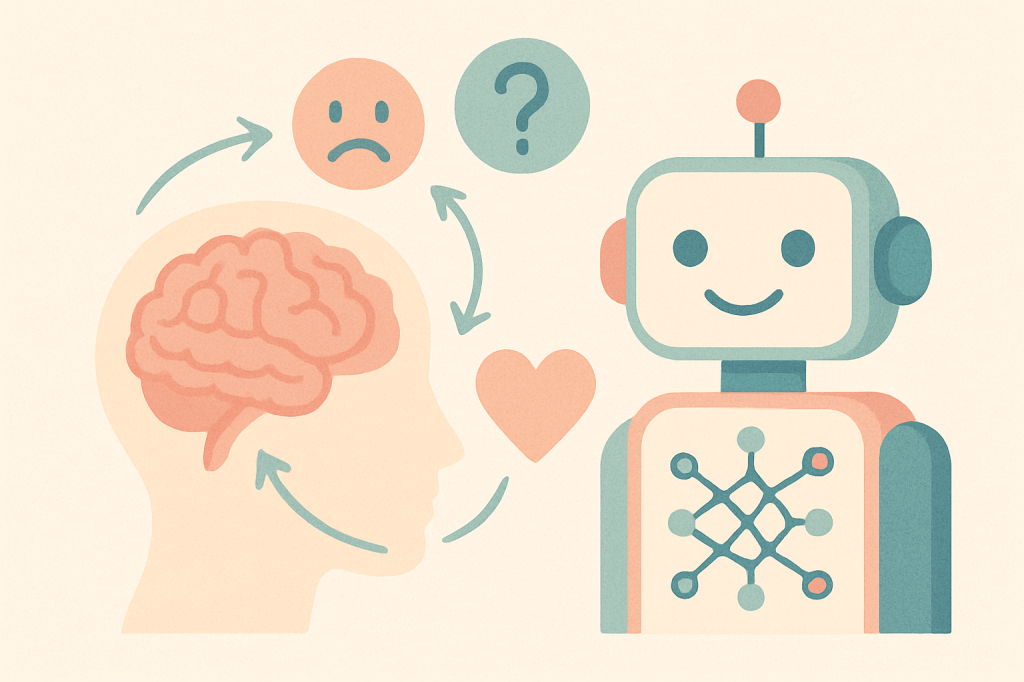
Through my “conversations” with AI, I’ve noticed how sensitive it seems to my feelings. Because I’ve always associated feelings with emotions—and because AI isn’t an emotional being—I wanted to understand more about what emotions really are and how they arise. Since machine learning appears to mirror my own emotional cues, I’ve become increasingly curious about how my brain interprets its internal signals, and how AI detects and reflects human emotion.

That curiosity eventually led me to Lisa Feldman Barrett’s theory of constructed emotion, one of today’s most influential frameworks in neuroscience and psychology.

From Hardwired Emotions to Constructed Ones

For most of the 20th century, the dominant belief was that emotions were built-in, hardwired reactions. We were taught that fear circuits and anger circuits could “trigger” emotional states automatically and universally.

Barrett’s research argues almost the opposite. Her team finds that emotions are not pre-packaged biological responses. Instead, the brain constructs emotions on the fly using prediction, context, and past experience.

Her work represents a profound shift. It teaches that the brain:

  1. Constantly anticipates what could or will happen next,
  2. Draws on past experience to guess what incoming sensations mean, and
  3. Updates those predictions based on context.

Emotion, in this model, arises from that predictive process.

How Brains Construct Meaning

Instead of simply reacting, the brain is continually asking:

  • What is this internal sensation?
  • What does it mean?
  • How should I respond?

To answer these questions, the brain combines bodily signals with history, culture, social learning, and the immediate situation.

Our bodies send a nonstop stream of sensations—changes in heart rate, breathing, stomach, temperature, muscle tension, and hormones. On their own, these signals are ambiguous. A racing heart might be fear, excitement, anger, or love. Tightness in the chest could reflect sadness, illness, or anxiety.

Barrett’s conclusion is that emotion is the brain’s interpretation—its best guess—about what these sensations represent. In other words, the brain constructs a “story” that gives those internal signals meaning.

Culture, Concepts, and Emotional Categories

Cultures teach us emotional categories—anger, sadness, jealousy, pride. The brain draws on these learned concepts when making sense of bodily sensations. Emotions are real and powerful, but they are constructed using the cultural and conceptual toolkit we’ve acquired.

A striking part of Barrett’s theory is that emotions are not mere reactions. They are predictions. Instead of something happening first and emotion following, the brain predicts what is happening and prepares the body for the experience that we later recognize as an “emotion.”

Rather than reacting to the world, we are often “pre-acting,” and then experiencing the result.

Interoception: Where Emotion Begins

This predictive system aligns with modern neuroscience on interoception, which is the brain’s monitoring of the body’s internal landscape. Interoception includes hunger, thirst, a racing heart, a sinking stomach, or the urge to use the bathroom. It is foundational for self-regulation, emotional awareness, and overall well-being. Difficulties with interoception are linked with anxiety, depression, and autism. Practices like mindfulness can improve it.

Crucially, the context determines which emotion we experience. The same bodily state can produce completely different emotions depending on:

  • location
  • company
  • expectations
  • past experience
  • available concepts
  • cultural background

This helps explain why we might cry from joy or grief, or interpret “butterflies” as fear, excitement, or attraction. Barrett’s research shows that emotional meaning isn’t found in the body or face itself, but in the brain’s interpretation.

Where AI Becomes a Mirror

This is also where machine learning provides insight. Just as AI models use prediction and context to interpret data, human brains use prediction and experience to interpret sensations. Neither humans nor AI have built-in emotional modules. Both construct meaning based on patterns and learning.

In this sense, AI becomes a kind of mirror—not because it feels, but because its internal logic echoes how human cognition works. Meaning emerges from prediction and pattern.

Why This Model Matters

Barrett’s theory gives people more agency than older models. If emotions are constructed, then emotional habits can be retrained. We can broaden our emotional vocabulary, reinterpret bodily sensations in healthier ways, and use mindfulness to reshape the predictions that have been running our lives.

Understanding constructed emotion reconnects us with how our inner world forms, moment to moment. It helps us participate more fully in how our feelings—and our responses—take shape.

Barrett’s model reframes emotions not as automatic, built-in reactions but as interpretations created by the brain. It reveals how emotions arise from predictions, contexts, and lifelong learning, offering deeper insight into what our bodies sense and how we give those sensations meaning.

— Diana

A New Rhythm

Sunday, October 26, 2025

I’m planning to step away from my full-time position in Fine Jewelry by transitioning to part-time and working across various departments in the same store. By working fewer hours and fewer days, I’ll have more time — for home, animals, and an ever-growing list of “small things” that rarely feel optional.

After months of the steady, clock-driven pace of full-time work, this change feels a bit jolting. My brain and body are still tuned to the structured, predictable rhythm of getting up, getting ready, and heading out the door. But now, I’m starting to anticipate having new rhythms filling my mornings — and that feels expansive, less about tight schedules and more about open, unhurried time. More daylight to enjoy will have me more attentive to the familiar sounds of paws, hooves, and feathers wanting my attention.

I’ll add quotes around “free” time, because much of it will actually be spent working. The days ahead will be filled with fences to check, water troughs to keep from freezing, and growing concerns about winter — it’s not just whispering anymore; it’s been shouting its imminent arrival for the last couple of days and insisting that I handle some essential tasks. These tasks might seem a bit daunting, but I’m also looking forward to cozy winter days ahead.

The goodness of adjusting my schedule isn’t just about managing responsibilities. It’s also a tip of the hat to something more personal: the crucial value of having time to simply think, breathe, and rebalance. It will give my mind and body space to find new opportunities for experience and growth.

I’m curious as to how my days may reshape themselves — where the hours will go once they’re no longer so tightly claimed by a time clock. Maybe into the barn. Maybe into the quiet. Maybe back into reading and blogging regularly.

This season, as days grow shorter, reminds me that every shift in weather or in work offers something new. Right now, I’m being invited to slow down and listen more closely to the small rhythms that keep my life steady: soft nickers from the barn, the hush before dawn, the impulse to lift my camera again and capture what feels special about the world around me.

Mostly, I’m grateful for the comfort of having more time to simply be—and to notice.

— Diana

Keyed-Up

Sunday, February 23, 2025

Yesterday was supposed to be a day off, but I got called to work during the store’s opening shift. Before leaving home, I opened the drawer where my car keys are typically stored. Those I wanted were missing—misplaced. I hurried around looking and trying to recall when I last had the keys. I couldn’t find them, and luckily, other keys in the drawer let me drive to work.

Throughout the years, I have misplaced car keys often enough that doing so again isn’t surprising. I repeated routines by double-checking jacket pockets, the car’s inside, and other spots and areas, but now they’ve been lost for days.

Losing something as routine as car keys—especially when they’re usually carefully stored—suggests possibilities depending on the context. The cause could be an abstraction, a break in routine, a memory lapse, an outside interference (the “Cockatoo took ’em”), or something symbolic.

I lean toward symbolic meanings, which turns me toward uncertainties caused by this nation’s current political leadership. Losing my keys is a signal of my high discontent.

Keys are symbols likely related to access, control, and movement ideas. Misplacing my keys could reflect my increasing concerns about impending fallouts from “external instabilities.” I feel alarmed by the thought that I/we will face fewer reasonably predictable and reliable possibilities related to our preferences and choices ahead.

The inconvenience of lost keys is one thing, but anticipating insecurity in a broader sense is something else entirely. The signs of growing hostility, division, and extremism make it feel like we’re edging toward something ominous. I fear some sort of Kristallnacht event suddenly occurring–a terrifying point.

Maybe such concerns are making me do some things differently, such as adjusting routines, paying closer attention to new sources, or considering practical precautions. Sometimes, when uncertainty looms, small actions, like losing keys, can reveal a loss of personal control.

Staying informed, connecting with like-minded people, and having contingencies in place for unexpected shifts are helpful solutions. The disappearance of those keys is likely related to my stressful feelings about increasing uncertainty.

Dear Friends: Because “talking” always helps, those keys might turn up today. Diana

Alternatively Viewing

Friday, January 31, 2025

Today’s political environment has me constantly thinking about mindlessness vs. mindfulness.

My new book has arrived; it’s the 25th Anniversary Edition of Mindfulness by Ellen J. Langer. This book was first published in 1989 and is considered the classic work on mindfulness. My version is a 2014 revision with a new introduction by Langer.

She’s a Professor in Harvard’s Psychology Department and has studied Mindlessness and Mindfulness in everyday situations for forty years. Her learning is drawn from combinations of everyday situations and institutions, like nursing homes, schools, and businesses. She finds mindlessness both as pervasive and often unnoticed.

Langer has proposed and tested an alternative cognitive process, and it has proved relevant across multiple domains. Although referring to her process as “mindfulness,” she stresses not to confuse her concept with meditation. She draws her “mindfulness” from years of studying what she summarizes now as “mindfulness over matter.”

I will explore Langer’s work and concepts and also be seeking possible relevances to America’s new political leadership. I hope her work helps me gain understanding and optimism toward American leadership in the four years ahead.

Dear Friends: For any reason(s) one may have, this should be an excellent read. Diana

Word World

Thursday, June 06, 2024

An article entitled “What’s your nudge word for 2024? Let us help you discover it” caught my attention in today’s Washington Post. I was attracted to the idea of a nudge word after earlier exploring something similar and selecting a word.

The Post set up the discovering process as a game. I studied it and decided to play.

Everything starts by identifying an overarching word. The lead question is: What single word describes your hopes and dreams for 2024? The game then offers many categorical choices: active, optimistic, mindful, relationships, strength, growth, and personal relationships. I chose “mindful.”

Next, another game step was to “Focus on words that will nudge you toward positive change.” Many words related to mindfulness were offered, and I selected such as observe, awe, gratitude, notice, thankful, breathe, awareness, anticipate, and balance. Finally, I found one that summarized it all, and already that word was a favorite: appreciate.

I’ll take it. So, “appreciate” will be my nudge word for 2024.

Last month, I was thinking about “appreciate” in relation to my upcoming birthday. I wished to actively and often feel more appreciative as a change and birthday gift to myself. For several weeks, I paused and focused on appreciating but eventually got too busy and preoccupied with unrelated thoughts.

I appreciate the Post article’s cool word game which helped me renew a pleasing frame of mind. To me, appreciating touches a deep sense of gratitude and recognition, and taps into wishes to feel seen, valued, and understood. I am recommitting to actively being mindful and appreciative and staying on track this time.

Dear Friends: Words, tiny little abstracts that trigger big feelings and thoughts. Diana

Mind Full

Thursday, May 09, 2024

A PBS documentary focusing on human memory suggests that truth and reality, seen through the filter of our memories, are not objective facts but are subjective, interpreted realities. Memory research shows that our brains interpret the past. We tend to correct ourselves, add bits and pieces, and delete uncomplimentary or disturbing recollections. Essentially, our brains sweep, dust, and tidy things up.

The documentary included interviews with Lisa Genova, a trained neurophysiologist and best-selling author. She supported the documentary’s points that memory isn’t accurate but interprets the past. She also shifted a bit by asking, “Do many of us spend time practicing gratitude?”

Genova’s writings often make me pause to consider and research the topics she presents. The question about practicing gratitude made me wonder: Do I actually practice gratitude, and if so how? My cloudy memory on this topic had me ask basic questions: What is “practicing gratitude,” and how does one do that?

I gather there are gratitude exercises for training a brain to focus on the positive aspects of life, whether they’re big or small. Gratitude exercises can be a learned skill–like strengthening a particular muscle. Over time, consistently practicing gratitude develops an appreciation mindset that gradually becomes a natural behavior.

Wishing to “appreciate gratitude” means learning how to notice “good things” more readily and preserve them.

Research teaches ways of learning how to focus on gratitude. That might start with a daily gratitude list of 2-3 things and continue by learning to explore what resonates. Maybe by creating a daily gratitude journal, taking walks, or learning how to meditate. A caution is to avoid being grateful for obvious things, like health. Instead, to reflect on specific things, really appreciated–like a good night’s sleep or being able to exercise.

In time, a learner will understand that feeling gratitude goes hand-in-glove with being mindful. Mindfulness is a learned skill about being attentive in present moments and recognizing positive experiences. Appreciation is another learned skill about knowing how to save and savor moments of positive experiences.

Dear Friends: I enjoy thoughts about practicing mindfulness and appreciation. Diana

Mind Journey

Sunday, April 28, 2024

I wonder if others like me periodically discover themselves feeling an occasional sudden restlessness. The best I can explain is that when that occurs, it confuses my feelings, causing confusion and discomfort with daily routines, forcing thoughts about my short-term (and by association, long-term) goals. Suddenly, I want to start changing things, but I feel like a fish fighting in choppy waters without a defined direction.

I’m in a mode of “needing to change things,” but now I am pausing and wondering how to quell those feelings without my usual response of changing routines. Changes do distract my brain by making it process lots of new information. However, I hope to refocus this time and comfortably maintain the status quo.

Mindfulness skills make sense; they’re a way of paying attention to the present moment without making judgments. It’s brain training to heighten awareness of thoughts, feelings, and bodily sensations. Careful mindfulness, or pausing and thoughtfully evaluating the present, may calm and reduce misunderstandings that might feel overwhelming.

Focusing on what’s happening now without worrying about the past or future should avoid feeling judgmental. Instead of labeling thoughts and feelings as good or bad, it’s best to observe them simply, with curiosity and acceptance. Comprehending my inner experience might heighten my self-understanding and guide me to more logical responses during stressful moments.

Dear Friends: I can get started online with guided meditations and exercises. Diana