
Sunday, September 21, 2025
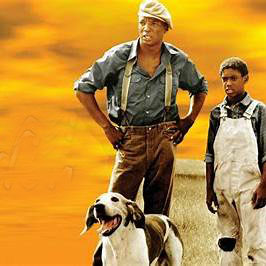
Over coffee yesterday morning, I started thinking about a long-ago movie that featured a dog and a family. It’s one of my all-time favorites and has stayed with me more than most. Today’s header photo, a still from that movie, shows Sounder the dog, the father (played by Paul Winfield), and the eldest child (played by Kevin Hooks).
It came to mind after I’d just finished reading a New York Times piece about “all-time best movies,” in which the writer asked readers to email him with their own favorites. As a former heavy-duty movie buff, I started thinking. The article listed some great films, but it left out the one that immediately came to me: Sounder. That 1972 film has never left my personal best list. I felt so strongly about its absence that I did something I’ve never done before—I emailed the writer, explained briefly why Sounder belongs there.
Reflecting further, I recalled the film’s extraordinary cast: Cicely Tyson, Paul Winfield, and other fine actors. Their performances earned Oscar nominations, and the film itself did something Hollywood had rarely attempted—showing a Black family’s dignity and endurance in a powerful, touching way.
The story follows a sharecropping family in Depression-era Louisiana. Daily life is already difficult before the father is jailed for stealing food to feed his children, leaving his wife and son to carry on. What struck me then—and still does now—is the quiet strength of that family, the boy’s coming of age, and the resilience that carries them through.
And of course—Sounder, the family’s hound dog. His loyalty and presence underscore the family’s strength and make the story unforgettable. Remembering him today, I half-wish I had a hound dog of my own.
Sounder is central to the film—both literally and symbolically. Loyal and loving, he represents resilience and hope, even when he’s gravely injured early on. The story’s emotional core is tied to the boy’s bond with Sounder, and how that love helps him endure his father’s absence.
The film received four Academy Award nominations: Best Picture, Best Actor, Best Actress, and Best Adapted Screenplay. Before then, no movie featuring an all-Black principal cast and story had ever received such high recognition. Its excellent director was Martin Ritt.
To me, Sounder belongs on every “best movies” list—as a film about survival, love, and hope. Remembering it reminds me that sometimes the quietest stories stay with us the longest.
— Diana
 Diana's Morning Blog