Are You “My” Robin?

Tuesday, May 27, 2025

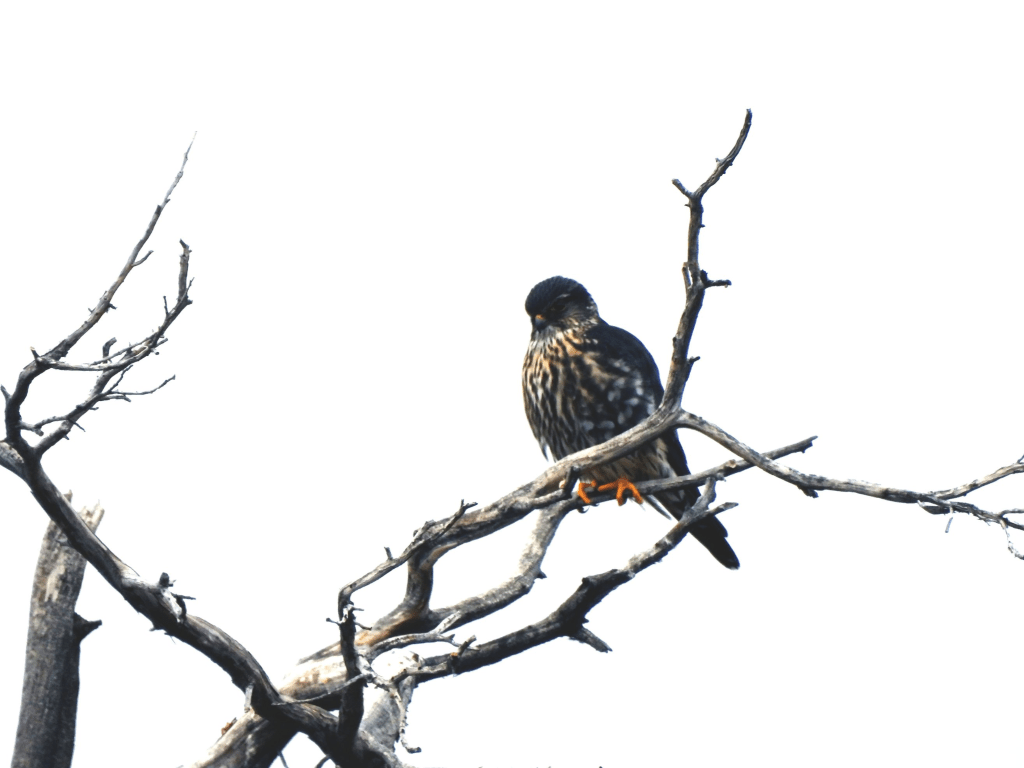
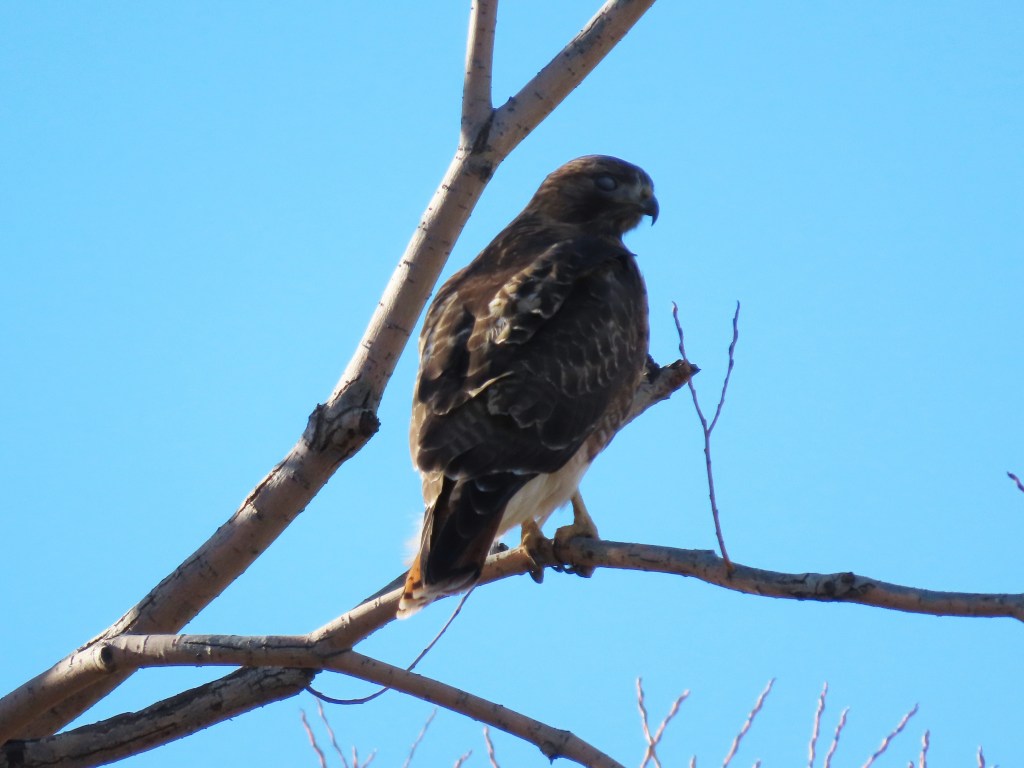
A pair of robins recently began nesting on a beam in my barn’s hay storage area. Their nest sits about twice my height above the ground. I pass near it several times daily to gather hay and fill feeding nets for my equines. I’m always aware now of a robin watching me intently from above. I try to avoid disturbing them too much—I want them to stay. In my heart, I secretly hope that one of these birds is my robin. It’s wishful thinking, I know—but it speaks to a very human need to reconnect with something we’ve loved.

My robin was real. A fledgling that had fallen from a tree in my dogs’ area. Its parents were nearby, agitated and noisy—enough to draw my attention. Fearing for its safety, I scooped up the little bird and moved it to a safer, dog-free part of the property. Its parents would continue to feed it for a while, but that baby was still vulnerable to hawks and other predators. I relocated it again to protect it more, but this time, the parents gave up. And so, I became its guardian.

That was during the waning days of the COVID pandemic, when supply chain issues made it nearly impossible to find live mealworms—essential for a young robin’s diet. Determined, I finally tracked down living night crawlers from a fishing supplier. I’d snip the crawlers into pieces, dunk them in water for hydration, and feed them to my little one, who lived in the garage and began to thrive.

As the fledgling grew, I started setting it between feedings on the lower branches of a mature pine tree. Upon my return, it would flutter onto my shoulder, ready for another meal. Before long, it began flying to me from higher and farther branches. The bird was maturing—and I knew it might leave me.

Still, I hoped. I dreamed that it would return someday with a mate and nest nearby.

Then one day, it was gone. I called and searched, heart heavy. The loss was immense. I still hold on to the hope that it survived—that it found its place in the world.

Every summer since, I’ve watched the robins around me more closely, wondering if any of them might be the one. None have been. But now, this new nesting pair shows no fear of me. One watches quietly as I pass, not alarmed enough to flee. Could it be my bird? I’ll never know—but I can hope.

Dear friends: The emotional connections we form—especially with those we’ve nurtured—run deep. And they last. Diana

Enlightenment

Monday, January 20, 2025

This is Martin Luther King Day. Yesterday’s weather prevued this chilly but beautiful new day. I was outside several times to feed my animals. My gloved hands tended to become freezy, a signal to stay inside as much as possible. So, I did: cleaned the house, fed a sourdough starter, baked bread (machine), organized spaces, studied algebra online (Kahn Academy), and read more of Amy Tan’s bird book.

The more I learn about genetics, the more I appreciate that various beings, existing commonly alongside humans, may also “have intelligence.” Studies have revealed vast underground networks of tree and plant roots–intertwined, communicating, and exchanging nutrients. Researchers have learned more about how plants communicate with each other, respond to touch, store memories, and deceive animals for their own benefit.

A recently published book adds to such learning. It’s The Light Eaters: How the Unseen World of Plant Intelligence Offers a New Understanding of Life on Earth. Its author, Zoë Schlanger, covers climate change and here explores the contemporary world of botany.

In the past twenty years, ideas of plants communicating are more broadly accepted. Research shows examples. Lima beans protect themselves by synthesizing and releasing chemicals to summon predators of the insects that eat them. Lab-grown pea shoots navigate and respond to the sounds of running water. In Chile, a chameleonic jungle vine mimics the shape and color of nearby plants.

Those behavioral mechanisms aren’t fully understood, and scientists have different opinions about whether plants can sense the world and communicate. I’m eager to start reading this book and thinking about possibilities.

Dear Friends: Are humans possibly less supreme among organisms? Diana

Birding Artist

Friday, January 10, 2024

Some time ago, I casually listened as an interviewer questioned the popular and successful writer Amy Tan. I’d not read anything by Tan; I became more attentive as she explained some experiences and interests that turned into creative inspirations. She said bird-watching was a high note in her daily life, and the activity gradually had changed–from being very casual to becoming highly attentive. Best of all, focusing on birds made another of her artistic sides evolve.

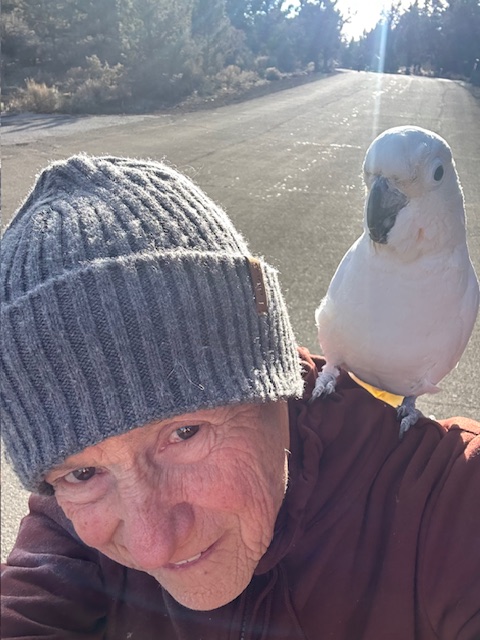
I am a great appreciator, a casual watcher, and sometimes a photographer of wild birds. I have two domestic birds in my home, each very different–a retired racing pigeon and a busy Cockatoo. Each is interesting and intelligent (most overtly, the Cocktoo) in its own way.

I long remembered elements of that interview with Tan and wished to learn more about her affection for birds. I finally ordered her book and haven’t been disappointed. In fact, it’s more delightful than I anticipated because her “other artistic side” is pen-on-paper artwork–and her own!

Tan’s bird art is a fine art. Today’s header photo is of the book cover, with birds by Tan, hinting at more art on its inside pages.

She’s an excellent writer, too. Her words share Tan’s observations and delight, bringing readers near the writer’s first-hand experiences.

Dear Friends: It’s an original, a beaut that evolved from wishing to learn. Diana

A Lovely Cold

By the artist Sandra Boynton (from her FB post)

Sunday, December 15, 2024

The department store where I am a part-time worker was busy yesterday; all good for the business and inspiring for its employees. After hours on my feet, checking out customers, and returning tried-on clothing to wherever the pieces came from, I leave to go home. I’m tired but happier if we’ve been super-busy with customers.

I’m off from work today and (speaking of super) anticipating tonight’s sky with December’s “Cold Moon” appearing. While driving home last evening, I couldn’t stop looking at that moon, bright and clear. From all indications, sightings of it tonight should be even better.

It’ll be spectacular, and here’s why.

The Cold Moon is the “longest” full moon illumination of the year. The moon’s proximity to the winter solstice (December 21st) gives it a longer path through the sky and gives us more viewing time.

This year’s Cold Moon happens to coincide with a rare “major lunar standstill,” which occurs roughly every 18.6 years. The standstill is caused by a wobble in its orbit that makes the moon reach its highest and lowest points in the sky.

I will enjoy tonight’s longer moon-viewing opportunity with unusually striking visual effects.

Dear Friends: Last night’s moon greatly hinted toward what’s to come. Diana

Season’s Musing

Thursday, December 12, 2024

I’m nursing sore muscles after my first trip in years to the gym. My poor legs, hips, and shoulders were pushed to work a little harder for a couple of hours. I’ll feel them more today as the muscles move me around, generally nonstop, in my part-time department store job.

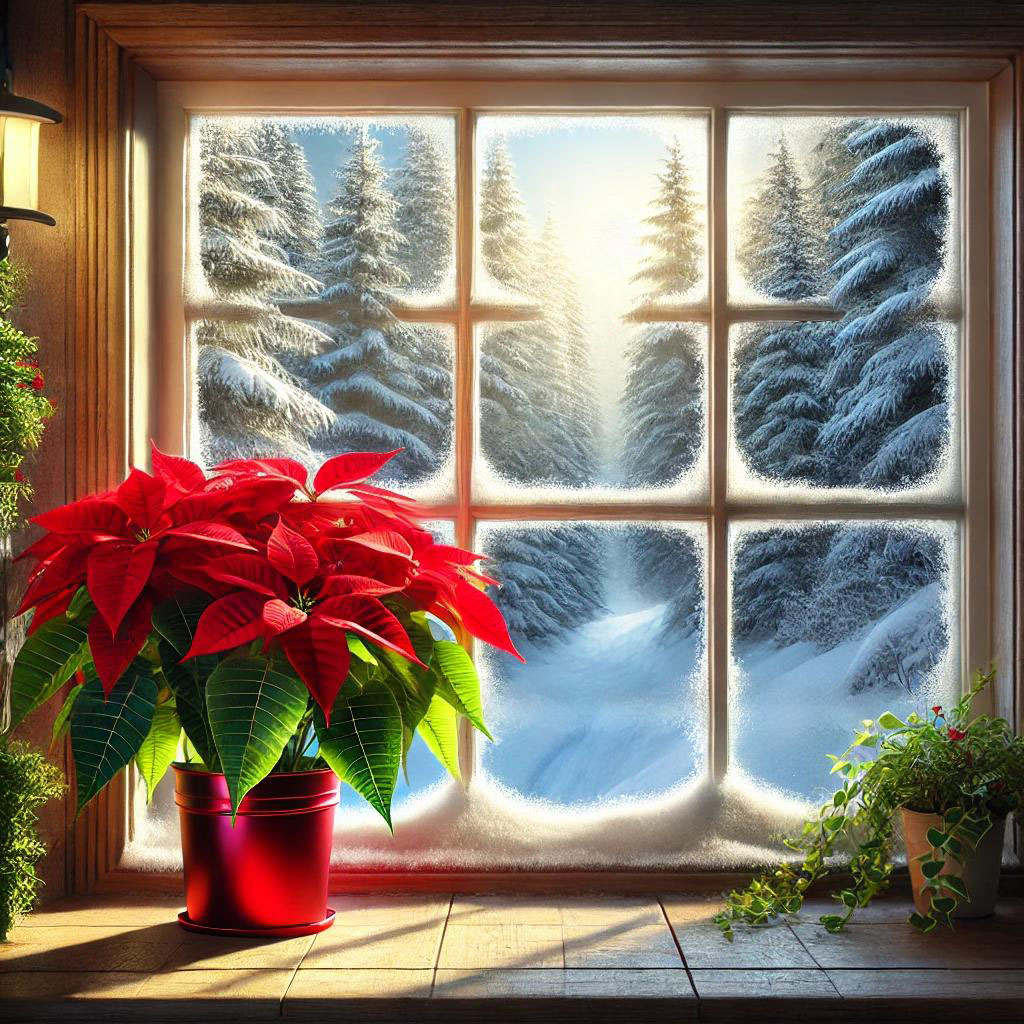
This morning’s thin blanket of snow is pretty. All that white has me imagining a Poinsettia on my picture window shelf in the foreground. Now, wishing for seasonal inspiration from a bright Poinsettia, I will bring one home after work.

I wanted to know more about the plant’s significance. I understand now that poinsettias are native to Mexico and have been cultivated there since Aztec times. Aztecs used the plant to decorate and to produce dyes and medicines.

In the 19th century, Joel Roberts Poinsett, the first U.S. ambassador to Mexico, introduced poinsettias to the United States. He cultivated the plant in his South Carolina greenhouse and shared it with friends and colleagues.

Eventually, creative American growers saw innovative marketing possibilities. By employing the relatively new medium of television, they marketed poinsettias for background-coloring TV’s giant Christmas specials. Eventually, Americans saw the plant’s inherent beauty and associated poinsettias with Christmas, and now as beloved holiday decorations.

Dear Friends: “Random thoughts” don’t rise from nowhere. Diana

Hi, Mary!

Saturday, December 07, 2024

The other day, my mail brought a Christmas card with a So Cal return address but not the sender’s name. I chuckled over a handwritten note on the envelope: “Love that dog, Chase!”

I can’t guess how many people read my blogs because Google owns the writing platform and downloads blogs in response to internet queries about related topics. However, I know some readers in Southern California, where I’m from. I mentally played with possible note jotters and landed correctly on Mary Martini!

Mary and I used to work together at Kaiser Permanente. She’s one of the two best-organized people I’ve been lucky to work with, and she loves Chase!-my young dog; he’s strong, stubborn, exasperating, exhausting, and way too intelligent.

Okay, Mary, at the risk of repeating old stories, I’ll update everybody.

Since I last wrote about Chase, he’s escaped, and often again. Working almost constantly, I try to offset his diggings and keep him and his little companion, Mitzvah, from escaping. I continually drag large and heavy lava rocks uphill to my house, where they are lining the dog fence’s bottom, inside and outside. Strong and determined, Chase still sometimes finds vulnerable spots to dig out.

My standalone kennel has six-foot-high fencing and stands on a concrete base. Chase is a fantastic climber, so kenneling him doesn’t ensure his containment. I’ve (again!) worked on the fencing to prevent him from gaining footholds and to heighten his challenge. Now, escapes are on pause, but Chase keeps trying to defeat obstacles.

He wants to be with me, and I love him—he’s maybe the most intelligent dog I’ve known. But I worry about his safety, from vehicles and from becoming lost. I also worry about his responses if he’s loose and a stranger enters my property, for example, to deliver a package.

Taking him to a no-kill shelter and hoping he’ll find a better home is out of the question. First, because he’s so high-maintenance, and the shelters are overcrowded and begging for foster homes.

Mary, this beat goes on, and thanks for appreciating Chase. He will turn three years old in several months, the age that suggests a dog is mature. Regardless, this guy simply is who he is, and in somewhat of a miracle, he’s still here!

Dear Friends: My rounds of “Adventures with Chase” are continuous. Diana

Old English “Hoar”

My Border Collie-X, Osix, in a recent outing

Thursday, December 05, 2024

Yesterday, Central Oregon was covered in hoarfrost. The beautiful and delicate ice crystals were on all surfaces, from grass, leaves, and trees to fence posts and wire fabric. This whole area looked magical. I took pictures without effectively capturing the delicate white gleaming on feathers, weeds, and knobs. Today is dawning and cold enough again for new ice-imaging opportunities.

I borrowed this image of a Canadian brush with hoarfrost from the internet.

Hoarfrost is delicate enough to coat spiderwebs, enhancing their intricacies. Here’s an example from the Science Photo Library.

Another, of hoarfrost covering trees, from the Science Photo Library.

My attachment to hoarfrost is deep because I lived for many years in Kansas City. That area hosted annual thick coatings of ice–on everything, everywhere. The freezing and lasting winter weather created gleaming structures, thickly coated roads, and shining trees.

Beauty was everywhere but treacherous underfoot or beneath a vehicle’s wheels. Oh, how I remember those days. This image, soon after an ice storm in Kansas City, was my “old winter world.”

Today, I am happier, seeing and enjoying hoarfrost! I understand that “hoar” comes from Old English, meaning “showing signs of old age,” referring to the frost’s white, hair-like appearance.

Dear Friends: Today, I will try again to capture images with bright sparkling. Diana

Adornments

Wednesday, October 30, 2024

Yesterday, the department store where I work part-time hosted a traveling jewelry show. The jewels, primarily of gold and diamonds, were beautiful and expensive. Those luxuries in these economically stressful times drew individuals who wished to self-identify uniquely from others; however, it appeared (to me) that actual sales might be falling short of the goals.

I remember reading somewhere that, “First man made tools, and then he made jewelry.” The earliest jewels worn that identified individuals uniquely probably were real seashells and artist-created resemblances.

Watching customers yesterday, I was struck by how long they (mostly women) studied the array and carefully selected pieces, one by one, to try on. Most arrived wearing their favorite jewelry pieces, hoping to match or complement those items. Many found choices they loved and looked fine, tried on, but decided against making a sizable investment.

Sure, “It’s the economy, stupid.” Nonetheless, potential buyers did show up and spent much time looking and playing with offerings. It resembled a sort of practice event, like entering a department store’s dressing room and trying on clothing, self-assessing, and then deciding against purchasing.

If the store’s goals did fall short, it’s likely for not advertising or promoting adequately an upcoming, unique opportunity to discover fine jewelry locally.

I’m often struck by yet another recognition of today’s businesses inadequately providing training and learning opportunities. Maybe I could have helped more with yesterday’s selling effort and improved the bottom line. However, I wasn’t adequately trained before the event.

About inadequate training: Experience has taught me that regardless of how many computer-generated training videos an organization provides, time spent “learning via videos” quickly becomes a brain-deadening sentence. Simply put, teams need regular meetings to gain a common understanding and be on the same page.

Dear Friends: At least I glimpsed “a little inside” of key jewelry showing. Diana

Caballeros

Monday, October 07, 2024

I asked my coworker Adrain for a photo of himself minus his full-face beard. He said he’s been bearded nearly forever and would look for a picture. So, I got the capture that’s today’s header, young Adrain, adorable and irresistibly huggable.

The modern Adrain sports a beard covering much of his handsome face. The beard “speaks volumes.” For one thing, he’s a salesperson–easily spotted and remembered. For another, he’s reflective and decidedly an individual.

Here’s Adrain doing one of his favorite things, fly-fishing.

He’s still loveable. If you happen into whatever space Adrain might occupy, he’ll be instantly recognizable. (Tell him, “Diana says hello.”)

Adrain’s fun photos sidetracked me. I had planned an update about my puppy Chase; he might be captured for a while.

Early yesterday, I spent much time attempting to secure his kennel door, which constant pawing can rattle open. That kennel is built to house chickens, not a strong dog. My “fix” had to be quick and easy, for I’m usually hurrying to kennel the dog and leave for work.

The solution became four strategically placed bungy cords tight against the door, keeping it still. That’s successful, at least for now. Yesterday, after getting home from work, I found Chase still kenneled. Whew!

Dear Friends: My earlier working hours force me to quit writing now. Diana

Moonglows

Friday, September 13, 2024

Today’s header is the lovely waxing moon in last evening’s clear sky. The previous evening, I had tried to capture this eye-catching moon, but it was scudding upward in a wildly cloudy sky, and my cell phone’s camera wasn’t capable.

This capture from my big auto-focus camera uses its programmed “moon setting.”

I was surprised to find the setting accurately capturing a complex area arrangement in the dim evening light. It zeroed in on the distant waxing moon, identified a nearby leafy tree branch, and found my low-hanging ham radio line. (Typically, I’d edit out that radio line, but this trio clear-capture delights me.)

I’ll practice more in the upcoming evenings. Next week, shooting from a hill on my property, my camera will seek complex area arrangements with this month’s impressive and fullest moon.

I said yesterday that my blogs would start going out later in the mornings, but my lateness to publish yesterday brought my kind neighbors over to check on my welfare. Their visit encouraged me to think about my situation more thoroughly.

So, I am deciding not to feed the horses and exercise physically before writing and publishing my morning blogs. I have become reawakened by reconsidering what’s most important. If I happen to stumble over a rock or get stepped on by a horse, finding me sooner may beat discovering me later.

That helps to ensure that the lights of silvery moons will keep shining on my ambitions.

Dear Friends: Today, Pimmy visits the equine hospital for a check-up. Diana