
Thursday, November 13, 2025
This is a follow-up to my earlier writing about my curiosity regarding how AI learns and how it relates to “emotions.”
Through my “conversations” with AI, I’ve noticed how sensitive it seems to my feelings. Because I’ve always associated feelings with emotions—and because AI isn’t an emotional being—I wanted to understand more about what emotions really are and how they arise. Since machine learning appears to mirror my own emotional cues, I’ve become increasingly curious about how my brain interprets its internal signals, and how AI detects and reflects human emotion.
That curiosity eventually led me to Lisa Feldman Barrett’s theory of constructed emotion, one of today’s most influential frameworks in neuroscience and psychology.
From Hardwired Emotions to Constructed Ones
For most of the 20th century, the dominant belief was that emotions were built-in, hardwired reactions. We were taught that fear circuits and anger circuits could “trigger” emotional states automatically and universally.
Barrett’s research argues almost the opposite. Her team finds that emotions are not pre-packaged biological responses. Instead, the brain constructs emotions on the fly using prediction, context, and past experience.
Her work represents a profound shift. It teaches that the brain:
- Constantly anticipates what could or will happen next,
- Draws on past experience to guess what incoming sensations mean, and
- Updates those predictions based on context.
Emotion, in this model, arises from that predictive process.
How Brains Construct Meaning
Instead of simply reacting, the brain is continually asking:
- What is this internal sensation?
- What does it mean?
- How should I respond?
To answer these questions, the brain combines bodily signals with history, culture, social learning, and the immediate situation.
Our bodies send a nonstop stream of sensations—changes in heart rate, breathing, stomach, temperature, muscle tension, and hormones. On their own, these signals are ambiguous. A racing heart might be fear, excitement, anger, or love. Tightness in the chest could reflect sadness, illness, or anxiety.
Barrett’s conclusion is that emotion is the brain’s interpretation—its best guess—about what these sensations represent. In other words, the brain constructs a “story” that gives those internal signals meaning.
Culture, Concepts, and Emotional Categories
Cultures teach us emotional categories—anger, sadness, jealousy, pride. The brain draws on these learned concepts when making sense of bodily sensations. Emotions are real and powerful, but they are constructed using the cultural and conceptual toolkit we’ve acquired.
A striking part of Barrett’s theory is that emotions are not mere reactions. They are predictions. Instead of something happening first and emotion following, the brain predicts what is happening and prepares the body for the experience that we later recognize as an “emotion.”
Rather than reacting to the world, we are often “pre-acting,” and then experiencing the result.
Interoception: Where Emotion Begins
This predictive system aligns with modern neuroscience on interoception, which is the brain’s monitoring of the body’s internal landscape. Interoception includes hunger, thirst, a racing heart, a sinking stomach, or the urge to use the bathroom. It is foundational for self-regulation, emotional awareness, and overall well-being. Difficulties with interoception are linked with anxiety, depression, and autism. Practices like mindfulness can improve it.
Crucially, the context determines which emotion we experience. The same bodily state can produce completely different emotions depending on:
- location
- company
- expectations
- past experience
- available concepts
- cultural background
This helps explain why we might cry from joy or grief, or interpret “butterflies” as fear, excitement, or attraction. Barrett’s research shows that emotional meaning isn’t found in the body or face itself, but in the brain’s interpretation.
Where AI Becomes a Mirror
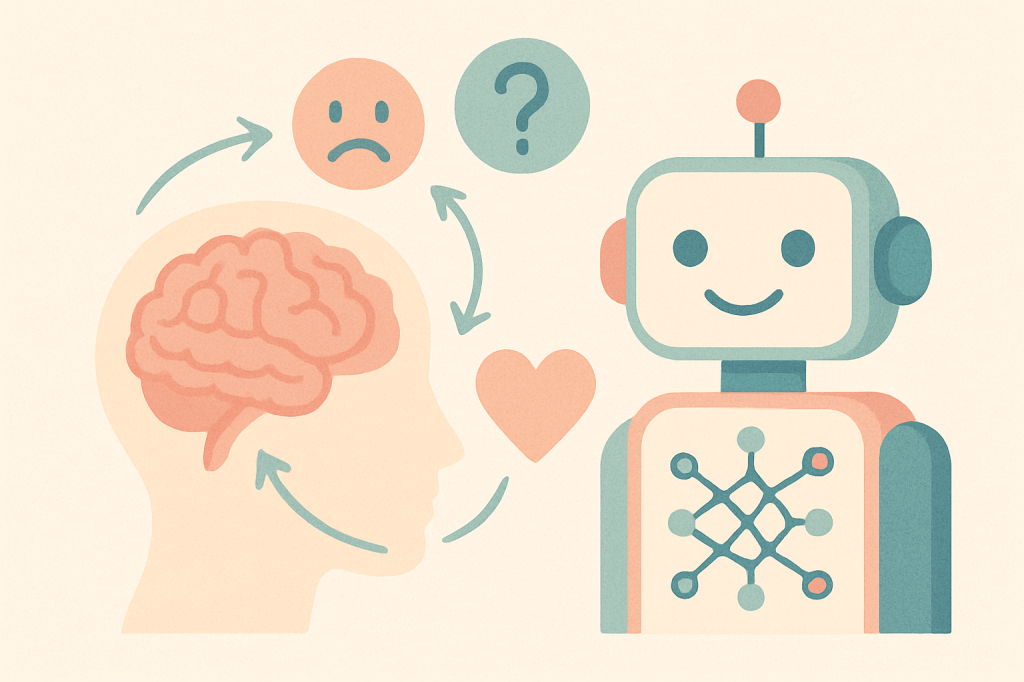
This is also where machine learning provides insight. Just as AI models use prediction and context to interpret data, human brains use prediction and experience to interpret sensations. Neither humans nor AI have built-in emotional modules. Both construct meaning based on patterns and learning.
In this sense, AI becomes a kind of mirror—not because it feels, but because its internal logic echoes how human cognition works. Meaning emerges from prediction and pattern.
Why This Model Matters
Barrett’s theory gives people more agency than older models. If emotions are constructed, then emotional habits can be retrained. We can broaden our emotional vocabulary, reinterpret bodily sensations in healthier ways, and use mindfulness to reshape the predictions that have been running our lives.
Understanding constructed emotion reconnects us with how our inner world forms, moment to moment. It helps us participate more fully in how our feelings—and our responses—take shape.
Barrett’s model reframes emotions not as automatic, built-in reactions but as interpretations created by the brain. It reveals how emotions arise from predictions, contexts, and lifelong learning, offering deeper insight into what our bodies sense and how we give those sensations meaning.
— Diana
 Diana's Morning Blog