Bend’s New Library – Revisited

Tuesday, May 26, 2026

I was excited on my first visit to this brand-new building not long ago, but I became disappointed when I found it wasn’t the kind of “real library” I was accustomed to. A day or two later, I reflected on how the structure is actually meant to be used. Certainly, it will be a popular meeting place — and already is — with its huge, nearly always full parking lot. Still, it wasn’t like the libraries I understood and had known. I left the building with a sense of loss.

Now I see things differently. At first, I was deeply wrapped up in myself and wanting what I expected. Later, my outlook began to recover as I reflected on the larger picture — the social changes that influenced the library’s design and purpose.

I was flummoxed to discover that the building primarily serves as a community gathering space. Although books on display hint at a traditional library, with well-arranged shelves holding the newest and cleanest volumes, they don’t fully counter the sense that the building functions mainly as a hub. Cardholders can go online, search for and reserve desired items, then simply pick them up. A dedicated drive-through even facilitates quick pickup and return of library materials.

Yes, social media and AI have changed our relationship with libraries. Online access makes things easier and reduces the physical need to wander through stacks or seek assistance from librarians. Libraries are adapting by becoming less centered on book browsing and more focused on serving as multi-purpose community spaces.

That realization had me reflecting on my part-time job as a department store cashier. During breaks, coworkers rarely talk with one another. Instead, we stare at our phones — and, personally, I usually prefer not to be interrupted by someone wanting to chat. Not only at work, but also out on city streets, people are absorbed in their phones.

Yet while I check out customers, many seem delighted to share parts of their lives with me — stories about their backgrounds, travels, pets, and adventures. Some even say they’ve appreciated our brief exchanges, and occasionally someone jots down a phone number and suggests I get in touch.

Those brief getting-to-know-you moments are enjoyable, but somehow they feel sufficient in themselves. I don’t follow up. Still, I sometimes think I might enjoy knowing some of those people better, as many clearly have unique backgrounds, interests, and accomplishments. And if we happened to meet in a non-work social setting — perhaps in that new library building — getting to know one another more deeply might seem more natural and appropriate.

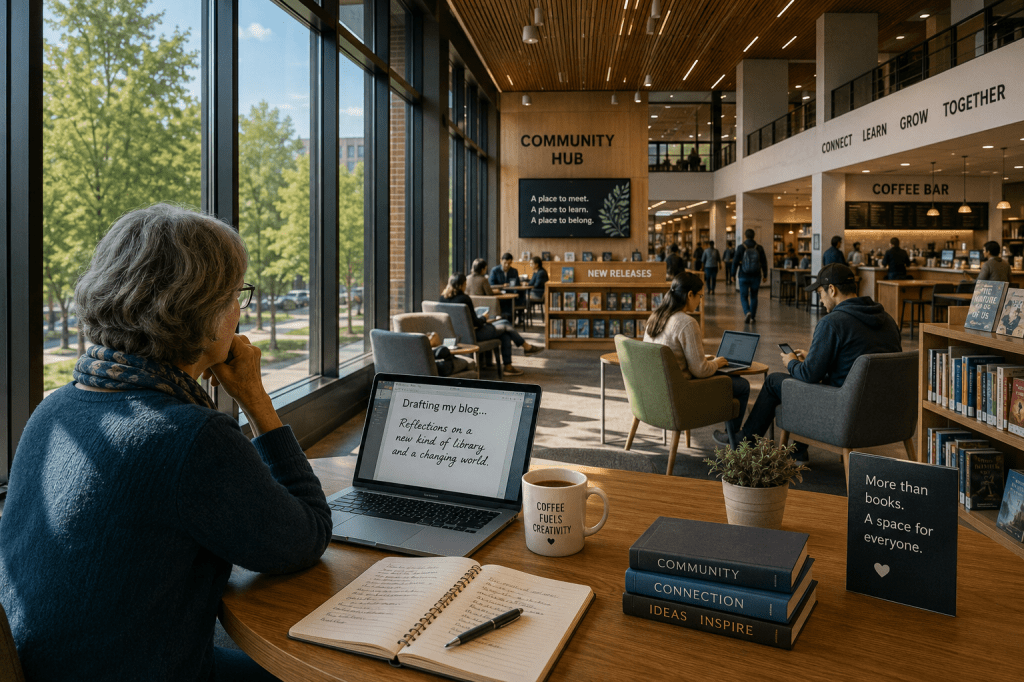
On this second visit, I’m not searching for books. I’m simply enjoying time in an enabling space while drafting this blog. No pressure, no disappointment. I’m sitting beside a large window, feeling creative — and communicative — while occasionally accessing social media myself. Nearby, other visitors are taking similar advantage of the space, working on studies or staring into laptops and cell phones.

This library — designed for meetings and work as much as for books — serves as an alternative to the popular coffeehouse. One can leave home with a laptop and come here to sit, think, and spend time among others in a non-demanding social environment. And there’s even a handy coffee bar.

I’m giving this new library building a great deal of slack. A modern community needs people-friendly spaces — and certainly more spaces like this one.

— Diana
Bend’s New Library

Saturday, May 16, 2026

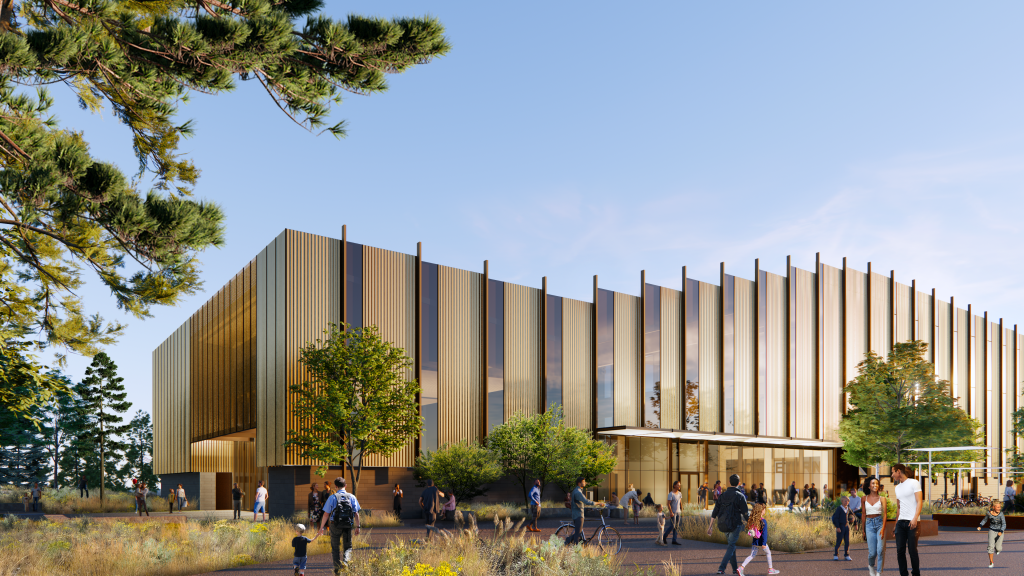
Yesterday, I sat in a “creative cubbyhole” beside a large window with my laptop in our new main library. It opened earlier this week, and inside it is beautiful—spacious, light-filled, modern, and carefully designed. Yet, surprisingly, as I looked around, I found myself missing this city’s old, now-closed main library. That crowded old place felt less curated and more discoverable.

Almost as soon as I entered the building, I began comparing what I saw to the old library’s stacks, which had always seemed endless. I recalled the faint dust-and-paper smell of well-used books and remembered running my index finger along crowded spines—often stumbling upon a surprise: a long-forgotten title, a long-unread author, or an unusual and compelling subject.

Central Oregon is full of readers. We’ve all been curious about this ambitious building, watching it rise and eagerly awaiting its opening. All week, visitors have filled the library, circulating among its attractively displayed shelves. But to me, the shelves feel too tidy, almost merchandised. Shiny book covers face outward in displays that seem heavily edited—perhaps too intentionally curated. Titles are visible, but authors’ names are partly obscured by catalog stickers.

Those displays push the curating system itself into the foreground, suggesting that organization matters more than browsing. I was surrounded by clear, clean order that somehow didn’t feel intimate. I assumed any book I wanted would be available and easily accessible, yet something essential felt absent.

While sitting there yesterday near the large window, I noticed the blinds lowering automatically in response to the changing light outside. I would call the library beautiful in the way airports and modern museums are beautiful: open, bright, efficient, and almost impossible to criticize directly.

The building even includes a first-floor coffee bar. One can order a designer coffee, settle beside a window to work or study, or simply linger over a latte. The interior design encourages community and socialization—a kind of environment I usually enjoy—but it is not quite my idea of a real library.

I found myself reflecting on the libraries of my childhood, my young adulthood, and my more recent past, remembering their narrow aisles and accidental discoveries. What returned most strongly was the feeling of books aging together in those old spaces. There, books were encountered almost physically: by touch, by proximity, by scent. In this modern setting, the books feel staged. There is more emphasis on display than discovery.

Old libraries invited wandering, browsing, and sampling. This new facility is designed for ease of navigation. Perhaps this very modern library optimizes access to materials. But a better building does not necessarily feel like a better library.

Essentially, it functions as a hub. Someone seeking a book, movie, or other item from the library’s non-visible holdings goes online, searches the catalog, and reserves the desired materials. The items are then picked up and returned at the building.

And yet, it is undeniably seductive. Imagine a Starbucks on steroids. Someone—maybe me—can walk in with a laptop, order a latte with an extra shot of espresso, settle beside a large window, think, create, and perhaps even meet new friends.

Diana

Allowing Journalism To Think

Sunday, January 25, 2026

I’m regularly reading a non-newspaper publication. I follow very few magazines, but these days I always check what’s current in The Atlantic. And I don’t skim its headlines or dip into a single article—I actually read its essays.

The magazine has a tone that feels educated—a better word might be oriented. Its editor in chief, Jeffrey Goldberg, strikes me as intelligent and impressive. He hosts the television roundtable Washington Week in Review, which thoughtfully models observation and discussion without performative outrage. I now try to catch every episode.

I follow a couple of other favorite magazines: The Economist and Foreign Affairs. Both publish serious essays by informed observers and skilled writers.

But The Atlantic, for months, has puzzled me. The magazine has been around for generations. In fact, I read it long ago, then stopped at some point and forgot about it entirely. Several months ago, I picked up an issue someone had left on a table, and was struck by how good it was. Since then, it’s become a favorite again—making me wonder what has changed.

Why did The Atlantic reappear for me? What made me suddenly recognize—again—its excellent writing, capable thinkers, and fine essayists? I might credit taste, talent, and luck. But no dice, because that familiar trio doesn’t explain the continuous, high-quality output I’m seeing.

My questioning has pushed me into social history. It teaches that good writing has always required more than taste, talent, and luck. It has needed patrons. History tells that serious journalism has required both a point of view and money—the two forces that make steadiness, thoughtfulness, and complexity possible.

In earlier eras, aristocrats, universities, and churches underwrote serious thinkers and artists. Today, there are fewer patrons of independence and seriousness. My research—and my renewed relationship with The Atlantic—suggest that point-of-view and money still matter. And today, perhaps, they matter more than ever.

Most contemporary media organizations seem to be running on fumes. They’re dependent on algorithms, advertisers, and relentless speed. Adding political expediency to the mix—consider The Washington Post’s recent loss of subscribers—makes media independence look increasingly fragile.

The Atlantic doesn’t shout or pretend. It’s a magazine that thinks—and thinking costs money. So, I looked for a story behind its resurgence. And, I found it.

In 2017, Laurene Powell Jobs became The Atlantic’s majority owner and fundamentally changed the magazine’s prospects. Jobs did not impose an ideology. Instead, she provided patience and capital. She didn’t demand instant returns, viral hits, or ideological obedience. Her money began funding quality rather than control.

That kind of backing allows writers and editors time—to follow ideas into uncertain or uncomfortable places—and also trusts readers to stay with the writers. Trusting works both ways. Trusting the magazine’s writers has drawn me into The Atlantic’s podcasts and videos as well.

It’s been many years since I felt attached to magazines. Once, there were several that spoke with original voices, and I loved them. Some that still exist feel to me like shadowy reflections of their former selves.

Those of us who love good journalism want to believe it can survive on virtue alone. But that’s unrealistic. Serious work that endures means someone, somewhere, has made a bold, fearless decision that it’s worth protecting.

The Atlantic didn’t become compelling again simply because “it got good.” What keeps its articles relevant, thoughtful, well written, well edited—and alive—is that someone is allowing fine journalism to happen.

For readers who prefer receiving these morning pieces by email, I’m also publishing them on Substack.

Diana

History Reminds

Tuesday, September 16, 2025

I am reading The Berlin Wall by Frederick Taylor, published in 2006. I picked it up after someone described it as a history that “…reads like a novel, and I couldn’t put it down!” I can’t say I agree with the “novel read” part—at least not yet—but for me it has opened a window onto Germany’s tangled past, and some of it feels uncomfortably familiar today.

Before Hitler ever arrived on the scene, Germany had spent 400 years as a patchwork of kingdoms, dukes, and city-states loosely tied together under the Holy Roman Empire. From 1400 on, there was endless infighting, power struggles, and even catastrophes like the Thirty Years’ War. When the country finally unified in the late 1800s, it still swung wildly between strongmen and shaky experiments with democracy.

That long, messy history makes me think of how easily fractured nations—then and now—can be pulled toward extremes. The old German pattern of division, promises of “restored greatness,” and sudden hard turns in politics has its modern echoes.

Americans today are asking fresh questions about the Constitution: what’s in it, what’s not, and whether it’s strong enough to steer the nation toward a future most of its citizens can embrace. Contemporary glimpses of social and national histories–and of course, not only Germany’s–remind us that human struggle is almost constant. And yet, the 20th and 21st centuries opened doors to hopeful new possibilities—spurred by human inventiveness, expanding wealth, and a broader reach of education and enlightenment.

Now we are witnessing history in motion once again—but this time in a broader stage, and unfolding not over centuries but at breakneck speed. Our real-time view of evolving nations is filled with warning signs: dehumanization, threats, and, too often, bloody conflict.

Events may feel distant from our own daily lives. But are they?

—Diana

Double Holiday

Sandra Boynton’s art, from her PB posting

Thursday, December 26, 2024

I don’t know why my brain failed to salute Hanukkah yesterday. Its first day this year was on Christmas Day. I was aware of and tuned into that, but only now offering, “Happy Hanukkah!” I’m letting Sandra Boynton’s art speak more for me.

Sandra speaks through multi-talent channels. Here’s a link to her boogie-woogie style video, with Zooey Deschanel, backed by terrific instrumentalists, singing Boynton’s retro toe-tapper, “I Just Want to Dance With Santa Claus.” https://www.facebook.com/sandraboynton/videos/1327490604947470

As I should have yesterday, today I salute two important holidays. (Thanks to my friend Rachelle for catching my oversight.)

A welcome thing happened yesterday. The ex-manager of the department store where I work part-time, and whom I appreciate and admire, sent me greetings from Colorado, where she manages another of the chain’s stores. She’s talented, kind, and fun, and ahead has a great career. Her message is a Christmas gift that puts us in touch again.

Yesterday was a quiet one at my house. I boinged-out on homemade whole wheat bread while watching sewing videos, to learn how to shorten a jacket’s lined sleeves. That’s a new reach for me–one I had never imagined tackling. This is happening because I fell in love with a corduroy jacket–in the Men’s Department! The jacket is a youth cut but too big, especially the sleeves. I’m gonna fix them!

That evening, I lit a candle for Hanukkah and reflected on my loved ones, distant or deceased.

Dear Friends: However you celebrated, I hope your yesterday was lovely. Diana

To See & To Think

Saturday, July 27, 2024

I wish Joan Didion, one of the most significant social observers and writers, were still among us and writing. She cycled through the Great Society’s changes, starting with the Kennedy-Johnson years, and wrote about societal situations with worthwhile insights. I would love to have her take on America’s current political landscape and how what is happening suggests for the future.

Naturally, we can all figure out for ourselves the ways that current happenings would frame the future. The male-dominated Republicans, now retreating, are trying to figure out how to combat an increasingly popular woman in a leadership role, without raising the ire of their more progressive followers.

Didion would know; she’d sense the possibilities and their impact on American and world populations. Sure, there are other writers tackling the issues and doing well, but none are doing as well as Didion did.

Her thinking was like a giant net cast over vast areas, captured and offered to us in essay after essay. Now, I want to re-read Didion’s writings to learn if she was predicting at least some of what’s happening today.

Besides, Didion was simply a great writer: spare, clean, and clear; she taught others how to do it.

In my perspective, the Repubs must refigure their fighting of fire with fire. They ought to start by highlighting their significant but reticent women, like Melania, to speak on their behalf about women’s issues. And they ought to reset Niki Haley, putting her in front again to message the general public about welfare in a Republican administration.

I know, I said I’d not be writing about politics. But, friends, this is a very different round; it’s mind-boggling and increasingly demanding attention.

Dear Friends: At heart, I’m forever a student of change. Diana

In the Tea Leaves

Saturday, July 06, 2024

Among things I’ve never done: Read a mystery novel by Agatha Christie. That’s about to change because I ordered, on an impulse, several of her classics. They’ve arrived, and I wonder why this seems a time for me to be reading, and why Christie, on an impulse. It’s not easily answerable.

As background, I seek quick information and deeper knowledge from online sources. For a long while, I’ve not sat reading a printed book. I’ve learned that the quick internet offers snapshots and summaries that satisfy most of my explorations, and these days, AI technology often speeds up discoveries.

I suppose Christie’s novels are attractive for various reasons. First, they are enduringly popular. All her books have remained viable for a very long time, testifying to their quality and appeal. Second, for unclear reasons, I lately am yearning to sit awhile and read a tactile book; one that’s well-written, easy to read, and entertaining. Christie popped into my mind.

I’ve been wondering why I’ll read mysteries; the genre never particularly appealed to me. Perhaps it’s that in these days of great political and social turmoil, I wish for the comfort and nostalgia of “simpler times.” Besides Christie’s stories having complex plots, what is also attractive is that her mysteries are solved in the old ways, through observation and deduction, instead of advanced technology.

I’ll start this reading project with, And Then There Were None, considered as Christie’s most popular book.

Dear Friends: On sweltering summer days, light reading becomes very inviting. Diana