Hearing Is Knowing

Friday, December 26, 2025

I had planned to wind down this listening series—focused on long-appreciated vocal artists—by stepping back and making observations about sound and musical genres. But something unexpected has happened along the way. By focusing closely on artistic styles, writing about musicians’ unique deliveries, and staying deeply attentive to how musical communication actually works, I’ve found that I can’t quit listening.

I’m no longer paying much attention to genres, backgrounds, or music as accompaniment to productivity or outcomes. Instead, I’m listening, paying attention itself—and seeking presence. I want to stay with sounds longer—to hear them doing their work.

Many of my earlier thoughts about “hearing music” resurfaced recently when I was visiting a neighbor’s garage. On most Friday nights, a group of long-time friends gathers there simply to play music together. No audience. No metrics. No urgencies beyond the shared pleasure of making sound and keeping time.

My “hearing memories” revived and renewed something essential. I have known—personally experienced careful listening and how it compels. Such listening feels vital. Yet, today, we mostly listen differently. Because we’re immersed in musical worlds that too often demand performance, circulation, and justification.

I’m not into re-circling nostalgia. I’m not into longing for vanished eras or arguing that music was once “better.” I’m into something more elemental that’s happening. By listening carefully, again, to humans singing, vocally or instrumentally—I am hearing them—as fully inside their voices.

This listening slows one down. Asks for patience. Asks not to scan ahead for what might be coming. Instead, it asks for staying with what’s here, now. Close listening alters the sense of time: it makes songs stretch, silences matter, and imperfections more meaningful than distracting. A sincere listener is less interested in quantity—or heavy listening—and far more in depth.

Something within me softens while listening to a singular voice, human or instrumental. There are sounds that don’t carry a brand or a narrative. They carry a “life”—shaped by contradiction, limitation, courage, and persistence.

Listening closely and hearing an artist’s lived history is a form of genuine respect.

I don’t expect others to hear exactly as I do, or to be drawn to the same voices. I’m simply inviting participation and noticing. Consider what sounds make you stop and lean in? Consider what sounds refuse to fade, even after a song ends, and a voice winds down?

Close listening helps us know where originality truly lives—and, equally important, in the encounters between the sounds and listening. It’s renewing my feelings of curiosity and wonder, pairing them with the acceptance that not everything needs sorting, explaining, or resolving.

Some things ask only to be heard.

I plan to keep listening—slowly, attentively, and without rushing to name what I find.

If you’ve been listening along with me, we’ve shared those quiet spaces between notes. We feel quietly grateful—and very much in the know.

Diana

Point Of View

Monday, July 22, 2024

Yesterday, I had a lovely visit with my long-time artist friend Janet. Several years ago, she and her daughters created a much-loved Christmas costume for my donkey Pimmy; our team had lots of fun participating in parades and photoshoots with well-dressed Pimmy.

Janet and I caught up with one another before taking a tour of the High Desert Classic Horse Show. The gorgeous, drool-worthy, and awesome jumpers made me happy to be a horseperson and to grasp their athleticism and fun. Horses are amazing and wonderful creatures; humans develop a partnership with a horse–and actually, a relationship unlike any other.

Janet is an artist and sees everything through an artist’s eye. She has always encouraged me to take second looks and to adjust my perceptions. I love that, and thinking about it makes a connection to my part-time work selling fine jewelry. I encourage customers to perceive gemstones and designs in different ways. For example, offering a viewer a jeweler’s loop and teaching its use clarifies design details.

Thanks to Janet for helping me remake connections among art, relationships, and practicality. This trio fuels most of our thoughts and perceptions.

Dear Friends: She says also that once we connect, we can forever reconnect. Diana

Scenting

Monday, July 08, 2024

Yesterday, my “midday shift” at work was a dream. My hours were free from the usual opening and closing duties, meaning I had no heavy lifting, no bending, and no worries about getting everything done perfectly. The primary purpose of my shift was to cover a coworker’s lunch break.

The scorching heat kept customers scarce, leaving me with ample time to explore a nearby fragrance counter. I had avoided perfume for years since my earliest gym days when I became wary of combining scents with sweat. But yesterday was a scorcher and our store had few customers.

After years of steering clear of commercial fragrances and now having free time, I wandered to Fragrances. It was hard to resist free-spray opportunities from numerous tester bottles, and I opted for a few casual sprays. However, when Chanel No. 5, a fragrance I had long forgotten, landed on my wrist, it triggered a flood of memories. Another surprise is that the original Chanel version is still pleasing.

The familiar fragrance instantly transported me back to younger, more carefree times and prompted me to reconsider my perfume aversion. I often returned to the Chanel tray through the rest of that shift. That classic fragrance will come back into my life; perhaps in one of its newer, slightly altered iterations.

A pleasant bonus was the lingering, subtle scent at the end of the day. That entire fragrance experience got me thinking about the fascinating world of scent perception. I could delve deeper into it, but for now, yesterday’s olfactory adventure adequately satisfies.

Dear Friends: What a delightful surprise! Diana

Film Art

Saturday, April 20, 2024

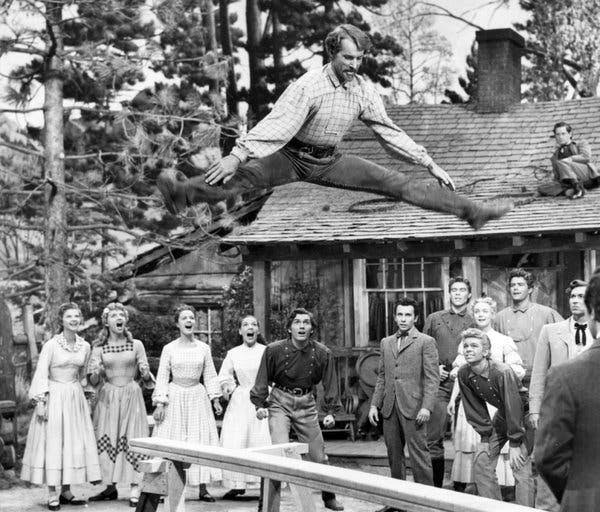
Last night, I was thumbing through some streaming offerings and stumbled across “Seven Brides for Seven Brothers.” The highlight of that 1954 musical was one of the greatest dance sequences ever filmed. In their real lives, six of the seven “brothers” were classically trained dancers; so were the townspeople, the men and women dancing partners. I was eager to see that movie again.

The underside of its wonderfulness is a dark story. It’s deep winter and the brothers are eager to find wives. They kidnap girls from the town and forget to kidnap a preacher. A sudden avalanche closes the pass to their remote property, preventing the townsmen from rescuing their girls.

The eldest brother is married, and his wife keeps his younger brothers and the girls separated throughout the winter. By spring, love is in the air and everybody is happy. A rescue group led by the town’s Chaplin arrives at the ranch, and finally, the Chaplin officiates over six marriages.

In its time of making, the film’s story was fun. In modern times, however, its fable is much less innocent. It’s hard to ignore the 2014 kidnapping of Nigerian schoolgirls by Boko Haram, an Islamic terrorist group. Finally, some of the girls managed to escape or became rescued, and only now some are telling their stories of years in captivity. Their stories aren’t pretty and don’t end well enough. Even today rescues again living in their village of origin are shunned, considered “Boko Haram women,” and with their children, are treated as outcasts.

Curious, I looked up Stephen Vincent Benét’s short story “The Sobbin’ Women,” published in 1937, on which “Seven Brides for Seven Brothers” was based. Benét’s story is beautifully written and readable. It’s also much leaner and tougher than the movie version.

Fortunately, artistry can overcome much. In “Seven Brides….” the dance sequences are outstanding, and sheer art that lives on film. Someday, I will watch that movie again.

Dear Friends: It’s all about having the capability of leading a good life. Diana

Powerful Silence

Monday, March 25, 2024

My constant desire to learn is highly motivating. Thinking about that yesterday, I wondered how much casual learning really sticks. I became interested in watching a silent British movie, “Piccadilly,” from 1928, starring the Chinese-American actress Anna May Wong, a film star.

That opportunity had me recalling elements of my journey years ago toward appreciating foreign films over Hollywood’s typical outputs. The best foreign films would activate viewers’ minds. Watching taught me about interpreting film action and dialogue to encourage a fuller comprehension of on-film behaviors. Foreign films had me reflecting more deeply on human behaviors and motivations.

My learning included watching Old Days’ Silents, which taught that on-film action, with only patches of printed dialogue, offers viewing experiences that are both powerful and highly emotional. Yesterday, while reflecting, I decided to watch “Piccadilly.”

I needed a few minutes to understand a series of silent actions that seemed disjointed and awkward. However, I was quickly impressed by the artistic scenery arrangements and superb camerawork by the film’s director. Before Wong’s appearance, the acting was old-fashioned and overly dramatic, but her film style was expressive and spontaneous.

As the film progressed, I became my former viewing self, focusing on key elements–script flow, scene shifting, camera angles, and believability. The script was jerky, its outcome dissatisfied and wasn’t believable, and throughout, every character overacted. What made viewing worthwhile were the excellent scene settings, the consistently great camerawork, and Wong’s appealing presence.

I used my old learning to interpret and appreciate a classic work, which has interested me in watching other well-known silent films. I would compare their fundamental elements, the scripts, scenes, and camera work—those backbones that made early movies appealing.

Dear Friends: I’ll add that this bit of film study cost me a new subscription. Diana

“Magical Mom”

Tuesday, March 05, 2024

My mom’s birthday is today, on a date she selected. I never asked why she self-selected the date, and much later, after she was gone, wished to know. By then, I wanted to know more about her early life and realized that many other questions never got asked. I’m always a little sad about my knowledge gaps.

Especially these days when the war in Ukraine raises questions about my maternal family’s life in that part of the world. Back in the very late 1800s, fearing Russia’s recurring violence toward Ukrainian Jews, they sailed to America, winding up in O’Fallon, IL, where my mom and her siblings grew up.

They lived in the most dire poverty. To survive, my grandmother made ice cream and my grandfather traveled into neighborhoods to sell scoops from an ice cart. My mom described her sheer unhappiness while a little girl, for having to go regularly to the local welfare office and request family existence money. When she was very young, her father passed away from TB.

Afterward, her mother found a job as a kosher cook in Oklahoma City and had to move there. She put her small children into an orphanage. Before long, her eldest child, Ruby, got married and became qualified to remove the children from that orphanage. Later in their lives, every single one spoke of Ruby as “a saint.” While still very young, Ruby, too, succumbed to TB.

That family history captured my attention many years ago when a Ph.D. candidate from New York phoned to ask me about the family during its O’Fallon time. While researching its Jewish immigrant community, she discovered in O’Fallon’s newspaper a contemporary article quoting my grandfather’s description of Ukraine’s dire anti-Jewish situation. The researcher sent me a copy of the article. It recreated the reality of my mom’s family in those times touching and blowing me away.

By then, my mom and her siblings were gone, and sadly, no one to question remained. Fortunately, I’m close to my cousin, Mary (her dad was my mom’s brother), and we often speculate on our family’s history, trying to fill in gaps with our combined knowledge.

So, Happy Birthday, Mom. If you could return, you’d find that your known world has evolved into a nearly unrecognizable social and political environment. Plus, these days, you’d not button up and avoid recalling an unhappy past; instead. like most of us, you’d be spilling the beans.

Dear Friends: Our moms–mostly intelligent and capable beyond what their times allowed. Diana