Hearing Is Knowing

Friday, December 26, 2025

I had planned to wind down this listening series—focused on long-appreciated vocal artists—by stepping back and making observations about sound and musical genres. But something unexpected has happened along the way. By focusing closely on artistic styles, writing about musicians’ unique deliveries, and staying deeply attentive to how musical communication actually works, I’ve found that I can’t quit listening.

I’m no longer paying much attention to genres, backgrounds, or music as accompaniment to productivity or outcomes. Instead, I’m listening, paying attention itself—and seeking presence. I want to stay with sounds longer—to hear them doing their work.

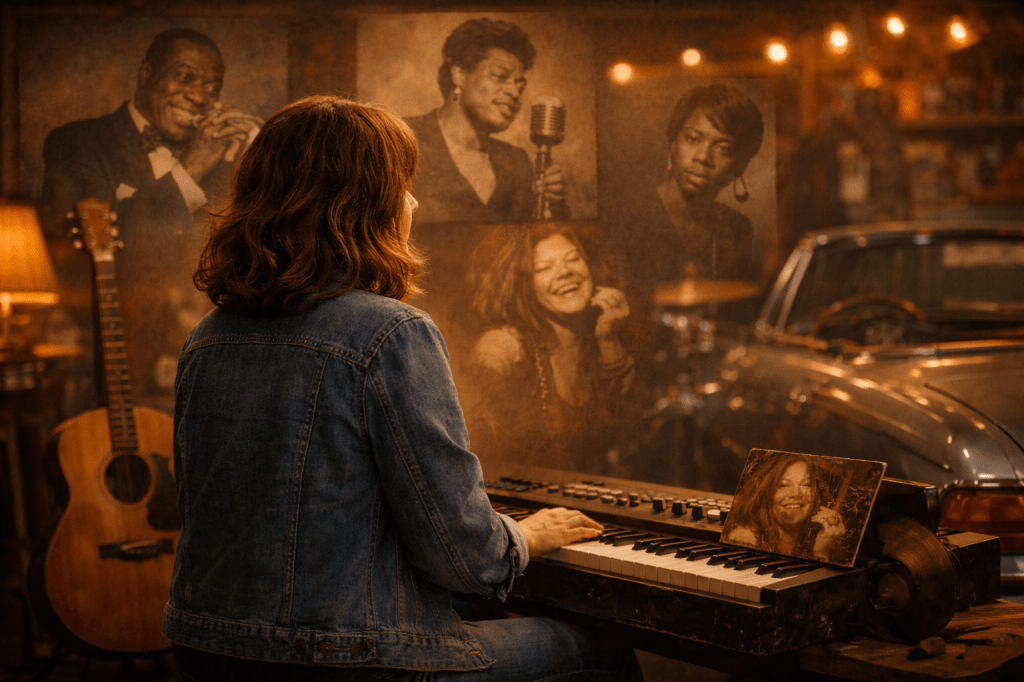
Many of my earlier thoughts about “hearing music” resurfaced recently when I was visiting a neighbor’s garage. On most Friday nights, a group of long-time friends gathers there simply to play music together. No audience. No metrics. No urgencies beyond the shared pleasure of making sound and keeping time.

My “hearing memories” revived and renewed something essential. I have known—personally experienced careful listening and how it compels. Such listening feels vital. Yet, today, we mostly listen differently. Because we’re immersed in musical worlds that too often demand performance, circulation, and justification.

I’m not into re-circling nostalgia. I’m not into longing for vanished eras or arguing that music was once “better.” I’m into something more elemental that’s happening. By listening carefully, again, to humans singing, vocally or instrumentally—I am hearing them—as fully inside their voices.

This listening slows one down. Asks for patience. Asks not to scan ahead for what might be coming. Instead, it asks for staying with what’s here, now. Close listening alters the sense of time: it makes songs stretch, silences matter, and imperfections more meaningful than distracting. A sincere listener is less interested in quantity—or heavy listening—and far more in depth.

Something within me softens while listening to a singular voice, human or instrumental. There are sounds that don’t carry a brand or a narrative. They carry a “life”—shaped by contradiction, limitation, courage, and persistence.

Listening closely and hearing an artist’s lived history is a form of genuine respect.

I don’t expect others to hear exactly as I do, or to be drawn to the same voices. I’m simply inviting participation and noticing. Consider what sounds make you stop and lean in? Consider what sounds refuse to fade, even after a song ends, and a voice winds down?

Close listening helps us know where originality truly lives—and, equally important, in the encounters between the sounds and listening. It’s renewing my feelings of curiosity and wonder, pairing them with the acceptance that not everything needs sorting, explaining, or resolving.

Some things ask only to be heard.

I plan to keep listening—slowly, attentively, and without rushing to name what I find.

If you’ve been listening along with me, we’ve shared those quiet spaces between notes. We feel quietly grateful—and very much in the know.

Diana

Unique Voices

Wednesday (Christmas Eve), December 14, 1015

I’m delighted to find myself right around Christmas—perhaps the most musical time of the year—thinking about music again and wanting to write about it.

My recent music-related posts have been about listening, particularly to performers with unmistakable presence and unique delivery styles. Their voices cannot be replicated, which leads to questions worth considering.

Why do some voices resist imitation completely? Why do certain singers and musicians remain instantly recognizable, even though there have been generations of covers, tributes, and technical study?

We often say a voice is “one of a kind.” That’s rather vague—almost sentimental. Actually, it’s because listening itself is remarkably precise. We hear a single note and recognize the artist immediately—before melody, before lyric, before context. We know who it is almost at once.

That recognition doesn’t come just from technique. We know that vocal ranges can be matched. Timbres approximated. Phrasing analyzed and rehearsed. And yet, we hear some artists as possessing something essential that never transfers.

There have been countless tributes to Ella Fitzgerald, Nina Simone, Janis Joplin, and Amy Winehouse. Many are impressive; some are genuinely beautiful. But they don’t feel complete. The outer shape may be there, but the interior weight is missing.

It seems logical, then, that a singular voice isn’t built from sound alone. It’s built from a life—and a particular life is audible, in timing, pressure, and its collision with the world.

Louis Armstrong could not have sounded as he did had he been born into comfort. Nina Simone’s music cannot be separated from her intelligence, her anger, her discipline, or her refusal to soften herself. Janis Joplin’s voice—carrying both defiance and hunger—is inseparable from the era that shaped her and constrained her. Amy Winehouse sang with an emotional directness that felt almost too exposed in a culture that practices concealment. Peggy Lee, writing deeply emotional songs, sang in a soft voice, creating impact not through force but through rhythmic shifts and carefully placed pauses.

Imitating artists cannot replicate another’s suffering—or the precise way an individual metabolizes experience prior to releasing it as sound.

And releases aren’t always tidy. Singular voices may include strain, cracks, or unevenness. They often ignore rules of prettiness or balance. In fact, polish can become the enemy of recognizability. Too much smoothing erases the friction that makes a voice distinct.

Many technically perfect performances leave us untouched because they arrive fully resolved—closed, complete, leaving no space for a listener to enter. I’m always wanting to feel a connection, sensing a presence that’s still unfolding.

Unrepeatable voices leave room and feel porous. They allow us to sense the human being “inside the sound”—the one thinking, remembering, insisting, sometimes even breaking.

Social timing matters, too, because certain voices emerge when the world is ready—or perhaps not ready—for them. They arrive as tensions that matter to listeners. A voice shaped in opposition, one that defies erasure, carries an urgency that cannot be rehearsed into existence later.

Voices that last are reminders that originality does not belong only to the past. They show us that originality is fragile, and dependent on conditions—social, cultural, personal—that cannot be mass-produced.

And so I return, again and again, to certain artists. Not drawn by nostalgia, but by recognition. They keep reminding me that music is one of the rare places where individuality can survive intact—and unflattened.

Another post will focus on genre, and why it can fail us when we try to describe what moves us most. Meanwhile, I’ll keep listening for what refuses to be copied—and wondering what it costs, and what it requires, to sound like no one else.

Diana

Hearing The Originals

Wednesday, December 17, 2025

My neighbor—professionally an engineering type—recently introduced me to his garage-based music studio. He and several long-time friends meet there every Friday night to play together. They don’t bother with advance planning; they simply gather and do.

The garage, a crowded but tidy man cave, half houses a skateboard collection, several motorcycles, and a pristine classic BMW convertible. The other half is filled with musical gear—guitars, a professional drum set, a keyboard, seating, and a large TV tuned to YouTube, making music videos instantly accessible. My neighbor says he’s felt intimately connected to music of all genres since he was a little boy.

I sat at the keyboard as he softly strummed a guitar, and we talked about music. I confessed—somewhat sadly—that I’ve fallen out of touch with much of today’s popular music. He queued up a few videos, introducing me to some of it. I was honest and explained that I’m a fan of what I call “the originals.” He understood immediately and shifted the screen to Louis Armstrong, singing alternately through his famous horn and his unmistakable voice. Then came Ella Fitzgerald, gently and passionately interpreting Summertime. We discovered that we share a love for a very modern original as well—Alison Krauss—and listened to her duet with Brad Paisley. Our wandering also touched briefly on cool jazz.

I keep myself too busy to pause and listen as often as I might wish. But after that evening, I revisited my old CD stacks from years of collecting and turned again to YouTube to hear artists I’ve loved for a long time. All of it stirred a familiar question: what is it that makes particular voices call to me so strongly—over equally talented and wildly popular newer artists?

I don’t consciously resist what’s new. Still, I find myself drawn back—almost involuntarily—to certain singers and musicians. Their work feels different, not just in style, but in kind. Especially the voices now gone: Louis Armstrong, Ella Fitzgerald, Nina Simone. Peggy Lee. Édith Piaf. Janis Joplin. Mama Cass. Amy Winehouse. And then there are current figures who still carry that same sense of singularity—Lady Gaga, Robert Plant, Alison Krauss, and a few others.

The word genre doesn’t help much. Jazz, blues, folk, pop, rock—the labels slide off what I’m trying to name. These artists don’t feel as though they belong to categories; instead, the categories seem to bend around them.

The same holds true for certain operatic voices that live vividly in my memory.

Perhaps what my favorite artists share isn’t an era, or even a particular sound. Maybe they share something closer to presence. When they sing—vocally or through an instrument—it feels as though something real is at stake. They aren’t merely performing a song; they seem to carry history, experience, contradiction, and truth all at once.

It’s striking, too, how many of these carrying voices are women’s. Not exclusively, of course—men like Sinatra and Nat King Cole clearly belong in this conversation. But with women, attention so often slides away from the work itself and toward their personal lives, their struggles, their supposed instabilities. Even celebrated women artists have rarely been allowed to remain simply artists. Their inner lives became public property, open to speculation, and too often eclipsed their undeniable musical intelligence.

I’m not going to look for neat answers to complex social realities here, and I’ll leave formal sociology aside. This is a more personal inquiry—an attempt to understand why certain musical patterns never release their hold on me.

Once I begin listening in this way, a much larger story presses in. Many of the voices that move me were shaped by what we now call American music—especially the blues and everything that grew from it—emerging from histories of profound suffering, endurance, and enforced silence. Acknowledging that responsibly requires slowing down, and resisting the urge to compress slavery, survival, and cultural inheritance into a paragraph or a slogan.

I’m not qualified to explain that essential history fully. Instead, I plan to begin here, at the edge of listening.

In future posts, I hope to explore this territory more carefully:
– what originality really sounds like
– why some voices can’t be replicated
– why genre so often fails to describe what moves us most
– and how social history—race, gender, power, visibility—shapes music and how we talk about it

This first post is simply a doorway—an acknowledgment that something important lives here, much like what keeps my neighbor’s Friday-night studio jams alive. And my growing wish to explore it deserves attention rather than speed.

For now, I’ll start listening again.

And I’m inviting you to listen with me.

Diana