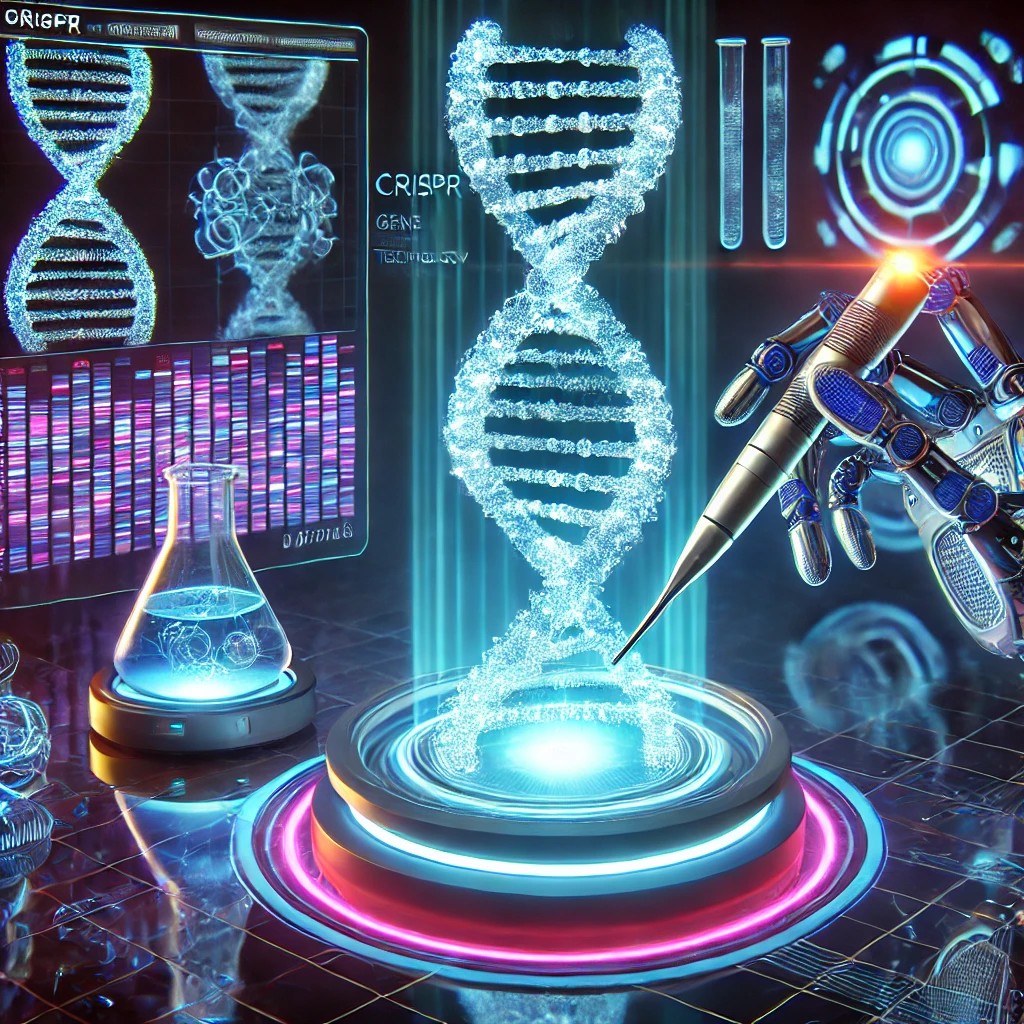
Imagining CRISPR

DNA helix being precisely edited by a high-tech robotic tool

Thursday, February 27, 2025

I’m reading more often about the gene-editing technology known as CRISPR. Its potential for manipulating every gene in living plants and animals (including humans) could complicate everything we have traditionally comprehended about life.

CRISPR technology has advantages: it could improve crop production and living beings’ health. It has serious disadvantages: it could introduce misuse, mistakes, and unwanted changes to everything we now understand chemically and socially.

Yesterday, I was thinking about CRISPR and initiated a “conversation” with AI about the technology. I hoped for more insight into its potential for producing good and evil. This “chat” lasted an hour because the AI produced lots of information to support each potential, often pausing and questioning my perceptions about the ideas it offered. I had to pause the discussion frequently to imagine and think before responding.

At its best, CRISPR technology could likely fix most, if not all, of the problems occurring on our planet. However, it has a high potential for misuse by “bad actors” and has too many unknowns about what future life might “look like” and “act like.” Eventually, CRISPR might create an Earth hosting only gorgeous, healthy, and relatively non-competitive human beings and animals. CRISPR could alter how plants grow in poor conditions, making them thrive and producing enough food for all living beings.

Right now, scientists aren’t necessarily envisioning a “perfect” world. They’re focusing on ways to overcome and eliminate inherited genetic flaws and make modifications to improve the overall health of living beings. All that’s okay starting off, but such technological capacity raises many doubts and fears of an altogether murky future.

Like everybody, I am influenced by technological advances. I never believed there would be anything like a workable AI, and now, I’m enjoying conversations with the technology. About CRISPR, I believe in the Darwinian theory of evolution and voting against gene editing’s massive capability of becoming widespread, creating who-knows-what alterations to every life form.

Last night, AI made me aware of the countless pros and cons either supporting or arguing against advancing with CRISPR. AI challenged me to imagine the potential “goods” and “bads” in a CRISPR-influenced future. There are many of both.

I’m opting for a more appealing (and human) way of achieving worthwhile outcomes without considering the possibility of over-modifying Earth’s living genetics.

On a large scale, more specific education and appropriate guidance (e.g., Leadership) would encourage humans to focus on and repair some of our planet’s key problems. A huge threat is global warming, which is now effectively challenging the well-being of all living creatures. Some of its worst effects are reversible—for example, revitalizing large and currently damaged areas of the earth to expand our food-producing capabilities.

Many current threats can be fixed to improve our overall quality of life. Those fixes require enlightened education and a leadership that comprehends the necessities and supports the fixing.

Dear Friends: Seductive technology, from everywhere, calls for caution. Diana

Dawkins-Struck

Wednesday, December 04, 2024

I am still roiled by America’s election results and the President-elect’s nominees for key leadership roles. I will become a turtle, withdrawing into my shell and focusing on the physically nearby. I will let the world turn as it may and hope for minimally noticeable impacts where I live, here in mountainous Central Oregon.

I’ve been taking more time to sit quietly and read books–a related topic because all are authored by Richard Dawkins. Dawkins is a prominent British evolutionary biologist and ethologist who’s made significant contributions to science. He has unique, learned, and outspoken views on the meaning of life.

I discovered Dawkins recently, for the first time, by following a newspaper suggestion and reading his latest book, The Genetic Book of the Dead (subtitled A Darwinian Reverie). Dawkins’ perspectives awed me. I obtained several of his previous books, finding his views consistent. His research and learning are built upon Darwin’s theories and provide logical and reasonable ways to comprehend the living world.

Reading Dawkins has me rethinking and reconsidering the meanings of reality and life. His work melds well with my lifetime of learning. Going forward (while inside my turtle shell and somewhat insulated from the larger political and social affairs), I will continue reading Dawkins and reworking how I might wish to view current and future events.

Another note on coffee beans: I’m enjoying some El Salvadorian coffee this morning.

Dear Friends: Dawkins is very woke and not everybody’s cup of tea. Diana

Woke Revisited

Wednesday, November 13, 2024

I am reading Bill Bryson’s The Body: A Guide for Occupants and Richard Dawkins’ The Genetic Book of the Dead: A Darwinian Reverie. These are making me very aware of being human at the genetic level.

Briefly defined, genes store and transmit information that guides an organism’s development and function. They don’t have brains or consciousness; however, they exhibit “intelligence” in how they respond to their environment and interact with each other. Genes can sense changes in their environment and adjust their activity accordingly to influence each other’s activity.

While absorbing genetic realities, I wish to comprehend the mechanisms that enable humans to self-perceive as individuals. I’m asking age-old questions about a “real reality” existing beyond whatever the genes sense, or in other words, is there “something real” outside ourselves?

It certainly seems that way and requires finding a beyond-the-gene-view.

A genetic perspective is limiting. It reduces our experience to biological mechanisms and doesn’t account for consciousness, emotions, or the subjective experience of being human. I wish to understand more about what creates the human realm of consciousness, awareness, and subjective experience.

The referenced books are easy reads and highly enjoyable. They are pushing questions about the existence of a reality beyond our physical perceptions. Ultimately, questioning “real reality” will prove to be deeply personal and philosophical, and there won’t be right or wrong answers.

I am an individual exploring. I might find myself forced to define my unique understanding of what constitutes “real reality.”

Dear Friends: I’ll keep reading and hopefully will gain more clarity. Diana

Planning Ahead

Tuesday, September 17, 2024

Yesterday was a day off from my part-time job, a tiring day that kept me busy. I cleaned the house, dragged the dry lot, handled laundry, dusted hardwood floors, and cared for critters. Soon after the dogs’ dinnertime, this household went beddy-bye.

Today is my back-to-work day. I’m scheduled for the closing shift and will get home late this evening when the September Moon is at its fullest. Then, I intend to take a camera to my property’s highest peak. I want to photograph the bright orb, showing a spread of tree branches framing its light. I anticipate the camera’s “moon setting” to clarify each component, making all visible in captures.

Here’s a sketch of an image I dream of capturing. Of course, it’s unmatchable, mostly because of my primitive eye and photography equipment and also because my shooting location will limit my opportunities. Yet, my goal is to capture the bright object way in space with what’s nearby, as in this arrangement.

That planned, not much around here ever happens easily and straightforwardly. Before I can be out shooting the moon, my equines must eat, and my Pimmy must accept her meds.

Over the next two months, Pimmy will receive quarter doses of Cushing’s medication and will graduate to half doses. At that time, she’ll receive another blood draw. If all looks well, she will be started on daily full-pill dosages.

The problems with providing the (one and only) Cushings medication are its odor and terrible taste. Equines can smell the medication and avoid allowing it in their mouths.

I remind myself not to borrow trouble by focusing on handling the baby steps. So far, I’m getting Pimmy to accept a daily quarter-pill buried in a drilled carrot. Next week, we will start working toward her accepting a daily half-pill. Maybe the carrot idea will keep working.

The point is to avoid worrying about getting her to accept a whole pill before its time comes.

Several years back, someone told me that the trouble of a horse coming to stay with you is that it stays for a l-o-n-g time. That’s true, and B-T-W, a donkey stays longer. However, there are worthwhile upsides to keeping the big animals. They offer fun and exercise, increase our attention and awareness of the surroundings, and by interacting with them, we become more self-enlightened.

Dear Friends: More again after my moon-capturing adventure this evening. Diana