What The Morning Asks

Thursday, January 22, 2026

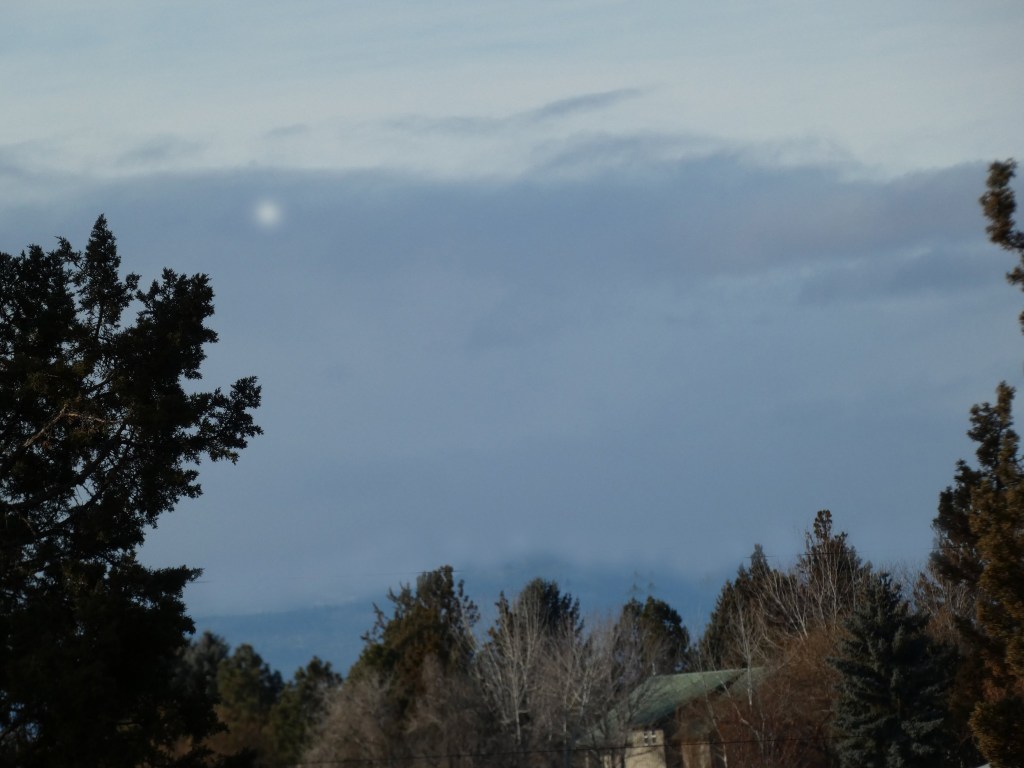
This morning feels like a quiet weight. Central Oregon still is hushed beneath a thick inversion layer—and my small world seems held in suspension—deeply still. I almost hear the air breathing as it freezes. I know that heavy fog will erase the Cascade Mountains from the horizon and leave my few acres monochromatic. I know that now the junipers are shadowy sentinels, half-seen and half-imagined. 

I’m standing at a window and holding a cup of steaming coffee—and, almost seeing the stubbornly cold air. Frost coats juniper branches and grass blades, and soon, the sun will struggle to rise—pale and ghost-like—trying to burn through the low mist. 

Despite this chill, there’s a necessary routine of feeding my horses. In this still darkness, layered in snow pants, a thick sweater, and my heaviest coat, I step outside—into a muffled world. The usual neighborhood sounds are absent; there is only the sharp, rhythmic crunch of frozen earth beneath my boots. I move slowly through this morning’s blurred edges. 

The horses are waiting, their whiskers white with ice and their patience thinned by hunger. I hurry through the usual labor—cleaning stalls, filling water buckets, and hauling fresh, sweet hay into the barn. It is work, but offers a few brief, pleasant moments of focus, too. Free of other concerns for the moment, I’m considering this weather inversion, hoping the fog will lift soon and normal clouds return.

Once I have settled the horses, I pause awhile. I listen. Few sounds are as satisfying as the steady, rhythmic grinding of horses chewing—watching them, wholly relishing their meal, is fun, too.

It’s time to turn back toward the house. I crunch across the frozen ground. My dogs, cat, and birds are waiting for their breakfast. Only after caring for them will I prepare for my part-time job.

This is how most of my days begin—as dependably as our January freezes—and regardless of any other weather conditions.

Diana

Seeing Isn’t Always Seeing

Tuesday, January 20, 2025

At first glance, I was certain I knew what I was seeing.

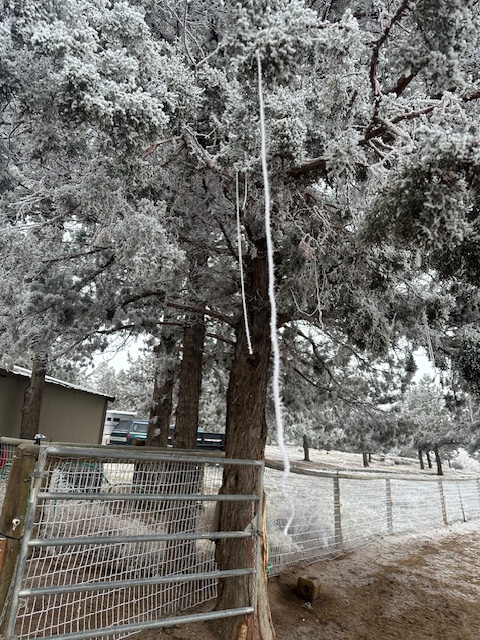
Two pale strands hung straight down from the branches of a juniper, each coated in frost. They were white, linear, and unmistakably rope-like. Our minds are quick that way. They reach for the nearest familiar explanation and settle in. We just go with it.

Like me, then—not questioning whether the frosty objects were rope, only wondering how they had gotten there. I reached up to pull one strand free from its branch, and in that instant, the scale shifted.

In my fingers, what had looked sturdy immediately shrank into something improbably delicate. I expected resistance. Instead, frost slipped away, and I found myself trying to grip emptiness. I paused and looked more closely.

You’ll never guess what I discovered. The “rope” I was trying to hold was a single hair from one of my horses’ tails. Looking up again, I noticed several similar strands—long, pale, impossibly fine—each thickened by frost and hanging, rope-like, from the branches.

The experience startled me. These fine hairs had likely been carried aloft by nest-building birds, caught by chance in the tree, and layered again and again with ice. The moment felt slightly dramatic and, at the same time, utterly ordinary. I had misread the evidence—and it had been astonishingly easy to do so.

I’ve been thinking about deciding and misassuming. These happen more often than we realize. We believe we’re seeing what’s there, when instead we’re seeing what our experience tells us ought to be there. Our brains—efficient and decisive—are always working to help us make sense of things quickly.

But efficiency may also be a kind of blindness. When we label something too fast and move on—without lingering long enough to reconsider—we miss the chance to see it differently.

The object I mistook for rope wasn’t merely a variation of what I expected; it belonged to an entirely different category of reality. It was something once living—shed, carried, and repurposed by chance.

Only later did my mind begin to imagine a quiet collaboration among animals, weather, and time—a whole story I had nearly missed before I paused, looked again, and wondered.

This experience reinforces something I’ve been learning: that deciding well often requires more than one look. Not because first looks are careless, but because they are incomplete. The longer I live, the more I understand wisdom as less about sharp eyesight and more about patience. Wisdom is staying a little longer with what we think we understand, allowing ourselves to be surprised by what else might be there.

Here’s today’s small example. A single strand of horse tail hair is usually barely visible. Yet here were several, transformed—fluffed with frost and suspended in front of me. I mistook them for rope. I tried to pull one down. Instead, I learned again that what appears solid may, upon re-examination, be lighter, finer, and less obvious than we first believed.

Seeing—really seeing—asks us to pause, reconsider, and sometimes admit that our first understanding was wrong. That lesson, offered by a few horse hairs, humbled me. And because of what it taught, it was also comforting.

If something as slight as a single horse tail hair can—against all odds—hold its place in the world, suspended and briefly transformed, then perhaps our own uncertainties deserve a little more time in the light as well.

Taking more time means looking again. Reflecting longer. It’s a practice that can help move our perceptions closer to what actually may be there.

Diana

Letting Go, Mending, Learning

Tuesday, December 09, 2025

Several weeks ago, after leaving my sales job in a large retail department store, I turned my attention back to a long list of needs waiting at home. I contracted for a new roof, got long-overdue electrical repairs done, and—perhaps in the biggest emotional task of all—helped my beloved donkey, Pimmy, transition to her new home.

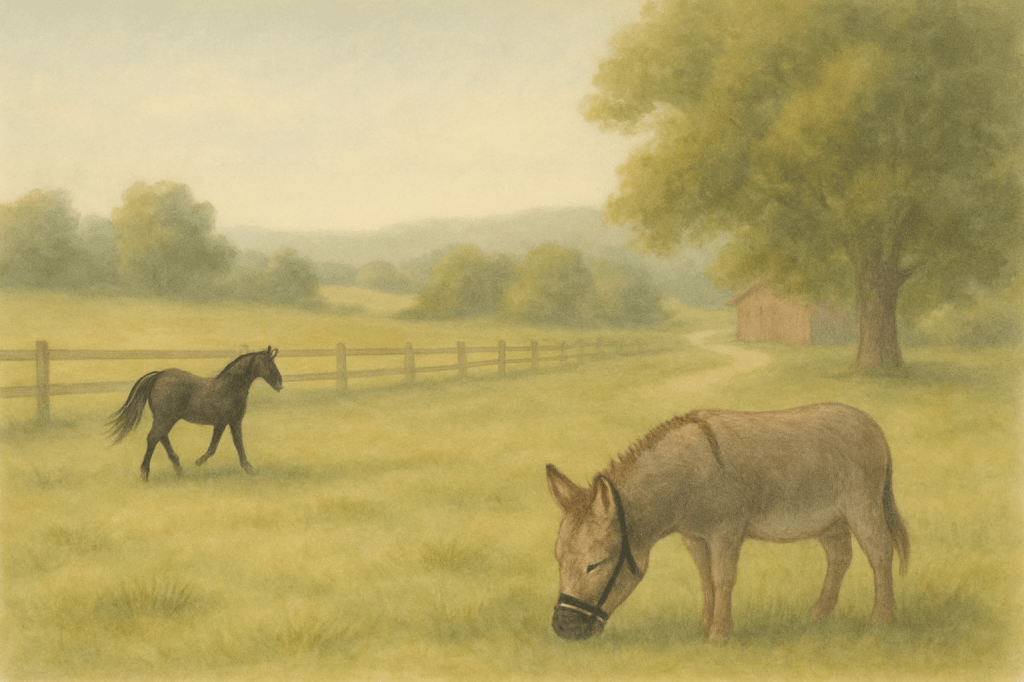
Fortunately, that new home is nearby and I visit often, which softens the bittersweetness. Pimmy is a “special needs” pet, living with Cushing’s disease and Type II diabetes. Over the past year, I carefully managed her diet, and she lost nearly 200 pounds. She now looks bright, alert, and almost youthful again.

Her “new person” is a retired nurse—gentle, steady, and knowledgeable—who understands Pimmy’s conditions and is both vigilant and deeply caring. Pimmy now wears a grazing mask and spends her days roaming a generous pasture with her new buddy, an aging Arab gelding. The regular movement is doing wonders: she’s walking more freely, her energy has lifted, and her coat is turning fluffier and shinier, as if she’s growing into a chapter all her own.

Meanwhile, life with my two horses has kept me just as busy. With Pimmy settled, I turned to repairing fencing, cleaning the barn, and making a few improvements to the horses’ living space—projects that had been quietly waiting for months. Horses have a way of creating their own to-do lists, and mine certainly did.

Rosie, who is sturdy but sometimes finds trouble, managed to develop a hoof abscess. It needed soaking, wrapping, and all the fussing Rosie insists on not enjoying. And Sunny—sweet, distractible Sunny—somehow scraped a surprising patch of fur off her face. No dramatic story, just the everyday mysteries of horse life. Between meds, bandages, and gentle reassurance, they’ve needed both hands-on treatment and the simple comfort of my presence.

All this work has kept me grounded, but I’ve also become aware of another familiar pattern: the slow return to isolation whenever I stay home long enough. It’s not that I don’t love being here—keeping the property in shape, caring for the animals, tending to the endless little realities of country life. I do. Yet after a while, I begin to miss the hums of human life. Conversations. Laughter. The ordinary noises people make while going about their day.

So, I decided to rebalance things. For this Christmas season, I’m taking a part-time job at a fast-moving retail discount store. A few short shifts each week will give me a little of the outside world again—energy, chatter, and a constantly changing flow of faces. And, for reasons I can’t entirely explain, I have a growing curiosity about retail as an industry. Now that I’ve learned how a traditional department store operates, I’ve also wanted to understand how the bulk discount retailers run their show. My new seasonal role will give me a chance to find out.

What I’ll ultimately do with my expanding retail knowledge is anybody’s guess—mine included. Maybe it will simply satisfy my curiosity. Maybe it will help me better understand the rhythms of modern commerce. Or perhaps it’s just another way of staying engaged with a world that keeps shifting under our feet.

For now, it’s enough that this will get me out among people again—listening, learning, and feeling connected—while still allowing me to come home to the animals and land that make up the heart of my days.

— Diana

Miss Merry

Merry Leggs (2010)

Thursday, February 13, 2025

Years ago, I suddenly lost my young and adorable Welsh Pony, Merry Leggs. She had been stricken by severe colic, and afterward, for weeks, I sat at a computer, fighting my incredible unhappiness by creating a story for young readers that starred a Welsh Pony.

My lead character, Miss Merry, was pretty, intelligent, and devoted to her family. She was courageous, too, and had many adventures. After initially drafting the story, I continued working on it; gradually, it felt reasonably compelling and maybe worthy of publishing.

A couple of drafting components didn’t go smoothly. Most critically, I couldn’t successfully edit my own creative writing. Upon attempting to make a sentence or paragraph more relevant and stronger, I’d find myself, instead, rewriting whole sections, altering the story’s flow.

My inability to self-edit demanded an outside objective editor, and Merry’s story increasingly called for an illustrator. Talented assistants weren’t available for what I could afford: $-Zero. Little Miss Merry eventually floated into the background and drifted from my active memory. I suppose that happened after I overcame my pony loss enough to move on.

Until yesterday, when a bright young colleague, Lily (who recently introduced me to Chat GPT+), suddenly asked if I’ve ever written fiction, I nodded and complained about self-editing until Lily pointed out Chat’s editing capabilities.

Later, I was thinking about Chat’s abilities and suddenly remembered “Miss Merry.” It needed editing and illustration—both are Chat’s capabilities. Additionally, Lily, a makeup specialist, has artistic skills and expresses interest in perhaps working with the story.

Gosh! A dozen years later, “Miss Merry” might be reborn. First, I must locate the saved story—probably on a disc or a thumb drive. Finding its location is one head-scratcher, and accessing a complete version may be another.

I’ll be off my part-time job today and looking for Merry.

Dear Friends: Revisiting my sweet pony vis-a-vis her alter ego–thrilling! Diana