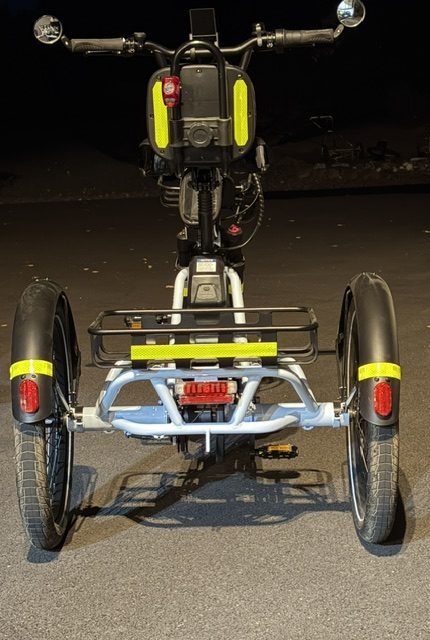
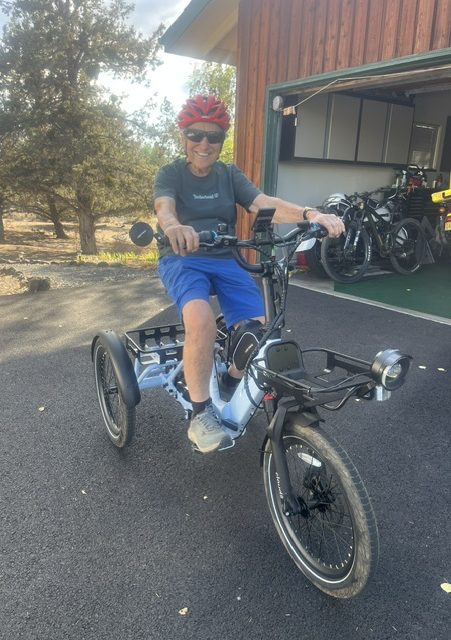
That seemingly “bandaged object” in today’s header photo is actually the backside of my recently acquired e-trike.
My friends and neighbors, Dale and Susie—both avid cyclists—convinced me that my pastel trike needed a vivid, eye-catching makeover. They are passionate advocates for road safety in all conditions, and they had a plan.
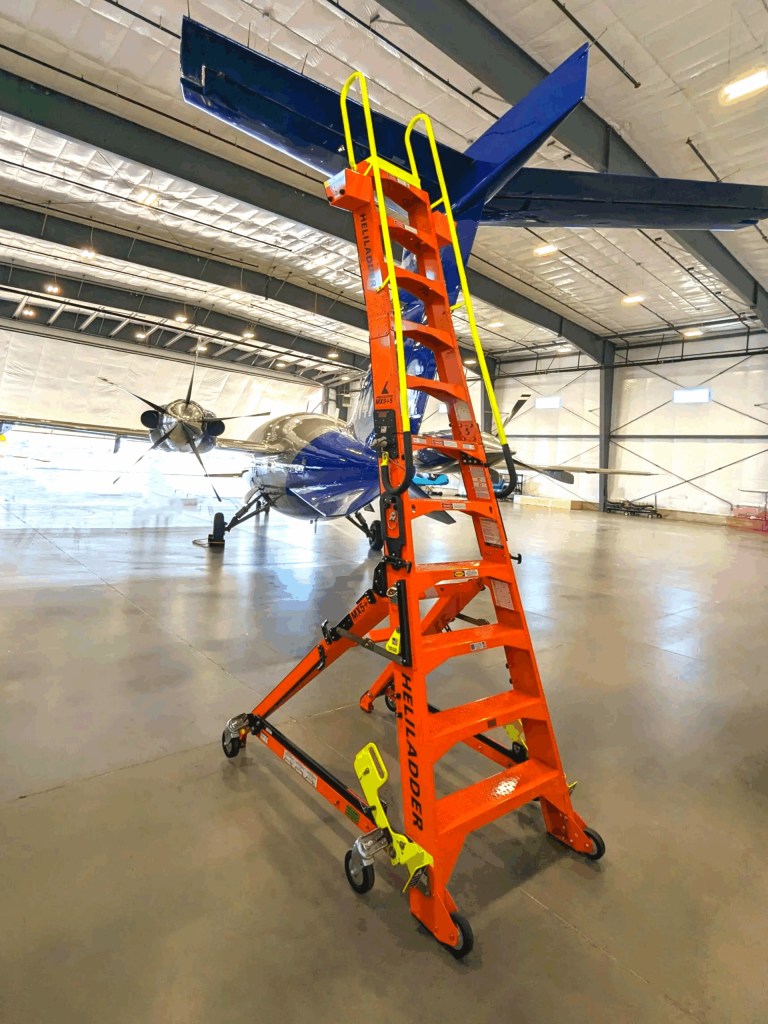
Dale, a retired helicopter mechanic, designed and now manufactures the HeliLadder, a specialized maintenance ladder for aircraft. When he inspected my new ride, he brought out a roll of heavy-duty, high-visibility reflective tape from his shop. He demonstrated how even a faint beam of light makes the color leap and glow, then offered to apply it to my trike’s frame and rear rack.
As an aside, Dale and Susie have long been champions of accessible outdoor adventures through their work with the AdvenChair—an all-terrain “hiking wheelchair” engineered with independent disc brakes and front suspension to keep riders safe and comfortable on rugged wilderness trails. Road safety and clever engineering run in their blood.
Taking their wisdom to heart, I’ve started suiting up in high-visibility neon gear whenever I head out. Now, dressed in bright layers atop a boldly taped trike, I am unmistakable to approaching traffic from either direction.
Here is the “before” look: me and the trike in Dale and Susie’s workshop, waiting for our splash of high-vis color.
At my age, an accidental spill on a traditional two-wheeler is simply not on the agenda. This sturdy three-wheeler completely eases that worry, and it is a delight to pedal. Most days I ride in low gear—or turn the motor off entirely—to give my legs a proper workout. But when a steep hill or a rough patch of gravel presents itself, having the battery and throttle ready at the flick of a switch is pure magic.
I also owe an enormous thank-you to another wonderful neighbor, John. When the trike first arrived, it was folded tight, bolted down, and wrapped in what felt like miles of heavy industrial packing material—a genuinely overwhelming puzzle to unbox alone. John stepped in and helped assemble the whole machine so I could get rolling.
It really does take a village, again, again, and yet again.
My neighbors and friends, Dale and Susie Neubauer, are often my inspiration. They operate a family business called HeliLadder, and over the years, our social chats have frequently turned to the rewards and challenges of growing a family business while continually expanding its product line.
I am naturally drawn to their story. I grew up in the years following World War II, when America felt a renewed sense of pride and optimism, casting off the shadows of the Great Depression and the war. An encouraging theme of my youth was the ideal of individualism—the pursuit of personal development, ambition, and self-reliance.
HeliLadder’s story echoes those classic ideals. In many ways, they reflect the classic Horatio Alger myth—the 19th-century author whose popular dime novels featured protagonists rising from poverty to success through hard work, determination, and integrity. Those stories helped shape a cornerstone of the American Dream, inspiring people to believe in their own potential.
I hadn’t thought about Horatio Alger in years, but observing HeliLadder brought that archetype back to mind. It’s one of the clearest real-world examples of that spirit I’ve been privileged to witness. The company began when Dale identified a specific problem, conceptualized a solution, and built a business model around it. Combining years of practical experience with self-confidence, he turned an idea into a tangible reality. HeliLadder’s success is the direct outcome of vision, craftsmanship, and steadfast family support.
For many years, Dale worked on aircraft maintenance. As a career helicopter repairman, he knew the physical demands and safety risks of the job firsthand—particularly the hazard of standing atop standard, wobbly A-frame ladders while leaning out to reach elevated rotors and components. His growing concern was not just his own balance, but the safety of the younger technicians he trained and supervised.
In 2010, Dale began tinkering in his garage to design a safer alternative. By 2011, he built his first prototype out of wood, featuring a cantilevered base engineered for stability. The design allowed technicians to stand securely and reach into the aircraft body without dangerous overextension. Dale brought these early wooden models to the airfield, testing them on the job and refining the concept based on real-world use.
To transition the product from wood to high-grade metal, Dale began collaborating with local fabrication experts. Financing these early trial-and-error efforts meant postponing his retirement and continuing his regular job while building the business on nights and weekends. Developing the ladder demanded immense grit, patience, and effort from both Dale and Susie.
Eventually, the industry took notice. Dale’s practical expertise and clear communication helped establish the product’s value, and sales began to grow. By 2018, Dale was able to fully retire from aircraft repair and focus entirely on HeliLadder. Susie was instrumental every step of the way, co-managing operations and logistics.
Shortly after I first met the Neubauers, they invited me to tour their initial rental facility. Even then, I was struck by the precision and build quality of the ladders. My untrained eye saw a beautifully balanced piece of industrial design that was purpose-built for safety and utility.
By 2025, HeliLadder had outgrown its original space. An opportunity arose to purchase a much larger, newly renovated industrial building—conveniently located directly across the street from their primary metal fabricator. I toured the facility with them when it was still just a vast, empty warehouse. Nothing about the open space fazed Dale; he strolled through with Susie and me, effortlessly pointing out where every assembly line, rack, and office would go.
I recently visited their completed facility, and the transformation is remarkable. The once-empty floor is now a fully functioning hub featuring administrative offices, dedicated assembly lines, inventory storage, and loading docks. The company has truly become a family legacy: their sons and niece now work in key roles within the business, allowing Dale to focus on sales and innovation. At the same time, Susie gradually steps back to enjoy her outside pursuits.
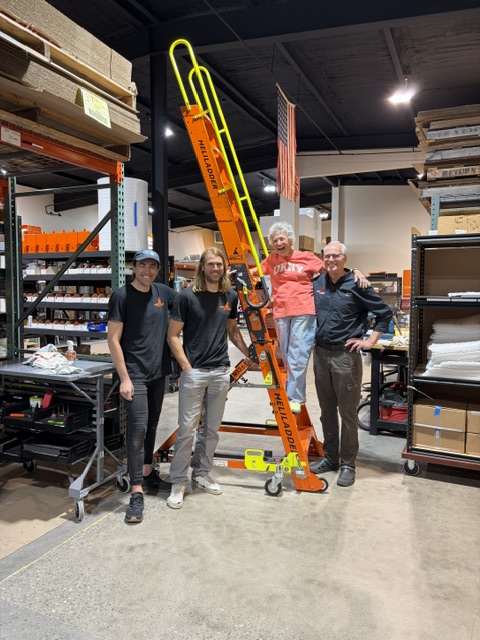
The Neubauers (Caleb, Ian, Susie, and Dale) taking a break.
I’m invited to join the scene.
In an era often dominated by rapid tech trends and social media noise, hands-on ingenuity can sometimes feel like a lost art. Seeing Dale’s practical vision come to life—backed by Susie and their family—is a refreshing reminder of what can be accomplished through persistence, skill, and clear purpose. HeliLadder is a classic, modern success story: identifying a real need, building a solution from the ground up, and seeing it through.
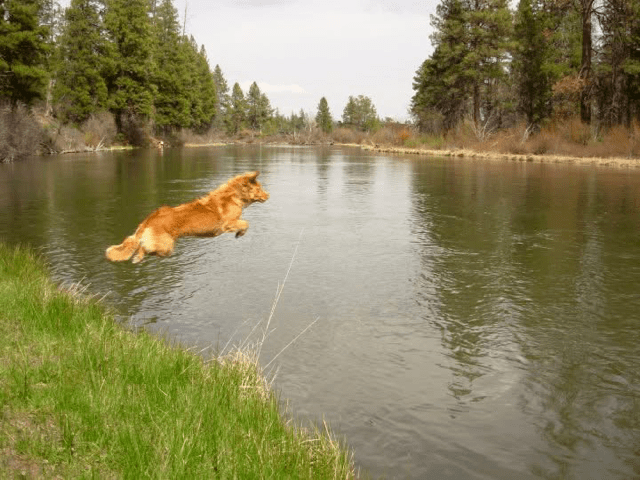
Rachelle’s past much-loved pal, her Nova Scotia Duck Tolling Retriever (named Bon Jovie).
Saturday, June 06, 2026
My dogs and I love a nearby BLM area for many reasons. For one thing, it has a long irrigation canal with rushing water, lined with colorful wild water lilies. We were there recently to meet up with our longtime friend, Rachelle, who brought Ryder, her beautiful Aussie. He and my Chase are vigorous play buddies.
Rachelle and I hadn’t walked with our dogs for many months. We’ve been busy, so we had lots of catching up to do. And we did, while walking along the path beside the busy canal as our dogs played, chasing one another into and out of the water.
Rachelle is a lovely companion—bright, well-informed, and creative. Years ago, during one of our walks, she encouraged me to explore podcasts. I did, and found myself enjoying the timely perspectives of favorite writers and newscasters. Recently, I graduated from podcasts by subscribing to YouTube Premium, which is now my go-to source for news and commentary. Rachelle said she, too, pays close attention to that platform.
We were in sync, walking, talking, and sharing thoughts about our strengths, weaknesses, and changing physical and mental energies.
I am aging and thus paying more attention to matters of aging, with mixed delights and worries. So, walking and talking with Rachelle is special because she’s open, honest, and insightful. While she’s younger than me, Rachelle understands many of my concerns about what may lie ahead in the unstoppable process of aging.
She told me that she had recently been deeply involved in one of the most sensitive issues associated with aging. Her mother, Fay, who was more than 100 years old, recently passed away—by Fay’s own choice and with medical assistance. Rachelle said the actual event was a peaceful ending. (Note: Rachelle has given me permission to write about her mother.)
Fay’s early history dates back to the 1920s, and I asked about it. Rachelle said that her mom had found her way into college, earning two degrees, a Bachelor’s and a Master’s, during years when women typically did not do so. After finishing college, Fay began teaching in the New York public school system. She continued there until retiring at age 59.
From a genetic standpoint, Fay’s genes were remarkable. Rachelle probably has inherited some of those advantages. Perhaps I have them, too, as my own mother lived to around 100. We were never entirely sure of Mom’s age because she was born into an immigrant family in America and had no recorded birth date. She estimated her birth year, but whether she was accurate or not, she was certainly long-lived.
Rachelle explained that Fay actively participated in choosing her method of death. That decision was made several years earlier, while Fay was more cognizant of the realities of aging. Rachelle and her brothers supported Fay’s choice. Rachelle filled a prescription and stored it for use when the time eventually came.
Next year, Rachelle’s brothers, who live in other cities, will join her to spread Fay’s ashes.
Meanwhile, our dogs were having a wonderful time, but an underlying worry nagged us. I had brought along Osix, my 15-year-old Border Collie mix. Physically, Osix remains active and strong, but she has lost 80 to 90 percent of her hearing and has developed cataracts, which have impaired her vision. These days, I take Osix only to trails she knows well, thinking that if she gets confused about where she is, she will still remember where my vehicle is parked.
Just in case, I had brought the dogs in my old, familiar Jeep, and at the BLM, after releasing them to run, I left the cargo door open. Somewhere along our walk, upon realizing that Osix had disappeared, Rachelle and I were concerned. But we remained cautiously confident that Osix could find her way back to the vehicle.
Upon finally returning to the parking area, we saw Osix waiting patiently in the Jeep’s cargo area. Yet, I sensed a bittersweet note in the moment; for that may have been my old dog’s last opportunity to roam freely in such wide-open spaces. Although I hadn’t spoken much about this, a worry in the back of my mind was what I’d do if it were necessary to search for a lost Osix in that vast BLM landscape. It was a tremendous relief that she remembered her way back to the Jeep.
Rachelle and I are planning another dog-walking outing in a couple of weeks. With more pleasure, good conversation, and mutual appreciation ahead for ourselves and our dogs.
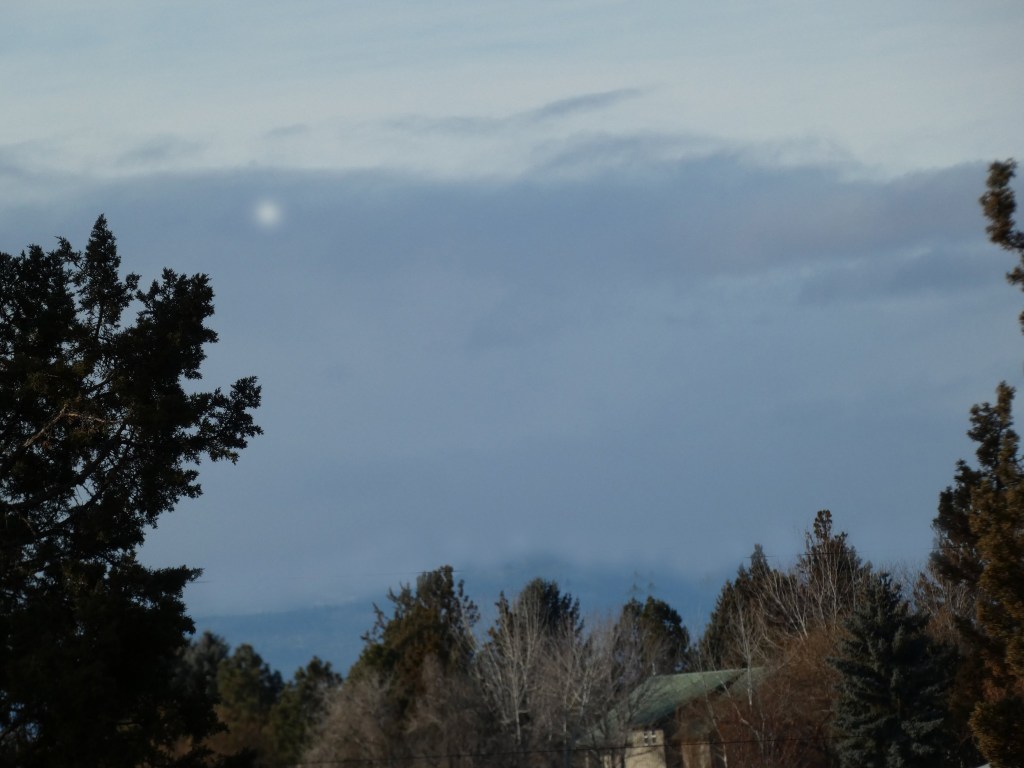
This morning feels like a quiet weight. Central Oregon still is hushed beneath a thick inversion layer—and my small world seems held in suspension—deeply still. I almost hear the air breathing as it freezes. I know that heavy fog will erase the Cascade Mountains from the horizon and leave my few acres monochromatic. I know that now the junipers are shadowy sentinels, half-seen and half-imagined.
I’m standing at a window and holding a cup of steaming coffee—and, almost seeing the stubbornly cold air. Frost coats juniper branches and grass blades, and soon, the sun will struggle to rise—pale and ghost-like—trying to burn through the low mist.
Despite this chill, there’s a necessary routine of feeding my horses. In this still darkness, layered in snow pants, a thick sweater, and my heaviest coat, I step outside—into a muffled world. The usual neighborhood sounds are absent; there is only the sharp, rhythmic crunch of frozen earth beneath my boots. I move slowly through this morning’s blurred edges.
The horses are waiting, their whiskers white with ice and their patience thinned by hunger. I hurry through the usual labor—cleaning stalls, filling water buckets, and hauling fresh, sweet hay into the barn. It is work, but offers a few brief, pleasant moments of focus, too. Free of other concerns for the moment, I’m considering this weather inversion, hoping the fog will lift soon and normal clouds return.
Once I have settled the horses, I pause awhile. I listen. Few sounds are as satisfying as the steady, rhythmic grinding of horses chewing—watching them, wholly relishing their meal, is fun, too.
It’s time to turn back toward the house. I crunch across the frozen ground. My dogs, cat, and birds are waiting for their breakfast. Only after caring for them will I prepare for my part-time job.
This is how most of my days begin—as dependably as our January freezes—and regardless of any other weather conditions.
At first glance, I was certain I knew what I was seeing.
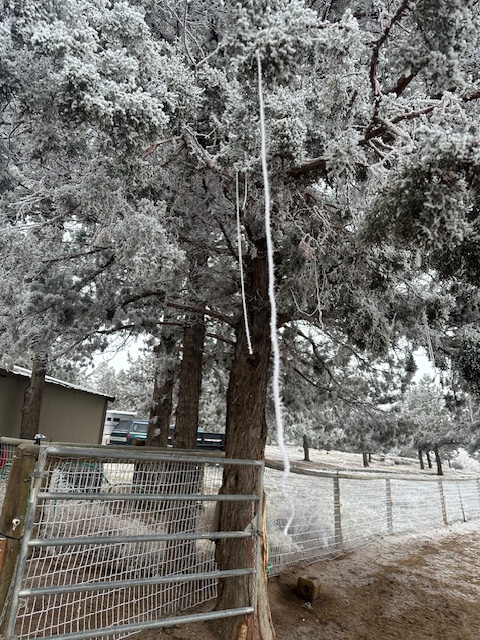
Two pale strands hung straight down from the branches of a juniper, each coated in frost. They were white, linear, and unmistakably rope-like. Our minds are quick that way. They reach for the nearest familiar explanation and settle in. We just go with it.
Like me, then—not questioning whether the frosty objects were rope, only wondering how they had gotten there. I reached up to pull one strand free from its branch, and in that instant, the scale shifted.
In my fingers, what had looked sturdy immediately shrank into something improbably delicate. I expected resistance. Instead, frost slipped away, and I found myself trying to grip emptiness. I paused and looked more closely.
You’ll never guess what I discovered. The “rope” I was trying to hold was a single hair from one of my horses’ tails. Looking up again, I noticed several similar strands—long, pale, impossibly fine—each thickened by frost and hanging, rope-like, from the branches.
The experience startled me. These fine hairs had likely been carried aloft by nest-building birds, caught by chance in the tree, and layered again and again with ice. The moment felt slightly dramatic and, at the same time, utterly ordinary. I had misread the evidence—and it had been astonishingly easy to do so.
I’ve been thinking about deciding and misassuming. These happen more often than we realize. We believe we’re seeing what’s there, when instead we’re seeing what our experience tells us ought to be there. Our brains—efficient and decisive—are always working to help us make sense of things quickly.
But efficiency may also be a kind of blindness. When we label something too fast and move on—without lingering long enough to reconsider—we miss the chance to see it differently.
The object I mistook for rope wasn’t merely a variation of what I expected; it belonged to an entirely different category of reality. It was something once living—shed, carried, and repurposed by chance.
Only later did my mind begin to imagine a quiet collaboration among animals, weather, and time—a whole story I had nearly missed before I paused, looked again, and wondered.
This experience reinforces something I’ve been learning: that deciding well often requires more than one look. Not because first looks are careless, but because they are incomplete. The longer I live, the more I understand wisdom as less about sharp eyesight and more about patience. Wisdom is staying a little longer with what we think we understand, allowing ourselves to be surprised by what else might be there.
Here’s today’s small example. A single strand of horse tail hair is usually barely visible. Yet here were several, transformed—fluffed with frost and suspended in front of me. I mistook them for rope. I tried to pull one down. Instead, I learned again that what appears solid may, upon re-examination, be lighter, finer, and less obvious than we first believed.
Seeing—really seeing—asks us to pause, reconsider, and sometimes admit that our first understanding was wrong. That lesson, offered by a few horse hairs, humbled me. And because of what it taught, it was also comforting.
If something as slight as a single horse tail hair can—against all odds—hold its place in the world, suspended and briefly transformed, then perhaps our own uncertainties deserve a little more time in the light as well.
Taking more time means looking again. Reflecting longer. It’s a practice that can help move our perceptions closer to what actually may be there.
Several weeks ago, after leaving my sales job in a large retail department store, I turned my attention back to a long list of needs waiting at home. I contracted for a new roof, got long-overdue electrical repairs done, and—perhaps in the biggest emotional task of all—helped my beloved donkey, Pimmy, transition to her new home.
Fortunately, that new home is nearby and I visit often, which softens the bittersweetness. Pimmy is a “special needs” pet, living with Cushing’s disease and Type II diabetes. Over the past year, I carefully managed her diet, and she lost nearly 200 pounds. She now looks bright, alert, and almost youthful again.
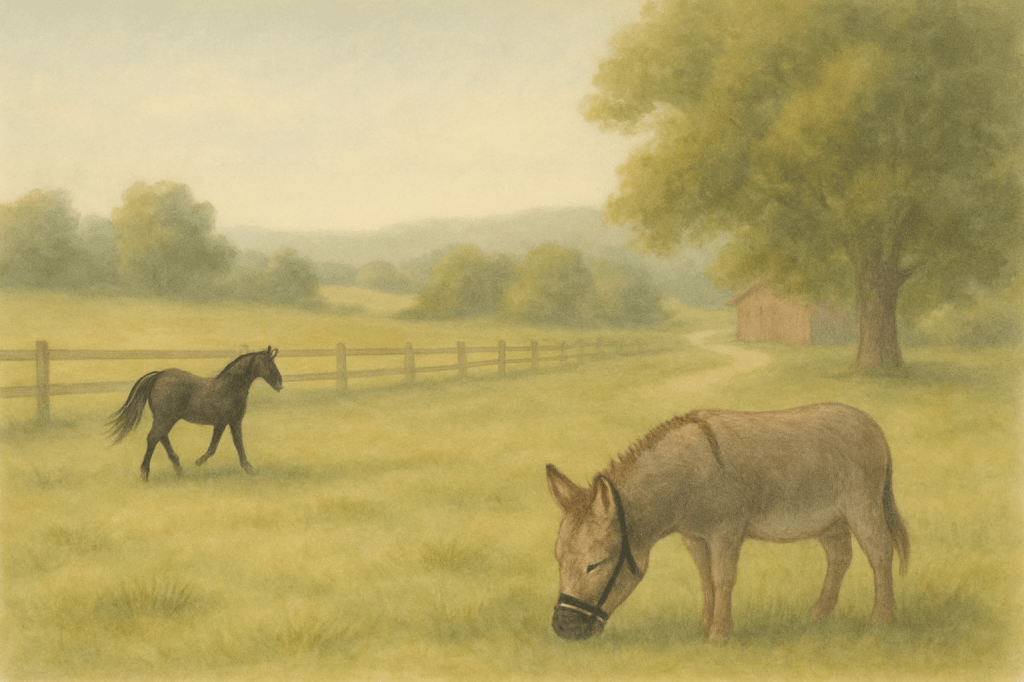
Her “new person” is a retired nurse—gentle, steady, and knowledgeable—who understands Pimmy’s conditions and is both vigilant and deeply caring. Pimmy now wears a grazing mask and spends her days roaming a generous pasture with her new buddy, an aging Arab gelding. The regular movement is doing wonders: she’s walking more freely, her energy has lifted, and her coat is turning fluffier and shinier, as if she’s growing into a chapter all her own.
Meanwhile, life with my two horses has kept me just as busy. With Pimmy settled, I turned to repairing fencing, cleaning the barn, and making a few improvements to the horses’ living space—projects that had been quietly waiting for months. Horses have a way of creating their own to-do lists, and mine certainly did.
Rosie, who is sturdy but sometimes finds trouble, managed to develop a hoof abscess. It needed soaking, wrapping, and all the fussing Rosie insists on not enjoying. And Sunny—sweet, distractible Sunny—somehow scraped a surprising patch of fur off her face. No dramatic story, just the everyday mysteries of horse life. Between meds, bandages, and gentle reassurance, they’ve needed both hands-on treatment and the simple comfort of my presence.
All this work has kept me grounded, but I’ve also become aware of another familiar pattern: the slow return to isolation whenever I stay home long enough. It’s not that I don’t love being here—keeping the property in shape, caring for the animals, tending to the endless little realities of country life. I do. Yet after a while, I begin to miss the hums of human life. Conversations. Laughter. The ordinary noises people make while going about their day.
So, I decided to rebalance things. For this Christmas season, I’m taking a part-time job at a fast-moving retail discount store. A few short shifts each week will give me a little of the outside world again—energy, chatter, and a constantly changing flow of faces. And, for reasons I can’t entirely explain, I have a growing curiosity about retail as an industry. Now that I’ve learned how a traditional department store operates, I’ve also wanted to understand how the bulk discount retailers run their show. My new seasonal role will give me a chance to find out.
What I’ll ultimately do with my expanding retail knowledge is anybody’s guess—mine included. Maybe it will simply satisfy my curiosity. Maybe it will help me better understand the rhythms of modern commerce. Or perhaps it’s just another way of staying engaged with a world that keeps shifting under our feet.
For now, it’s enough that this will get me out among people again—listening, learning, and feeling connected—while still allowing me to come home to the animals and land that make up the heart of my days.
Years ago, I suddenly lost my young and adorable Welsh Pony, Merry Leggs. She had been stricken by severe colic, and afterward, for weeks, I sat at a computer, fighting my incredible unhappiness by creating a story for young readers that starred a Welsh Pony.
My lead character, Miss Merry, was pretty, intelligent, and devoted to her family. She was courageous, too, and had many adventures. After initially drafting the story, I continued working on it; gradually, it felt reasonably compelling and maybe worthy of publishing.
A couple of drafting components didn’t go smoothly. Most critically, I couldn’t successfully edit my own creative writing. Upon attempting to make a sentence or paragraph more relevant and stronger, I’d find myself, instead, rewriting whole sections, altering the story’s flow.
My inability to self-edit demanded an outside objective editor, and Merry’s story increasingly called for an illustrator. Talented assistants weren’t available for what I could afford: $-Zero. Little Miss Merry eventually floated into the background and drifted from my active memory. I suppose that happened after I overcame my pony loss enough to move on.
Until yesterday, when a bright young colleague, Lily (who recently introduced me to Chat GPT+), suddenly asked if I’ve ever written fiction, I nodded and complained about self-editing until Lily pointed out Chat’s editing capabilities.
Later, I was thinking about Chat’s abilities and suddenly remembered “Miss Merry.” It needed editing and illustration—both are Chat’s capabilities. Additionally, Lily, a makeup specialist, has artistic skills and expresses interest in perhaps working with the story.
Gosh! A dozen years later, “Miss Merry” might be reborn. First, I must locate the saved story—probably on a disc or a thumb drive. Finding its location is one head-scratcher, and accessing a complete version may be another.
I’ll be off my part-time job today and looking for Merry.
Dear Friends: Revisiting my sweet pony vis-a-vis her alter ego–thrilling! Diana