
Monday, February 09, 20-26
Geography’s “Quiet Pressure” Points
Continuing my long look at the geographic world, I see that certain places repeatedly surface—glowing, though small on the map. Taiwan and Greenland. Neither is large nor loud—yet each carries geographic weight—pressing heavily on the ambitions of powerful leaders.
Taiwan: An Island That Blocks A Giant
Taiwan commands political attention—as a symbol—democracy versus authoritarianism, and independence versus reunification. Geographically, however, its meaning runs deeper and is far less negotiable.
Taiwan—historically known as Formosa—sits just off China’s coast, anchoring what strategists call the first island chain. This chain of islands stretches from Japan, through Taiwan, and south toward Southeast Asia. It forms a natural barrier—it limits China’s direct access to the open Pacific Ocean. In this sense, Taiwan isn’t merely an island—it’s a gate.
China’s eastern coastline faces the Pacific, one of the world’s most economically vital seas. Unrestricted access to that ocean matters commercially, militarily, and psychologically. Taiwan’s location complicates China’s access. As long as Taiwan remains separate—and especially if it’s aligned with Western powers—China faces persistent geographic constraints.
Absorbing Taiwan, therefore, isn’t a passing political goal; it’s near the center of long-term Chinese strategic thinking. Control of Taiwan would transform China from a regionally constrained power into a fully Pacific one. Geography explains why that objective has survived leadership changes and rhetorical shifts. Taiwan’s position makes it an enduring prize.
This is what makes geography strategically persistent. It does not impose deadlines. Instead, it creates patience.
Greenland: Ice, Distance, and “Future Mapping”
Greenland usually appears on maps as vast, frozen remoteness—far removed from daily concerns. But its geography suggests otherwise.
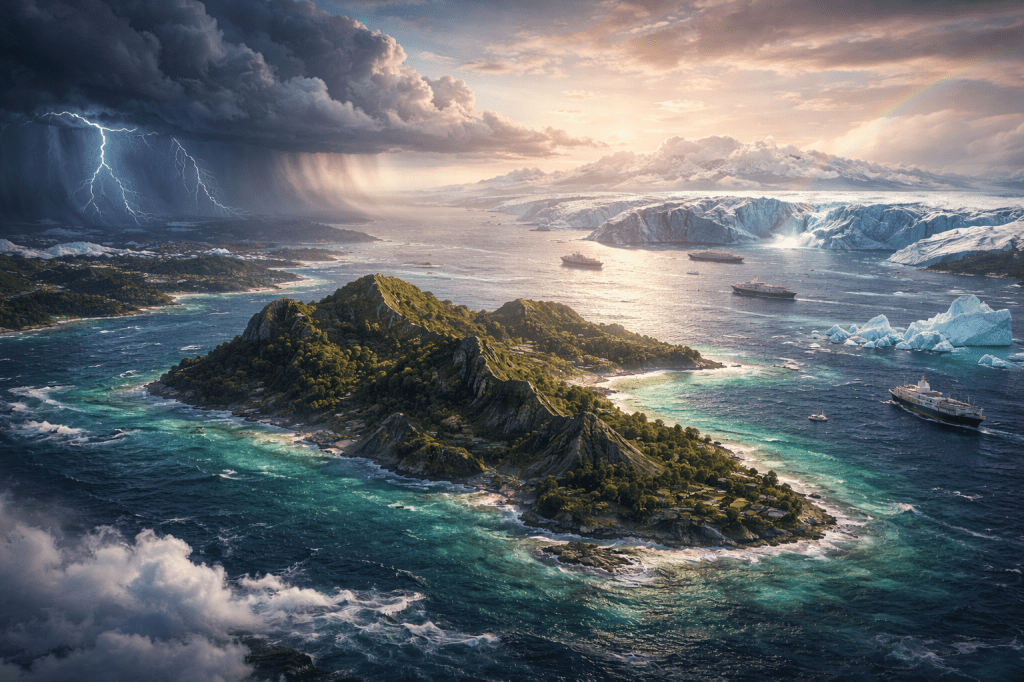
Greenland’s position, astride the Arctic, is where rapid climate change is redrawing the map. As the ice recedes, new shipping routes are emerging—and shortening distances between Asia, Europe, and North America. Beneath Greenland’s ice lie rare earth minerals—critical to modern technologies and military systems. Above it lies airspace essential to missile detection and early-warning systems.
Geographically, Greenland is becoming less peripheral. Climate change is making it central to future power balances. Major powers—the United States, Russia, and China—increasingly are attentive to the Arctic.
Greenland’s geographic position offers strategic advantages—emerging trade lanes and defense systems—drawing sustained interest, regardless of political intentions or stated values.
Its population is small, and its voice often overshadowed—but its geography refuses to be ignored.
Geography Outlives Beliefs
Taiwan and Greenland illustrate an uncomfortable truth: ideologies rise and fall—geography does not. Leaders change, slogans evolve, and moral frameworks shift—but landforms, coastlines, choke points, and distances remain largely fixed across generations.
Ambitious and aggressive states “hear” geography as a constant reminder—both of opportunity and vulnerability. Over time, repeated geographic pressures can harden into conviction—and conviction, when paired with power, tends toward action. Even when war feels unthinkable, it remains possible. Geography helps explain why.
Studying geographic conditions will not make us safer. But it can reduce surprise. It can help us sense building pressures before they erupt—and understand why certain places, no matter how small or remote, glow steadily on the map.
[For readers who prefer receiving these morning pieces by email, I’m also publishing them on Substack.]
— Diana

 Diana's Morning Blog