Letting Go, Mending, Learning

Tuesday, December 09, 2025

Several weeks ago, after leaving my sales job in a large retail department store, I turned my attention back to a long list of needs waiting at home. I contracted for a new roof, got long-overdue electrical repairs done, and—perhaps in the biggest emotional task of all—helped my beloved donkey, Pimmy, transition to her new home.

Fortunately, that new home is nearby and I visit often, which softens the bittersweetness. Pimmy is a “special needs” pet, living with Cushing’s disease and Type II diabetes. Over the past year, I carefully managed her diet, and she lost nearly 200 pounds. She now looks bright, alert, and almost youthful again.

Her “new person” is a retired nurse—gentle, steady, and knowledgeable—who understands Pimmy’s conditions and is both vigilant and deeply caring. Pimmy now wears a grazing mask and spends her days roaming a generous pasture with her new buddy, an aging Arab gelding. The regular movement is doing wonders: she’s walking more freely, her energy has lifted, and her coat is turning fluffier and shinier, as if she’s growing into a chapter all her own.

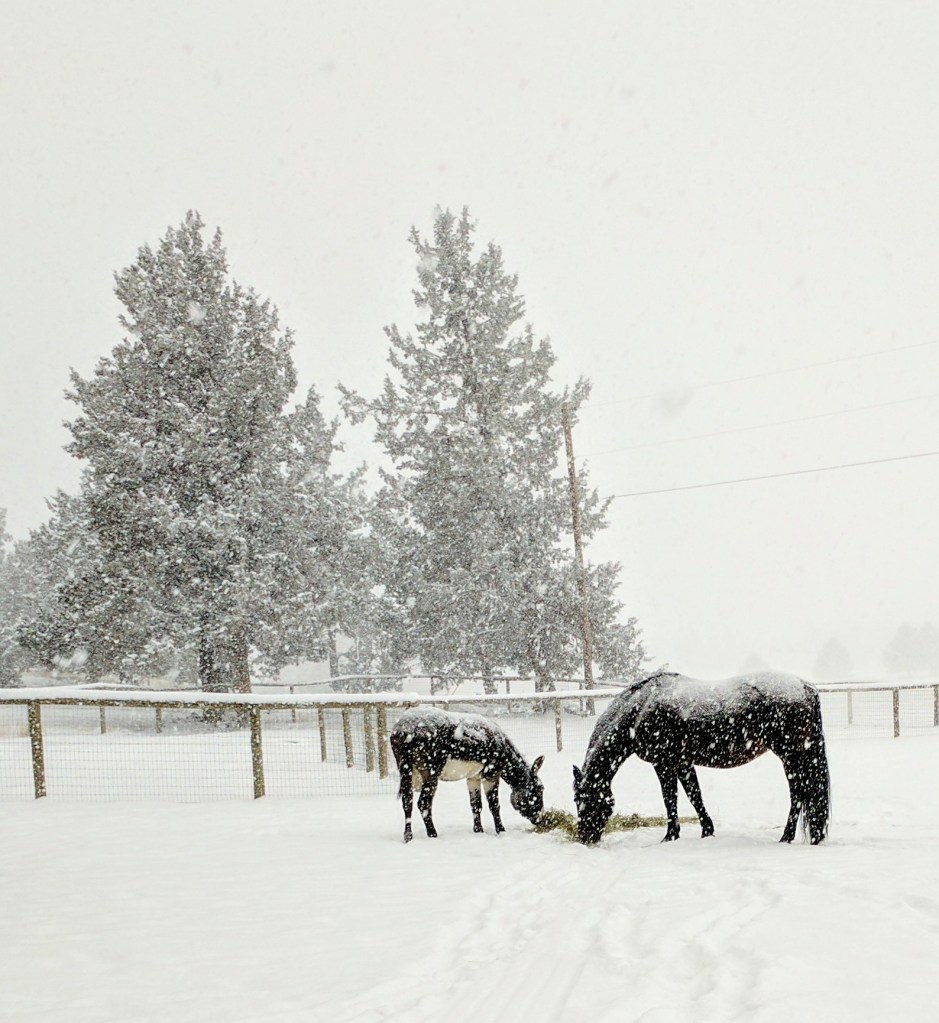
Meanwhile, life with my two horses has kept me just as busy. With Pimmy settled, I turned to repairing fencing, cleaning the barn, and making a few improvements to the horses’ living space—projects that had been quietly waiting for months. Horses have a way of creating their own to-do lists, and mine certainly did.

Rosie, who is sturdy but sometimes finds trouble, managed to develop a hoof abscess. It needed soaking, wrapping, and all the fussing Rosie insists on not enjoying. And Sunny—sweet, distractible Sunny—somehow scraped a surprising patch of fur off her face. No dramatic story, just the everyday mysteries of horse life. Between meds, bandages, and gentle reassurance, they’ve needed both hands-on treatment and the simple comfort of my presence.

All this work has kept me grounded, but I’ve also become aware of another familiar pattern: the slow return to isolation whenever I stay home long enough. It’s not that I don’t love being here—keeping the property in shape, caring for the animals, tending to the endless little realities of country life. I do. Yet after a while, I begin to miss the hums of human life. Conversations. Laughter. The ordinary noises people make while going about their day.

So, I decided to rebalance things. For this Christmas season, I’m taking a part-time job at a fast-moving retail discount store. A few short shifts each week will give me a little of the outside world again—energy, chatter, and a constantly changing flow of faces. And, for reasons I can’t entirely explain, I have a growing curiosity about retail as an industry. Now that I’ve learned how a traditional department store operates, I’ve also wanted to understand how the bulk discount retailers run their show. My new seasonal role will give me a chance to find out.

What I’ll ultimately do with my expanding retail knowledge is anybody’s guess—mine included. Maybe it will simply satisfy my curiosity. Maybe it will help me better understand the rhythms of modern commerce. Or perhaps it’s just another way of staying engaged with a world that keeps shifting under our feet.

For now, it’s enough that this will get me out among people again—listening, learning, and feeling connected—while still allowing me to come home to the animals and land that make up the heart of my days.

— Diana

Pimmy’s New Beginning

Sunday, November 30, 2025

My middle-aged donkey, Pimmy, may soon be living in a new home. It’s bittersweet to even write that, because the past year with her has been so intense, so emotional, and so full of learning.

Pimmy’s health crisis last year took me completely by surprise. I was unfamiliar with Cushing’s disease in equines, let alone equine Type II diabetes. By the time I understood how sick she truly was, she needed to be hospitalized in an equine ICU—days of specialized care, IVs, monitoring, and the kind of worry that settles in your bones.

When she finally came home, it was with lifelong medical needs: daily medication, careful feeding, and the responsibility of helping her lose nearly 100 pounds. At first her treatment routine was twice a day, and eventually it shifted to once daily, but the vigilance and devotion never lessened.

Through it all, Pimmy remained sweet and willing—devoted to “her horses,” Rosie and Sunny, even when I had to separate her from them so she wouldn’t overeat. They stayed close, calling to each other over the fence, a small reminder of their bond. I became unexpectedly proficient at mixing medications and administering them to a donkey who had her own opinions about anything that didn’t involve hay. And each time I walked toward the barn, she greeted me with hopeful, hungry brays—touching, funny, and a bit heartbreaking.

But she adapted, and so did I. Over the year, Pimmy lost the weight she needed to lose. She looks wonderful—bright-eyed, balanced, and healthy. Somewhere along the way, this stubborn little donkey transformed into “my big puppy,” easy to handle, affectionate, and smart as all get-out.

Through her recovery, my biggest worry remained her future. Donkeys, when well cared for, can live forty years or more. At my age, I know I won’t be here for the whole arc of her life. Rehoming her has weighed heavily on me. Anyone responsible for Pimmy would need to understand the realities of a “special-needs” donkey—the monitoring, the daily medication, the vigilance around weight. Not everyone can take that on. But for the right person, the reward would be immense. Pimmy, in my fully biased opinion, is one of the sweetest donkeys on the planet.

And then, early in Thanksgiving week, something unexpected happened.

A nearby neighbor, Alison—someone I only vaguely knew, though I knew she was a horseperson—texted me out of the blue asking if she and her husband could come talk. After so many years living near each other, I had no idea what she might want.

They arrived and told me their old horse had recently died, leaving their remaining elderly gelding lonely and unsettled. Softly, and very respectfully, they asked whether they might “borrow” my donkey for a few weeks as a companion until they found another horse.

Because they’re experienced with horses, they already understood the essentials of Pimmy’s care. They played with her, scratched her in all her favorite places, and fell for her immediately. And without much hesitation, we made an agreement: Pimmy would go to their place as a companion. If they loved her—and if they could manage her medical needs—she could stay permanently.

A remarkable part of this is that Alison, besides being a lifelong horsewoman, is a recently retired nurse. She understands chronic conditions; she’s comfortable with medications and observant about details. She asked the right questions, noticed everything, and handled Pimmy with a calm confidence that reassured me instantly.

Yesterday, Alison returned with several friends who were excited to meet Pimmy.

We all escorted Pimmy, who wore a grazing muzzle, as we had to walk across a pasture, to meet the elderly gelding. Those two hit it off right away. And, everyone adored Pimmy—her sweetness, her curiosity, her gentleness. I watched her step into this new circle of people and animals and felt the full bittersweetness of those moments.

Letting go of a beloved companion is never easy. She has been part of my daily rhythm, part of my barnyard family. But alongside the ache, I could feel something else—relief, gratitude, and a genuine joy. I could see clearly that Pimmy was stepping into a home where she would be appreciated, understood, and deeply cared for.

It felt like the universe whispering, Here. This is the right place. This is the right time.

That it’s Thanksgiving season, too, has me feeling a special mixture of gratitude and humility. Gratitude that Pimmy is healthy and happy, that the right people appeared at precisely the right moment, and that she will be cherished in her new home. And, humility in realizing that letting go—when it’s done with love—is also an act of giving care.

Pimmy will always be an essential part of my story. But now she belongs to a new one, and that’s bringing me a quiet, hopeful peace.

(Note: The photos, “moments of transition,” were captured by our friend, Susie.)

— Diana

Creative Longing

Saturday, November 29, 2025

I keep wondering why certain objects can hold such power over me. They’re not things that glitter or impress. But cameras. And computers. Tools that can capture images or help me shape words. Tools that let me look more closely and think more deeply.

Yesterday, on Black Friday, I impulsively purchased a lightweight laptop—an extravagance I can’t quite justify, and one I’ve argued with myself about since clicking “Buy.” At the same time, I felt a strong tug toward using my camera more often. Something is dawning on me: I’m not really longing for the gadgets themselves. I’m longing for what they represent—seeing and understanding.

For as long as I can remember, I’ve been drawn to anything that helped me make sense of the world. I was a confused, unhappy youngster who studied people’s faces, their gestures, the tiny habits that revealed who they were. I was always searching for clarity.

My adulthood carried the same pattern—observing and learning through books, conversations, history, and the complicated turns of human nature. And for many years now, I’ve written almost daily, using words as a way to understand the world around me.

Underneath all of this—beneath the reading, the writing, the curiosity, the endless blog posts—is a quiet truth: I look because I want to see. I write because I want to understand.

So when that high-end laptop appeared in the Black Friday ads, something in me stirred. Something hopeful, almost childlike. I brushed aside my doubts and ordered it—not because I needed a new computer, but because I wanted the possibility it represents: mobility, clarity, freedom to explore ideas wherever I happen to be.

In realizing this, my doubts have softened. The laptop has even renewed my interest in photography. Not in “taking pictures,” but in pausing long enough to truly notice something—
a slant of morning light,
frost edging a fence board,
the expression on a horse’s face.

A camera grants permission to look a little longer, to silently declare that this moment matters.

The new laptop is on its way, and the battery for my camera is charging. Yes, the laptop is a luxury—I already have a perfectly good one—but it isn’t lightweight enough to carry with me. And at this stage in life, I’m finally admitting something simple: some people crave adventure or entertainment; I crave clarity.

It’s no surprise, really. Part of it comes from where I began, still seeking the clarity I never had as a child. That clarity now comes from noticing, reflecting, and catching the fleeting things that daily responsibilities make easy to miss. It grows as I put words to feelings and capture images that echo something within me.

These yearnings aren’t weaknesses or indulgences. They’re my learned way of staying awake to the world—choosing what my mature eyes and mind want to truly see.

Yes, I’m “wasting” money in a sense. Tools come and go. Cameras break. Laptops age. But the more profound desire—to see, to understand, to express—has never faded. These threads have run through my life for decades, woven into my work, shaping my aging years, and helping me rebuild after losses. They’ve colored every blog post I’ve written.

I keep reaching for creative tools not because I want more possessions, but because I need ways to follow the parts of myself that still want to grow.

So my impulsive purchase isn’t wasteful after all.
It’s a way of keeping my inner world alive and bright—
one image, one insight, one small moment at a time.

Diana

Thanksgiving 2025

Thursday, November 27, 2025

In the very early hours on this Thanksgiving Day—and somewhere between drifting out of sleep and deciding to get out of bed—I found myself thinking a great deal about my mother. Not about her holiday meals or the rituals of past Thanksgivings, but about something quieter and far more enduring: her creativity, especially as she expressed it, in her clothing choices.

She had a way of dressing that was a little unusual for “those days.” People might have called her overdressed or a touch too polished for everyday life. Yet if she were strolling into a department store today, she’d simply be called stylish—bold, intentional, and entirely herself.

My own style has wandered a long road. During my working years in the corporate world, I wore the expected uniform: suits—navy, brown, black—paired with conservative tops and sensible pumps. Nothing daring, nothing loud, nothing to draw a second glance. I wore a kind of professional armor—respectable, reliable, and utterly unremarkable.

When retirement arrived, I traded corporate life for horses—beautiful, messy, mud-slinging horses. My “style,” if one could call it that, became functional layers, dusty denim, barn jackets, and shirts no longer resembling their original colors. Horse life doesn’t care about fashion; it cares about surviving the elements and getting hay out of your clothing and hair. I spent years happily dressed in what was only describable as rags-with-purpose.

It wasn’t until much later, when I found a job in retail, that I realized how far I’d drifted from any real sense of style. Surrounded suddenly by fabrics, mannequins, new arrivals, and customers asking for advice, I felt nudged to re-engage—to look again, learn again, and find my footing in a world I had set aside.

And that’s when my long-past style influencers quietly began resurfacing.

I found myself drawn to earlier icons—especially the simplicity of Chanel, her confident elegance, and her refusal to apologize for beauty or individuality. I re-discovered that Chanel’s originality speaks to me, still, even after all my years of practicality and barn dust.

One of the more “interesting” designers who followed in Coco’s House of Chanel was Karl Lagerfeld. I discovered his bold creations after starting to work in retail. At first, I disliked them wholeheartedly. Karl loved to scrawl his name with messages from Paris all over his designs. I swore—loudly to myself—that I would never wear a garment plastered with an egotist’s name and scribbles.

Until, on a whim and unable to resist, I brought a pair of Karl’s Jeans—they had large and rhinestone-encrusted cuffs. I finally got up the courage to wear them in public—and found my jeans becoming noticed up and down the street—greeted not with laughter, but with appreciation. Real appreciation. For their sparkles, their boldness, and mostly, the humor of it all.

After that, I softened—began studying “the Karls.” I’d try on a piece or two and, after that, buy one and wear it in public. I discovered that being noticed could feel…fun. Beneath it all, though, my clothing choices always drifted back to clean and timeless Chanel lines—ones my mother would have admired.

So early today, my mind wandered to fashion—my mother appeared as my guide. At first, her presence confused my drowsy self, until I realized that she had been my guide—the style influencer that I never fully recognized, until now.

Here, in my later years. While reflecting sleepily on my recent journey in retail and hearing my customers ask, “What is my style?” (and asking myself, what’s mine?), I could see myself gradually viewing “something called style” differently. Most importantly, this morning, I understood how I’ve learned to appreciate what my mother quietly handed down to me.

Today, I’m thankful for all these—for the subtle inheritance of taste, for the courage to express myself, and for a mother whose sense of style found its way back to me—long after I thought I had left it behind.

Happy Thanksgiving!

— Diana

The “Third Thirty”

Wednesday, November 26, 2025

My advanced age has me thinking a lot about our aging years—and not as times of decline, but as times of progression. They’re another movement—and a series of choices we can make about who we’re becoming.

Recently, I listened as an “old friend,” Jane Fonda, spoke about believing that our lives unfold in three acts—and emphasized that each act lasts 30 years. Her ideas struck me immediately, both for their simplicity and for their accuracy.

In Fonda’s model, our first thirty years are a period of discovery, in which we figure out how to live, work, love, and become thoughtful about ways to survive our mistakes. Our second thirty years are a period of responsibility, in which we build careers, raise families, create homes, deepen commitments, and steady ourselves. And then—if we’re fortunate—we enter our third thirty years. Then, after sixty, we can finally look backward with clarity and also look forward with intention.

I am adopting Fonda’s view. She’s refusing to “get old” in any traditional sense. She doesn’t deny the body’s changes or the brevity of time ahead, but instead, suggests that by sixty, we’ve gathered enough wisdom to see our remaining years as something like a design project. That’s a new span of years for us to use, to edit, refresh, and refine—much like a cherished home or garden—which we finally have time to tend properly.

I agree with her, and I get her point—that each of us arrives at our third thirty carrying the sum of our experiences. She says that point represents our lessons learned: the habits that kept us going, the relationships that shaped us, and the courage we’ve gained the hard way.

What’s remarkable about our third stage is the sense that we’re not simply living out our remaining years—but actively shaping them. We’re deciding who we want to be in our third act. We might want to be identifiable—and thus, stylish or invisible, curious or complacent, engaged or withdrawn.

The old ideas about “not getting old” harken back to times when people tried to pretend they were younger than they were. Instead, new ideas about getting old have everything to do with staying current, interested, and actively in one’s own life.

Like Fonda, I want my style to say I’m still here. I want my choices to reflect a mind that’s awake. I want to use what I’ve learned from my first sixty—or eighty—years in ways that open and make my third stretch feel richer and more spacious—and maybe even more joyful.

It’s a relief to find myself thinking this way! To be imagining my third-thirty as not needing to be a “fading-out,” but instead be a revision—a reinvention—and a “creative third act.”

How extraordinary that the cycles of aging can lead to and allow us this—a moment when we have finally shed enough expectations to become more fully ourselves.

I sense others around my age feel similar rumblings. A sense of not being finished—not even close. Jane’s view captures what our third-thirties are meant to be—a time to show up dressed, interested, and ready to be the next version of ourselves.

— Diana

A “New Aging” Conversation Circle

Saturday, November 22, 2025

Imagining The Circle

In my mind, the group isn’t large. Maybe six to twelve people—enough for richness, but small.

I’ve written recently that those of us in our 70s, 80s, and 90s may be discovering that we’re living in moments no one could ever have prepared us for. These days, we find ourselves living healthier longer, staying mentally alert longer, and remaining deeply engaged with the world longer—way beyond what earlier generations ever imagined. Our younger society hasn’t yet recognized all the changes affecting its oldest population. These changes are personal, complex, sometimes isolating, and often surprisingly similar among people of advanced ages.

Writing has made me consider such “elderly biological and cultural shifts” more deeply. I’m even imagining what it might “look like” to gather with others also navigating the new territories of aging. I’m not visualizing a formal club or a structured workshop—just a thoughtful, recurring space to talk about our “inner lives of growing older” in today’s world.

What A Group Might Feel Like

In my mind, such a group isn’t large. Maybe six to twelve people—enough for richness, but small enough for real conversation. A circle of chairs, not rows. A living-room feel, not a classroom. Perhaps it would meet monthly or every few weeks, with no obligation beyond showing up and being oneself.

There needn’t be a leader in the traditional sense—it’s more of a shared stewardship. A group that could gently guide itself, the way good conversations naturally do. Meetings might center on topics. One might be the surprise of still feeling young inside. Others might explore purpose, or changing friendships, or the odd friction between staying capable and being treated as fragile.

The group wouldn’t represent therapy, nor serve as a complaint circle. It’d be a place to name what today’s aging really feels like—and to hear others say, “I’ve felt that too.”

This Matters Because

We’re the first aging generation to find that, while living this chapter of life, we’re also having to invent this chapter. We’re the first generation to be alive for decades of healthy years beyond traditional retirement. And we’re the first generation needing to reconcile our longer lives against an outdated cultural script that still imagines “old age” as it looked fifty years ago.

Our task—to pioneer and modernize the aging experience, may feel easier—and richer—when it’s shared.

This is a suggested “conversation circle” of elderly participants—not a way to solve the larger social issues of aging. It could, however, illuminate them, while also offering grounding, connection, humor, and clarity. It could help participants understand ourselves in ways we don’t always get to while navigating the advanced years alone.

For now, it’s just an idea I am sketching—an outline—a possibility. If others feel the same pull, perhaps it will take shape. As with most meaningful things in life, maybe energy will start to gather around it.


For The “Interested Some”


What’s this group about?

It’s a small, recurring conversation circle for people in their 70s, 80s, and 90s who want to talk about the inner experience of aging in today’s world—identity, purpose, vitality, ageism, relationships, curiosity, and what it means to be living longer and healthier than previous generations. (Okay, too, if people in their 60s wish to participate.)

Is this a support group or therapy?

No. It’s not a therapy or counseling group. It’s a thoughtful discussion circle—more like a gathering of peers who want to explore life’s later years with honesty, humor, and insight.

How big will the group be?

Small—ideally 6–12 participants. Big enough for varied perspectives, small enough for everyone to speak and feel comfortable.

Who leads the group?

There is no formal “leader.” The group guides itself. One person may help keep time or open the meeting, but the conversation belongs to everyone.

What kinds of topics will we discuss?

Topics may include:

  • staying healthy and active
  • experiences with ageism
  • identity shifts and reinvention
  • loneliness, friendship, connection
  • unexpected confidence or creativity
  • memories that take on new meaning
  • the realities of energy, motivation, and purpose
  • navigating losses while also discovering new growth

Every meeting may have a theme, but there will always be room for whatever people bring that day.

How often will the group meet?

Most likely once a month or every few weeks, depending on what the group decides.

Is there a cost or commitment?

No cost. No long-term commitment. Just come when you feel drawn to the conversation.

Do I have to talk?

You’re welcome to speak as much or as little as you wish. Listening is also a valuable form of participation.

What would the atmosphere be like?

Warm, respectful, curious, confidential, and welcoming. A place where no one is judged for aging in their own way. A place where humor is welcome and honesty is valued.

I’m interested and a Central Oregonian; so, what now?

Simply share your name and contact information to let me know you’d like to be included as the idea takes shape. Once enough people express interest, we’ll choose a meeting time and place.

— Diana

A Space For The “New Aging”

Friday, November 21, 2025 (DRAFT)

Thoughts About Community

In my last post, I wrote about what it feels like to live in my mid-80s with health, clarity, and purpose—something I never imagined experiencing decades ago. The more I reflect on this unexpected stage of life, the more I notice something important: people my age are living through a transition that no generation before us has experienced.

We are healthy longer.
We are active longer.
We are present in the world longer.

And yet, it seems that almost no one talks about what this actually feels like.

A Missing Conversation

In recent months, I’ve noticed how often folks around my age quietly share stories with me that echo my own:

  • being underestimated because of age
  • feeling “out of sync” with stereotypes
  • balancing independence with shifting social expectations
  • managing losses while also discovering new energy
  • feeling invisible and visible at the same time

These conversations usually happen in corners—in my retail job while speaking with customers, or spontaneously during errands or in spaces between tasks. They’re brief, spontaneous exchanges that end with, “I’m glad we talked about this.”

I’ve been wondering why there isn’t a regular place for people in their 70+ years to have such deeper conversations openly. Not about illnesses or medications—that’s already been done. I mean about the life side of aging: identity, purpose, invisibility, curiosity, grief, reinvention, and the strange thrill of still being very much here.

A Thought That Keeps Returning

What if there were a small group that gathered—say, weekly or monthly—simply to talk about what it’s like to live in these later years with awareness and vitality? That would be creating a setting where age isn’t the topic so much as the lens.

This could be a group that sees aging not as retreat, but as a frontier.

This idea isn’t about therapy or advice-giving. It’s more like a conversation circle—thoughtful, warm, respectful, and open. A place where people who are navigating this unfamiliar terrain can compare notes, share insights, and feel understood.

But Here’s the Truth

The thought of organizing such a group overwhelms me a bit. Maybe that’s because it feels larger than one person. It feels like something that should grow naturally, not through pressure or obligation.

Yet the need keeps nudging me. It’s as if something in our culture is waiting to be named—and conversation is often how naming begins.

Maybe the Group Begins Here

So for now, I’m simply writing about it—opening the idea—to the air—to see if it wants to take a shape and what that might be like. Perhaps others will feel the same pull, and maybe a few voices will gather. Maybe such a group will form itself, slowly and organically, the way meaningful things often do.

I’m not ready to declare myself the leader of anything. But I am ready to acknowledge that many of us—living longer, living differently—are hungry—for a place to speak, to listen, and to understand this unexpected chapter together.

This post is simply a beginning.
A seed.
A space held open.

And we’ll see what grows from it.

— Diana

In My 80s: A New Kind of Frontier

Thursday, November 20, 2925

I’ve been thinking about what it means to be in my mid-80s—healthy, clear-minded, deeply involved in daily life—and how strange and surprising this stage feels compared to what I imagined many years ago.

The truth is, I never pictured myself “here.” Growing up, I didn’t know a single person in their 80s who was still vibrant, working, and engaged. Most older people I saw (even in their 60s) were frail or withdrawn, already living in the narrow, expected lane that society has quietly painted for “seniors.”

But today’s medicine has changed dramatically. So has nutrition, lifestyle science, and our understanding of the mind. Something new is happening: people are living longer and staying healthier. We’re extending not just lifespan, but healthspan. And those of us who find ourselves active and well in our 80s are, in a way, pioneers. We’re the first generation who must learn how to inhabit this expanded stage of life—because there is no blueprint yet.

The Question I Keep Getting

In my retail work, where I interact with countless customers, I am asked about my age more than ever. And I don’t answer. Not because I’m ashamed—far from it—but because the question usually comes with something else: an immediate rush of unsolicited expectations.

People seem eager to explain what they think someone my age should be doing. Resting. Retiring. Slowing down. Disappearing from the working world.

What they’re really telling me is that they can’t imagine being my age any more than I once could. They’re trying to match the person they see—present, engaged, competent, and curious—with the outdated stereotype of an “elder” that they still carry. That mismatch unsettles them, and age questions become a way to resolve the puzzle.

I’ve come to understand this as a soft, reflexive form of ageism. Not cruel or intentional—just unexamined. A product of our culture’s old mental images about aging, images that many people haven’t updated yet.

A Quiet but Powerful Shift

But here’s the interesting part: every time someone encounters a healthy, active, eighty-something, their internal map of aging shifts—just a little. They’re being stretched into acknowledging a new possibility: that older age can look very different from the images they grew up with.

When I decline to answer age questions, I’m setting a boundary, but I’m also doing something else. I’m reminding people that age is neither a credential nor a limitation. My value—in work, in conversation, in life—comes from who I am right now, not the number attached to my birth year.

What Comes Next

Lately, I’ve been reflecting on how many people around my age are experiencing these same shifts, these same mismatches between who we are and how the world imagines us. Our generation is living through an evolution that society hasn’t fully named.

There’s a bigger conversation to be had about aging today—about identity, purpose, mental and physical vitality, boundaries, curiosity, and what it means to live longer and healthier than we ever expected.

That conversation is brewing inside me. Perhaps it will grow into something more structured—a regular discussion, a gathering, a community space for people in their seventies and eighties to share experiences and observations. Perhaps it will simply unfold one piece at a time.

For now, this is just the beginning.

And I’m curious where it will lead.

— Diana

Emotion Doesn’t “Happen” – We Create It

Friday, November 14, 2025

I can’t quit thinking about how the mind constructs emotion—especially after diving into Lisa Feldman Barrett’s work on constructed emotion. I studied her findings to understand what makes my frequent “conversations” with AI feel so remarkably human—almost like exchanges with an understanding friend.

The more I’ve learned about Barrett’s theory, the more I see signs of it everywhere. I see her ideas woven into the books I read, the films I revisit, and even the sentimental corners of my own memories.

While thinking about all this, I found myself comparing two of my favorite artists—and they could hardly be more different: Woody Allen and Emily Dickinson. One lives in a world of fast-talking neurosis, humor, relationships, and urban anxiety. The other lives almost entirely inside the mind—quiet, solitary, deliberate, and intensely inward.

Despite their stylistic differences, they each reveal something profound about what we feel and how we feel it. In their unique ways, both artists show us that emotions aren’t fixed. Emotions are not automatic reactions.

Comparing their ways of creating and communicating helped me understand that emotions are interpretations—as Barrett’s work has shown. At their core, emotions are “stories” that our minds quickly construct, from sensation, context, and the emotional vocabulary we’ve learned.

This idea has become one of the most meaningful insights I’ve come across:
Emotions don’t just “happen” to us—we create them.

And once I grasped that insight, I began noticing it happening in real time within myself.

This comparison of two artists’ work highlights just how differently humans communicate emotional meaning. Yet, despite their vastly different styles, their emotional outputs converge powerfully as illustrations of constructed emotion.


Woody Allen: The Social Construction of Emotion

Woody Allen’s films are full of people racing to interpret their own sensations. His characters overthink, over-explain, over-negotiate. They construct their feelings out loud. Their emotions arrive only after they’ve decided what those feelings should be.

There’s a classic joke he tells:

A man goes to a psychiatrist and says,
“My brother thinks he’s a chicken.”
The psychiatrist replies, “Well, why don’t you turn him in?”
The man answers, “I would—
but I need the eggs.”

It’s funny because it’s true. We stay in imperfect relationships because of the meaning we’ve assigned to them—not because emotion is some hardwired force, but because we’ve built a story about what the relationship gives us. The “eggs,” in other words, become the emotional interpretation.

In this sense, Woody’s characters are demonstrations of constructed emotion in motion.
They feel tenderness, longing, jealousy, dread—but only after their minds have named the sensation, given it cultural shape, and predicted what it should mean.

His films are emotional not because the characters dive into deep feeling, but because they dive into deep interpretation.

That’s pure Barrett. And pure humanity.


Emily Dickinson: The Private Construction of Emotion

If Woody Allen gives us emotional construction in noisy, messy, social form, Emily Dickinson gives us its opposite: emotion distilled to its silent, solitary source.

Dickinson rarely names feelings outright. Instead, she describes the sensations from which emotion is born:

“I felt a Funeral, in my Brain—”

“A certain Slant of light—”

“A Chill—like frost—upon a Glass—”

She returns again and again to breath, light, gravity, space, the tiniest internal shifts. She notices the moment before a feeling forms—the flicker of sensation that precedes the story we later tell.

In Barrett’s terms, Dickinson writes from the level of interoception—the raw internal data the brain uses to construct emotional meaning. Where Woody presents fully assembled emotional narratives, Dickinson shows us the materials before they become emotion.

Where he interprets, she observes.
Where he talks through his feelings, she listens to hers.
Where he uses culture’s vocabulary, she invents her own.


Two Artists, One Truth

Despite their differences, Woody Allen and Emily Dickinson converge on a profound insight:

Emotional life is constructed by the mind—not imposed by the world.

But each illuminates a different side of that construction.

Woody Allen: Emotion shaped by the world
– by culture
– by other people
– by expectations
– by relationship dynamics
– by the stories we tell to stay connected

Emily Dickinson: Emotion shaped by the self
– by raw sensation
– by inward attention
– by metaphor
– by imagination
– by the stories we tell to stay whole

Together, they offer a full map of human feeling—both the external and the internal, the public and the private.

They remind us that emotion is not just felt;
it is built—moment to moment—out of everything we’ve ever sensed, learned, remembered, or hoped.


Why Their Work Lasts

Their works endure because they tell the truth about emotional life in ways we recognize immediately:

We don’t simply have feelings;
we assemble them from meaning.

We carry cultural scripts about love, fear, longing, loss—and we perform them.

Our bodies send sensations that our minds rush to name.

We seek connection even when connection is confusing.

We misunderstand ourselves in company, and discover ourselves in solitude.

And somewhere between the chaos of Woody Allen’s city streets and the stillness of Emily Dickinson’s upstairs bedroom lies the full portrait of what it means to feel.

We live between those two worlds—
the social and the solitary,
the comic and the contemplative,
the interpreted and the sensed.

And in that space, emotion becomes what it truly is:
the mind’s best attempt to make sense of being alive.

— Diana

Learning From The Learners

Wednesday, November 12, 2025

I’m one of billions of AI users curious about why artificial intelligence can seem so humanlike. While working to understand how AI learns, I find myself drawn to a closely related mystery — human emotion. I wonder how—and whether—machine learning and human feelings intersect. So far, here’s what I’ve come to understand.

We humans are becoming more knowledgeable about ourselves by observing the technical processes of teaching AI to “think.” Researchers training the machines are learning from them, too, gaining fresh insights into what being human means.

This deep training of machines to think is reflecting us back to ourselves. The deeper we train, the more feedback we receive. Glimpses into how AI learns offer a new understanding of how we’ve been doing it all along—quietly, efficiently, and with a touch of mystery. That mystery still separates us from the supercomputers we want to emulate us.

It’s an intriguing reversal: AI training is becoming a kind of mirror for human psychology. Modeling AI on the human brain is beginning to decode some of our brain’s most elusive workings. We’re learning, for instance, about a looping relationship between neurons and algorithms—how they both generate profound ideas—and thus reveal more of what it means to learn, imagine, and grow.

AI is showing us that memory isn’t a vault but a living process. Essentially, memory reconstructs. When recalled, memory fragments are rediscovered and then reassembled into something new. Humans recall and reassemble instinctively. For example, we may soften the edges of pain by misremembering certain details, to paint a gentler version of the truth—like artists returning to the same canvas, we repaint our pasts again and again—comforted not by precision but by memory evolution.

AI language models do like us; they build new meaning from old information. They predict the “next possible” word or image, and then create knowledge through probability rather than imagination—and without fear. Humans, too, are prediction-makers, but with one difference: curiosity. We project futures, blend ideas, and dare to believe in “what ifs.” The daring keeps our minds alive.

In teaching machines empathy, we’re discovering something psychologists have long known—that emotion is intelligence. Feelings are not the opposites of logic but are extensions of it. Each emotion is a data point, which helps us interpret what we perceive. Understanding emotional depth reveals, in a kind of wisdom, a refined ability to predict, but with heart.

Even as we age, our brains are capable of change. They reshape themselves through new habits, perspectives, and stories. The AI world calls this continual learning. In human life, we call it resilience. It’s what allows us to adapt, to grow, and to keep the essence of who we are.

AI, for all its precision, still misses something essential—the human advantage of having a heart. Our heart is a living pulse that connects knowledge with caring. Human intelligence, unlike AI, is embodied. It sweats, grieves, laughs, and ages.

The mind’s true elegance lies in its fragility—its humor, its willingness to evolve. Machines can help us visualize the shape of our thoughts, but only humans possess the heartbeat behind them.

Perhaps the most poignant lesson in teaching machines to learn is what they’re teaching us to remember:
the preciousness of awareness, of feeling, and of knowing that we can keep growing.

— Diana