What The Morning Asks

Thursday, January 22, 2026

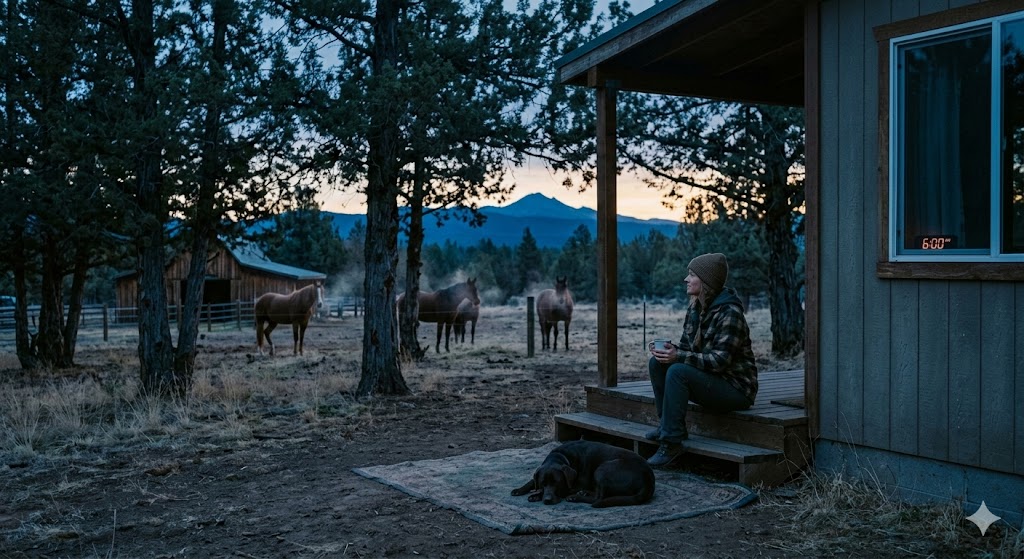
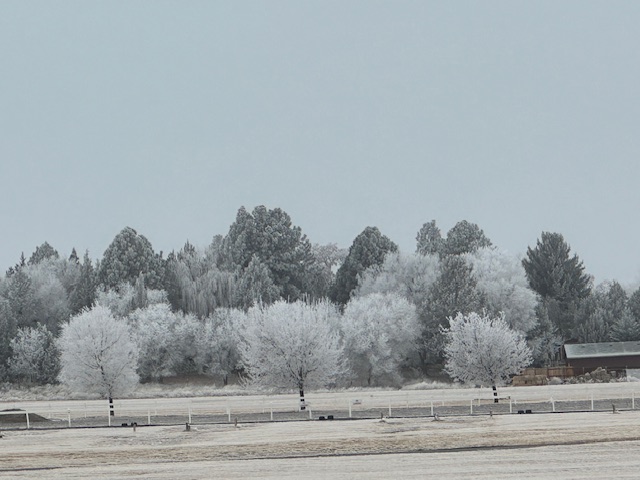
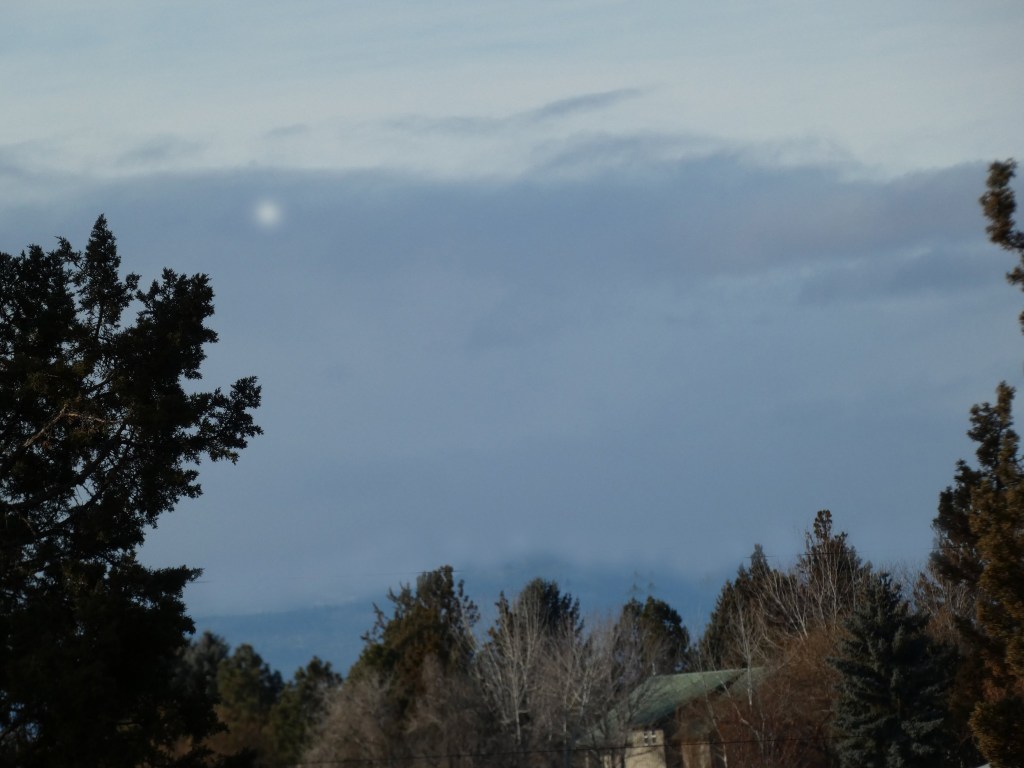
This morning feels like a quiet weight. Central Oregon still is hushed beneath a thick inversion layer—and my small world seems held in suspension—deeply still. I almost hear the air breathing as it freezes. I know that heavy fog will erase the Cascade Mountains from the horizon and leave my few acres monochromatic. I know that now the junipers are shadowy sentinels, half-seen and half-imagined. 

I’m standing at a window and holding a cup of steaming coffee—and, almost seeing the stubbornly cold air. Frost coats juniper branches and grass blades, and soon, the sun will struggle to rise—pale and ghost-like—trying to burn through the low mist. 

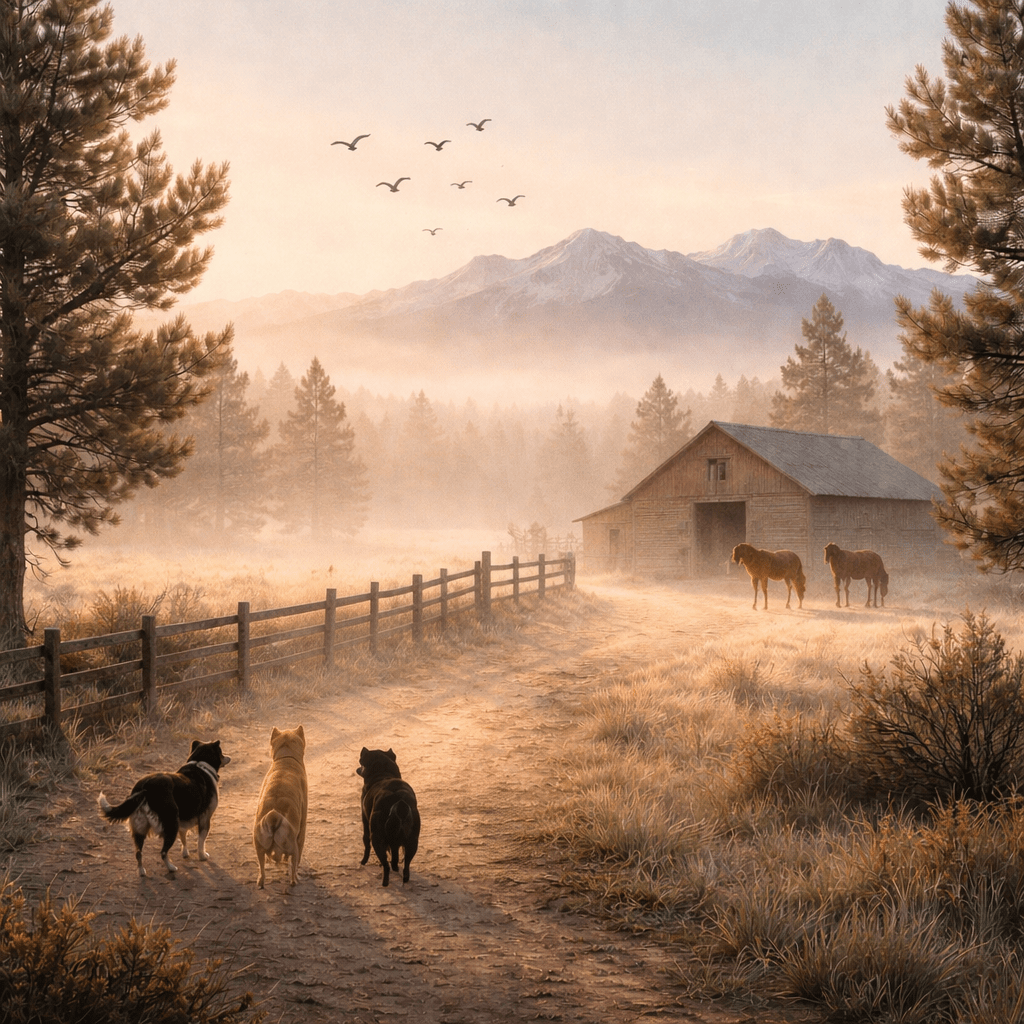
Despite this chill, there’s a necessary routine of feeding my horses. In this still darkness, layered in snow pants, a thick sweater, and my heaviest coat, I step outside—into a muffled world. The usual neighborhood sounds are absent; there is only the sharp, rhythmic crunch of frozen earth beneath my boots. I move slowly through this morning’s blurred edges. 

The horses are waiting, their whiskers white with ice and their patience thinned by hunger. I hurry through the usual labor—cleaning stalls, filling water buckets, and hauling fresh, sweet hay into the barn. It is work, but offers a few brief, pleasant moments of focus, too. Free of other concerns for the moment, I’m considering this weather inversion, hoping the fog will lift soon and normal clouds return.

Once I have settled the horses, I pause awhile. I listen. Few sounds are as satisfying as the steady, rhythmic grinding of horses chewing—watching them, wholly relishing their meal, is fun, too.

It’s time to turn back toward the house. I crunch across the frozen ground. My dogs, cat, and birds are waiting for their breakfast. Only after caring for them will I prepare for my part-time job.

This is how most of my days begin—as dependably as our January freezes—and regardless of any other weather conditions.

Diana

Seeing Isn’t Always Seeing

Tuesday, January 20, 2025

At first glance, I was certain I knew what I was seeing.

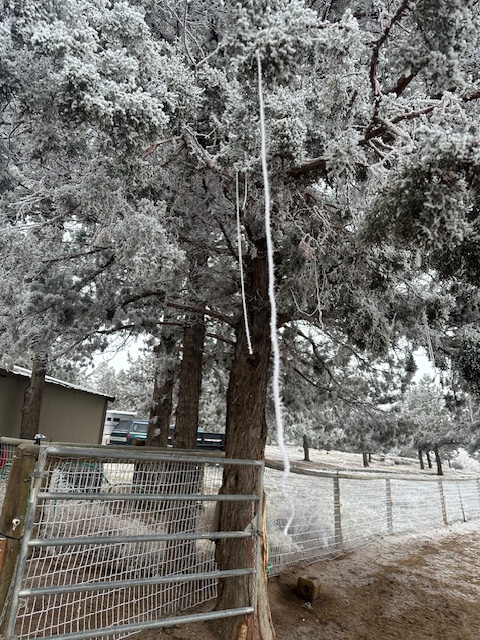
Two pale strands hung straight down from the branches of a juniper, each coated in frost. They were white, linear, and unmistakably rope-like. Our minds are quick that way. They reach for the nearest familiar explanation and settle in. We just go with it.

Like me, then—not questioning whether the frosty objects were rope, only wondering how they had gotten there. I reached up to pull one strand free from its branch, and in that instant, the scale shifted.

In my fingers, what had looked sturdy immediately shrank into something improbably delicate. I expected resistance. Instead, frost slipped away, and I found myself trying to grip emptiness. I paused and looked more closely.

You’ll never guess what I discovered. The “rope” I was trying to hold was a single hair from one of my horses’ tails. Looking up again, I noticed several similar strands—long, pale, impossibly fine—each thickened by frost and hanging, rope-like, from the branches.

The experience startled me. These fine hairs had likely been carried aloft by nest-building birds, caught by chance in the tree, and layered again and again with ice. The moment felt slightly dramatic and, at the same time, utterly ordinary. I had misread the evidence—and it had been astonishingly easy to do so.

I’ve been thinking about deciding and misassuming. These happen more often than we realize. We believe we’re seeing what’s there, when instead we’re seeing what our experience tells us ought to be there. Our brains—efficient and decisive—are always working to help us make sense of things quickly.

But efficiency may also be a kind of blindness. When we label something too fast and move on—without lingering long enough to reconsider—we miss the chance to see it differently.

The object I mistook for rope wasn’t merely a variation of what I expected; it belonged to an entirely different category of reality. It was something once living—shed, carried, and repurposed by chance.

Only later did my mind begin to imagine a quiet collaboration among animals, weather, and time—a whole story I had nearly missed before I paused, looked again, and wondered.

This experience reinforces something I’ve been learning: that deciding well often requires more than one look. Not because first looks are careless, but because they are incomplete. The longer I live, the more I understand wisdom as less about sharp eyesight and more about patience. Wisdom is staying a little longer with what we think we understand, allowing ourselves to be surprised by what else might be there.

Here’s today’s small example. A single strand of horse tail hair is usually barely visible. Yet here were several, transformed—fluffed with frost and suspended in front of me. I mistook them for rope. I tried to pull one down. Instead, I learned again that what appears solid may, upon re-examination, be lighter, finer, and less obvious than we first believed.

Seeing—really seeing—asks us to pause, reconsider, and sometimes admit that our first understanding was wrong. That lesson, offered by a few horse hairs, humbled me. And because of what it taught, it was also comforting.

If something as slight as a single horse tail hair can—against all odds—hold its place in the world, suspended and briefly transformed, then perhaps our own uncertainties deserve a little more time in the light as well.

Taking more time means looking again. Reflecting longer. It’s a practice that can help move our perceptions closer to what actually may be there.

Diana

Still Running

Saturday, January 17, 2026

Yesterday, two of my dogs and I went for an outing in my favorite BLM. It’s local and small—only about a thousand acres—with an irrigation canal running alongside a well-trodden footpath. The canal is empty now, except for bottom ice in places.

The afternoon was overcast, with temperatures in the mid-thirties—cold enough to freeze the fingers of my ungloved hand as I worked the camera. The camera itself felt cold-bodied, too, its mechanisms slightly sluggish.

The dogs, unbothered by any of this, were on fire.

Chase popped out of the SUV and never stopped running. Mitzvah started off more slowly and cautiously, but soon fell into the serious business of being a dog. I’ve long felt the absence of recent photos of these two, and this seemed the right chance to repair that.

It was also an opportunity to learn more about my fairly new camera. It has amazing zoom capabilities, but it doesn’t enable new shots quite quickly enough for me. It recalibrates in only an instant, yet that pause still frustrates me. That hour or so of practicing didn’t magically make the camera operate better—but it did make me more comfortable with how it handles.

And I like the images.

Both dogs are difficult to capture. Chase is fast, rarely pausing long enough for a clean shot. Little Mitzvah, equally busy, easily disappears into tall brush and weeds.

This BLM is a special place. It’s unknown to tourists and doesn’t allow overnight camping. Mostly, it’s known to locals—people with dogs—who look for semi-private spaces where dogs can run freely. We love this BLM.

Every year brings some new, quiet creativity along the path. This season, it’s foot crossings over the canal.

This post isn’t merely about an outing in a beloved spot. It’s an update, with current photos of my younger dogs—and a reassurance that Chase still lives with me. That escape artist may be slowing down, working a little less at defeating confinement. He’s a happy camper.

Still, Chase requires a close eye—because that’s simply who he is.

Diana

Feathers & Footsteps

Friday, January 16, 2026

The other afternoon, Peaches and I went for a walk. The day was lovely and warm; I didn’t even need a jacket. He perched on my shoulder—a heavenly lookout post—greeting anyone nearby with “Hello, hello!” or “Goodbye, goodbye!” Or he simply screamed, unrestrained and joyous, resisting every attempt I made to quiet him. (If your ears had ever been on the receiving end of his screams, you’d understand.)

Peaches, my Cockatoo, loves going on walks, and on this one he was especially delighted. I’d been promising him an outing for a long time. But I’ve been busy—winterizing the house and barn, and, rather suddenly, starting a new part-time job. Short winter days haven’t helped either, with daylight disappearing before it ought to.

But now, no more promises. We’re finally out and about.

Peaches is quite an attention-getter. People, seeing him for the first time, doubt their eyes: a large, white, very alive bird on someone’s shoulder (or arm, or head—if the wind isn’t too strong—or essentially anywhere he decides to perch). Walkers stop to ask about him. Drivers roll down their windows. Everyone wants to hear him talk. And does he, when they ask? Of course not—he waits until they’re out of earshot, and then he suddenly won’t shut up.

This year, Peaches turns twenty. All wonderful, except for the fact that a healthy parrot can live to be seventy. I’ve always known that someday he’ll need another home. Finding the right one for him weighs on me. Deciding to keep a parrot means making a long-term commitment to a bird who is no shrinking violet.

What makes it easier is that parrots are fun, companionable creatures. My Peaches sings, dances, and talks. He loves music—the louder and more rockabilly, the better. He makes me laugh. What surprises me most is how easily I fall into lively conversations with him. I’m often caught off guard by his inquisitive, animated, and lovable qualities. He’s not “just a bird.” Peaches is a person-bird. And yes, we have discussions.

An earlier sweet Cockatoo in my life, named Crackers, and now Peaches, too, have convinced me of the high intelligence of birds. All birds—wild and domestic—are smart, but some species are famously so: members of the Corvid family (Crows, Ravens, Jays, Magpies) and the so-called “intelligent parrots,” like African Greys.

Corvids and parrots demonstrate their intelligence through tool-use, problem-solving, and complex communication. Cockatoos are among these bright ones—so smart, these birds. (And because I can’t help myself, here’s my extra two cents: over the years, my chickens—and especially my turkeys—have proved themselves far smarter than people typically give them credit for.)

Today’s header photo shows the road ahead on our walk. To complete the loop, here’s another look at that same road—the section we’ve just left behind.

— Diana

Record-Breaking Warmth

Wednesday, January 14, 2025

Monday, January 12th, broke a remarkable record. It was the warmest January day in Central Oregon since 1920. Yes—more than a century ago was the last time a mid-winter temperature matched Monday’s. That 100-plus-year-old record quietly fell, without much ceremony—no fanfare, just a few weather-related announcements. And there I was, feeling the mildness and sunlight, noticing the odd sensation of stepping outside without first bracing myself.

Probably like everyone else, I looked around and wondered what this warmth was doing to the season. Snow should still be lingering, but there was none. Ice should be stubborn over my chickens’ water bowls, but ditto. I scanned the nearby treetops—bird-watching is one of my everyday pleasures—and wondered about the birds. Were they even slightly confused? Were their internal calendars, like mine, a little out of sync? Even the air felt different—less like January, more like some invasive in-between month.

Part of me celebrated the comfort of that warm day. After all, comfort is comfort. But there was also a strange dissonance—another reminder that nature keeps its own counsel, and that the seasons might be shifting beneath our feet. The warmth was pleasant and unsettling all at once—belonging to January while feeling nothing like January.

Whenever something captures my attention, I tend to look for meaning tucked inside it. Yesterday’s record-breaking warmth nudged me to pay closer attention to the weather itself. One of my mantras is that pausing and looking twice often reminds me that whatever I thought I knew isn’t entirely the truth.

This photo—taken years ago, on a typical January 12—shows what our weather used to look like.

My “second look” on this new warmest January day offered a quiet insight: we are all changing, and constantly are adjusting to change, even when it arrives disguised as good weather.

Real weather records remind us of time. Monday’s warmth happened to us in real time, and on a real January day. And I found myself standing right on the margin—between time and reality—grateful to feel informed, and awed anew by nature’s power.

Diana

Enduring Lights & Shadows

Tuesday, January 12, 2025

The ancient volcano in today’s header photo is Broken Top—my favorite among the Cascade Mountain profiles—and easily visible from my house. I love the whole range, but Broken Top feels extra special. I think that’s well deserved. Its peaks practically explode with personality. And many times, I’ve ridden horseback there. Broken Top is an old friend, even if it’s a mountain.

It’s also a teacher.

Broken Top is an ancient, spent volcano—its fire was gone long before any of us arrived. And yet, on a clear winter day like this, it feels alive to me, especially for the precision of its contrasts.

I’m fascinated by how the mountain holds light and dark at once. Snow burns bright along its slopes, while shattered rock catches shadows in every crevice and angle. The contrasts don’t compete—they belong to each other. One reveals the other. Without shadows, Broken Top’s lights would flatten; without lights, its darks would disappear.

Seeing Broken Top—whether in person or in my photographs—always pulls at something in me.

Maybe because I’m noticing similar interplays inside my own days. Aging has brightnesses—clarity, spaciousness. I’m surprised to find myself more patient, more observant, more willing to look twice. But aging also brings shadows—losses, changes, old urgencies cooling, and quiet reckonings with time.

Like Broken Top, I’m a terrain. And like that mountain, I’m shaped by experience.

It feels natural to accept vivid contrasts on a mountain. Yet I’m struck by how reluctant I am to accept unexpected contrasts within myself. Maybe because early in life, we’re taught to sort our experiences into clean categories: “good years” and “hard years,” “growing seasons” and “declining seasons.”

In contrast, Broken Top does no such sorting. On the mountain, erosion lives beside endurance. Sharp ridges beside soft snow. Light beside dark. Everything adds up to the shape of the thing.

From where I stand, Broken Top’s contrasts feel honest—less dramatic than simply true. They reflect what happens when something stops trying to be anything other than what time has made of it.

Staring at the mountain, I can catch meaning. It adds up to a life that, viewed from far enough away, doesn’t need smoothing. Its irregularities—fallen rocks, jagged silhouettes, deep cuts—are precisely what’s letting the light in.

Looking longer increasingly matters to me. My first look gathers an outline—giving certainty. My second, longer look gathers depth. It shows me light gathering on one slope while darkness settles on another. Staying with the view lets its “true story” come through. And I’m touched by a mountain long past its fire and entirely at peace with that.

Broken Top never tries to impress. It simply stands there—weathered and luminous—letting the day draw its shadows where it will.

And in its very quiet way, Broken Top reassures that: we don’t lose our shape as we age; we reveal it.

Diana

Revisiting A Darkened Room

Sunday, January 11, 2026

I always used to rely on movies—not just for entertainment, but for guidance, inspiration, and small lessons in “being human.” Throughout my growing-up years, films were a kind of companion.

The early ones—Hollywood standards of the 40s and 50s—taught me about glamour, timing, and emotion, and that stories can move with an almost musical rhythm. Later, I gravitated toward the New Age filmmakers of Italy, England, and the independent Americans who emerged in the ’60s and beyond. The emerging works felt looser, freer, more searching. They offered complexity instead of polish. They lingered in ambiguity. They asked viewers to stay longer, look again, and participate.

Eventually, as with so many things, the growing internet altered my habits. I stopped going to theaters. I became a streamer—at first enthusiastically. Art houses were becoming harder to find, and searching for them was tiresome. Over time, I watched fewer movies and watched less attentively. Eventually, part of myself drifted. One that used to feel essential, that welcomed art as nourishment.

Right now, considering the year ahead, I’ve started noticing that absence. Not dramatically—but more like realizing a room has gone quiet. I miss great movies. I miss the feeling of settling into a seat, lights dimming, a subtle sense that something meaningful might happen. I miss my own alertness, my old curiosity, my willingness to follow a director’s point of view.

I’ve done a little exploring and learned something surprising. There is an art movie house in this Central Oregon city. And “just like that,” something old and familiar stirred in me.

Today’s header photo represents today’s matinee, and I’ll be attending.

Not from nostalgia or needing to reclaim some earlier version of myself. I’m going because sitting inside a darkened room—surrounded by strangers, facing a screen larger than life—once held great purpose for me. And purpose, even if lost for a while, can return in surprising ways. Sometimes renewal begins by doing something small, but true. Something once beloved.

I’ll be watching a very modern American art film. I’ve no idea if it’ll be extraordinary or forgettable. (As a note, this film also might be streaming now, and I’m avoiding that.) Because today I will join a live audience. I will return to a first theatrical experience after many years.

This might renew more than a habit. It might refresh my relationships with attention and imagination. There is a possibility that art can still shift me, nudging me and inviting me into a “different room” than the one I walked into.

Entering this new year has made me think about purpose. Somehow, today’s adventure seems a small re-beginning. I will re-explore a once-significant source of learning. And most importantly, this could be a new beginning.

Later, I’ll know more. About the film itself, and about how it feels to sit, again, in a darkened room with emotional potential. For now, it’s feeling great simply for having decided to go.

Diana


My Miles

Sunday, January 04, 2026

My Border Collie, Miles, turned fifteen this year. Yesterday, he crossed the Rainbow Bridge. I cannot say enough about how special he was.

Miles was a big boy. His beautiful double coat made him appear larger than his fifty pounds—all of them slim, flexible, and fast across countless horse trails, with me and the rest of our entourage. He never passed up an opportunity to swim in water holes or wallow in mud.

He was an independent fellow. He didn’t push other dogs around, nor did he allow others to push him. During our many trail adventures, there were long stretches when I couldn’t see Miles, but I always knew he was tracking—and before long, he’d appear ahead of us on the trail.

The dogs and I often hiked a small BLM parcel alongside an irrigation canal. Miles adored that canal. He swam in it, snorkeled in it, and leaped from one side to the other. He also loved the area’s high, rocky peaks, his flexible body handling even the toughest terrain with ease.

Miles was a true Border Collie. His herding instinct was immense. The one thing that might have made his life even more complete would have been a herd—sheep, cattle, or any group of critters needing a decision-maker to help guide them.

Even without that, Miles had a lifetime full of joy. He fairly earned the arthritis that gradually overtook his once-extraordinary flexibility. His mind, however, never accepted those physical limits. Miles insisted on going everywhere with me—and always insisted on being off-leash. Eventually, his safety required otherwise, when his body could no longer support his free-ranging spirit.

I loved Miles. That big Border Collie was a gift for many years. I miss him now—and will forever—because he was one of a kind, irreplaceable.

Diana

Pause & Reflect

Saturday, January 03, 2026

I’m still thinking about the activity of looking again and wondering why it feels so striking—why it seems newly available to me, and why it matters now.

In my writing, reflecting, and observing—and in noticing changes in my own behavior—I’m beginning to think that looking again isn’t accidental. Perhaps slowing down and taking a second look has something to do with getting older. As I am.

When I was younger, I remember being purposeful—looking, scanning, evaluating—quickly, in order to decide. In my workplaces, speed mattered. Quick looking was essential in order to choose, advance, improve, protect ourselves, and move on. Confidence mattered. Being right mattered. First impressions were treated as efficiency—back when efficiency felt necessary.

Experience is teaching me that aging can quietly change that behavior.

It’s not a change that happens all at once, nor does it arrive with any announcement. Over time, and by living differently, urgency begins to loosen its grip. I experience this as a softening of the need to prove competence. The pressure to reach conclusions is fading. That change creates new spaces, and something else becomes possible—a willingness to stay longer and have another look.

That longer look requires pausing. And pausing becomes most available when one is no longer rushed to decide the reality or worth of something.

I’m not worried about diminished acuity or curiosity. If anything, looking again feels like a refinement. I don’t find that aging dulls perception; instead, it alters the terms of attention. It becomes easier to tolerate ambiguity, to be less invested in categorizing, and more interested in noticing.

If we can stop asking, Is this impressive? we can begin asking, What is actually here? That shift matters.

Cultural norms teach us to associate renewal with reinvention—with starting over, becoming new, replacing what’s old with something brighter or sharper. In later life, however, lived renewal often moves in the opposite direction. I find myself pausing, returning, re-seeing, and allowing familiar things to reveal aspects that are easily missed when we’re intent on moving fast.

Looking again doesn’t erase age, deny loss, or chase youth. It doesn’t dismiss what has been. Instead, it notices that as detail fades, form becomes clearer. As sharpness diminishes, balance stands out. As noise recedes, presence becomes easier to recognize.

That’s true when evaluating photographs and music. And it’s true in how we perceive one another.

Aging invites a softening—and with it, a second way of seeing. This means less accumulating and more subtracting. When urgency eases, assumptions lighten, and the need for resolution loosens, intrinsic elements come forward: gesture, weight, timing, presence.

Maturing makes ordinary things hold our attention more fully. A bird on a branch. A familiar voice. A routine walk. These moments don’t announce themselves as important. They ask us, instead, to recognize them quietly and without hurry.

Looking again isn’t nostalgia. It isn’t longing for what’s past. It’s a form of attention shaped by experience—an understanding that essential meaning rarely arrives dramatically.

Experience is teaching me that aging doesn’t close the world down. It seems, instead, to be opening it. And this time, I see differently.

Looking again combines seeing and renewal. Finally—at last—I’m seeing more of what’s been available all along.

Diana

Looking Again

Thursday, January 01, 2026

“Happy New Year!”

I’m outside on this very chilly first morning of the year, along with the pictured brave House Sparrow (a male, I believe). My camera isn’t yet capturing the light correctly, but today’s photograph is pleasingly straightforward and clear, with a strong graphic shape and a compelling composition.

While it isn’t perfect, it’s a good photograph—one that rewards attention, though lacking technical polish. For my purposes this morning, the image speaks to looking again, which is very much aligned with what I’ve been thinking and writing about lately.

“Looking again” isn’t so much a technique as a shift in stance. It’s not about better equipment, sharper focus, getting the right answer faster, or proving competence. Those habits are useful, but they can be shallow.

Looking again means staying after the initial judgment.

Take today’s header photo. At first glance—my reflexive response—it seemed too dark, not sharp enough, and frankly, disappointing. Fortunately, I didn’t stop there. I looked again. And with that second look, something changed.

The first look asked, Is this good enough?
The second look asked, What’s actually here?

Those are entirely different questions.

Suddenly, I began to see the bird less as a detail and more as a presence: a small weight on a branch, a balance point, a pause in winter—as a life holding still against a pale sky. These impressions appeared only after I quit scanning for what was “wrong.”

This is reminding me of my recent blog series about listening to music. In those posts, I wasn’t categorizing voices by genre, ranking them by power or novelty, or asking what they were trying to accomplish. Instead, I stayed. I listened long enough to feel how those voices inhabit sound. That was me “listening again”—a nonvisual equivalent of looking again.

This header photograph of an ordinary bird matters—not because it’s exotic, rare, or dramatic—but matters because I paused. I noticed. I asked. I stayed. Our contemporary world pushes us to move on instantly, but pausing and looking again turns paying attention into a quiet form of resistance.

And that kind of attention calls for some courage.

Looking—or listening—again represents a decision. It’s to pause and allow what seems ordinary to reveal more of itself. These days, I find myself doing less dismissing of what initially appears unremarkable, and doing more walking with it—slowly, thoughtfully—letting it deepen rather than resolving it too quickly.

Those impressions draw me, again and again, back to other worlds, offered even by the simplest of cameras. And that might be why so many of us—including those who are only minimally technically inclined—are finding something essential to our inner selves there.

I’m thinking about drafting another blog to explore looking again, more deeply, which I often associate with wishing to understand—not faster, but better. Maybe that’s something having to do with aging. Perhaps “looking again” is an emerging trait, one that gently offsets our earlier need for urgency—maybe that need is often softened by time.

Looking again, like aging itself, can blur edges and soften details—and thus, let form, balance, and essence come into our clearer view.

Hang in with me for the rest of this journey.

Diana