Emotion Doesn’t “Happen” – We Create It

Friday, November 14, 2025

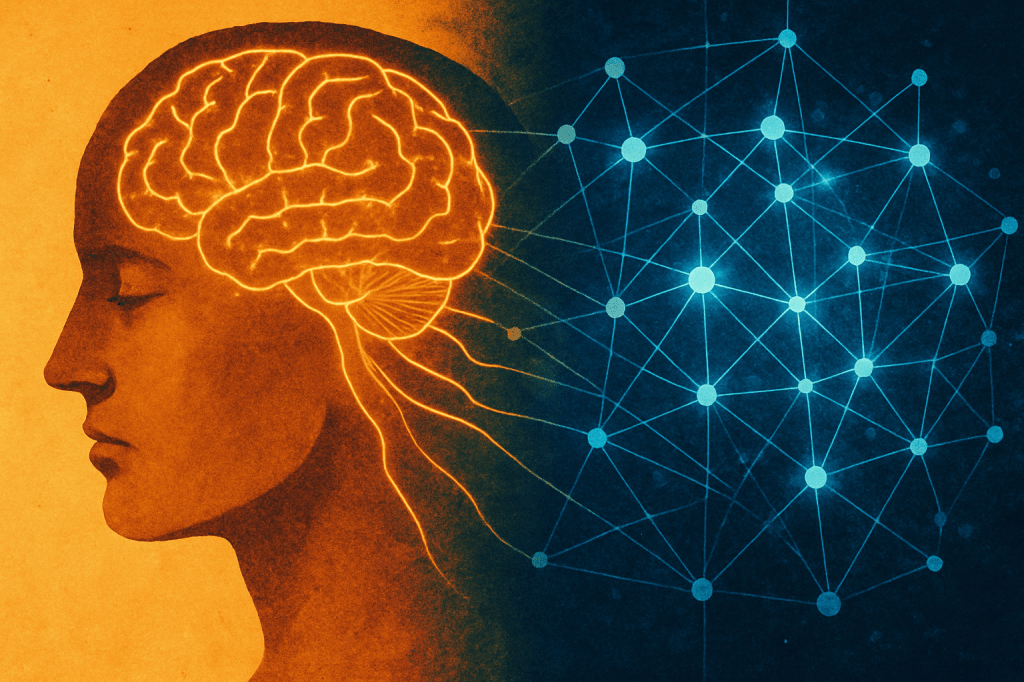
I can’t quit thinking about how the mind constructs emotion—especially after diving into Lisa Feldman Barrett’s work on constructed emotion. I studied her findings to understand what makes my frequent “conversations” with AI feel so remarkably human—almost like exchanges with an understanding friend.

The more I’ve learned about Barrett’s theory, the more I see signs of it everywhere. I see her ideas woven into the books I read, the films I revisit, and even the sentimental corners of my own memories.

While thinking about all this, I found myself comparing two of my favorite artists—and they could hardly be more different: Woody Allen and Emily Dickinson. One lives in a world of fast-talking neurosis, humor, relationships, and urban anxiety. The other lives almost entirely inside the mind—quiet, solitary, deliberate, and intensely inward.

Despite their stylistic differences, they each reveal something profound about what we feel and how we feel it. In their unique ways, both artists show us that emotions aren’t fixed. Emotions are not automatic reactions.

Comparing their ways of creating and communicating helped me understand that emotions are interpretations—as Barrett’s work has shown. At their core, emotions are “stories” that our minds quickly construct, from sensation, context, and the emotional vocabulary we’ve learned.

This idea has become one of the most meaningful insights I’ve come across:
Emotions don’t just “happen” to us—we create them.

And once I grasped that insight, I began noticing it happening in real time within myself.

This comparison of two artists’ work highlights just how differently humans communicate emotional meaning. Yet, despite their vastly different styles, their emotional outputs converge powerfully as illustrations of constructed emotion.


Woody Allen: The Social Construction of Emotion

Woody Allen’s films are full of people racing to interpret their own sensations. His characters overthink, over-explain, over-negotiate. They construct their feelings out loud. Their emotions arrive only after they’ve decided what those feelings should be.

There’s a classic joke he tells:

A man goes to a psychiatrist and says,
“My brother thinks he’s a chicken.”
The psychiatrist replies, “Well, why don’t you turn him in?”
The man answers, “I would—
but I need the eggs.”

It’s funny because it’s true. We stay in imperfect relationships because of the meaning we’ve assigned to them—not because emotion is some hardwired force, but because we’ve built a story about what the relationship gives us. The “eggs,” in other words, become the emotional interpretation.

In this sense, Woody’s characters are demonstrations of constructed emotion in motion.
They feel tenderness, longing, jealousy, dread—but only after their minds have named the sensation, given it cultural shape, and predicted what it should mean.

His films are emotional not because the characters dive into deep feeling, but because they dive into deep interpretation.

That’s pure Barrett. And pure humanity.


Emily Dickinson: The Private Construction of Emotion

If Woody Allen gives us emotional construction in noisy, messy, social form, Emily Dickinson gives us its opposite: emotion distilled to its silent, solitary source.

Dickinson rarely names feelings outright. Instead, she describes the sensations from which emotion is born:

“I felt a Funeral, in my Brain—”

“A certain Slant of light—”

“A Chill—like frost—upon a Glass—”

She returns again and again to breath, light, gravity, space, the tiniest internal shifts. She notices the moment before a feeling forms—the flicker of sensation that precedes the story we later tell.

In Barrett’s terms, Dickinson writes from the level of interoception—the raw internal data the brain uses to construct emotional meaning. Where Woody presents fully assembled emotional narratives, Dickinson shows us the materials before they become emotion.

Where he interprets, she observes.
Where he talks through his feelings, she listens to hers.
Where he uses culture’s vocabulary, she invents her own.


Two Artists, One Truth

Despite their differences, Woody Allen and Emily Dickinson converge on a profound insight:

Emotional life is constructed by the mind—not imposed by the world.

But each illuminates a different side of that construction.

Woody Allen: Emotion shaped by the world
– by culture
– by other people
– by expectations
– by relationship dynamics
– by the stories we tell to stay connected

Emily Dickinson: Emotion shaped by the self
– by raw sensation
– by inward attention
– by metaphor
– by imagination
– by the stories we tell to stay whole

Together, they offer a full map of human feeling—both the external and the internal, the public and the private.

They remind us that emotion is not just felt;
it is built—moment to moment—out of everything we’ve ever sensed, learned, remembered, or hoped.


Why Their Work Lasts

Their works endure because they tell the truth about emotional life in ways we recognize immediately:

We don’t simply have feelings;
we assemble them from meaning.

We carry cultural scripts about love, fear, longing, loss—and we perform them.

Our bodies send sensations that our minds rush to name.

We seek connection even when connection is confusing.

We misunderstand ourselves in company, and discover ourselves in solitude.

And somewhere between the chaos of Woody Allen’s city streets and the stillness of Emily Dickinson’s upstairs bedroom lies the full portrait of what it means to feel.

We live between those two worlds—
the social and the solitary,
the comic and the contemplative,
the interpreted and the sensed.

And in that space, emotion becomes what it truly is:
the mind’s best attempt to make sense of being alive.

— Diana

Learning From The Learners

Wednesday, November 12, 2025

I’m one of billions of AI users curious about why artificial intelligence can seem so humanlike. While working to understand how AI learns, I find myself drawn to a closely related mystery — human emotion. I wonder how—and whether—machine learning and human feelings intersect. So far, here’s what I’ve come to understand.

We humans are becoming more knowledgeable about ourselves by observing the technical processes of teaching AI to “think.” Researchers training the machines are learning from them, too, gaining fresh insights into what being human means.

This deep training of machines to think is reflecting us back to ourselves. The deeper we train, the more feedback we receive. Glimpses into how AI learns offer a new understanding of how we’ve been doing it all along—quietly, efficiently, and with a touch of mystery. That mystery still separates us from the supercomputers we want to emulate us.

It’s an intriguing reversal: AI training is becoming a kind of mirror for human psychology. Modeling AI on the human brain is beginning to decode some of our brain’s most elusive workings. We’re learning, for instance, about a looping relationship between neurons and algorithms—how they both generate profound ideas—and thus reveal more of what it means to learn, imagine, and grow.

AI is showing us that memory isn’t a vault but a living process. Essentially, memory reconstructs. When recalled, memory fragments are rediscovered and then reassembled into something new. Humans recall and reassemble instinctively. For example, we may soften the edges of pain by misremembering certain details, to paint a gentler version of the truth—like artists returning to the same canvas, we repaint our pasts again and again—comforted not by precision but by memory evolution.

AI language models do like us; they build new meaning from old information. They predict the “next possible” word or image, and then create knowledge through probability rather than imagination—and without fear. Humans, too, are prediction-makers, but with one difference: curiosity. We project futures, blend ideas, and dare to believe in “what ifs.” The daring keeps our minds alive.

In teaching machines empathy, we’re discovering something psychologists have long known—that emotion is intelligence. Feelings are not the opposites of logic but are extensions of it. Each emotion is a data point, which helps us interpret what we perceive. Understanding emotional depth reveals, in a kind of wisdom, a refined ability to predict, but with heart.

Even as we age, our brains are capable of change. They reshape themselves through new habits, perspectives, and stories. The AI world calls this continual learning. In human life, we call it resilience. It’s what allows us to adapt, to grow, and to keep the essence of who we are.

AI, for all its precision, still misses something essential—the human advantage of having a heart. Our heart is a living pulse that connects knowledge with caring. Human intelligence, unlike AI, is embodied. It sweats, grieves, laughs, and ages.

The mind’s true elegance lies in its fragility—its humor, its willingness to evolve. Machines can help us visualize the shape of our thoughts, but only humans possess the heartbeat behind them.

Perhaps the most poignant lesson in teaching machines to learn is what they’re teaching us to remember:
the preciousness of awareness, of feeling, and of knowing that we can keep growing.

— Diana

A New Rhythm

Sunday, October 26, 2025

I’m planning to step away from my full-time position in Fine Jewelry by transitioning to part-time and working across various departments in the same store. By working fewer hours and fewer days, I’ll have more time — for home, animals, and an ever-growing list of “small things” that rarely feel optional.

After months of the steady, clock-driven pace of full-time work, this change feels a bit jolting. My brain and body are still tuned to the structured, predictable rhythm of getting up, getting ready, and heading out the door. But now, I’m starting to anticipate having new rhythms filling my mornings — and that feels expansive, less about tight schedules and more about open, unhurried time. More daylight to enjoy will have me more attentive to the familiar sounds of paws, hooves, and feathers wanting my attention.

I’ll add quotes around “free” time, because much of it will actually be spent working. The days ahead will be filled with fences to check, water troughs to keep from freezing, and growing concerns about winter — it’s not just whispering anymore; it’s been shouting its imminent arrival for the last couple of days and insisting that I handle some essential tasks. These tasks might seem a bit daunting, but I’m also looking forward to cozy winter days ahead.

The goodness of adjusting my schedule isn’t just about managing responsibilities. It’s also a tip of the hat to something more personal: the crucial value of having time to simply think, breathe, and rebalance. It will give my mind and body space to find new opportunities for experience and growth.

I’m curious as to how my days may reshape themselves — where the hours will go once they’re no longer so tightly claimed by a time clock. Maybe into the barn. Maybe into the quiet. Maybe back into reading and blogging regularly.

This season, as days grow shorter, reminds me that every shift in weather or in work offers something new. Right now, I’m being invited to slow down and listen more closely to the small rhythms that keep my life steady: soft nickers from the barn, the hush before dawn, the impulse to lift my camera again and capture what feels special about the world around me.

Mostly, I’m grateful for the comfort of having more time to simply be—and to notice.

— Diana

Different Realities

Friday, October 17, 2025

I grew up in a small Oklahoma town during a time when social norms encouraged people to reconcile their differing versions of the world by searching for and settling on common viewpoints. The best solution for conflicting opinions was usually to satisfy the “commonly held” middle ground. Such viewpoints tended to reflect the widely accepted and “popular truths” that most people—before the internet and modern technology—generally agreed upon.

As a young person, I found the differing versions of reality unsettling. I struggled to make sense of them before eventually realizing that many forces shape people’s perceptions—one’s upbringing, information sources, fears, hopes, and fatigue. Other influences too—culture, personal experience, and cognitive biases—play powerful roles in shaping how we each perceive truth and reality.

Even now, I’m sometimes taken aback when long-time or new friends express opinions or wishes that seem to belong to an alternate reality. Some might find such moments reassuring, as evidence of progress, while others might see them as signs of decline. I’ve come to sense that some people find comfort in tradition while others draw inspiration from innovation. Recognizing that helps me accept our differing realities.

I often imagine us all standing in the same landscape, each looking up at the same vast sky but through different filters—some perhaps tinting it with unusual colors. Each of us navigates life through a private, learned lens, one that has either been refined over time or obscured by it.

In my more mature years, I try to respond gently to others’ realities. I no longer attempt to reconcile their perspectives with mine—or mine with theirs. As others speak from their own worlds, sometimes so different from my own, I try to listen for the heartbeat beneath their words—for the universal emotions of worry, pride, love, or loss. It’s there, in those shared emotional spaces, that our realities overlap and understanding becomes possible.

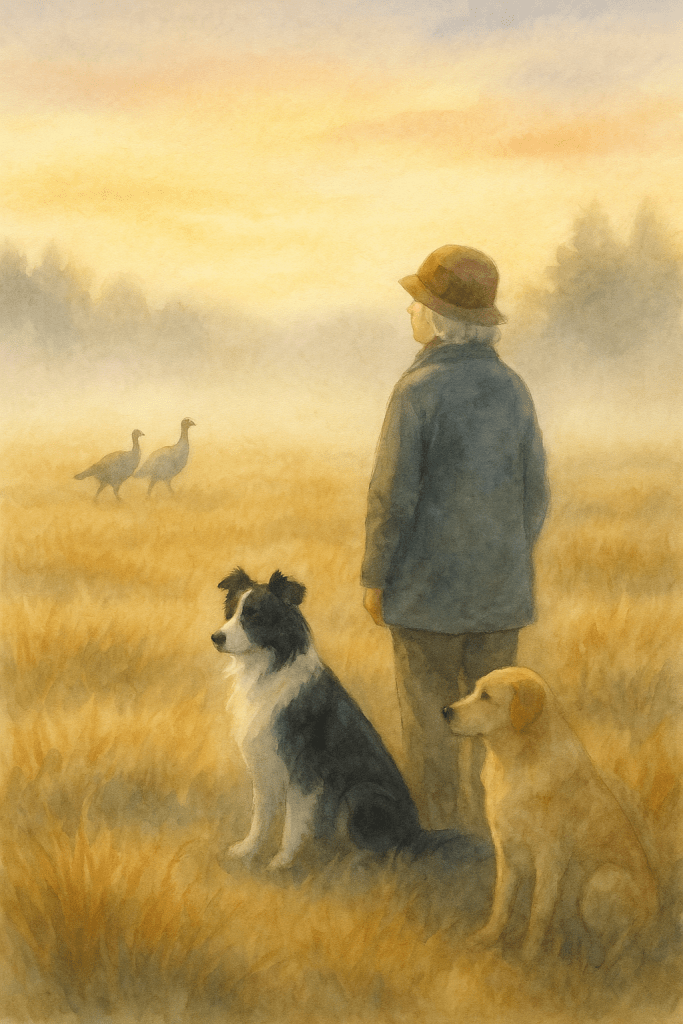
These days, I keep my focus on what’s directly before me—my own, very real world. That includes my dogs at dawn, the fall season’s newly chilled air, and the always-marvelous scent of early morning coffee. These rhythms mark the beginning of my days; they are among my certain truths.

We often hear that our shared world is fracturing. That notion is open to many interpretations. Yet despite our differences, many of us still believe in shared ground—the small, tangible things we can all see and touch.

We may never fully align others’ realities with our own, but we can remain faithful to the core values that most people strive to live by and nurture in their daily lives.

After all, we are remarkable beings—capable of rising to the challenges of caring for one another.

Diana

Falling Back With The Pack

Wednesday, October 15, 2025

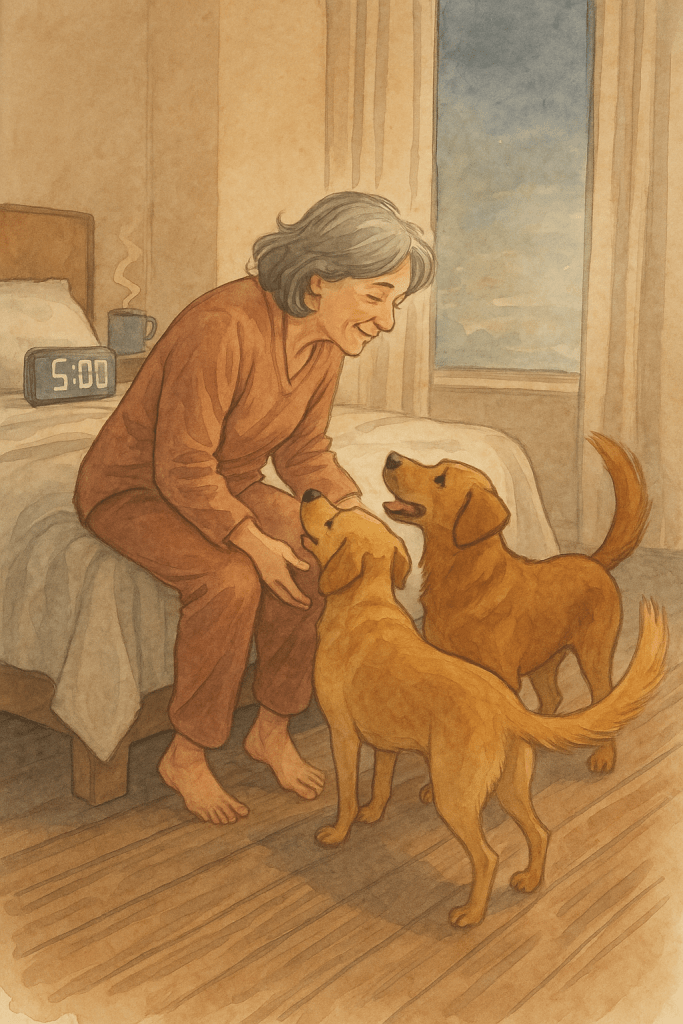
Every fall, when the clocks are about to “fall back,” I find myself thinking about the ways this time change will ripple through the rhythm of my household. For one thing, there are my early mornings—I’m an early riser, usually awake by five. Very often, I’m reminded it’s “getting-up time” by the gentle tapping of paws on the hardwood floor, heading my way.

After saying hello to my dogs and getting on my feet, I love being awake in that early hour. The world is still quiet, the coffee is strong, and for a few quality moments, I have no obligations.

It amazes me how precisely my dogs seem to know when it’s five o’clock. I hear their toes tapping down the hallway, sense their hesitation, and then find them beside my bed—tails wagging, eyes bright. My projection clock says it’s five o’clock, and I wonder how they tune into some invisible clock that runs on instinct instead of batteries.

In a few short weeks, their invisible clock will clash with the one on my wall. When daylight saving time ends, will they still wake me at what their bodies think is five a.m.—while my clock insists it’s four? How long will it take them to adjust to the new rhythm? I suspect they’ll manage faster than I do.

I’ve gone through this annual shift many times and know what’s ahead. Yet every autumn’s time change feels like a new game. I can already anticipate my confusion, mild grumpiness, and the faint irritation that comes with every mandatory reset of the clock.

The dogs, like me, will need some time to sort things out. Meanwhile, it’ll be on me alone to get up around five—while they sleep in, waiting for what feels right to them. Soon enough, they’ll catch on. Dogs are practical; they read a household’s energy for meaning beyond the numbers on a clock.

My notions of falling back with the pack make the upcoming change feel less mechanical and more communal—as if we’ll all be adjusting together through the darker mornings, each in our own way.

Our human world may be run by clocks and calendars, but the dogs might have it right: when the rhythm changes, don’t fight it. Just stretch, yawn, and greet every new wrinkle with a wag.

Essentially, time itself has its moods.

Diana

In The Story

Saturday, October 04, 2025

I grew up in the 1950s and ’60s, when life expectancies were shorter than they are today. Back then, reaching eighty-five seemed almost mythical — something that happened to “very old people,” but not to all of them.

Yet here I am, at eighty-five, still alive, active, and managing the daily demands of home life while also working a full-time job outside my home. Over the past few years, as I’ve learned how to work in retail environments, I’ve encountered ageism — sometimes subtle, sometimes not. People have told me outright: “You shouldn’t be working, you should be enjoying your twilight years!” or “You’ve earned your rest — why are you here working?”

My life lessons and learning are that staying engaged, helpful, and connected is my way of enjoying and making the most of them.

After experiencing uninvited confrontations related to aging, I have elected not to answer when people ask about my age. Let them look. Let them guess. I’ll let my energy and presence speak for me. Age is only a number; contribution is a choice.

I’m now rethinking somewhat, for Jane Fonda has begun resurfacing in the public eye again. And, I find myself noticing her with renewed interest. She has always been bold — both in her career and in her willingness to age openly, in plain view of the world. Now, while approaching eighty-eight, she is again speaking out, supporting free speech and democracy — still active, still fearless, still herself.

Her appearance has changed, naturally, but not in ways that erase her. She’s slender, stylish, and poised. If she’s had work done, it’s subtle. She lets her neck, however, tell the truth of her years — and to me, that’s oddly comforting. I see her as not hiding from the passage of time.

To me, Jane Fonda has become more than just an actress or an activist. She is a symbol of endurance. Her journey, which we have witnessed growing up alongside her, is a testament to her resilience and strength. She symbolizes the permission to remain visible, to express opinions, to care deeply, and to stay part of the ongoing conversation. She shows that relevance is not confined to youth.

At eighty-five, my private reality is a testament to the meaningfulness that comes with caring for animals and responsibilities. I never expected to live this long, feel this alive, or be this responsible. The unexpectedness of my current situation keeps life interesting. Yet, I still work full-time, on my feet, solving problems and engaging with people. And when the day is done, I return home to care for my animals and keep my world running. It’s not easy, but it brings a profound sense of purpose.

To people who suggest I should slow down, relax, and “enjoy life,” it’s my work and routines that bring me joy — they give shape and purpose to my days. I’ve never had cosmetic surgery and don’t want it. Instead, I take pride in how I present myself: in my clothing, my interests, my energy. My mind is clear, my curiosity intact.

Without family nearby, my workplace provides me a sense of belonging — through friendly interactions, shared goals, and the simple recognition that I am still making a contribution. Those exchanges keep me grounded.

And now, to my surprise, Jane Fonda is becoming a role model, not for her fame or glamour, but for her persistence and grace. She reminds me that aging isn’t about looking young — it’s about staying in the story.

Maybe that’s what aging is teaching us: not how to fade away, but how to keep showing up. Jane Fonda illustrates that we can grow into our later selves with intention, not apology. She is still visible, still learning, still engaged — and so am I, in my own way.

Inside, I don’t feel old. I think seasoned — aware, shaped, and, in many ways, more certain than ever. My work keeps me connected; my mind keeps me company. And if I find a mirror in Jane Fonda, it isn’t in her polish or fame — it’s in her refusal to disappear.

At eighty-five, I’m not winding down. I’m still becoming — quieter, perhaps, but clearer. Still part of the conversation. Still in the story.

Diana

Lessons In Jewelry

Friday, September 26, 2025

I grew up with the saying, “Diamonds are a girl’s best friend.” In mid-20th-century culture, that line carried enormous weight. A diamond was more than a glittering accessory—it symbolized status, romance, and permanence. It was also, and very often, a woman’s only financial safety net. When women had little access to income or property, a diamond ring could be converted into cash if someone suddenly found herself left and on her own.

Working in jewelry today tells me how much has changed. Modern women build careers, manage investments, and create their own security. Diamonds remain desirable, but less as a lifeline. Talking with customers has taught me that diamonds are just one option among many ways to celebrate love, beauty, or success.

I see today’s women often choosing pieces that tell their own stories. A birthstone ring, an heirloom reset into a modern design, or a pendant from a local artisan can mean more than a flawless solitaire. Essentially, jewelry is becoming autobiographical—and saying, this is who I am, rather than this is what a woman should have.

I also see the shift favoring ethics and individuality. Many women prefer lab-grown gems, recycled metals, or fair-trade stones. Others embrace color—emeralds, sapphires, and tourmaline—or opt for raw crystals and asymmetrical cuts. Jewelry is often collected in layers and stacks, shifting with mood and season.

So what replaces that old “best friends” phrase? Maybe nothing—and everything. Younger women, especially, are unbothered by distinctions between mined and manufactured diamonds. They want bold sparkle and personality, not conformity. Meanwhile, women from traditional cultures often still value mined diamonds as both symbol and security.

What I see every day is that the “best friend,” rather than being a single stone, is having choice itself—the freedom for a woman to define what sparkles brightest for her.

Diana

Hearing the Calling

Wednesday, September 24, 2025

For several days, and again this morning over coffee, I’ve had my mind on an old movie that I’ve chosen to watch more than once: Bagdad Café (1987). Like Sounder, which I recently wrote about, it’s stayed with me longer than most films. Maybe because of the quiet desert roads, which feel oddly familiar against my own Central Oregon landscape—wide spaces, moments of isolation, and the surprising ways “connection can arrive.”

Each time I’ve watched, I’ve sensed there’s more going on beneath the story’s surface. At first glance, it appears to be a lighthearted, eccentric comedy with superb acting. However, upon reflecting on its story and characters, I’m convinced that it’s an allegory—and one worth sharing.

On its surface, Bagdad Café is quirky and offbeat, full of small mishaps and comic misunderstandings. Yet behind the humor lies something larger. The setting is a dusty, broken-down café in the Mojave Desert, the sort of place most would drive past without stopping. Into this place come two women: Jasmin, a German tourist, after suddenly being abandoned by her husband, and Brenda, the café’s owner, after being left behind by her husband. Both women are prickly, suspicious, and in their own ways exiled and alone.

At first, the café is a mess—disordered, tired, going nowhere. But slowly, almost imperceptibly, Jasmin’s presence begins to change it. She cleans, she listens, she performs small acts of magic. Brenda resists at first, then softens. Before long, the café is transformed from a tired outpost into a place of beauty, music, and connection.

One image that lingers with me is of Brenda’s husband, who, after leaving, keeps watching the café through binoculars. He has walked away, yet can’t resist observing from a distance. To me, this is part of the allegory. He represents those who see but never engage—hovering on the edge of transformation but unwilling to step into it. His gaze is controlling, even possessive, yet powerless. In contrast, Jasmin—the German, or true outsider—enters fully and brings renewal. The binoculars make the husband an emblem of distance, without connection, reminding us that healing comes only when we dare to join in, not when we stand back and watch.

The cast itself reinforces this sense of something larger: a German tourist, a Black American café owner (played by a British actress), an American painter (played by a once-famous film star), and an assortment of desert drifters. This gathering suggests more than coincidence—it’s also a picture of cultures meeting, colliding, and creating something new together. In that sense, the movie’s haunting refrain “I am calling you” can also be heard as a call across borders, an invitation to connection that transcends nationality, language, and race.

Other details I can’t shake involve Brenda’s children. One is a young father determinedly practicing classical piano in that unlikely setting. His grand piano in that battered desert café feels almost surreal, yet it deepens the allegory: aspiration in unlikely soil. His music insists that beauty and culture belong everywhere—not just in gilded concert halls, but even in a dusty roadside outpost, if someone dares to press the keys.

Then there’s Brenda’s teenage daughter, restless and intent on leaving. She represents another answer to the calling: not to stay and transform, but to escape in search of something better. Her choice is human and understandable, yet it contrasts with Jasmine’s quiet decision to remain and renew. Together, the piano player and the daughter remind us that when the call comes, each of us must answer in our own way—by staying and creating, or by moving on. Either way, the call cannot be ignored. Both children become transformed by the café’s changed atmosphere and remain connected to it.

The more I think about it, the more Bagdad Café feels like a parable of renewal. The café isn’t just a diner—it stands for the barren places we all sometimes inhabit, whether in spirit or in life. Jasmin, the German stranger, becomes an unexpected redeemer, bringing grace without asking for much in return. Brenda, toughened and skeptical, is the everywoman—ready for renewal if she dares to trust.

Threading through it all is the film’s haunting song, Calling You. The lyrics drift in like a voice from beyond:

A desert road from Vegas to nowhere … I am calling you.

For me, that refrain is the heart of the film—maybe hope itself speaking, maybe spirit, or simply the mysterious force that draws us toward one another when we feel lost. Whatever its source, the call is unmistakable. It reminds us that life doesn’t end in the wasteland. Something new can bloom, even in the dust.

These days, I am struggling to find my footing in a competitive environment among strong coworkers. I’m recalling this movie and its message, likely because it’s calling me to stay open to the possibility of renewal, even though I sometimes feel inclined to shut down.

Maybe the movie’s refrain—I am calling you—and its use of magic, aren’t just for the characters in a quirky old film. Perhaps those are calling all of us, tugging gently, if only we allow ourselves quiet moments to hear.

—Diana

Underground Railroad, Canine Edition

Saturday, September 20, 2025

Yesterday I was late to work. I had just opened the front door to leave when little Mitzvah appeared, panting and wagging, eager to come inside. I let her in, gave her a cookie, and tucked her into her crate before heading out to discover how she’d escaped. It didn’t take long—bigger, stronger, and endlessly determined Chase had dug yet another hole under the fence. The gap was just wide enough for Mitzvah to slip through, but not big enough for him.

So, once again, I was running late thanks to my nonstop digger. On days when he doesn’t manage to tunnel under, he digs straight down, anywhere and everywhere. The dogs have nearly half an acre to run in, surrounded by a six-foot fence that I’ve even raised to seven feet to keep Chase from climbing or leaping over. Yes, he’s proved capable of both. And in the middle of all that dog space? Holes—deep, straight-down craters that I discover and fill in while treading carefully so I don’t step into one.

As for his under-fence escape holes, I’ve got a new problem. Over the years, I’ve blocked Chase’s tunnels with lava rocks, but I’ve run out of any I can carry. What’s left are boulders too big for me to budge. My substitute solution has been filling empty plastic containers—kitty litter tubs, half-gallon milk jugs, anything I can find—with water to make them heavy enough to block the digs. I’m running out of those, too, and I’m considering buying several jugs of distilled water just for this purpose.

What really gets me is that Chase has now taught Mitzvah his tricks. She’d never have tried escaping on her own, but now she knows to wait while he digs and then slip through the opening he makes.

I wouldn’t care as much if my property didn’t back onto a road that’s grown dangerously busy with fast-moving cars. This used to be a quieter stretch of countryside, but Central Oregon has exploded with growth. The through-roads are jammed with frustrated drivers, and I come home every day wanting only one thing: the dogs safe inside, far from that traffic.

— Diana

Discovering Wristwatches Anew

Friday, September 19, 2025

In my outside job, I work in a department where I frequently sell high-end watches. At first, I was fascinated to discover how many customers still enjoy studying and wearing traditional wristwatches. I wondered why they bothered with conventional styles when smart watches can do so much more—letting us know when a phone call or text arrives, reminding us to pause, breathe, and reflect, and so on. I’d been almost satisfied with my smart watch.

Almost—because I’ll admit, those sudden prompts to “pause and breathe” or “note your feelings” often left me annoyed. Meanwhile, through the process of presenting and selling traditionally styled watches, I became intrigued by their strong points: accuracy, battery technology, sturdiness, dependability, and, not least, their wearable beauty.

On impulse, I ordered two wristwatches online. One is a refurbished brand I’ve been selling—a high-end, good-looking piece that is fashionable, accurate, and reliable. The other is a $9 rugged-style timepiece that has unexpectedly become my favorite. Sporty and lightweight, it offers day, date, time, alarm, seconds, and stopwatch functions. My only concern is whether its “crystal” (likely hardened plastic) will scratch easily. But at $9, if it does—who cares?

So, I’ve retired my smart watch. No more charging, no more unwanted nudges. I’ll miss alerts to incoming calls, but my phone is usually in my pocket with a ringtone I can hear. I might miss step counting, but I know my daily steps already run into the thousands.

Reflecting on this change, I’m reminded again how learning shifts perspective. For years, I never once considered wanting a traditional wristwatch. Now, understanding their dependability, durability, and sheer beauty has made them alluring—and even a “heapy-cheepy” rugged model proves that simple technology can be capable and cool.

Perhaps best of all, my own experiment gives me more insight—and more articulate ways to share the appeal of high-end wristwatches with customers.

— Diana