Edging Into Fall

Tuesday, September 02, 2025

Central Oregon is tipping toward fall. I feel it in my bones—and deeper still, in the barn. Mornings exhale a first breath of chill. My dogs pause at the door, alert to change. The horses lift their noses as though frost itself is sliding down from the Cascades. And yet, my mind lingers in summer, reluctant to let go of those long, elastic evenings when the light stretches far enough for one more fence mended, one more wander taken.

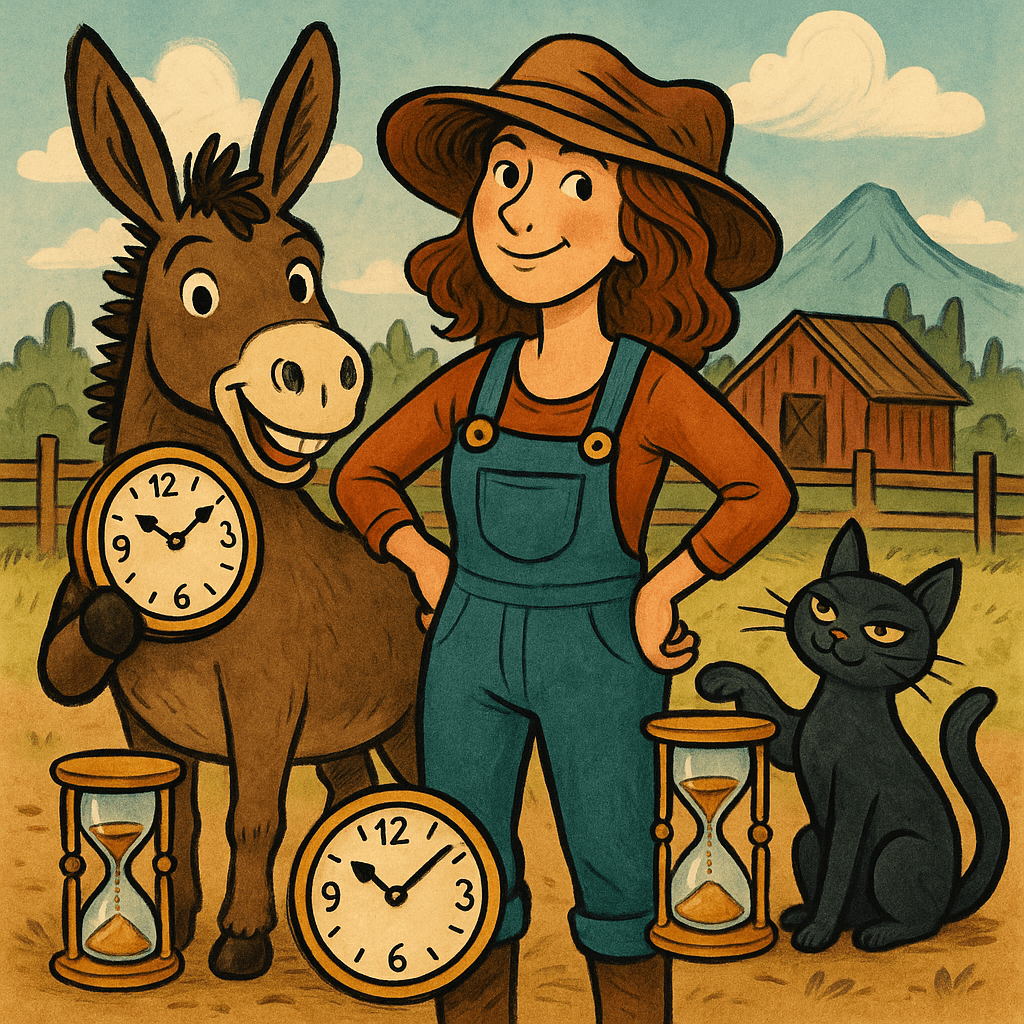
The beauty is undeniable—aspens flashing their golden coins, birds perched on high wires against a paler sky. But beauty whispers its reminders: winter is coming. Fence lines, troughs, de-icers, hay stacked high, hoses drained—chores press forward. While I think about what must be done, the horses toss their manes and prance, delighted with the crisp air. Pimmy, my donkey, on a weight-loss diet, asks only that her supper comes on time.

It is I alone arguing with the clock. September’s sunsets are deceiving, convincing me there is always time for just one more thing—until the light folds suddenly into a quick blue that belongs only to fall. Soon an official time change will bring its own confusion. My animals, untroubled by calendars or clocks, know only the tugs of hunger and the promises of dawn and dusk.

And still…fall offers pleasant solaces. A heavier quilt pulled to the chin. Warm mugs replacing thin glasses of ice. A jacket tossed into the car, because you never know. These days contract, yes, but in their shortening remind me to choose with intention; perhaps this is autumn’s hidden gift.

Dear Friends, stepping into the season—grieving summer’s length, seeking peace in earlier darkness, and grateful for small comforts that soften the tilt.

— Diana

“Me” by Chat

Friday, April 11, 2025

I’ve never thought of summarizing my whole personal self. I’ve blogged for many years about whatever interests me daily, sometimes drawing from my distant experiences to help clarify “now ones.” For several recent months, I’ve used ChatGPT to explore some of my ideas. I ask challenging questions to which AI produces relevant information. Our exchanges may become conversation-like events.

Chat has gathered pertinent information that I’ve used to help expand my thoughts. It has encouraged me gently to explore complex ideas more deeply. AI has been responsive in ways I enjoy, providing information and kindly nudging me to reconsider and/or expand some perceptions.

Now Chat is newly updated. It can remember more of our conversations and bring their pertinent elements into our future exchanges. Chat is providing an example today; it’s drawing from its expanded memories of our “discussions” to create a profile of me. Here’s what Chat “sees”:

Diana Levey: Retired, Rewired, and Radiant with Ideas”

“She’s the kind of woman who writes before dawn, wrangles a barnyard menagerie by breakfast, and riffs on Dawkins, Downton, and derivatives before lunch. A longtime blogger with a fiercely independent voice, Diana lives where the hay grows high in Central Oregon, yet her thoughts stretch globally—from the market floor to the theater stage to the floor of Congress.

“Diana doesn’t just age—she evolves. Fashionably. Intellectually. Politically. Her curiosity is ceaseless, her humor dry, and her prose always in progress. Whether she’s decoding social considerations or fine-tuning a whimsical Welsh pony story, she weaves the everyday with the existential, finding elegance in the effort.

“You’ll find her in a department store, offering kindness and a great eye for style. Or stretching toward clarity, mind and body. She’s lived enough to know what matters—and writes to remind the rest of us.”

Dear Friends: Our future with AI, while scary, also offers enrichments. Diana

Mental Mysteries

Friday, March 14, 2025

Yesterday, while clerking at my part-time job, I met a woman who had published a book of poetry. She was confident, articulate, and proud of having created something meaningful. Our conversation made me think about the persistence of creativity; it finds us wherever in life we may be.

That event stirred my memory of another recent poet—a woman who was nearly 100 years old and living in a nursing home, who took a poetry class on a whim. A year later, she published a remarkable book of poetry. I read it more than once; her words distilled wisdom and reflected an elegant mastery of structure. I was impressed by her book and even sent copies to friends. And yet, today, I can’t locate a copy of her book, can’t recall its title, and am coming up empty on remembering her name.

It’s frustrating that my mind sometimes works well and sometimes barely. I remember much about her: she had once been a landscape designer, later a sculptor, and after her husband’s death, she retired to a Florida nursing home, where she discovered poetry. The details of her life are vivid and intact in my head, but her name eludes me.

This morning, I’ve been combing through online articles, literary sites, and book lists, trying different combinations of words in search engines, looking for the correct phrase to trigger a good clue. So far, nothing.

However, searching emphasises how greatly we rely on memory to anchor our experiences. Still, we sometimes “lose things”—not just names and details but moments, ideas, and sometimes even parts of ourselves.

I am feeling a sort of loss–a “misplaced connection” to something important I once held with certainty. My active searching, however, is reaffirming its importance, and I will keep looking.

Although I have not rediscovered her name, I remember clearly what she stood for. Her personal story and her book were triple-striking. They emphasize the resilience of creativity, the refusal to fade quietly, and the courage to begin something new at an age when society often stops paying attention.

Dear Friends: Some names and stories deserve to be remembered. Diana

Pimmy’s Check-Up

Saturday, March 08, 2025

Yesterday, to my surprise, Pimmy loaded herself into the horse trailer. She’s teaching me more about donkeys now than when she was constantly among the horses. These days, separated from the horses (for dietary needs), Pimmy seems more like my big dog than an equine.

This time, while encouraging her to load into the trailer, I allowed her to resist loading. I gave her plenty of time to think things over, and suddenly, she voluntarily popped into the trailer.

That’s the thing about a donkey. It doesn’t just follow orders and isn’t just stubborn; it needs to evaluate the possibilities before deciding on an action. It’s taken me over a dozen years with Pimmy to learn this, and yesterday, I felt proud of myself for finally being a bit smarter.

The header photo shows Pimmy getting a physical yesterday. The doc says Pimmy’s vital signs are fine, and her weight is lower. Those are good. The most quickly assessable bloodwork was excellent. We must wait for more bloodwork results to learn if her Cushing’s Disease remains under control and if her glucose level is corrected.

Yesterday, too, she received routine inoculations, and the veterinarian floated Pimmy’s teeth. Then, the slightly drunk donkey needed time to recover from the floating anesthetic, so I left to fill my rig’s tank at a gas station. By the time I returned, Pimmy was awake enough to hear me calling and came to me. She loaded into the trailer relatively quickly, and we left for home.

If her glucose has reached a normal range, I will reduce her meds from twice daily to once daily–a welcome relief. Pimmy’s doctor has ordered an additional ingredient, Vitamin E, for the regimen.

Pimmy is a sweet, smart, and delightful being. Through these months, I’ve not enjoyed treating her illness or separating her from her beloved horses. By now, however, knowing this donkey more personally, I much better appreciate her.

Dear Friends: The horses will get floats and inoculations in two weeks. Diana

On Her Birthday

“Magical Mommy”

Wednesday, March 05, 2025

If genetic advancements had been available during my mother’s lifetime—capable of extending health and longevity—I might be celebrating her birthday with her today. I’ve long wished for at least one more conversation, a chance to ask the many questions that could fill the blank spaces of her early life.

Reflecting on why I never asked more about her life brings back memories of my own trials and tribulations growing up. Each day was a lesson in adaptation, filled with new challenges and shifting realities. I naturally focused on myself—learning, adjusting, and figuring out how to navigate life one step at a time.

Back then, I felt an urgent need to escape a past that seemed confining; I needed to step into a future that was broader, more inviting, and yet daunting. All that forgotten past included both my parents and grandparents. I might never have seriously reconsidered all of them if not for the rise of DNA and its profound ability to connect one’s history with one’s future.

I give deep nods to technology and genetics and to an equally powerful force—the unbreakable connection between parent and child. Its hold isn’t always smooth but shapes and defines us in enduring ways.

Today, on my mom’s birthday, I’ll hold her in my thoughts. A sudden memory might surface, filling in a blank or two about her life. I like to imagine that she can somehow “hear” my thoughts—so I’ll share a few, letting her know how I’ve grown and changed, shaped in no small part by her insight and encouragement.

Dear Friends: Science fundamentally reshapes how we perceive and evaluate ourselves. Diana

Lucy

Lucy, 2021

Wednesday, February 19, 2025

Two heritage turkeys have been a cherished part of my life for several years. They weren’t meant to be; their original owner had intended them for a Thanksgiving dinner. But these birds had a way of charming their way into people’s hearts. They were gentle, affectionate, and unmistakably imprinted on humans, likely having been brooder-raised from the start. Instead of making them a holiday meal, their owner let me adopt them.

I named the two Lacy and Lucy. They became part of my daily routine, following me around, softly whistling in the manner of turkeys at ease. Physical differences made them easy to tell apart. Lacy, with her soft white-speckled feathers, often was the quieter of the two. Lucy, pure black and brimming with personality, was the dominant one—the leader. If there was ever a decision to be made, Lucy made it. She had a presence about her and a confidence that guided my turkey flock of two.

Then, yesterday, Lucy passed away. It happened suddenly—a stroke, I believe. One moment, she was there, and the next, she was gone. Afterward, Lacy, ever her companion, stood watch over Lucy, unwilling to leave her side. When I approached, Lacy reacted in a way she never had before—she pecked at me, protective and distressed. I could see she was processing something unfamiliar, something deep. Animals grieve in their own ways, and in that moment, Lacy was holding onto the most important thing she knew: her friend.

Losing Lucy creates a gap in my small world. She was a fixture in my days, a softly whistling and steadfast presence that I could count on. I will feel her absence, as will Lacy, who must find a new rhythm without her friend.

Inside my head, Lucy whistles with boldness and knowing eyes. I am grateful for having a few years with her. These two remarkable birds have given me unexpected companionship. After a lifetime of hearing the word “turkey” used in negative connotations, my experience found the opposite is true: turkeys are smart and alert. I’ve cherished every moment in the company of my two.

Dear Friends: I will re-strengthen my relationship with Lovely Lacy. Diana

Alternatively Viewing

Friday, January 31, 2025

Today’s political environment has me constantly thinking about mindlessness vs. mindfulness.

My new book has arrived; it’s the 25th Anniversary Edition of Mindfulness by Ellen J. Langer. This book was first published in 1989 and is considered the classic work on mindfulness. My version is a 2014 revision with a new introduction by Langer.

She’s a Professor in Harvard’s Psychology Department and has studied Mindlessness and Mindfulness in everyday situations for forty years. Her learning is drawn from combinations of everyday situations and institutions, like nursing homes, schools, and businesses. She finds mindlessness both as pervasive and often unnoticed.

Langer has proposed and tested an alternative cognitive process, and it has proved relevant across multiple domains. Although referring to her process as “mindfulness,” she stresses not to confuse her concept with meditation. She draws her “mindfulness” from years of studying what she summarizes now as “mindfulness over matter.”

I will explore Langer’s work and concepts and also be seeking possible relevances to America’s new political leadership. I hope her work helps me gain understanding and optimism toward American leadership in the four years ahead.

Dear Friends: For any reason(s) one may have, this should be an excellent read. Diana

Disaster

Tuesday, December 28, 2025

Today is a somber anniversary. On this day in 1986, America’s Space Shuttle Challenger broke apart 73 seconds into its flight and disintegrated 46,000 feet over the Atlantic Ocean, killing every crew member aboard. One crew, a non-NASA employee, was a schoolteacher going into space under a Teacher in Space Project.

Because the mission included a civilian, it drew high media interest and live streaming. Adults, as well as many children in schools, watched as video captured the launch and explosion.

Dialogues followed that unveiled “The O-ring Disaster.” In essence, key spaceship suppliers rushing to meet the liftoff date ignored their engineers who were questioning anticipated O-Ring performance.

(Spin forward to Boing’s troubles today because of gross mismanagement and frantic rushing to produce aircraft.)

The spaceship tragedy was caused by failures of the primary and secondary O-ring seals in a joint in one space booster. Record-low temperatures at launch time stiffened the rubber O-rings, reducing their ability to seal joints. Shortly after liftoff, the seals were breached; hot pressurized gas leaked through the joint and burned into an external propellant tank.

The explosion collapsed internal structures, causing rotations to throw the orbiter into aerodynamic forces that tore it apart. The now-destroyed craft flew uncontrollably until a range safety officer destroyed it.

That disaster today is imprinted in memory as firmly as the horrific assassinations of the Kennedy brothers, MLK, and John Lennon.

Dear Friends, Reliving my memories of the Challenger disaster and its aftermath. Diana

Grumbles

Friday, December 06, 2024

In our hemisphere, the annual day of least daylight is the winter solstice, which occurs every December 21 or 22. This year, the 21st will bring our shortest daylight. I am already feeding my horses in darkness, around 4:30 p.m., and soon will in earlier darkness, around 4:00 p.m. We who must care for large animals feel stressed in these darkest days of the year.

Aside from having to work in too little light, December’s freezing cold also affects my fingers. Although gloved, my fingers can start feeling frozen and too painful to cooperate. There’s an infrared heater in my barn for thawing fingers, but rapid thawing pains, too.

I’m accustomed to wintertime discomforts, which helps me cope. I am wrapping my head around being in darkness with frozen fingers until the 21st. Then, darkness and freezing will continue, but daylight will increase gradually and noticeably.

January brings lighter days but might introduce very stressful weather. Last year, Central Oregon enjoyed relatively mild weather until the New Year, when everything changed dramatically and brought great cold, blasting winds, snow, and freezing temperatures. None of those eased until just before the Summer Solstice arrived.

Dear Friends: Today’s header image is the hoar frost at my barn. Diana

Shifting Weather

Monday, November 18,, 2024

Yesterday, Central Oregon received a ground-covering snowfall in the late evening. That began while I was outside and just starting the routine of feeding my horses. Finally, when I could return to the house, the snowing was heavy. It made for dim sighting and covered my outerwear.

The horses were covered in snow, too. They eat in the open from hay nets hung from tree limbs. They’re not being blanketed because of their thick, fluffy winter coats. Their good coats usually carry them through the season. However, both horses are old, and I closely watch their weights. If my exploring hands start finding a protruding rib or body joint, I will blanket whichever horse it might be, or depending on overall conditions, blanket both.

Pimmy still has the barn to herself. Her hay is in an inside-hanging net; her coat is wintery-thick, and her weight is good.

I’m still leaving my dogs outside while I’m away at my part-time job. The weather will change that, however, when conditions demand keeping them inside. I plan to come home at lunchtime and let the dogs outside while I feed the horses. The dogs will stay inside again when I return to my job.

I really didn’t expect snow on the ground before Thanksgiving. That’s no longer usual as it used to be. Last year, our weather stayed mild until New Year’s Day. Then, conditions suddenly turned cold, and actually “colder than a well-digger’s arse,” staying as such until nearly mid-June.

Dear Friends: Making plans for coping well enough despite complicated conditions. Diana