
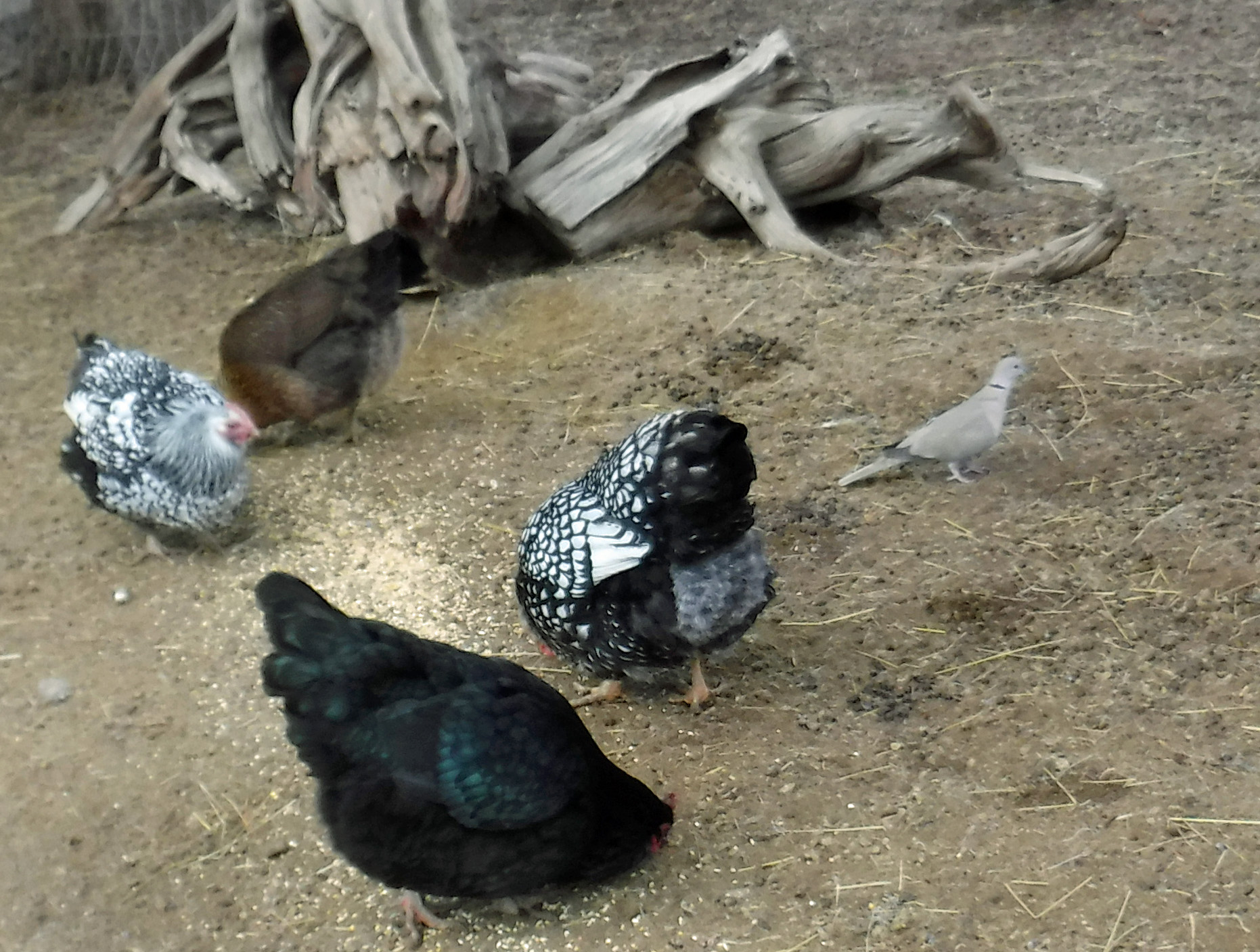
This little Ring-Necked Dove doesn’t fear me enough. At my approach, its many buddies make warning sounds and fly up to dense branches. This bird maintains a reasonable distance, more or less standing its ground and determined to continue feeding with my hens. I admire its tenacity, worry about its bravery, and hope for its continuing safety.
Several years ago and first-noticing Ring-Necked Doves on my property, I took a photo of one perched atop a junipher and posted it on Facebook. It earned a few negative comments. Generally, “This bird is non-native, a nuisance, a highly-disliked intruder.”
That attitude set me back and I paused to study the birds. As their numbers grew, they collected in a big tree overlooking my hens’ area where I toss to the chickens multi-grains. Upon my departures, the pigeons fly down and eat with the hens. I don’t mind, for I’ve only a few chickens and lots of grain scratch. I’ve learned to enjoy the doves, and, admire them, for they’re absolutely beautiful flyers, fast and graceful. They watch the goings-on, without bothering me, forage with my chickens, drink from my horses’ watering trough, and fly from tree to tree.
My interest in doves really accelerated after I adopted Gilbert, a racing pigeon, rescued by my friends Dave and Julie Gilbert. Gilbert is gorgeous–big-chested and built-to-fly (a conditioned racing pigeon flies at an average speed of 60 mph for many miles). While Gilbert raced from Washington State to home in California, something made the bird land, find its way into the Gilberts’ barn, and stay–unafraid of Dave who examined its leg tags, identified its purpose, and learned who owned it. That owner didn’t want a failed racer and suggested that Dave find it a new home. So, Gilbert came to live with me, and my Cockatoo, Peaches.
Gilbert is gentle and can be handled, but unlike Peaches isn’t a “people bird”. Gilbert is happiest mostly unhandled, that’s probably how racing pigeons are raised. Today’s racers have evolved from Homing Pigeons, with one purpose: flying competitively against other birds from a distant location and being first to reach home. Winners are the valued birds.
Outside, above my place, “my wild pigeons” fly beautifully, as doves should. (BTW, pigeon and dove refer to one bird, as pigeon is the French word for dove.) My Ringnecks are closely connected in flocks. They perch in a home tree, watch closely those on the ground, and signal at a sign of danger.
This summer, I hope to build a small outside aviary, providing Gilbert with more room to move around, spread and exercise flight wings, but allowing for a capture when it’s appropriate for this sweet bird to be inside.
Dear Readers, Have a great day, look for and enjoy the wild doves! Diana
 Diana's Morning Blog
So good to hear more about Gilbert. Dave and I would be happy to help you build an outdoor space for him. We would help buy materials too. Thank you for taking Such good care of him. I’m sure he would enjoy outside time.
On Mon, Jan 28, 2019, 8:01 AM Diana’s Morning Blog trailriderincentraloregon posted: ” This little Ring-Necked Dove doesn’t > fear me enough. At my approach, its many buddies make warning sounds and > fly up to dense branches. This bird maintains a reasonable distance, more > or less standing its ground and determined to continue feeding wit” >
LikeLike
Great, when the weather’s warmer, we’ll talk more! Thanks, Julie.
LikeLike