
Wednesday, June 17, 2026
Finally, June has settled in. The mornings are warmer, crisper, and very clear. The daylight skies greet early risers with nearly impossibly beautiful shades of blue. And the neighborhood’s wildlife is suddenly making more demands for attention. Most recently, in the early mornings, my coffee is frequently interrupted by new, highly vocal bird sounds.
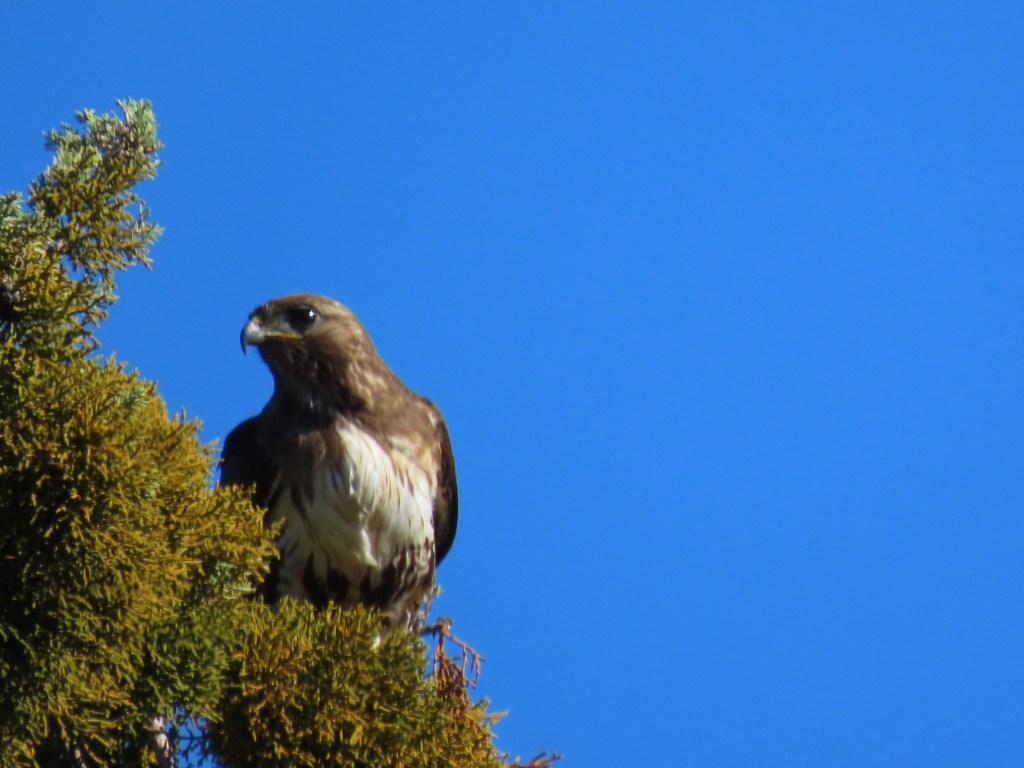
Lately, those sounds have drawn me outside. I look up high and far around to locate their source, finally focusing on the tallest surrounding juniper tops and the open sky. I quickly started taking a camera on my early trips outside, to listen and look—for glimpses and images of our newest local resident: a magnificent Red-tailed Hawk.
For days, that striking raptor has been perched atop several of my tallest trees. It stays in place while highly visible for long periods. That bird usually isn’t quiet, and so, it’s likely a juvenile. This is the season when young hawks fledge. Their relentless, raspy screams insist on (something like): “Mom! Dad! I’m hungry, and I’m here, waiting!” Young hawks testing their boundaries are still entirely dependent on the parents. This particular local noisy youngster vividly demonstrates a fledgling’s sheer patience—sitting, staring intently at the ground, crying for attention…and waiting.
To me, seeing this is like witnessing a masterclass that highlights the focused, solitary, and fierce nature of raptor life.
Of course, curiosity led me to research, where I learned that, like most other raptors, Red-tailed Hawks are monomorphic —meaning that males and females share the exact same plumage, coloring, and patterns; no distinct feather-color markings set them apart.
My local resident’s gender will always be a beautiful high-desert mystery!
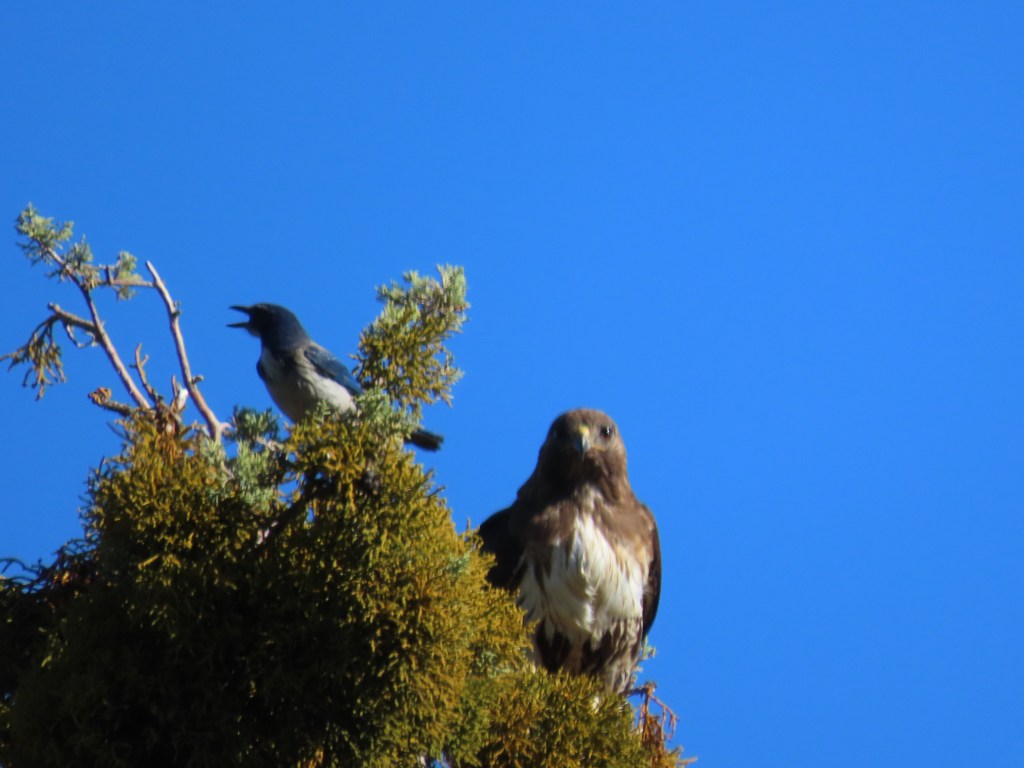
In one of my more interesting photos, a (protesting?) California Jay (formerly known as a “Scrub Jay”) appears positioned uncomfortably near the Red-Tailed. What a contrast, for if this jay happens to be worried about its own nearby nest, that focused hawk couldn’t care less.
These days, in another big part of my birding routine, I’ll lift my sights higher, trying to sense way beyond the juniper tops, the mountain air currents. Sometimes, luckily, I’ll find myself witnessing completely different bird behaviors—and actually another form of masterclass—this time, seeing an adult-juvenile summer school in session.
Featuring others of our local residents, the ravens, way up there. Teaching their fledglings!
The young hawk I am enjoying represents a more solitary, focused species. In contrast, the active raven family represents pure, cooperative joy. There’s little as beautiful as the ravens—riding, gliding on thermal drafts—flying and playing. Parents guiding their young through wind’s invisible circles—practicing floating effortlessly, making sudden stalls, and sudden acrobatic tumbles—vividly acted against the big blue. Those birds’ sheer intelligence radiates as the fledglings mimic the adults—learning the physics of the sky. It’s a program of sheer curiosity and aerial dancing.
In this wonderful time of year, Central Oregon offers front-row seats to these and other fascinating bird worlds. Here, beside my home, on a high treetop perches a young predator—a perfect combo of intensity and impatience—working to find its footing. And higher above, in the wide open air, brilliant and socially complex corvids are mastering the winds.
Yes, in summer, all that’s local becomes very much alive. There are squawks and screams drawing attention to glorious raptors. And there’s sky-watching that brings sheer joy in seeing other fabulously intelligent birds working their magic.
Yep, summer’s here, finally.
— Diana

