Hola, Scooter, Happy 80th!

Rosie

Monday, August 04, 2019

I’ve written that a neighbor, Sherry, who lives about a mile away, recently flagged me to a stop as my driving horse and I cruised the neighborhood on an exercise run. Sherry wondered if next Sunday, I might be willing give her mom, Scooter, a former horsewoman, a ride in my driving cart. That day would be Scooter’s 80th birthday. Saying yes was easy, because my driving horse Sunni is kind, dependable, and well-trained. Fast forward to yesterday, Scooter’s birthday, and time for Sherry’s intended surprise for her mom, the planned “horse fix”.

Last Friday, I injected vaccinations into the necks of my equines–a process usually without incident. But Sunni had reacted with a stiff neck–similar to how a human arm may react after an injection. I knew that in a few days Sunni’s neck would be normal, but right now she couldn’t be harnessed and driven. Unfortunately, by Scooter’s birthday Sunni’ wasn’t okay, I didn’t want to disappoint Sherry and also wanted to help her former-horsewoman mom have a “horse-fix”.

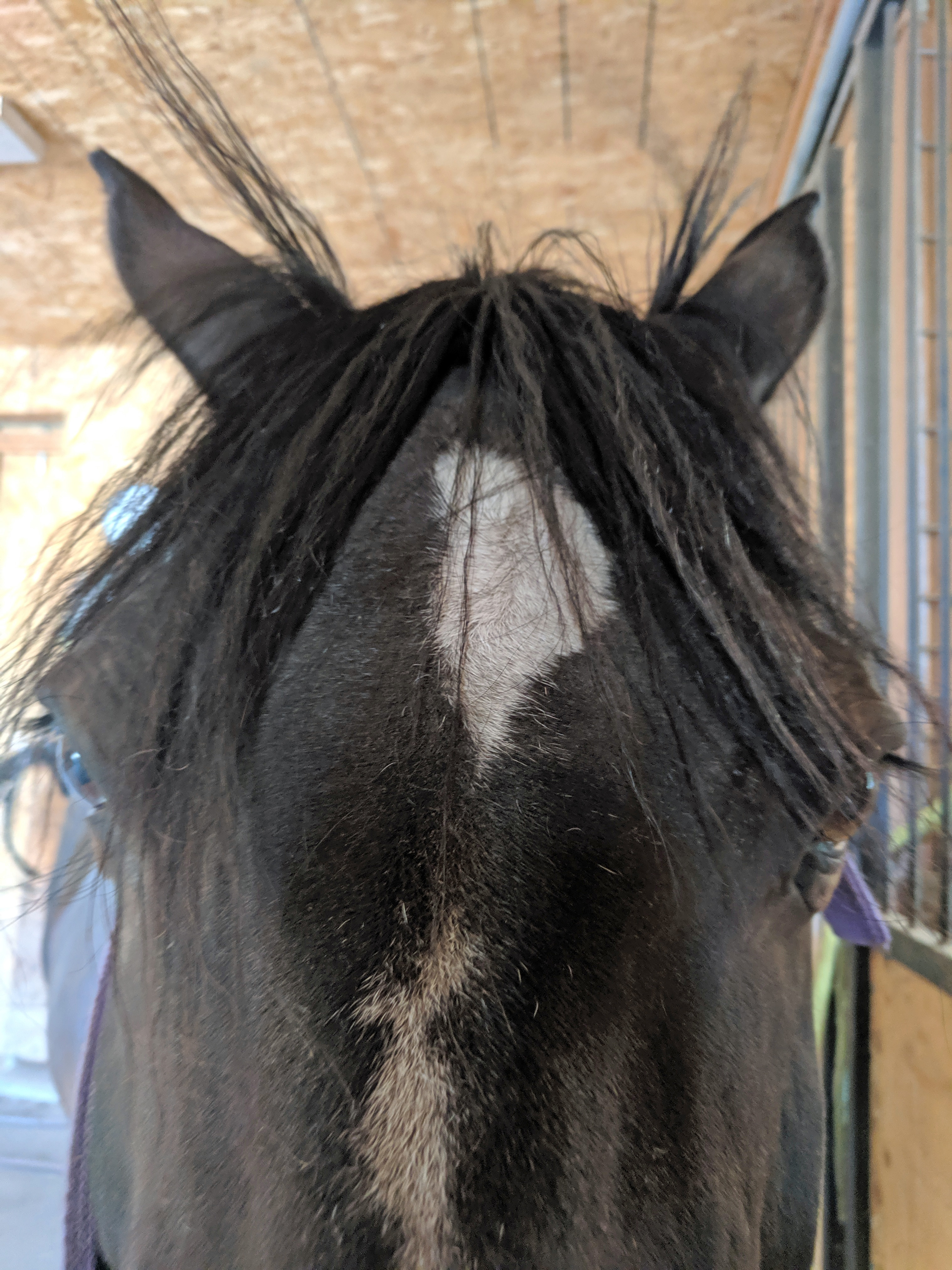
The alternative would be to drive Rosie, an well-trained horse but with a strong mind and imagination. Driving Rosie makes me work hard, to keep her from jigging and hopping instead of walking. Keeping her while trotting from stretching her head from side to side and looking around. Keeping her from weaving and not staying near the roadway’s right side. Oh, yes, and those dangerous trash cans, especially the ones overturned that can bite. Would Rosie’s over-alertness frighten Scooter? On the other hand, do I really distrust Rosie? After all, several times weekly, I’m in a cart behind the moving mare. Driving her demands attention, is work, but she’s not done anything to make me fear being on the road with her. So, when Sherry called, Rosie it was.

After I harnessed, hitched, and forced Rosie to walk a bit, we began trotting so she could warm up and loosen joints. Our ride to Sherry’s gave me a chance to be certain nothing in the neighborhood was alarming–no loose kids or dogs, nor overturned trash cans. After reaching Sherry’s and pulling to a halt, Scooter’s adult children helped the birthday girl board and don a protective helmet. Meanwhile, Rosie, although a bit impatient, seemed to enjoy having Sherry at her head, massaging her ears.

We started off at a slow trot, before I realized that Scooter was frightened in the bouncing cart. She said she feared being bounced out, asking if we could walk. I slowed Rosie for whom walking nearly is impossible, she jigs and hops. To my absolute shock, she easily slowed and began walking, pulling the cart steadily without looking around nor worrying about anything in the world, including passing cars. In another quarter mile, on reaching our turnaround point, Rosie turned walking and back toward Sherry’s.

Meanwhile, Scooter and I talked. She’d moved to Bend about 40 years ago, and soon afterwards became a single parent. To support her family, she worked in the mills, and afterwards for years worked as a bartender. She had grown up with a beloved horse and referred to its breed as an “Oregon Broomtail”. She describes the “old Bend”, long a teeny-tiny town–a great perspective to hear from one who’s lived in this place since way before it became popular.

I asked Scooter if she’d be okay now if Rosie goes into a slow trot. She decided, yes, at first gripping the cart, but relaxed as we rocked along behind the horse, toward Sherry’s home and to welcoming cheers from Scooter’s kids. Rosie stood patiently while Scooter dismounted, excited. I looked at my horse and thought, “Bless you, Rosie.” As we headed home, she swung into an easy trot, going without a single distraction.

That afternoon was wonderful. Not only could I offer something special to a “birthday girl” and meet a nice family, but Rosie had seemed different–easy and cooperative. Once home and unharnessed, she cuddled by pushing her head against me for some face-rubbing. Oh, my, is this Rosie?

Well, it’s all about perspective, isn’t it? That evening I stood watching Rosie, and now, from her seemed to flow rainbows instead of lightening rods. Really! Is it a dream or has our relationship evolved?

Dear Friends: Scooter’s birthday turned over that glass, made it half-full. Diana

Eva & Kathe, Art Extraordinaire

Sunday, August 04, 2019

In my young years as an aspiring artist, I was particularly attracted to a style of drawing–spare and emotional. This style was well-represented by early 20th Century German artists in response to brutal government oppression. One of the most powerful representatives of this art was Kathe Kollwitz. I studied her works with fascination and awe, the artwork of others, too, but Kollwitz remains most-burned in my memory.

Just the other day, a blogger I follow wrote a piece about Eva Frankfurther, a German-born artist who grew up in England. I’d never heard of Frankfurter, but her drawings and lithographs immediately captured my attention. Her art made clear that she understood the terrors of Nazi Germany, and that her expressionism was influenced by the works of Kathe Kollwitz.

Kollwitz lived in Germany during the terrible years. Her art is a compassionate history of the experience of terror for humans of all ages. Frankfurter’s experience was different. She was removed from Germany as an infant just as the Nazi terrors began, but her mind and imagination were impressed by all happening in the homeland of her people. Her entire emphasis through art is on people, those in the streets of London where she lived and in Italy where she studied. She explained their taunt emotions with spare lines and made amazing art.

Unfortunately, she was one of those super-bright, creative and capable artists unable to tolerate the pressures of genius. In the 1950s, she self-imploded, committed suicide in her mid-twenties, leaving hundreds of unpublished and unsold drawings and lithographs–results of her never-ending preoccupation, studies of people on the streets and at their work.

Her art and persona have captured my thoughts and imagination. I intend to learn more about this talented individual who before now was lost to me.

Dear Readers: You will be invited to learn, along with me. Diana

Afternoon of Shoeing

Slow process, trying to remain patient

Saturday, August 03, 2019

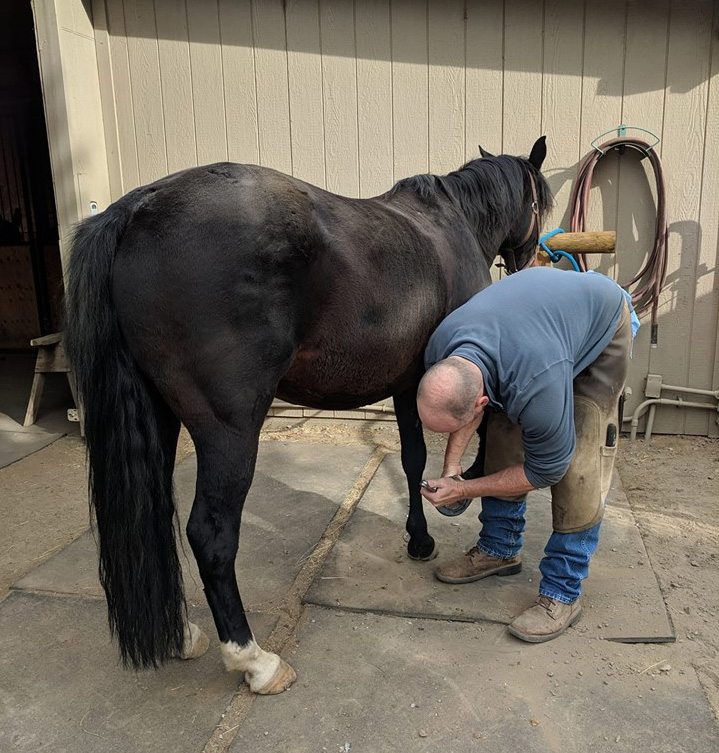
Yesterday, our farrier was here. He doesn’t work rapidly, is specific, careful, and knows how to correct a horse’s stance and movement. After all, he’s been working on horse hooves for about 30 years, loves his job, and has a thousand or so stories about horses, trainers, other farriers, injuries, accidents, and just plain anything ya might wanna know.

He self-describes as a learned professional, is self-confident and maybe a bit arrogant but it’s okay. I’ve spotted arrogance in people who know too little, and for sure, this fellow isn’t that type. He sees accurately what’s needed, knows what he’s talking about, and delivers what he intends to accomplish.

He’s not from this area, divides his time between Bishop, CA, and Bend where he has close friends. He’s cared for the hooves of hard-working horses, mules, and donkeys, understands the differences among their hoof structures and the stresses of their work. He takes excellent care of my athletic horses, and trims little Pimmy correctly.

Yesterday, he was delighted over Rosie’s hooves. They’ve grown stronger. He noted with what he described as “true awe”, that despite her rather small overall size her hooves are “very large”. I’d never given this a blink, for to my eye her hooves are about right. I noted though when he began working on Sunni (overall more little than Rosie) that her hooves are much smaller. Nonetheless, the end result is that the farrier has protected the feet of both horses. They’re wearing pads (to absorb the impact of traveling on pavement), underscored by heavy metal. It’s burned into my brain that at all costs my pitiful boot-clad toes must be out of the way of any shod hoof!

There’s an interesting note having to do with Sunni’s one hoof that had suffered a severe injury when she was a foal. Although the hoof is strong and doesn’t cause problems, the old injury created a brittle section that periodically pops out and then regrows. Now, it appears that Sunni’s shoes have cushioned and supported the brittle section so that it remains in place. That’s a biggie.

Dear Friends: All us girls are good to go for another six weeks. Diana

Twinkle Toes

Fitting shoe to hoof

Friday, August 02, 2019

This is short and sweet for the farrier is coming soon. I must get out to feed the horses before he arrives. Fortunately, he moved our appointment up an hour, which left me with time to jot a blog.

My horses naturally have very tough hooves and always were barefoot before we started driving. Pulling a vehicle forces hooves into traction against the ground. This wears a bare foot more severely than does carrying a rider.

When I first got horses, it seemed their hooves amounted to little more than sturdy blocks of matter at the ends of legs. Well, I sure learned, for hooves are very complex structures full of nerves and with critical bone mass. Mistreating its hooves will end a horse’s ability to function. A horse that’s barefoot needs regular trimming and balancing of hooves.

When it comes to shoeing, the stakes are more complex. A good farrier shoes to protect the hooves during traction, and to correct the alignment of legs and strengthen gaits. Horses like people are subject to club feet, pigeon-toes, and misalignments, small or large, that impede flexibility and ease of movement.

Neither of my horses trot with adequate width between their rear legs. This reduces function. Our farrier makes corrections by building shoes that force the rear legs to lift off and land more properly. Over time, we hope this shoeing will strengthen unused muscles and improve natural gaits.

Oh dear, as usual I digress, and build a watch instead of telling the time.

Dear Friends: Good morning to you all, and have a great day. Diana

Birthday Special

Trainer driving Sunni

Thursday, August 01, 2019

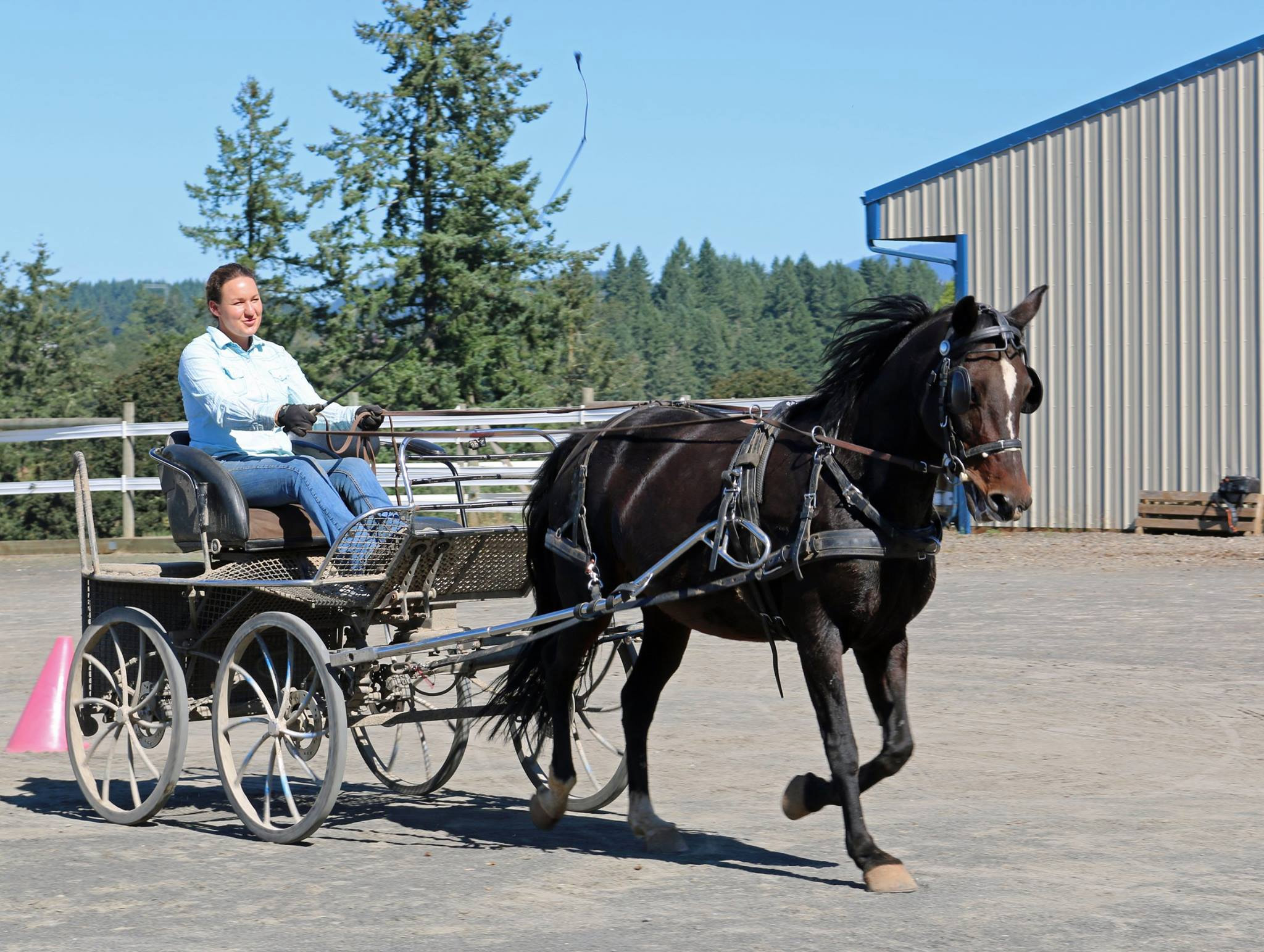
Every day I’m not scheduled to work at my part-time job nor must fulfill obligations that take me from home, I exercise both my driving horses. There’s a three-mile loop in my neighborhood, paved streets with little traffic and few interruptions. My cart covers it twice, once behind each horse.

They’re full sisters, these mares. Sunni is solid as a rock, dependable and easy to drive. The other, Rosie, a capable and beautiful driving horse, worries as we move. Her head turns this way and that to spot whatever might be scary. Like the time we came around a curve, and there edging the street, she saw the beginning of a rock wall! Such surprises freeze her momentarily and my job is to encourage her to keep moving. Her over-alertness might never lessen but she’s responsive to reins and voice. Interestingly, I find that Rosie’s more relaxed when we’re driving on country horse trails. But we must use what’s easily available and that’s neighborhood streets.

So yesterday, Sunni and I are out exercising and approaching a four-way intersection. I slowed her to check for traffic, and somewhere to my right sensed unusual movements. I turned and saw a woman waving, gesturing for us to approach. I pointed Sunni toward her driveway and learned that the woman had a request.

Her mother will turn 80 years old next Sunday and this lady has arranged a birthday party. The mother loves horses, used to be very active with them but no longer rides. The question was if I’d accept money to give her mother a carriage ride. Of course, and for free. We’ll happily go there and give the mom a ride. We’ll keep to paved streets so the ride won’t be bumpy and rock-steady Sunni will pull.

It’s always a delight, relearning how easily our pets help us to make friends. Having dogs has introduced me to other dog lovers, particularly when we share a breed-type or particular training interest. My experience with horses proves them to be almost instant friend magnets. Like the lady who flagged us down hoping to give her mom a special surprise, and I understand.

Dear Friends: Horses are experiences and relationships–loved forever. Diana

Jumping Competition

Wednesday, July 31, 2019

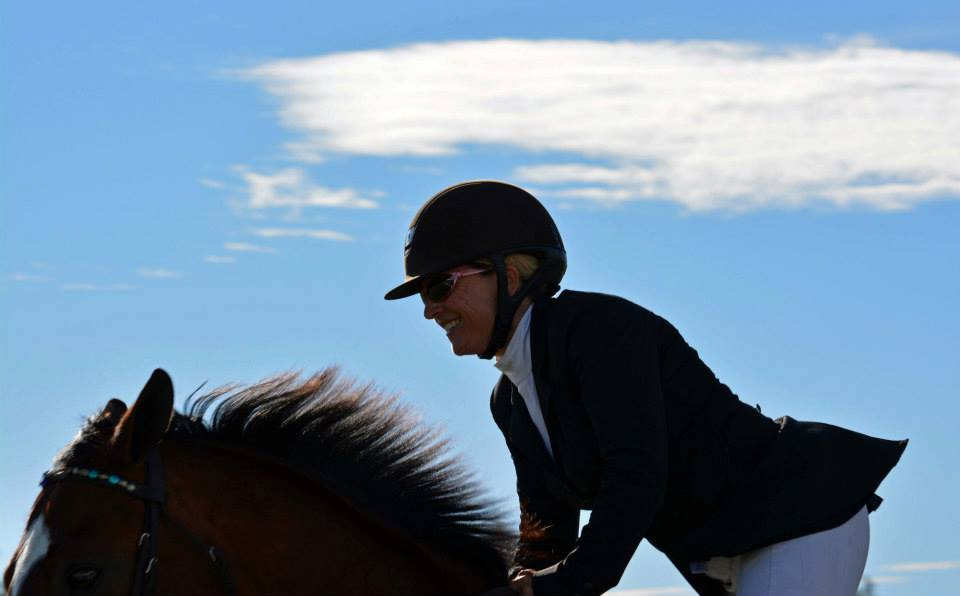
The annual horse show held in Bend at the J-Bar-J Ranch draws hundreds of competitive jumping horses and riders of all ages. This show occurs in my neighborhood and I enjoy trekking there for the final big competition where winners earn very lucrative prizes. This show draws from the northwest, and beyond, the best horses and talented riders.

After spending most of my time around my two mares–Morgans in the size-range of large-ponies–those jumping horses astound me. They’re mostly Warmbloods, or what’s known as middle-weight horses, and to my eyes seem nearly tall as trees. More specifically, Warmblood jumping horses average 16-17 hands tall, or huge compared to mine in the 14-hands range.

For all their size, speed, and ability to clear huge jumps, the Warmbloods also are flexible. They’re capable of turning rapidly and efficiently, and adjusting to the technicalities necessary for approaching and clearing jumps. In action they’re exciting to watch, and now, as they circle galloping past and in front of me, fun to photograph.

Much as I love the big horses, it’s as much fun to see the smaller, normal-size ones that young people ride competitively. Some adorable riders, around five-six years old and dressed in formal riding clothes, appear very self-confident while listening to last-minute inputs from coaches or parents.

The horse show lasts a couple of weeks. The neighborhood adjusts to the noises and traffic, and about when everybody gets used to the event, it’s over. Within a single day, all the horses, trailers, RVs, and competitors are gone. And in another few days, hundreds of temporary stalls become dismantled and hauled off. Soon, there remains an empty field waiting for next July and another arrival of temporary stalls.

Dear Friends: All animals in full-action are beautiful and awesome. Diana

Tripping Through Time

Tuesday, July 30, 2019

I’ve been thinking about how it seems in early August that summer starts slipping away. This idea got boosted yesterday while I was in Costco, at my part-time job, and saw a new huge display of winter skiing gloves tucked neatly beside the remaining school supplies. I saw in the clothing stacks new warm-lined pullovers and vests, and now, lots of summer items on sale. I’ve been at Costco long enough to know that later this month, the store will introduce spooky skeletons, Christmas light-strings, and more varieties of winter gloves.

It’s always a bit astonishing in August and September to see carts rolling by with holiday gifts and associated knick knacks. Asking customers why they’re shopping so early for Christmas gets proud responses like, “I want to be prepared and ahead of the holidays,” Or, “So many bargains right now, they’re simply irresistible.” By the time December actually rolls around, the few remaining holiday items are marked down. That’s when we employees start buying.

In late November or early December, the store’s merchandise again starts changing. Then, it’s astonishing to see baskets hauling Speedos toward checkout stands. Over the years, Costco has helped many lose a sense of time by manipulating what’s around us. Our head-calendars shadow merchandising calendars. The rule at Costco is, if you spot something you like or just simply might enjoy using, get it now–for it might disappear in an eye-blink.

The store’s merchandising is amazing in that displayed items help to alter the calendar for many of us. After the store closes, nighttime workers move things around, forcing customers that return to travel aisle-by-aisle to find what they’re looking for. While watching closely for items they want, they spot wanted-others previously overlooked. As a food sample server, I enjoy assessing loaded shopping baskets. I try to calculate the percentages of purchases possibly-planned opposed to impulsive pickups.

Everybody inside the store learns to assess baskets this way. After getting to know Costco, this skill becomes second nature–and handy–for items tossed into carts communicates to insiders and shoppers alike what’s hot and what’s not.

Anyway, I digress from my thesis that summer might be slipping away. Despite signals in the universe, there’ll be no turns toward ski mittens or warm pullovers. I’ll hang onto a “summer-like reality”, sticking to a warm weather state of mind, for it’s early August and there’s still much to accomplish.

Dear Friends: Merchandisers are masters at manipulating perceptions. Diana

Evening Beer

Monday, July 29, 2019

Changes that mark summer’s ending: fully loaded horse trailers departing the big jumping show; sunflowers drooping on strong stalks and surrounded by dropped pedals; the strident screams of resident Ravens, now hushed, for their babies have become independent; hotter days but with cooler nights. Most significantly: my thoughts turning, from getting this place ready for action, toward preparing it for an off-season.

Yesterday afternoon and considering changes, I trudged uphill and into the house, grabbed a beer, and flipped on the TV for what’s new in the outer world. Just in time to catch the action in Gilmore with people desperately running from a shooter. I watched frozen, trying to reconcile this recurring obscenity, another sudden terror, destroying families and friends on a summer-day outing.

I remembered the previous day and the nearby horse show that had been packed with observers. I thought about the planned for musical and art venues, our big box stores crowded and without hiding places. For sure, this relatively small community has had shooters–deranged individuals who’ve murdered someone’s horse or horses, or shot wild horses in the Ochocos, or killed swans on the River, or destroyed household pets. Yes, some locals have murdered family members, too. These unhinged, obscene acts frustrate and frighten those of us who can enjoy and do appreciate life.

But an active shooter or shooters chasing people, to kill randomly those enjoying a summer day! It’s beyond comprehension, and yet, has become all too common. I cannot comprehend the degree of mental illness that can drive one to murder randomly, regardless of whether the goal is to achieve a single death or many.

Dear Friends: To this former Californian, the Garlic Festival is a gentle event. Diana

Never Say Quit

Sunday, July 28, 2019

Appropos to my frequent musing on the biological and social affects, and the influences of experience on aging minds, an article caught my eye in today’s Washington Post: “At age 101, this woman released her first collection of poems”. From this story, one who enjoys scribbling, ahem, me in this case, finds delight and inspiration.

First of all, the elderly author, Sarah Yerkes, is a woman with a creative, productive history and a trigger-sharp mind. We’re not meeting someone who awakened to talent in old age, suddenly and unexpectedly–like maybe Grandma Moses did before starting to wield a paintbrush.

Yerkes graduated from Harvard’s Graduate School of Design, and for years was a landscape architect using brick and stone, and later a sculpture creating abstract works in papier-mache. When her aging made physical work too challenging, she followed a fellow resident of her senior home into a poetry writing class that met monthly.

Last month, at age 101, she published her first book of poems–the latest output from a creative mind that for many years worked with form and style. Writing forced her to deal with a “WASPy past” that encouraged her while growing up to repress many feelings. She also learned the habit of diligence, until finally now, it forced her to continue to work at creating her poetry.

Samples of her poems highlight memorable private episodes in her life, and her perspectives past and current. She’s spot-on in describing memorable moments, her thoughts and feelings then, and later explorations about meaningfulness, or what-might-have-been.

Her story is an inspiration!

Dear Friends: Let me add, that her book already is on its way to me! Diana

Chicken Delight

Saturday, July 27, 2019

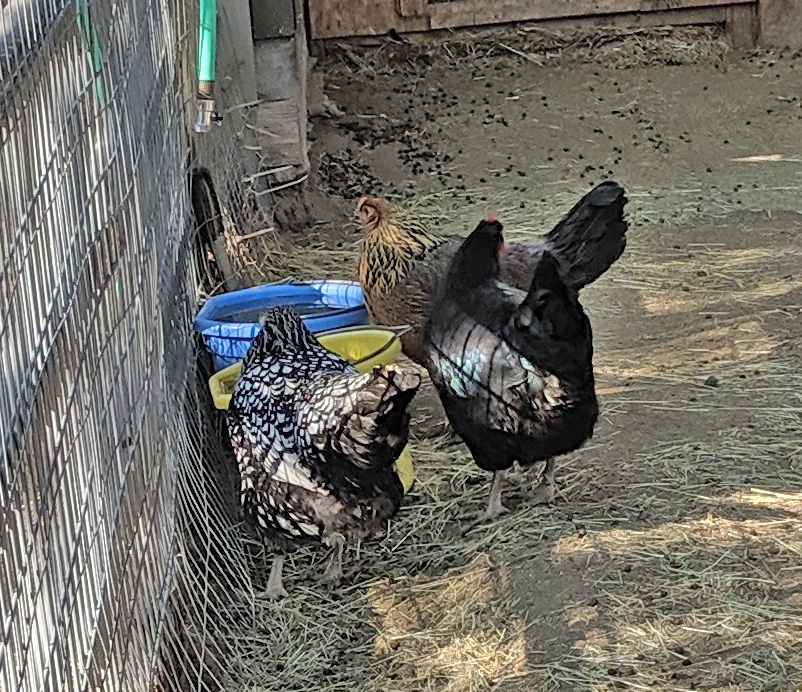
A sign (courtesy of Purina Feeds) affixed to my chicken enclosure gate announces that, “Happy hens live here!” In the above photo, my four (yes, four, this capture is poor) girls, clustered around water buckets, are what remains of the dozen day-old chicks that I carried home nearly 10 years ago. Having chickens has been a worthwhile and enjoyable experiment.

Not without trauma, for there’s little more brutal than normal action in the chicken house where they pick on one another. One’s always the group victim, ragged from missing feathers and bleeding from picked-on skin. I’ve used much purple-dye spray to try and hide the sight of “appealing red” from a poorest one’s more-dominant coop mates. As the flock gradually diminishes, usually because the most-picked-on fails, another falls into the role of group victim.

In observing this phenomenon, it became important to try and save a failing hen. Sometimes the purple dye helped but not enough. Even a most troubled chicken didn’t want to be parted from the others. Occasionally, I did separate a hen, bringing her into the house to heal skin and recover feathers; but it was complex to return her (now an outsider) to the flock. Even my little dwarf goats who live with the hens would lower their heads and charge “the newcomer”. Before long, she’d again be bleeding and featherless, but feeling as if she belonged, and I supposed, relatively happy.

Anyway, now there are four, presumably the strongest of that original dozen. Among these survivors, one appears a bit more ragged with missing feathers and spots of red skin (no bleeding) apparent. I observe her closely: weight is good and eating aggressively, comfortable among her mates. In evenings, all huddle together and roost, and that’s most likely when the vulnerable one looses some downy, protein rich feathers to one or another greedy sister.

If this weakest is next to go, it’ll probably be apparent in winter when all spend more time huddling, and by next spring she’ll be really ragged and weakest. I won’t intervene beyond applying purple spray. On the other hand, I can be hopeful that she’ll remain viable. My thought is that when a group becomes very reduced, it’s in everybody’s best interests to keep all members well and functioning.

Dear Friends: Chickens really are likeable, they give and teach so much. Diana