Egg-zactly

Saturday, April 27, 2024

I love 30- to 60-second microwave meals made from scratch. This morning, a low-carb tortilla sprinkled with cheese turned into a cheesy melt breakfast delight in merely 30 seconds. Peaches, my Cockatoo, enjoyed a slice, too; he “hearts” anything with cheese.

My love affair with quick cooking started on a morning long ago. I was in a hurry and experimenting, so I microwaved a stirred egg for 45 seconds. To my surprise, it created a lovely little soufflé. After getting good at producing the basic cooked product, I played around by stirring simple ingredients into a raw egg, like bacon bits and a drop or two of cream. Those made my microwaved soufflés really pop.

All that happened because of my chickens. They lay bunches of beautiful eggs. After teaching myself to cook quickly, I began carrying a raw egg and a little cup to work and microwaved 45-second lunches. Coworkers became interested and learned the cooking process.

These days, after washing fresh eggs and setting them into one-dozen-size cartons, I refrigerate them. Periodically, I take eggs to work for coworkers. They contribute $2/dozen, which helps defray costs for bags of chicken feed. Happily for all, a fresh egg easily becomes a hot lunch.

Here are more quick microwaved-egg meals for protein-packed breakfasts or light lunches:

Mug Scramble: Whisk an egg in a mug with a splash of milk, chopped veggies (spinach, mushrooms, tomatoes), and a sprinkle of cheese. Microwave for 45-60 seconds, stirring halfway.

Spicy Edamame: Toss frozen edamame into a microwave-safe bowl with a stirred egg, drizzle of olive oil, chili flakes, and a pinch of salt. For a hot and spicy snack, microwave for 30-45 seconds, stirring occasionally.

Mini Quiche: Prepare a small portion of pre-made pie crust dough and press it into a microwave-safe mug or ramekin. Fill with a beaten egg, shredded cheese, and chopped ham or bacon. Microwave for 45-60 seconds or until the egg is set.

Dear Friends: I am transformed into an egg guru, to my great surprise. Diana

Learning Is…

Friday, April 26, 2024

Writers have subjects they’re passionate about. A high interest fuels creativity and makes writing processes more engaging. A favorite topic may recur frequently. Over time, I’ve blogged mostly about adult learning. Apparently, it’s my favorite topic, a springboard for exploration. The learning theme lets me delve into complex ideas, ask big questions, and share my perspective.

We are lifelong learners. Our constant learning usually isn’t from single incidents but it’s cumulative. Our challenge is to face our unique behaviors and speaking patterns and be self-aware enough to see learning opportunities. We must be able to rearrange some attitudes.

It’s all very tricky because new learning may manifest as anger or frustration about something carefully planned that went wrong. If we become obsessive about what went wrong, we might remain in a cloudy mode of, “Why instead, didn’t I?” We must refocus, reevaluate, face, and discover what might have created a better outcome.

That’s an adult learning experience.

Spotting errors lets us see things we previously overlooked or did incorrectly. However, new information may challenge our existing beliefs. That requires the strength to face shortcomings and to plan differently ahead. Misplanning brings new insights, new knowledge, and a huge challenge to evaluate new ways of handling what might have contributed to a current discomfort.

New learning illuminates something we thought we understood and creates a fresh perspective. It encourages us to change our behaviors to achieve more favorable outcomes. Essentially, grasping a new concept offers satisfaction and accomplishment.

My point is that learning is a continuous process, but it doesn’t always occur clearly. Only by slowing and being thoughtful may we start seeing its signs. Learning is amazing because something new can spark our curiosity and encourage us to delve deeply into a subject.

Dear Friends: Patience with ourselves is how new information may sink in. Diana

Magical Gifting

Thursday, April 25, 2024

Working in retail teaches that charge accounts are a key way the retail industry makes money. Retailers that issue their own cards establish a special relationship with cardholders. A store’s unique card increases sales, ensures customer loyalty and repeat business, earns interest income, and provides data and customer insights. Stores also may partner with banks to provide credit card services and share monetary rewards.

For customers, it’s convenience. Almost magically, they shop without needing cash or a debit card. Many stores also offer rewards programs tied to their charge cards. Customers receive points or cash back for purchases. Incentivizing customers to return and use a store’s card ensures repeat business.

Charge accounts also provide a retailer with valuable data on customers’ spending habits and preferences. This helps the store create targeted marketing campaigns and personalized promotions and develop new products better suited to its customer base.

My part-time job in retail has made me a witness to all those elements. I’m impressed by how efficiently the retailer I work for captures everything associated to its credit business. My job also makes me aware of a very negative side to the business of easy credit and rewards for customers with charge accounts.

Customers with credit cards often say they purchase too much. Many such shoppers soon learn that store cards’ interest rates are high and that late fees accumulate quickly. These days, shoppers often explain that they have opened credit cards previously and ultimately found they couldn’t pay off monthly card balances. After accumulating great debt by using a card and finally managing to struggle from under the burden, these shoppers are adamantly opposed to opening another charge card.

Dear Friends: All this argues for a greater focus on managing our assets skillfully. Diana

Retail Rant

Wednesday, April 24, 2024

I was called to work on my day off yesterday, which was no surprise. The department store is shorthanded in workers and asks all its regulars to help above and beyond.

These days, the retail industry is in crisis. There are many confusing price cuts, much pushing for credit applications, incredibly complicated online competitions, and growing numbers of empty brick-and-mortar stores.

While I am working in the department store, its customers keep me aware of the confusion in navigating current retail processes. For example, they have learned to compare online and in-store prices and may enter an actual store to negotiate for the best price. Upon finding an item online that they want but that a physical store doesn’t stock, disappointed customers are essentially forced to shop online.

Price cutting is rampant, and nobody knows where that might go. Retailers must make profits, so price-cutting is an art; sale pricing is a game–a tease designed to draw would-be customers. All retailers are doing whatever’s needed to make buying quicker and easier, to attract customers.

Customers know all this, are highly aware and still purchasing like crazy. Retailers keep pushing sales and offering rewards as incentives. Meanwhile, buyers are struggling with debt from easy buying.

You get it because most of us overbuy readily available products. Nonetheless, retail must keep changing and solve the current burdens of disappearing storefronts, its hugest retailers competing mightily to keep and gain customers, and a central issue of pricing dancing with the unrest of inflation and interest rates.

Dear Friends: This commercial climate stresses a hard lesson of restraint. Diana

Social Lesson

Tuesday, April 23, 2024

Shakespeare was born in 1564, almost 500 years ago. His mature writings have endured, and to this day, they teach and influence powerfully. His story elements have created an enduring legacy. His words are quoted, his characters analyzed, and his stories retold. Shakespeare is a permanent fixture in the worlds of literature and theater.

I have wondered if Shakespeare’s influence is equal to that of the Ten Commandments. After some research, I understand that the two works operate in different spheres. They hold differing kinds of weight among humanity.

Shakespeare’s influence focuses more on artistic expression and cultural understanding, while The Ten Commandments have a broader social impact.

Shakespeare’s influence is primarily in literature, theater, and language. His influence is inspirational, offering insights into the human condition and sparking creativity. His works transcend religion and culture, appealing to anyone who appreciates storytelling and language.

The Ten Commandments are religious and moral guidelines; they are prescriptive, dictating right from wrong. Primarily aimed at religious followers, the Commandments have vastly influenced the shape of Western societies for millennia by impacting legal systems and social codes and influencing individual behavior.

Understanding the differences, I now see that The Ten Commandments are the backbone of Shakespeare’s plots. Similar to how The Commandments greatly influence Western society, they make Shakespeare’s plots very powerful and lasting. Shakespeare’s genius is his creativity, an artistry for structuring complicated plots that beckon highly emotional responses.

Today, Shakespeare’s birthday encouraged me to work through my long-held, knotty question. I understand better now what makes his works continually impact humanity. He was an artist at creating plot structures that intertwined closely to, and often fell against, acceptable social orders and norms.

Dear Friends: Shakespeare makes us think about us! Nobody’s done it better. Diana

Perspectives

Monday, April 22, 2024

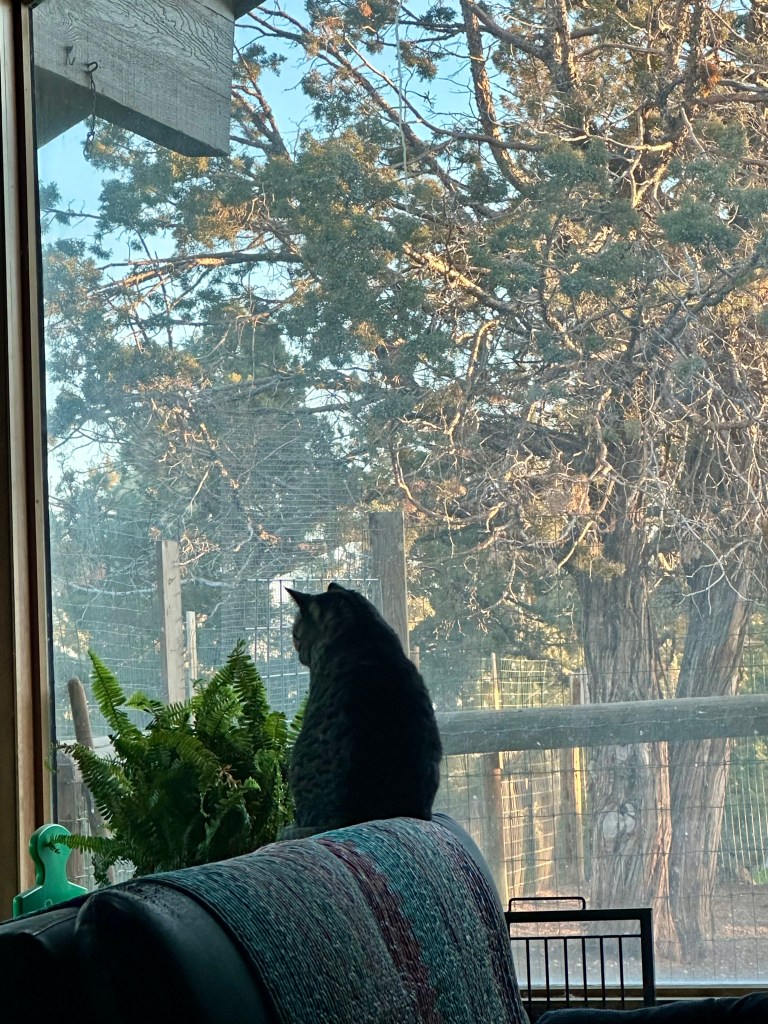
A beautiful morning. Today’s header photo shows Maxwell having an early view.

Last night, I got caught up in my tendency to make impulsive decisions. I’m not fond of that quality, having learned that impulsive decisions don’t necessarily work out as I might have wished. Actually, last night, I wanted to look forward realistically and make some meaningful plans for the future.

That forced me to pause and think about my perspectives and outlooks. Clearly, the two are closely related and interact constantly. Focusing on perspective, I think, is a way of essentially self-assessing, in other words, self-informing, to grasp my key attitudes and expectations. An understanding of the two opens a personal baseline, which moves thinking forward and helps with planning for new directions logically.

That’s much better than deciding impulsively, emotionally, and on the spot. In other words, by planning based on perspective and outlook, and combining hope and imagination, I’ll be able to anticipate a more achievable future.

Dear Friends: I’ll have to remember all that and plan accordingly in the future. Diana

Bird-Eyed

Julia’s adorable doodle-pup, “Josie,” @ 6 mos.

Saturday, April 21, 2024

I was called in to work on my day off yesterday and had my first stint at cashiering in the store’s main kiosk, which is dedicated to handling customer service. I enjoyed working in the spot, learning new processes, enjoying a bird’s eye view of a large store section, and not running across unexpected customer issues. An issue that might have occurred would have been handled well because a capable coworker nearby had my back.

My competent backup was the nice fellow who sells sunglasses in the store. Oh, not just any old glasses, but “designer kinds.” During my time working there, and deliberately, I’ve not paused to look at sunglasses. However, now in Central Oregon, the sun shines with real summer arriving. So yesterday, in the main customer service kiosk, I was near a large array of displayed sunglasses; they dominated my bird’s eye view, and they teased! You’ll easily guess the outcome.

Summer thoughts that are pushing more blood into my brain are refocusing me on the horses. Yesterday, I brushed out most of their remaining dense winter coats, combed and untangled their manes and tails, and today will start their reconditing by exercising on a long line.

My working hours are many, as the store is low on employee numbers and I want to help. Meanwhile, I want the time and energy to be working regularly with my horses–wonderful and fun, they’re not to be neglected.

Dear Friends: My new specs, engineered to stay on while riding horseback, are very cool. Diana

Film Art

Saturday, April 20, 2024

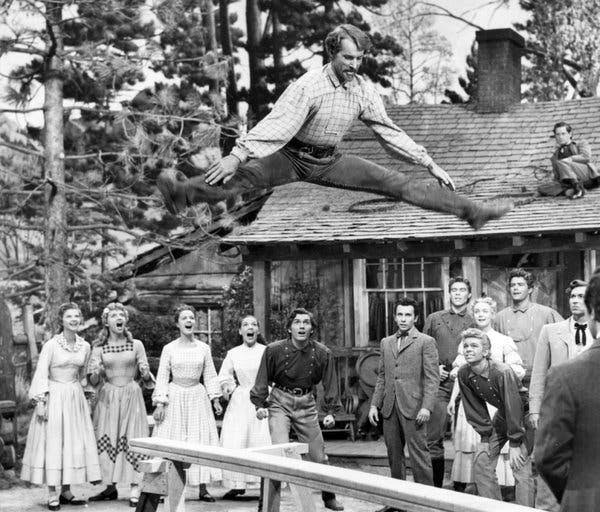
Last night, I was thumbing through some streaming offerings and stumbled across “Seven Brides for Seven Brothers.” The highlight of that 1954 musical was one of the greatest dance sequences ever filmed. In their real lives, six of the seven “brothers” were classically trained dancers; so were the townspeople, the men and women dancing partners. I was eager to see that movie again.

The underside of its wonderfulness is a dark story. It’s deep winter and the brothers are eager to find wives. They kidnap girls from the town and forget to kidnap a preacher. A sudden avalanche closes the pass to their remote property, preventing the townsmen from rescuing their girls.

The eldest brother is married, and his wife keeps his younger brothers and the girls separated throughout the winter. By spring, love is in the air and everybody is happy. A rescue group led by the town’s Chaplin arrives at the ranch, and finally, the Chaplin officiates over six marriages.

In its time of making, the film’s story was fun. In modern times, however, its fable is much less innocent. It’s hard to ignore the 2014 kidnapping of Nigerian schoolgirls by Boko Haram, an Islamic terrorist group. Finally, some of the girls managed to escape or became rescued, and only now some are telling their stories of years in captivity. Their stories aren’t pretty and don’t end well enough. Even today rescues again living in their village of origin are shunned, considered “Boko Haram women,” and with their children, are treated as outcasts.

Curious, I looked up Stephen Vincent Benét’s short story “The Sobbin’ Women,” published in 1937, on which “Seven Brides for Seven Brothers” was based. Benét’s story is beautifully written and readable. It’s also much leaner and tougher than the movie version.

Fortunately, artistry can overcome much. In “Seven Brides….” the dance sequences are outstanding, and sheer art that lives on film. Someday, I will watch that movie again.

Dear Friends: It’s all about having the capability of leading a good life. Diana

Mind Viewing

Friday, April 19, 2024

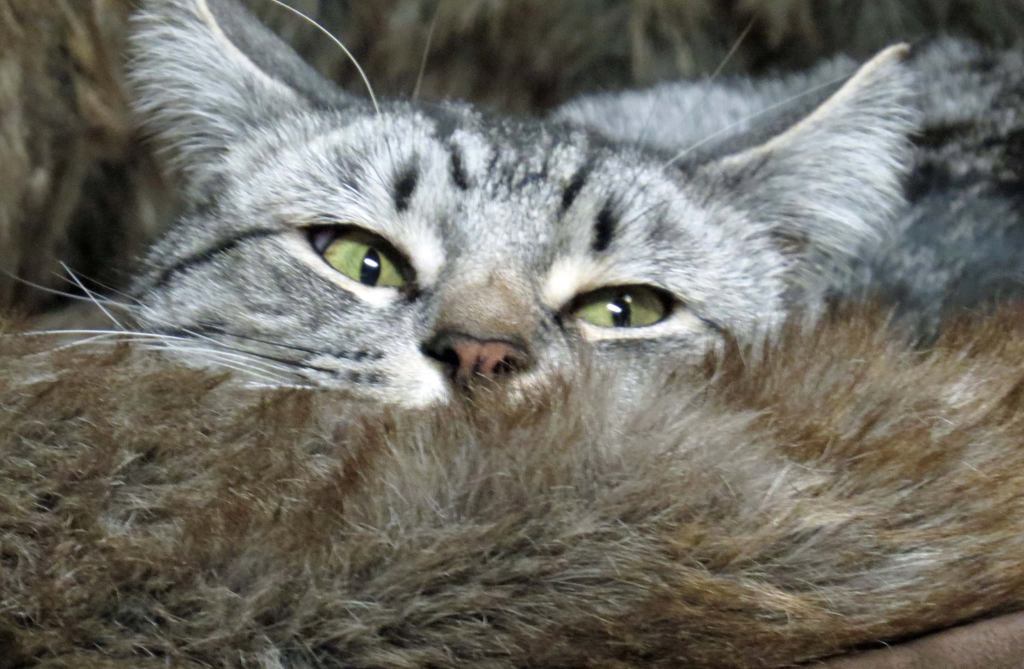
They say that a picture is worth a thousand words. This capture of Maxwell says a bunch.

The department store manager where I work part-time will leave in a few weeks. She’s heading to Colorado, to start managing a “sister store.” Our Bend employees are sad that she’s going because she’s a good store manager, but are cheering for her new opportunity.

Bend’s second-tier managers who report to her are well-seasoned, know their stuff, and are good leaders who can keep the store’s goals and line workers on track to succeed. I’ve never found it easy to say farewell to a well-liked someone, but I have learned that a capable succession group can ease the challenges, and we who still are here will adjust appropriately and move forward.

Socially, in contrast to lengthier, earlier times, the post-Viet Nam era’s explosion of technology and wealth has encouraged populations to keep moving and seeking new opportunities. We have learned to live in a nuclear age, and are accustomed to people being constantly on the move. We have become seasoned shifters of allegiances.

We have learned that families may split, long-time close friendships may become long-distance friendships, our supporters and mentors might move away, and now, we’re learning that people are living longer, for more years than ever anticipated. We understand that our home base essentially is ourselves and that calls for self-confidence and self-structuring.

To that end, we are exploring new interests to keep our minds alert, being active to build strength and remain active physically, and knowing it’s important to be sure of ourselves and carry on despite the constant social changes affecting us.

Anyway, now, a capable, fine friend is leaving. I’ll adjust.

Dear Friends: Always, a huge challenge to wrap one’s head around change. Diana

Visuals

Thursday, April 18, 2024

Yesterday was weird. I was thinking about air space and visibility. While driving home around 4 p.m., I couldn’t see a cloud in the sky. Suddenly, I noticed overhead a partial globe, maybe the moon? It was alone, just hanging. After several seconds of doubting reality and double-taking, I understood that it was most of the moon, just floating, naked.

I wondered why the moon sighting had been confusing and why visual perceptions sometimes cause doubts. A little research explained that our brains don’t receive perfectly detailed pictures from our eyes. Instead, they absorb sight data and fill in blanks with what’s known from past experiences and expectations. The “filling-in” can lead to misinterpretations, like my doubting that overhead and so early, I was seeing the moon.

Filling in may be especially confusing when sightings are unfamiliar or in low-light conditions. How things are arranged or lit affects how we perceive their sizes, shapes, and colors. Our brains are generally very good at interpreting the visual world. Still, overconfidence can add to confusion. Our human sighting limitations remind us to be aware of and critical of what we see. Understanding has a reward of less wondering if what we see is an illusion or misinterpretation.

Take this a step forward and consider magicians. Their hands move very quickly, not directly fooling our eyes, but fooling our brain’s perceptions of what our eyes are seeing. They create illusions by exploiting the loopholes in how humans process visual information.

Dear Friends: Now, quitting, on seeing that illusion-related topics are unending. Diana