Aerial Ballet

Red Tailed Hawk

Friday, March 22, 2019

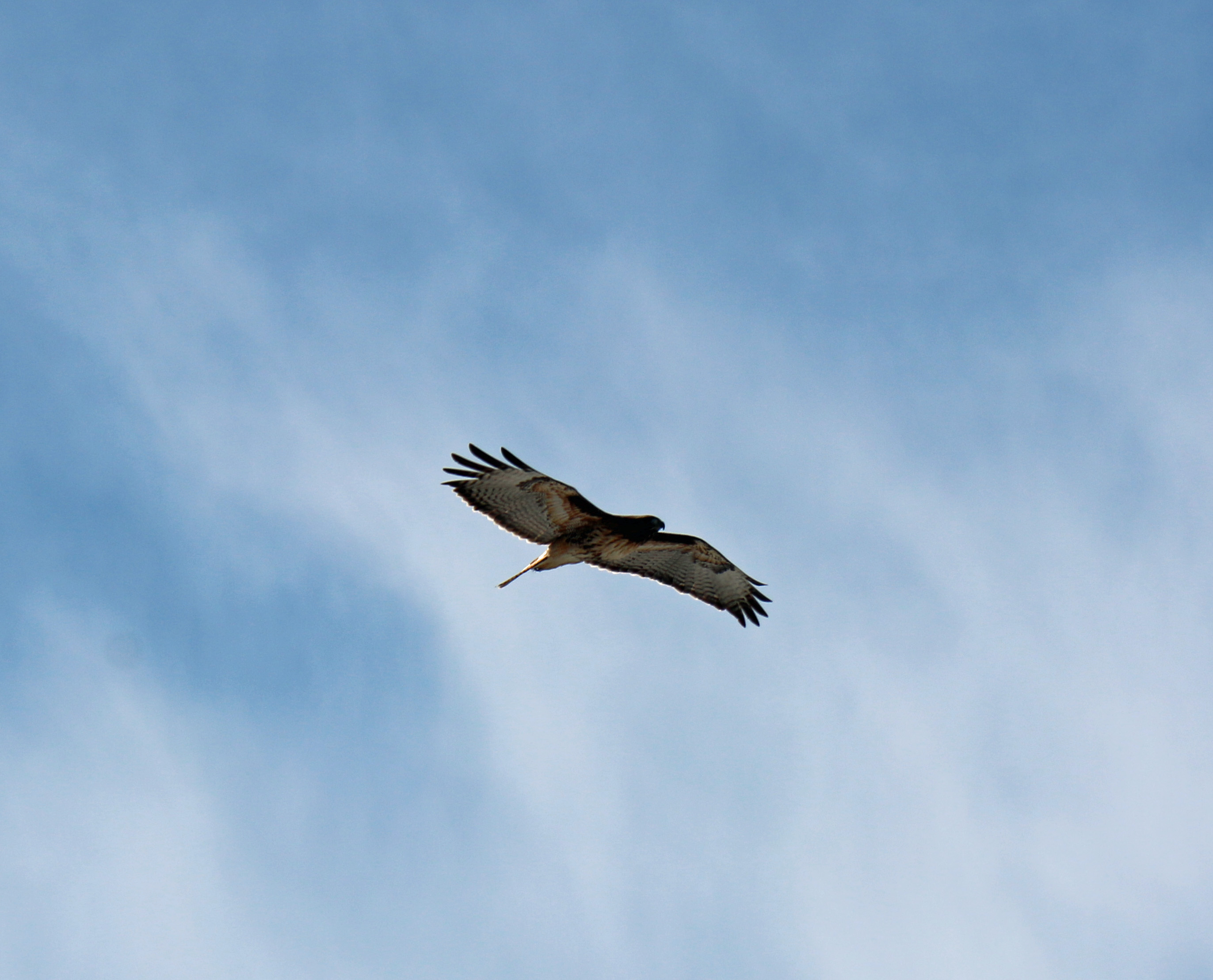
I was hiking in BLM carrying my Canon 70D camera, which stops action but isn’t the greatest for capturing flying birds. Usually, the birds are very high beyond lens range. Oh, for a big-time zoom lens! Anyway, imagine my surprise on seeing overhead a pair of Red Tails, low enough to capture, and maybe without great detail, but what the heck. Before long, I put two and two together and found myself a witnessing an eyecatching aerial performance.

I’d already been hearing Raven screeches, which I ignored, for they’re noisy birds. To most country folks, Ravens are nuisances, they steal eggs and perhaps baby chicks. Ravens are Corvids, tough, determined, exceptionally smart birds. Several Ravens nest near my property and train their offspring before my often-astonished eyes. I watch them teaching their kids to sail on currents–a fabulous overhead visual–the birds noisily staying in touch, circling together, at once higher and higher, and then, lower and lower. They repeat this series, eventually circling so high they disappear in clouds.

The moment that Red Tail’s mate entered my vision those high-pitched Raven’s screeches began making sense. Now, I saw that a single Raven was chasing two hawks that probably had approached its nest. I’ve seen similar aerial battles but never a single Raven chasing a pair of Red Tails. I’ve seen the opposite, single hawks chased by pairs of Ravens. I’ve learned that angry Ravens are relentless and will chase Red Tails to near exhaustion.

Here’s what happened (with apologies for fuzzy photos).
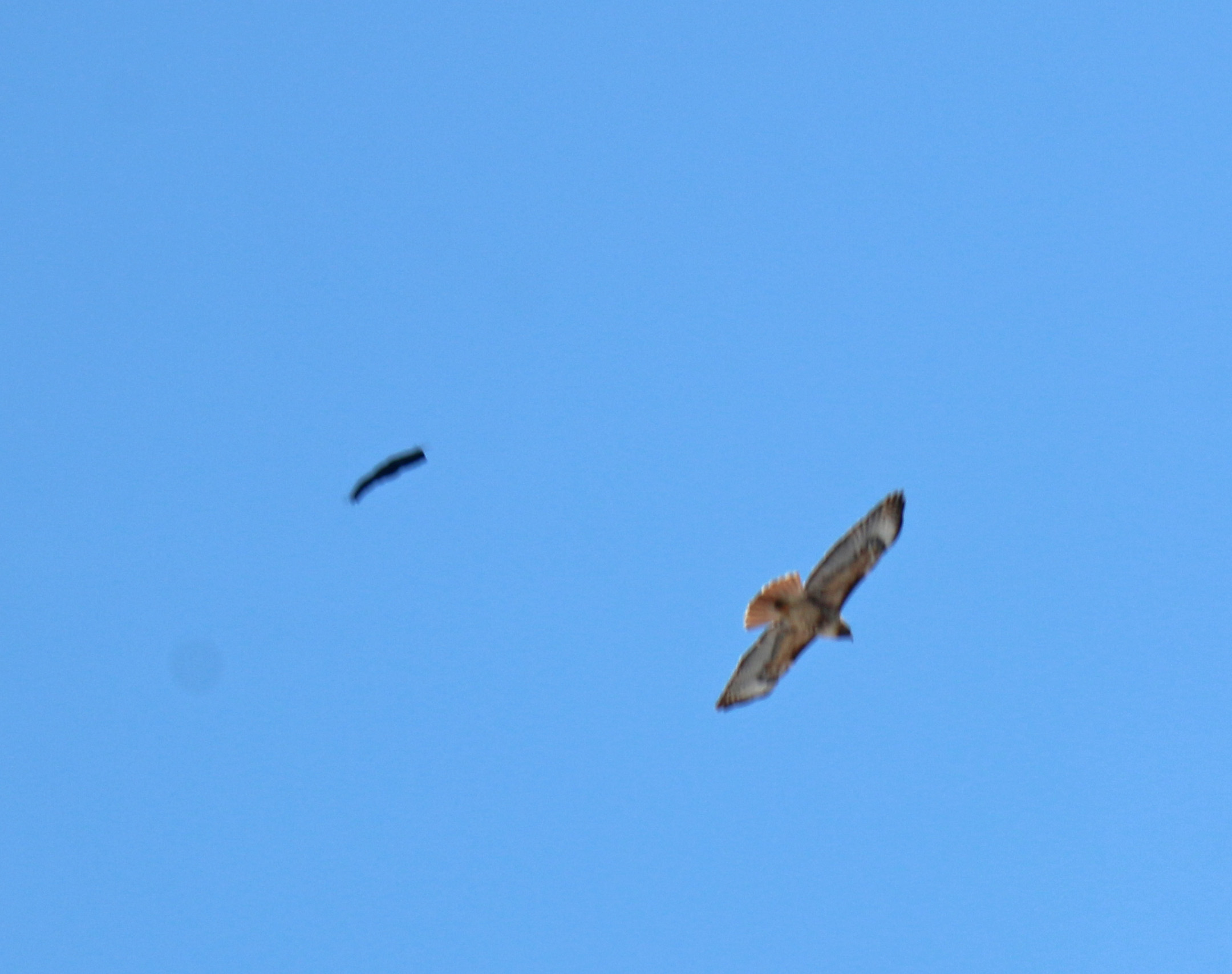
Hawk evading the Raven

For awhile the two hawks seemed to be playing with the Raven, separating and circling as the noisy Raven tracked. Suddenly, the trio flew wide, beyond tall tree branches and out of my sight, before reappearing, and now, the Raven was closer, very serious.
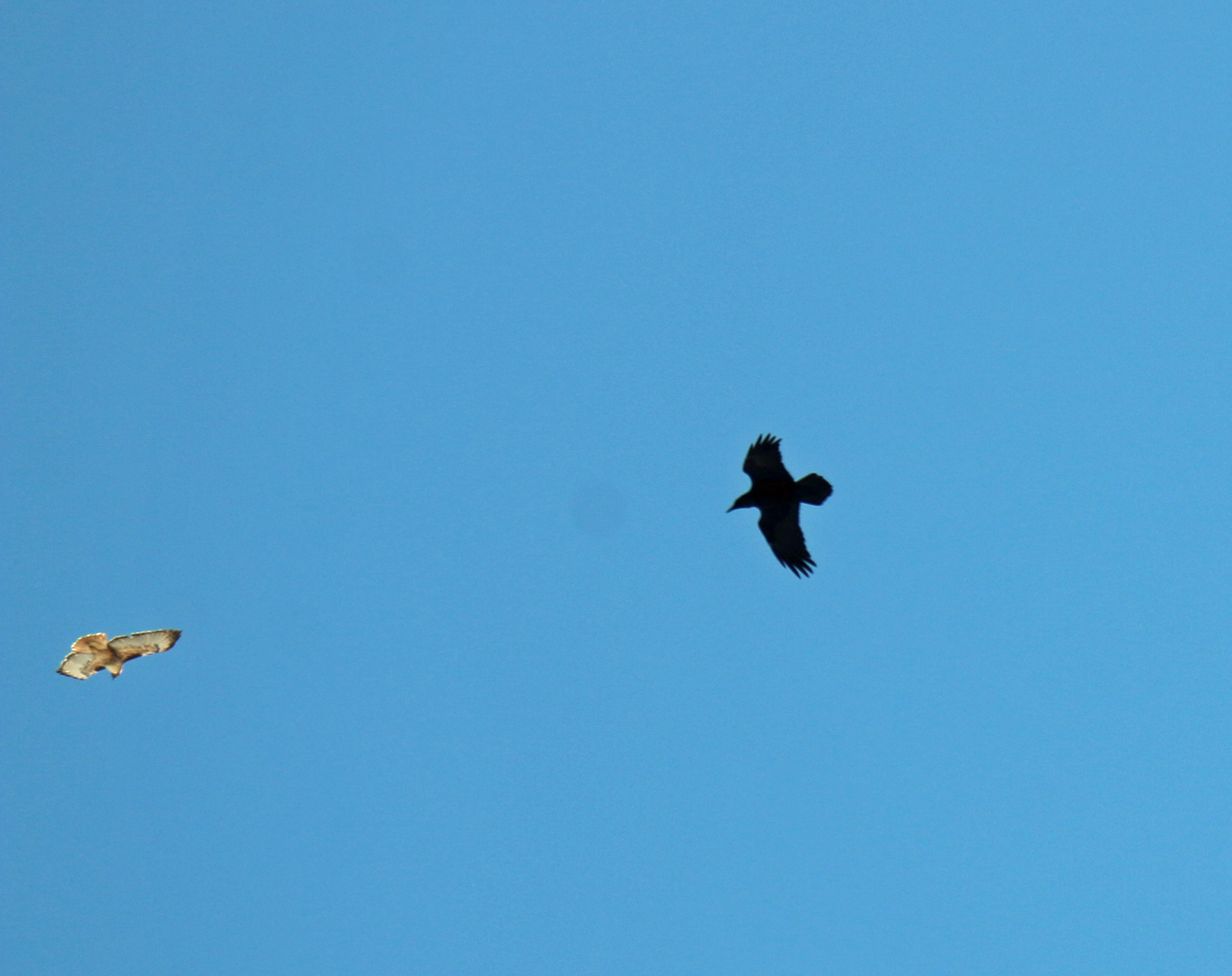
Raven closing in

The hawks suddenly veered away in a very large circle, the Raven hotly pursuing, and all flew out of my sight. For awhile, I heard screeching, and when it stopped, figured the Raven had won.

The episode provided me with yet another demonstration of how social dynamics in the wild animal world are no less complex than those in our human world.

Dear Friends, If only my lens had captured better that awesome performance. Diana
Snowy Outing

Free at last!

Thursday, March 21, 2019

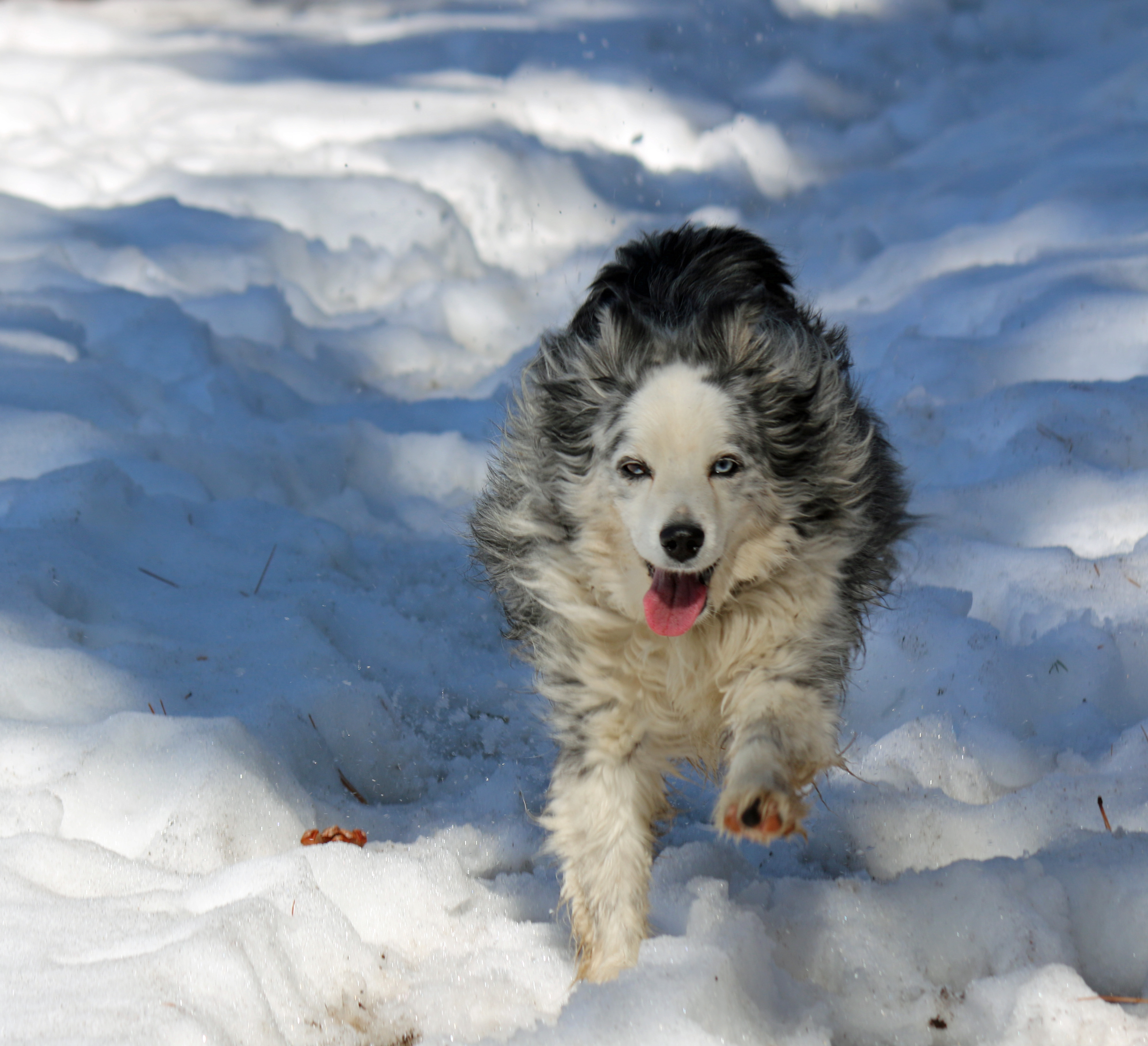
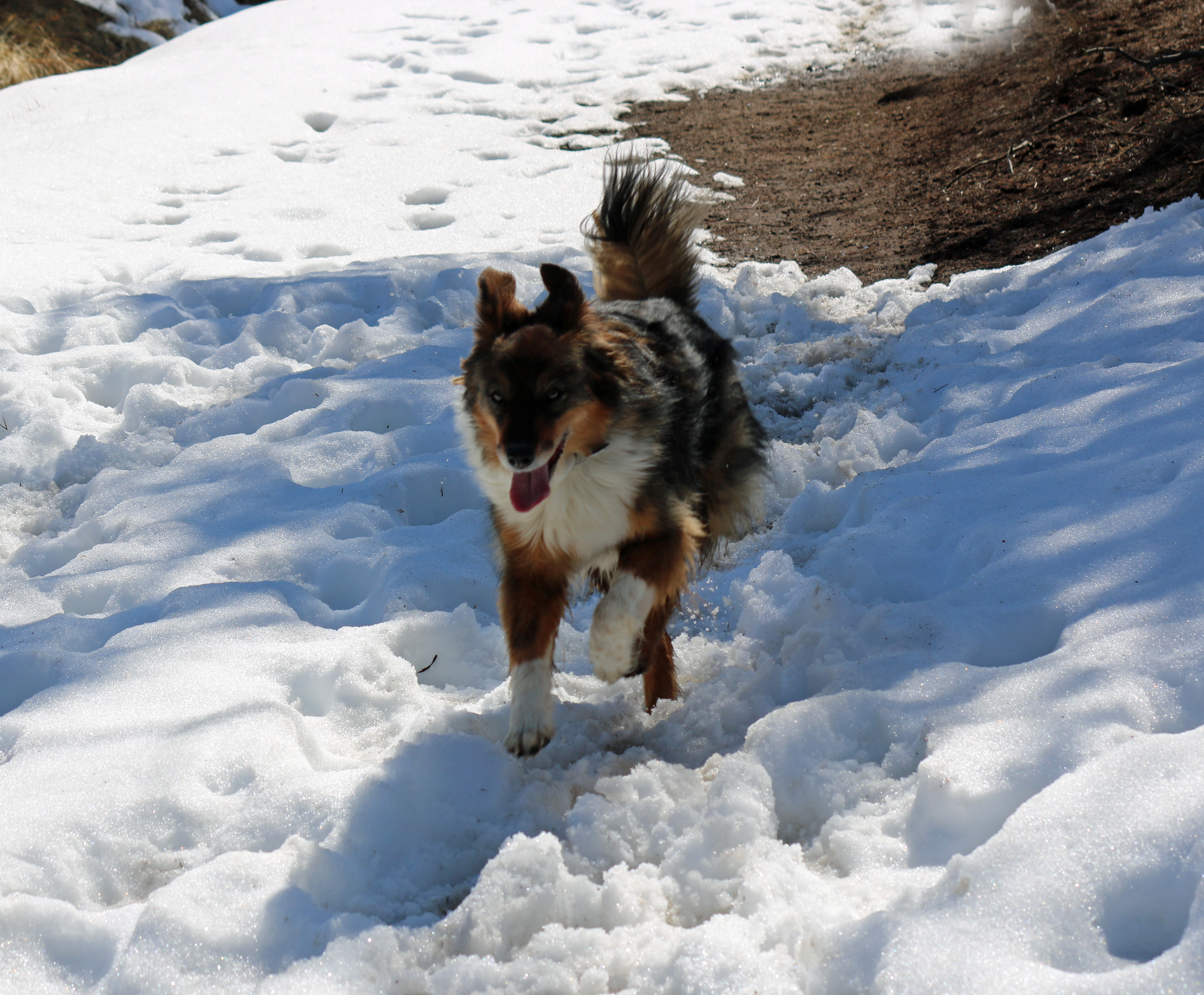
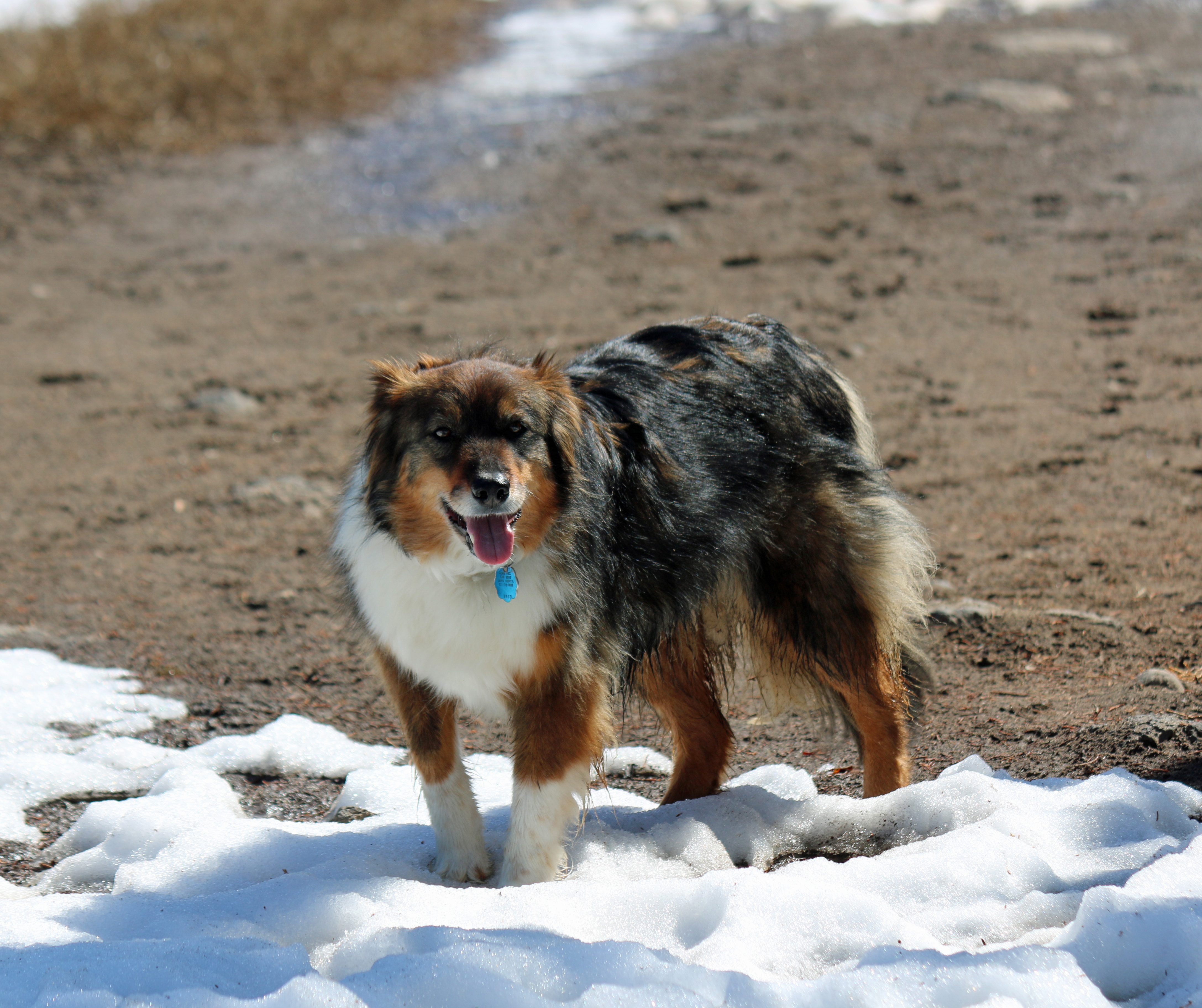
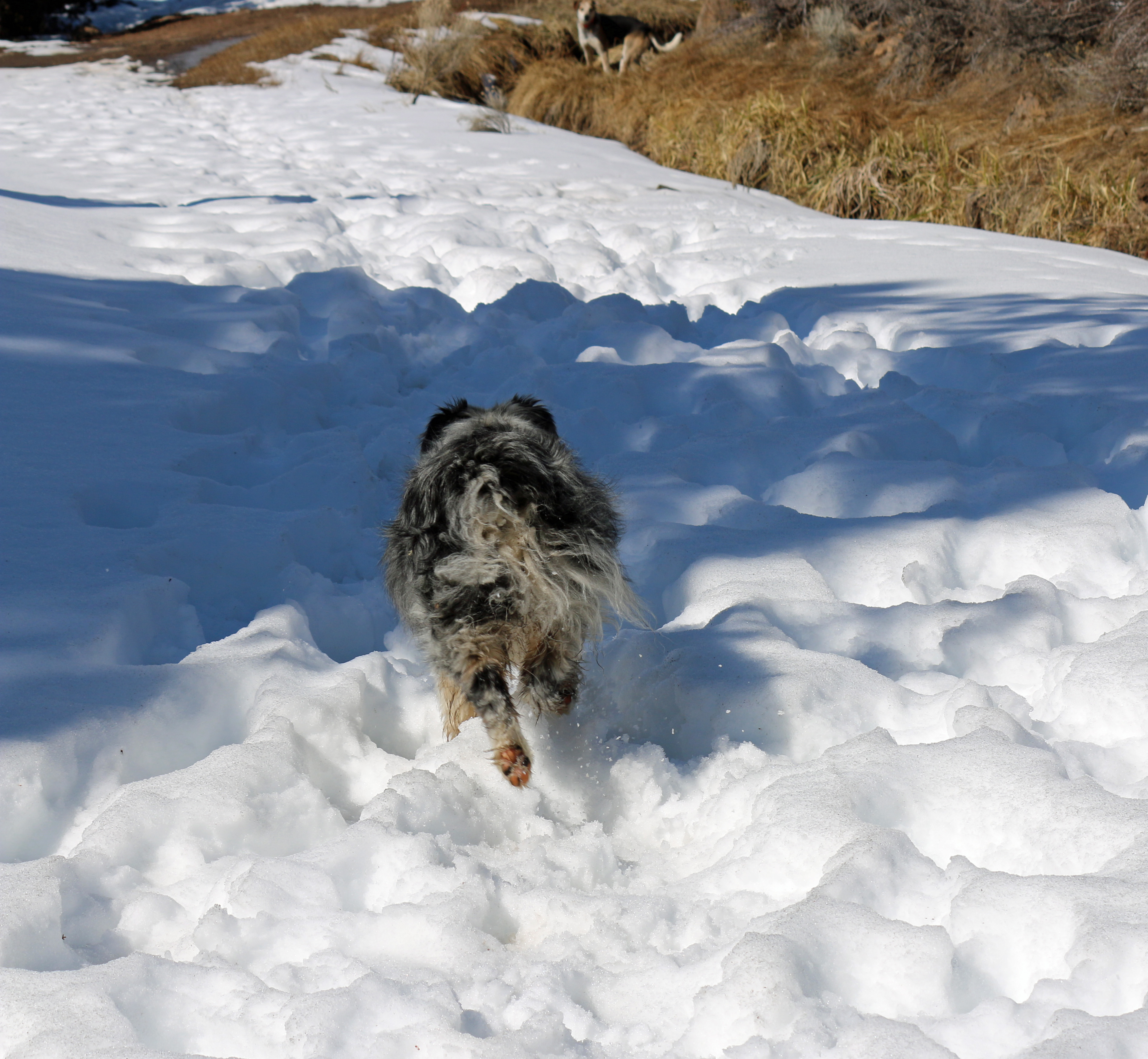
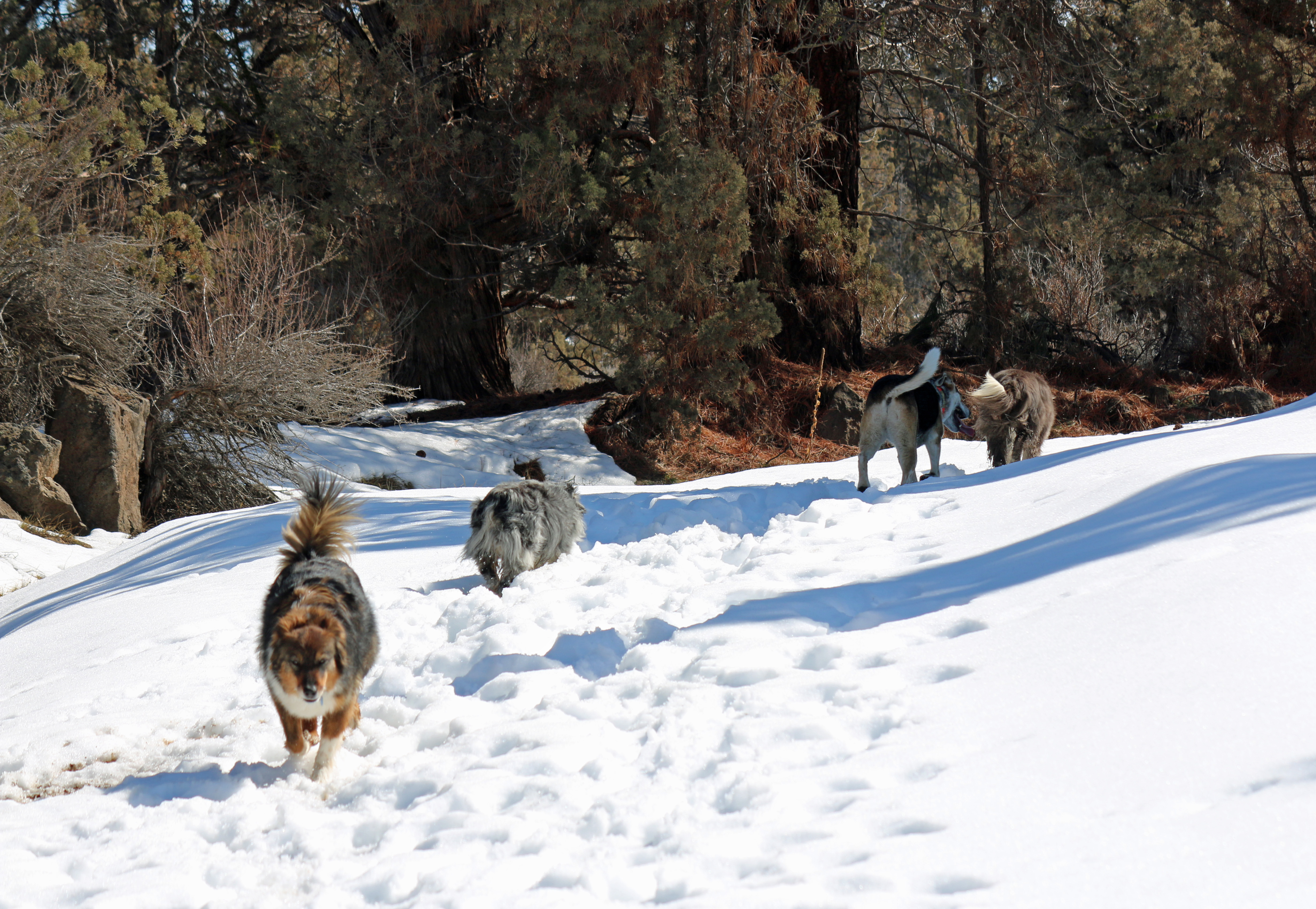
Recently, after what seemed ages of home confinement, the dogs needed to run freely in BLM. I prepared to cope with still-standing snow by finding and lacing on Sorel Boots that had been stored for years. I guessed the popular trail would already have been beaten down by earlier hikers exercising their dogs.

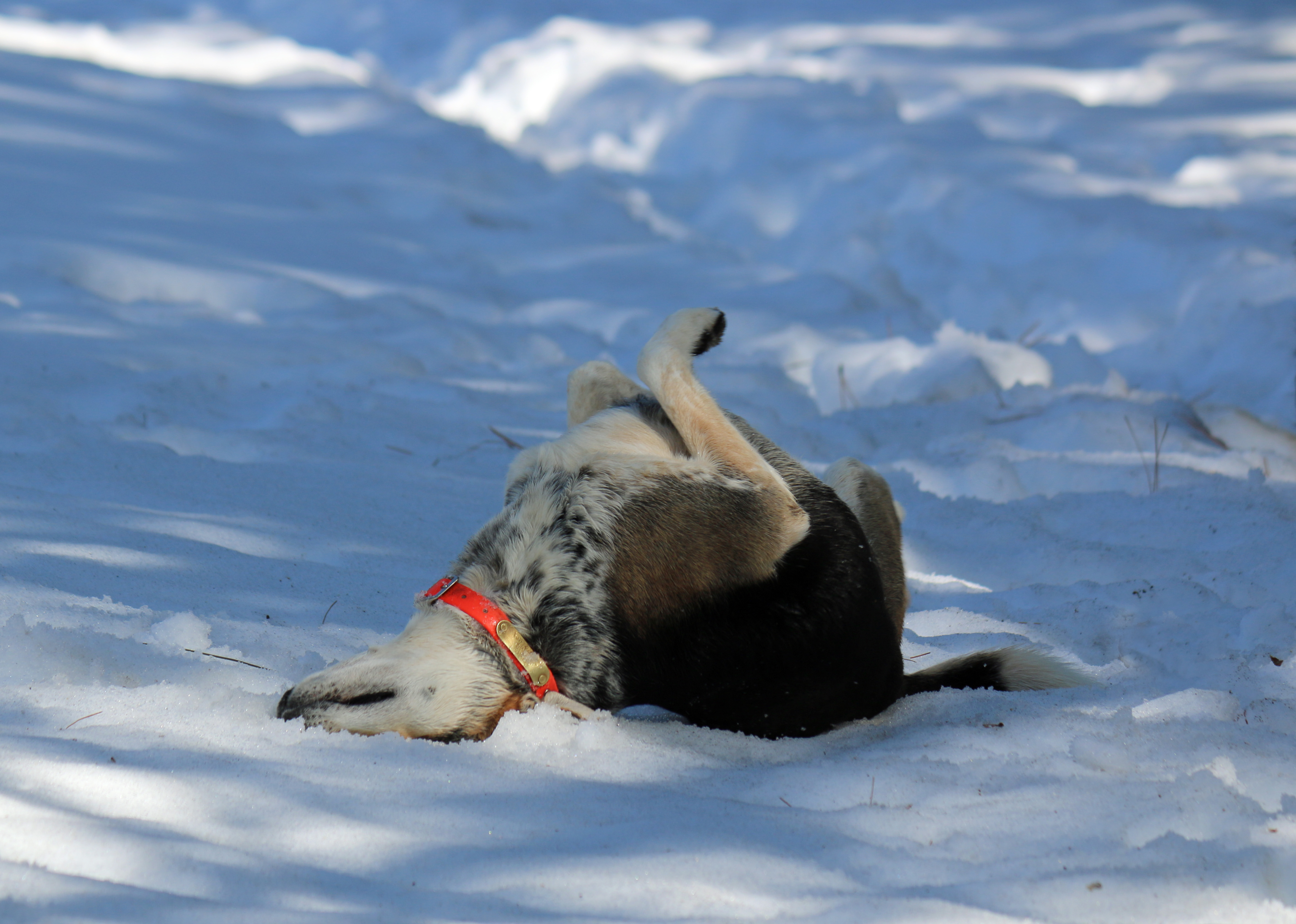
In previous winters, I’ve taken the dogs to that very trail, and in snow hiked a couple of miles. The first mile follows a canal where Miles, my nutty Border Collie, loves to lounge and snorkle in freezing snow melt. After that mile, we usually turn to the BLM’s desert side and make a wide circle back to the car. In snowy winters, it’s an easy, fun route.

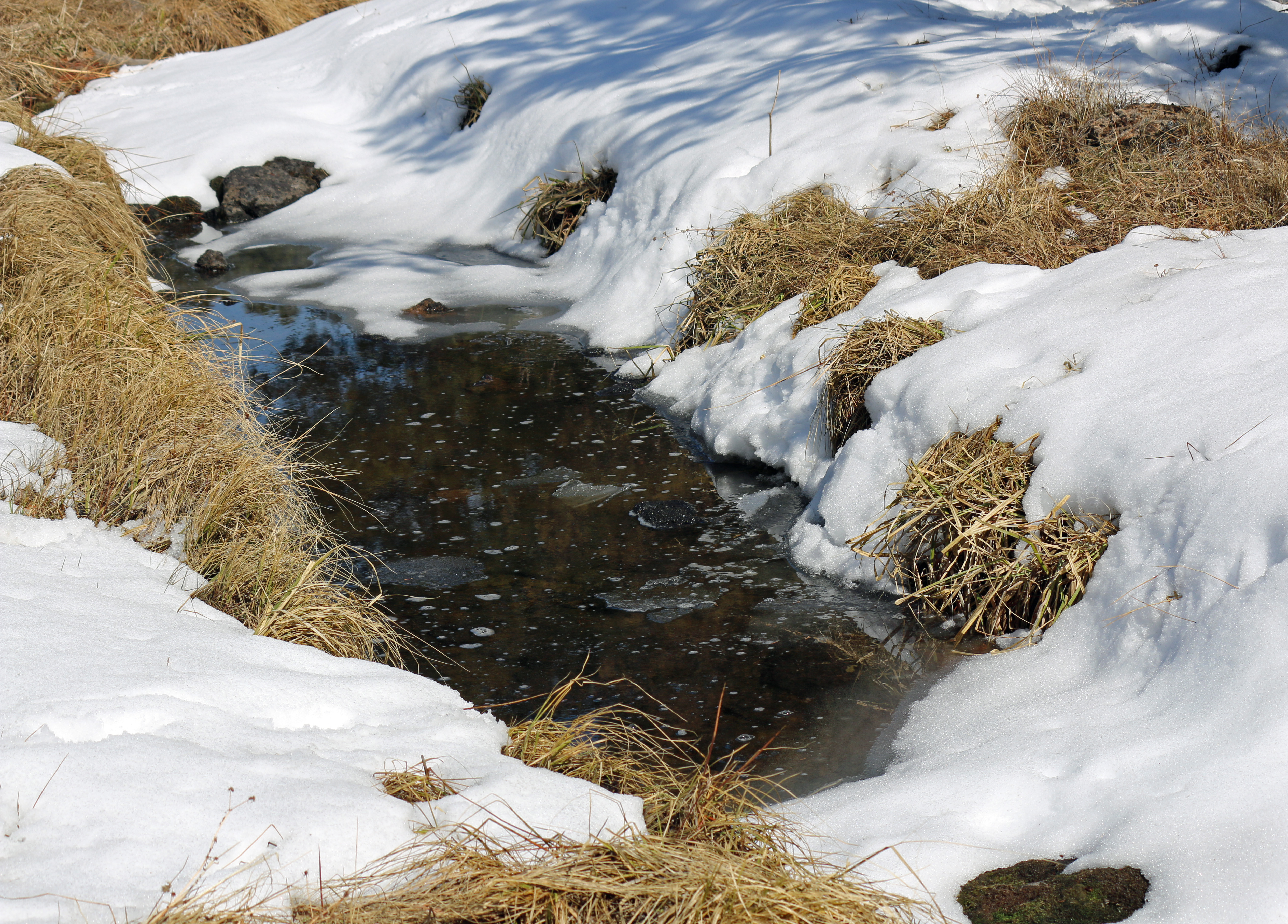
Snow Melt

This winter’s snow is deeper. My first hint of this on entering the BLM, was driving through a water-filled ditch that challenged my four-wheel drive; my second was nearly getting stuck while testing parking spaces for stability; a third was seeing the canal trail not much beaten-down by previous walkers. There was no turning back, with the dogs eager to be outside and noisy Osix screaming in excitement.

Ranger

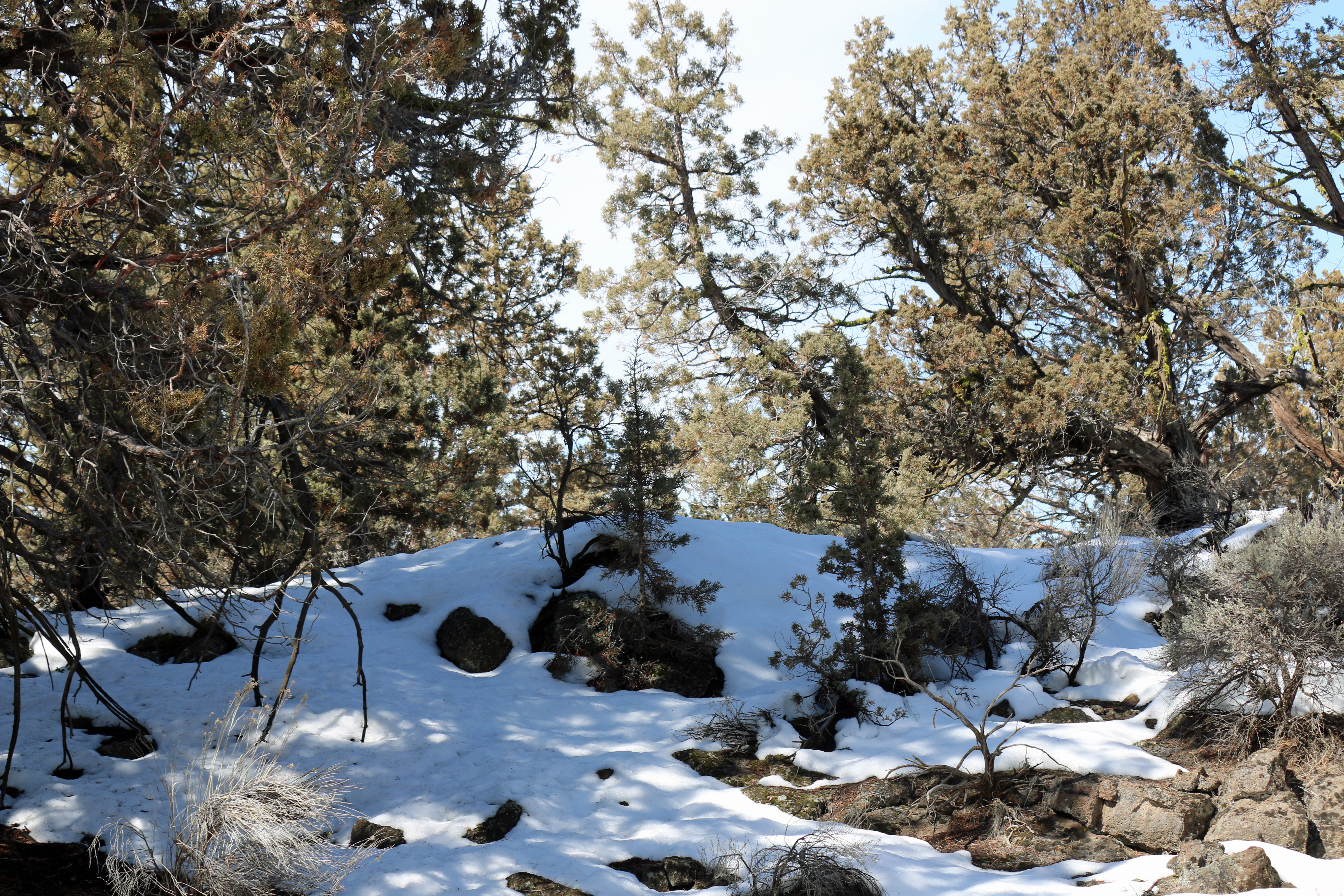
My Sorels were perfect for traipsing in snow, but this snow-deep trail turned walking into hard work. Looking around, I saw that deep snow hid rocks and ankle-twisting holes, so we’d best not venture to the desert side. Instead, we’d turn around after the first mile.

Off Trail
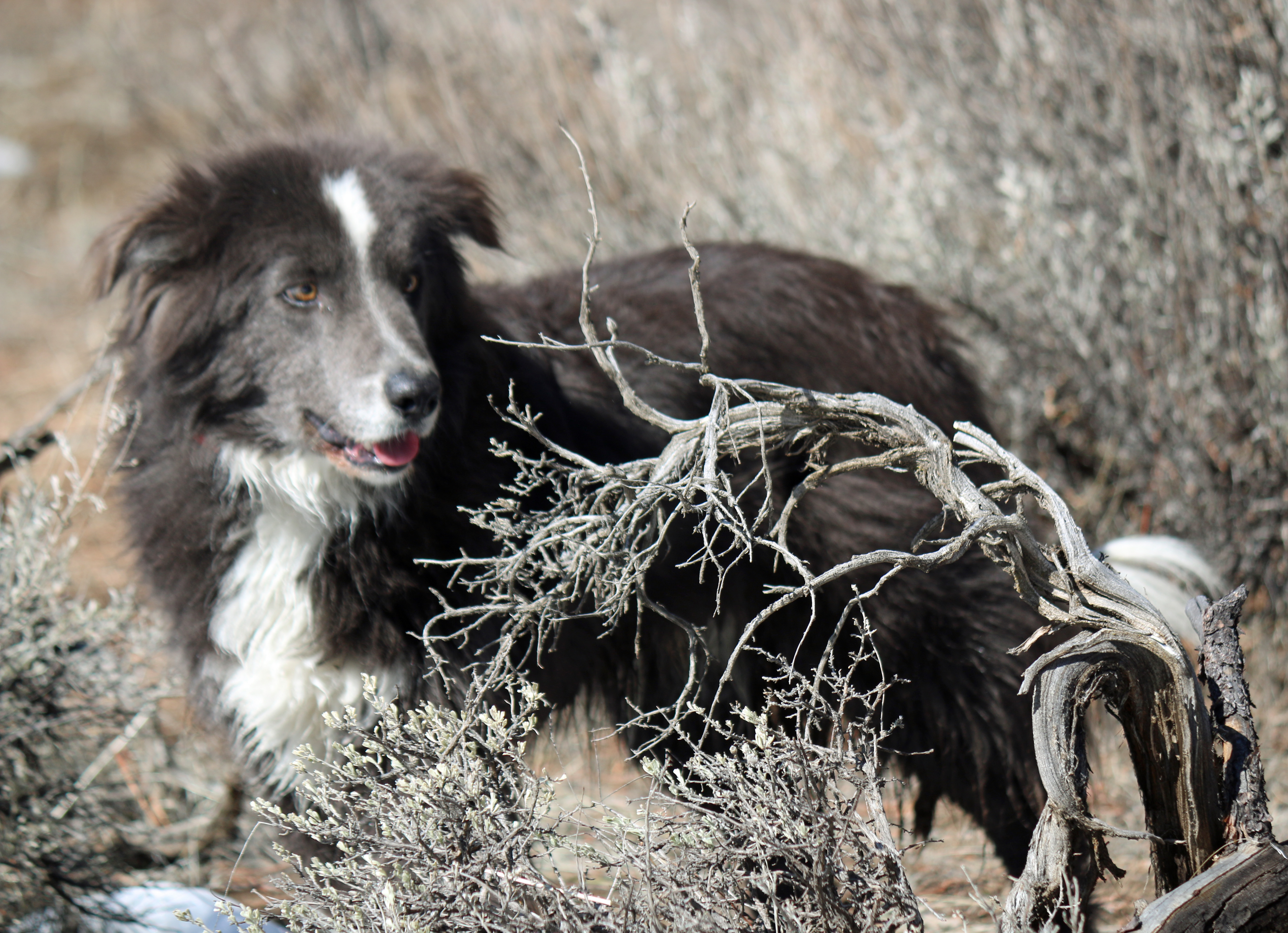
Miles
Louie
Osix

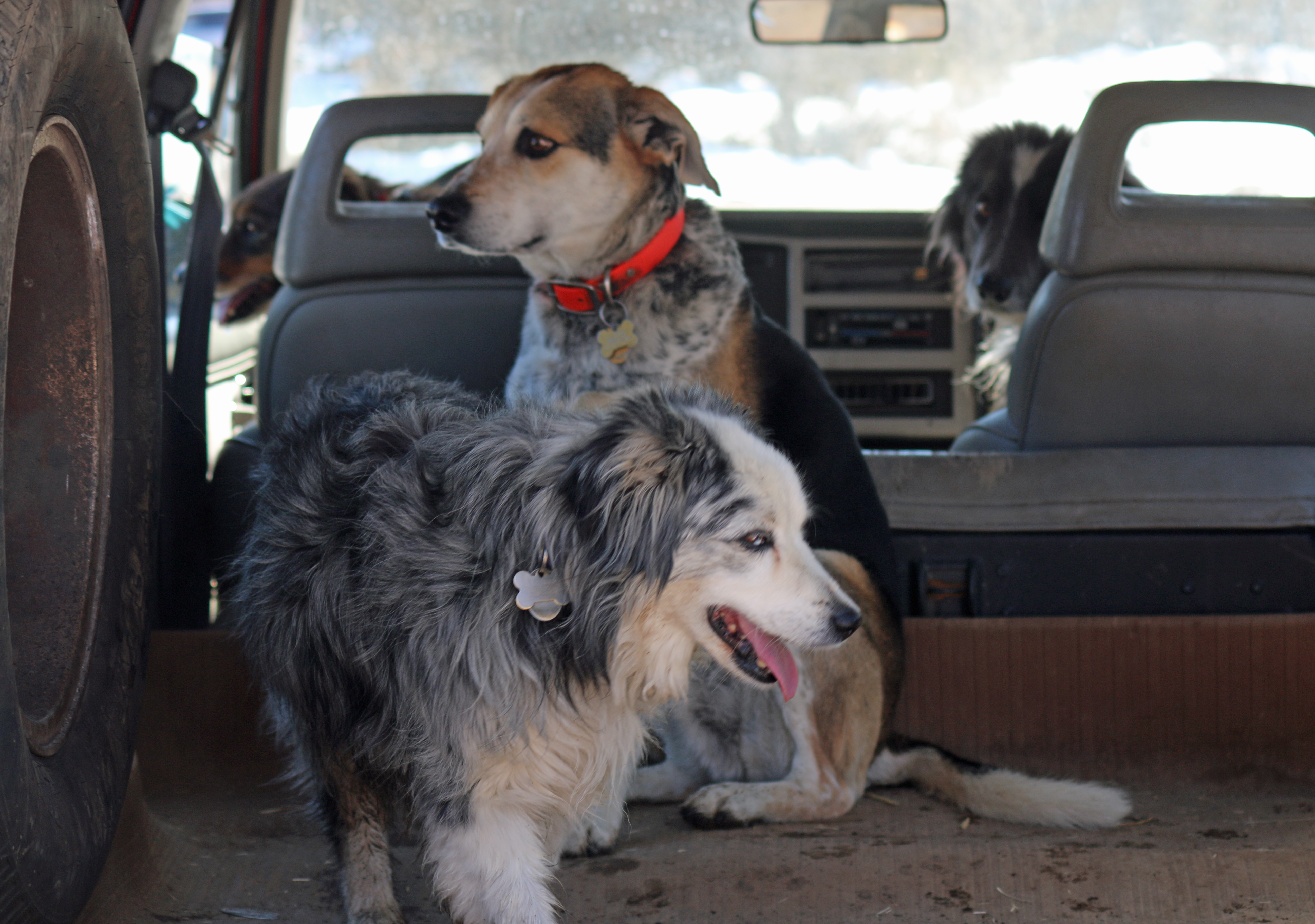
My out-of-condition dogs and I became tied before managing to cover a half mile. Even Miles slowed down, very unusual. It’s hard to read Ranger and Louie who make a point of staying with me. The most obvious signal that we needed to turn around was Osix’s behavior. She began hanging behind and moving forward only reluctantly. Her subdued body language said she’d soon slip off and return to the car.

Warning…

That convinced me to reverse direction. Osix disappeared and Miles soon followed her. My steadfast fellows, Ranger and Louie, stayed with their slogging dog-mom.

At the Jeep, after a quick head count, we headed home.

Dear Friends, Hope you saw last night’s biggest Supermoon: gorgeous! Diana

Clair de lune

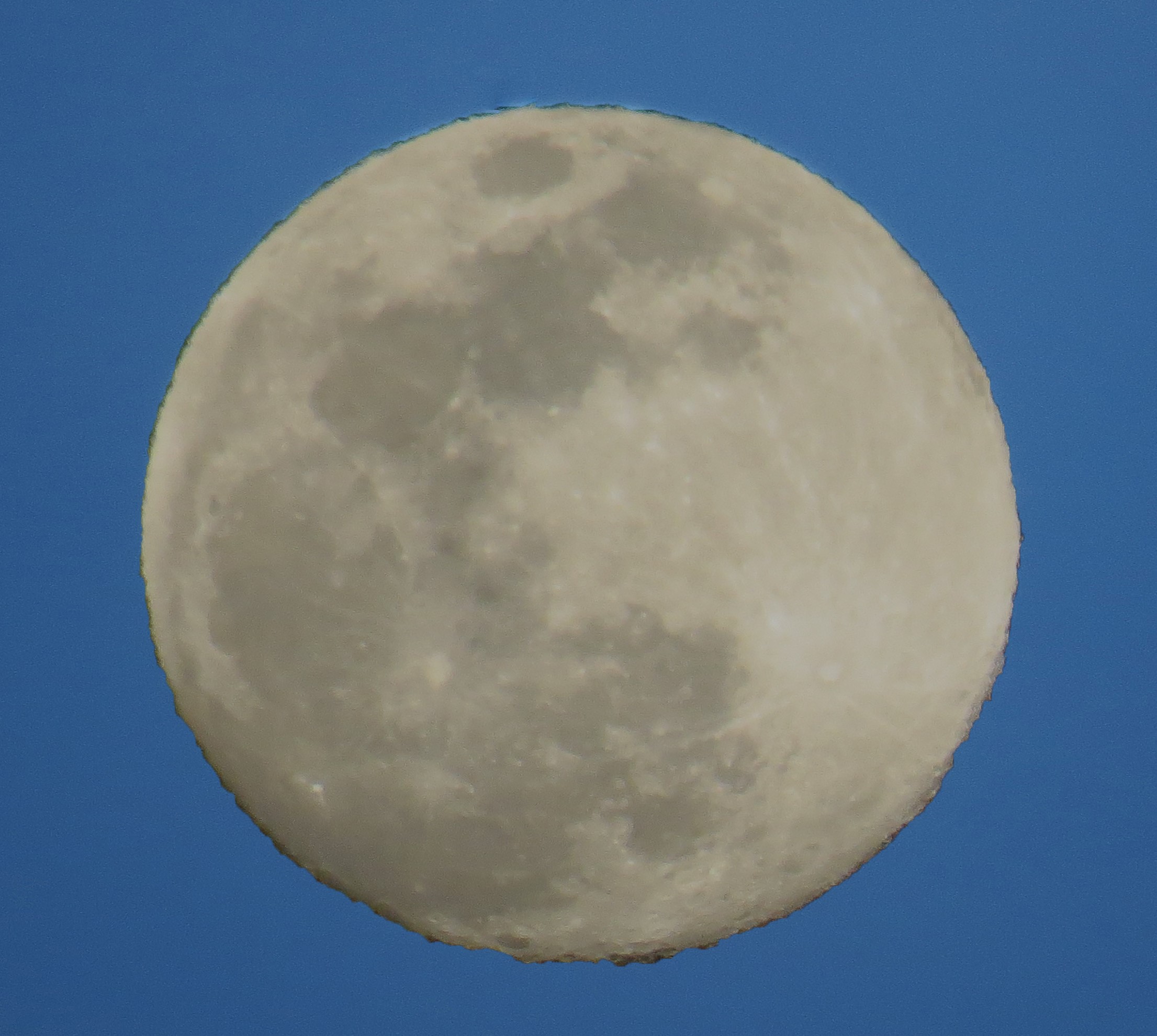
March Supermoon, 2019 (Canon SX50)

Wednesday, March 20, 2019

This month’s full moon, having reached its peak at the spring equinox, is March’s Supermoon–nearest to earth, and thus, the month’s largest moon. Early Native Americans named the annual Supermoons to indicate the changing weathers and tendencies of nature. Since spring equinox signifies the earth’s warming and an oncoming abundance of wild game and crops, its moon is called a “Full Worm Moon”, representing when Robins will start pulling earthworms from softening ground. It’s also named (among others) a Lenten Moon, Crow Moon, Crust Moon, Sugar Moon, and Sap Moon.

Yesterday, around 7 p.m., and not thinking of anything related to the first day of spring, I exited the house to make a final check on the horses. I stopped short at a sight of the rising moon, “Oh, my, it’s March’s Supermoon!” I hurried inside for a zoom camera in order to photograph the lovely moon.

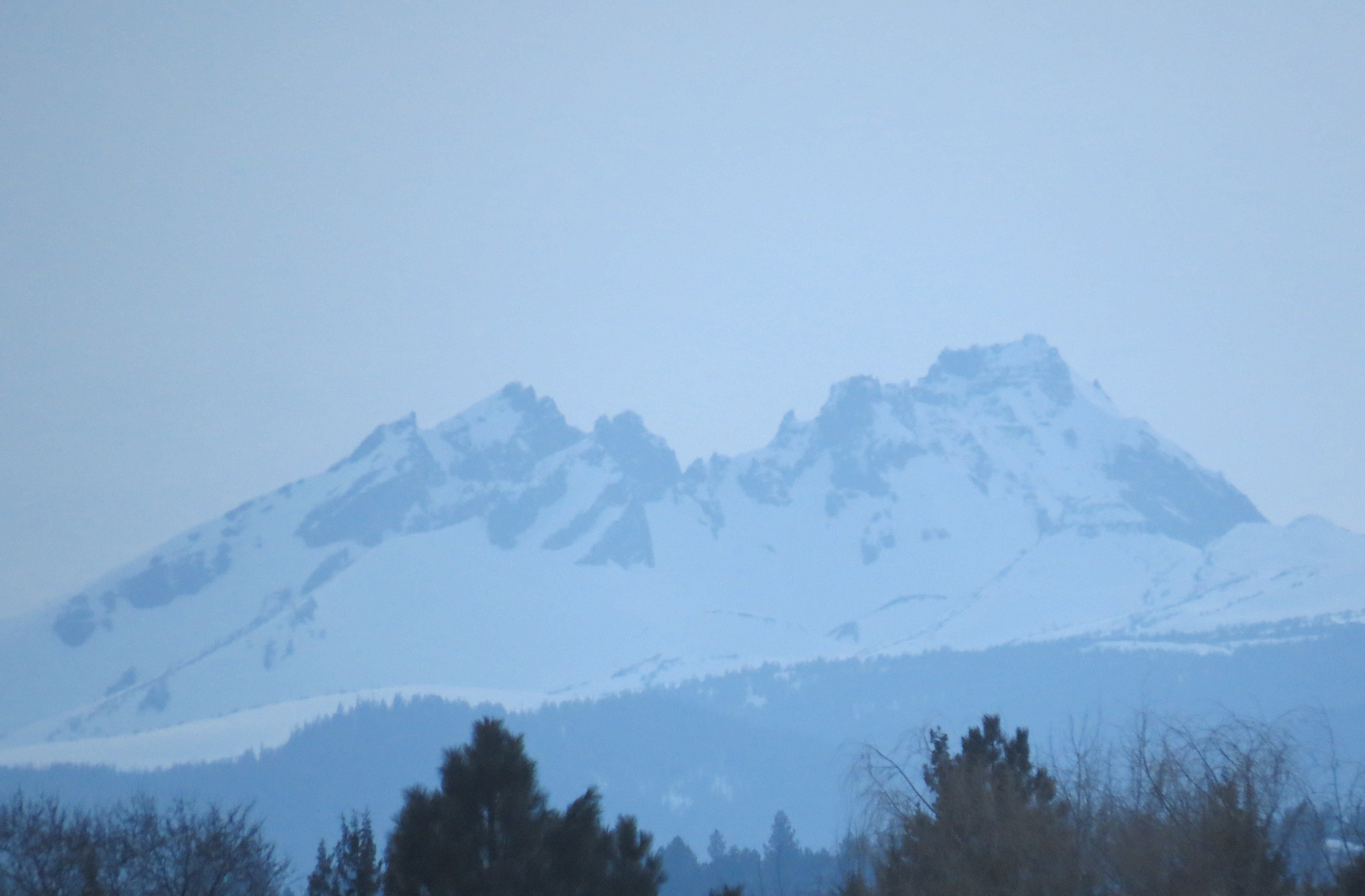
While heading down to the barn and noticing that this almost warm day had turned cooler, another sight captured my fancy. The Cascade Mountains, which earlier had been sunny and clear, now were shrouded in a curtain of dimming frost. The slightly visible string of dreamlike peaks felt mysterious–this top line, especially captivating.

Broken Top in Freezing Fog (Canon SX50)

I was planning to stay out and photograph more, but around here, unexpected realities demand attention. Just then, I saw that a gate (one Rosie often kicks at compulsively) finally had been seriously damaged, and to an extent that forced changes to my plans. And so, in that beautiful, misty moonlight, instead of a camera I held a bunch of zip ties, and while on hands and knees in deep snow and squishy mud, tried to create temporary repairs.

Ah, another first day of spring!

Dear Friends, For sure now, it’s spring, so sigh, and breathe deeply of new air. Diana

Relationships

Sunni

Tuesday, March 19, 2019

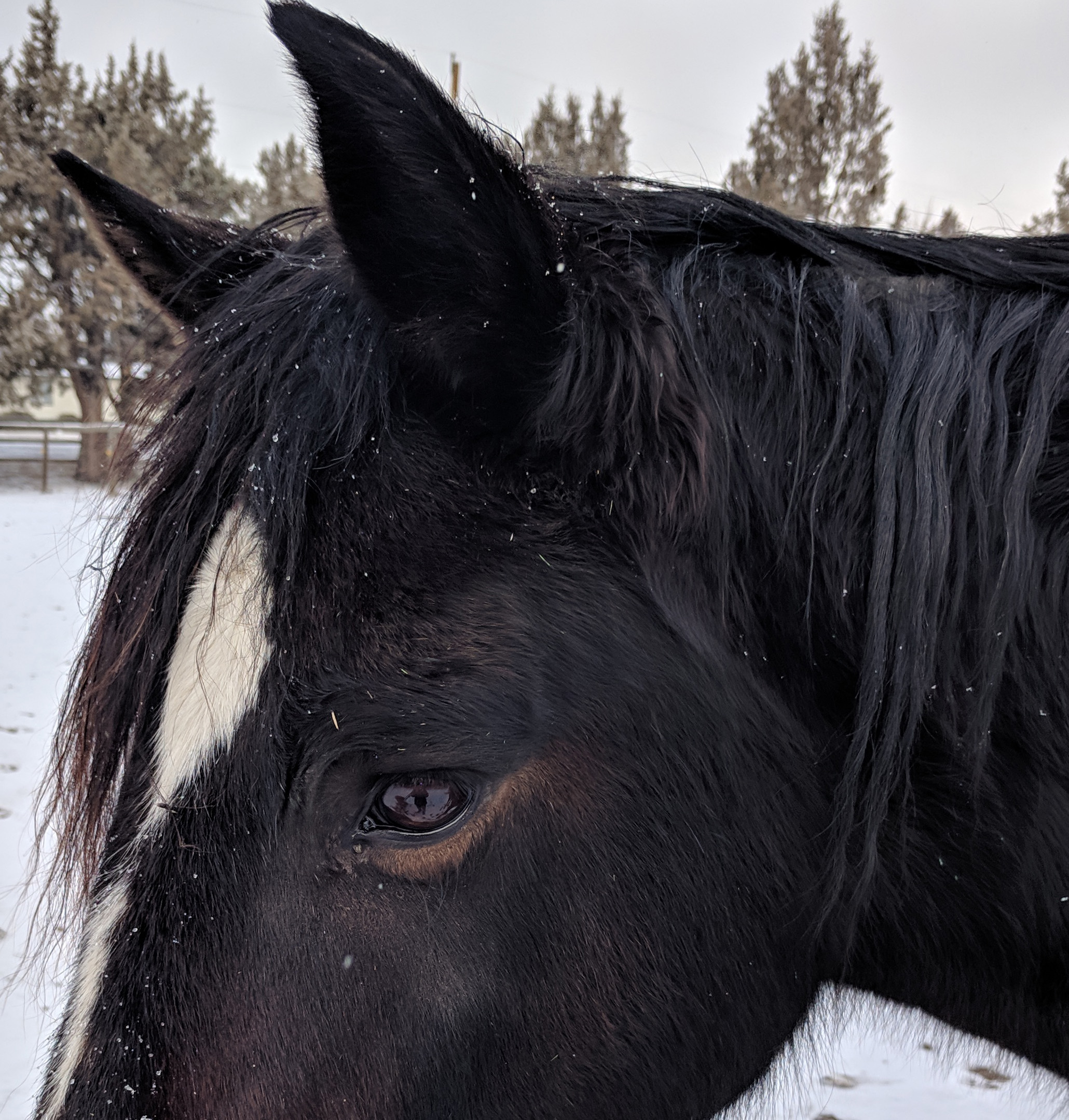
The eye of a horse is an in-the-moment reflection of its being. Read a soft gentle eye as expressing an easygoing, affable mood, while an active, nervous eye raises questions about how best to handle. The most gentle and willing horses will have nervous eye moments, and of course, body language also signals mood and intent. A person spending time with an equine constantly watches eyes and body to sense the inner horse.

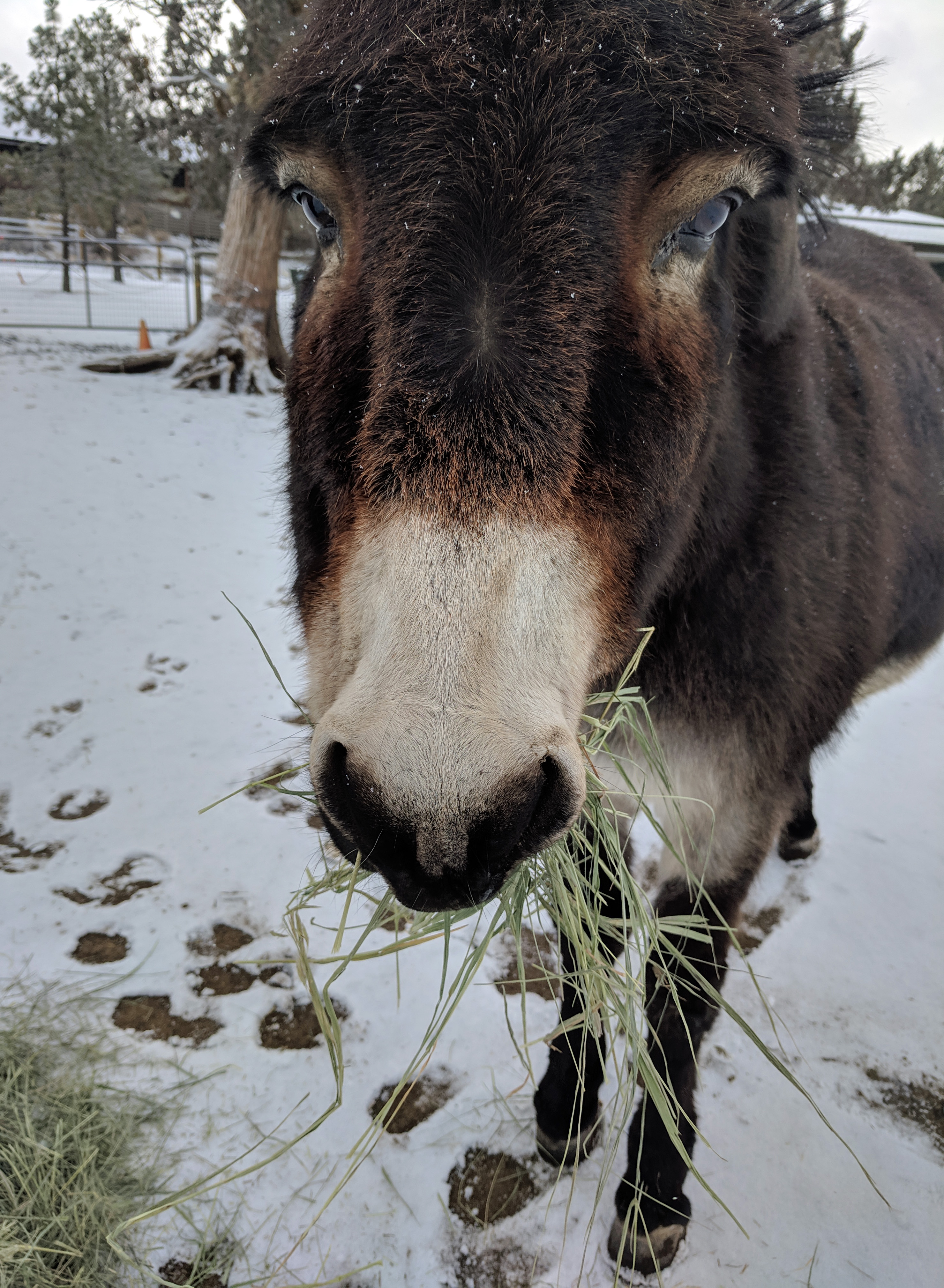
My donkey has moments, too, but are noticed differently. She’s by nature a very cautious creature, her worries often less evident than a horse’s. When I took her for a first walk around the neighborhood, what seemed her stubborn behavior was concern over painted lines on the pavement. Never having seen such lines, she stopped before each, needing encouragement to step over. The same as we approached mailboxes. I gave her time to see, process, and then walk on.

Pimmy

Pimmy’s style has become recognizable. Infrequent handling difficulties emerge as stubbornness, with the solution being time for her to adjust. Typically, she’s an expert on herd behavior, stays close to the horses, reads the “tea leaves”, takes care of herself.

Recently, when the equines entered the barn for their hay, I saw a missing patch of hair on Pimmy’s withers, exposing two inches of bare skin to the bitter cold. One of the horses must have bit her–most unusual, because Pimmy always has escaped damages from herd bossiness.

Had she been kicked and couldn’t get away quickly? I watched closely and saw another oddity. She ate less, left more hay than usual, but didn’t appear colicky–like wanting to roll around to escape stomach pain. I’m ready to call for veterinary help when an animal refuses to eat.

As the trio left the barn, was Pimmy moving more slowly, stepping differently than usual? Did her head hang more heavily? Did she want to be near to or distant from the horses?

Whatever was wrong didn’t seem an emergency. The exposed skin was in a spot impossible to keep warm. Maybe her slow movements were because of almost-icy terrain. I gave her an anti-inflammatory in case she’d been kicked. If she didn’t appear better soon, I’d call for help.

The next morning, Pimmy ate all her hay. That evening and again, she consumed all her hay, seemed in a better mood, and came looking for a chunk of apple (in which I’d buried another anti-inflammatory). Our daytime temperatures had risen dramatically and her exposed skin was shedding a damaged layer.

The movement of an eye, the twitch of a limb, a sense of low or high energy–none of these are species-dependent; it’s about relationships, in which all living beings share amazing depths of perception and abilities to communicate.

Dear Friends, Have a lovely day! Diana

Max’s Waiting Mode

Warm Day Bird-Watcher

Monday, March 18, 2019

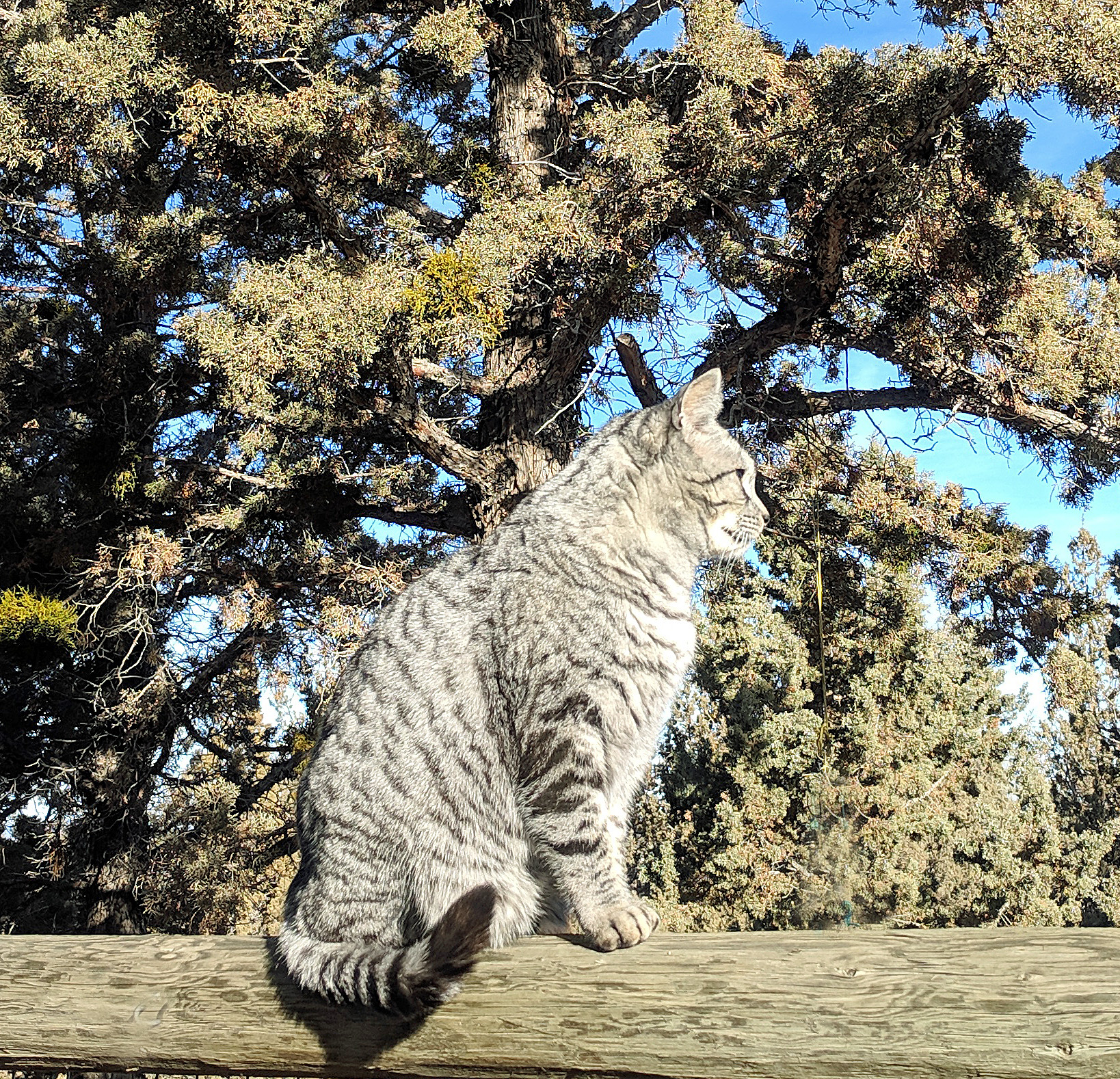
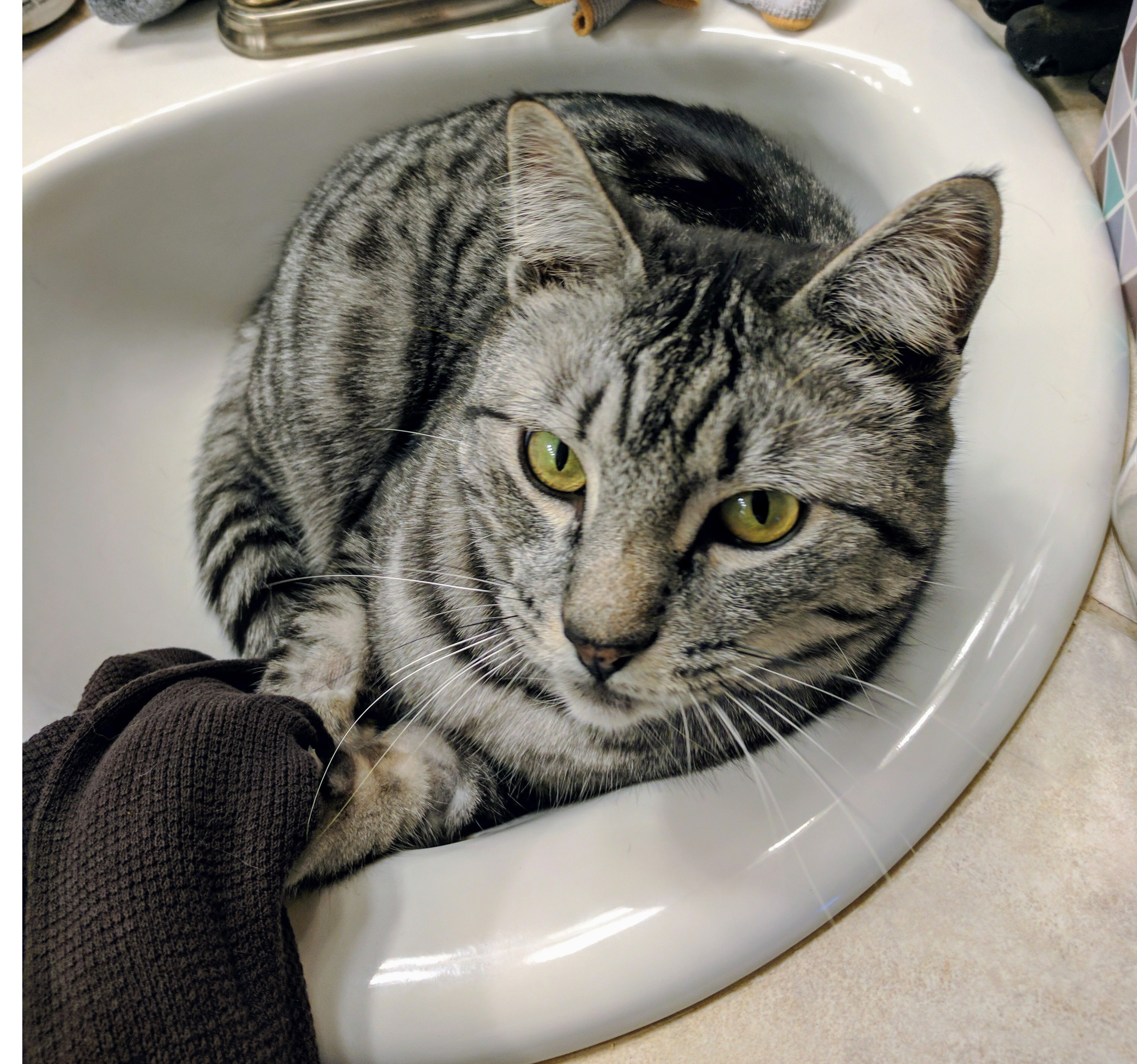
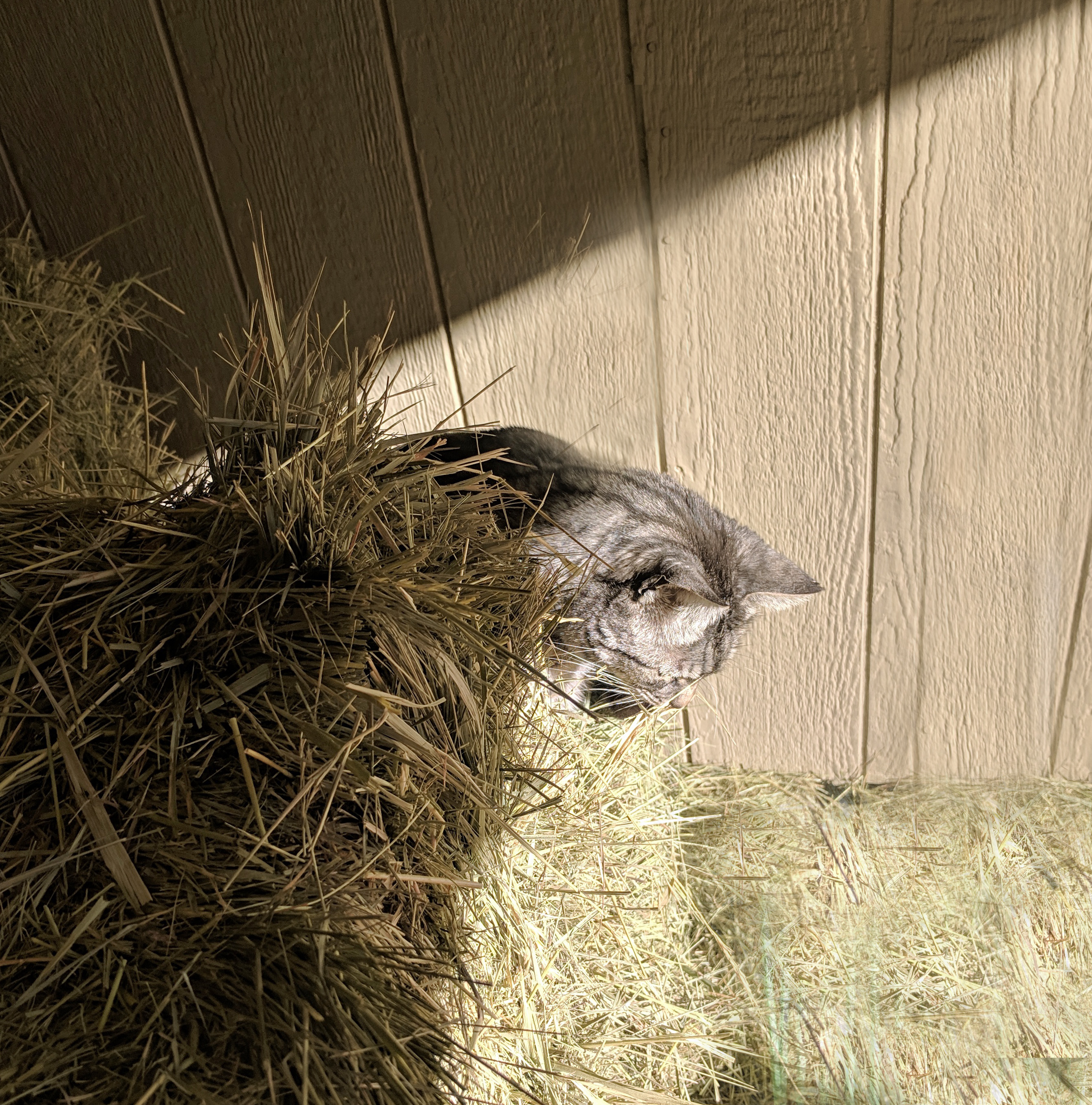
My poor cat, Maxwell, for weeks has been confined in the house. An inside-outside guy, he’s okay out in snowy weather and when necessary getting warm by burrowing into the haystack. For his first seven or so years, Max was outside-only, living comfortably in the barn. He knows how to take care of himself, is a capable hunter.

Some years ago he showed up with an injected jaw, the vet estimated from a cat fight, meaning he’d be tested for kitty aids, which couldn’t happen for another three months. During that time he couldn’t be outside, in case he actually had contracted an autoimmune disease, to infect another cat. During his ensuring weeks of life inside, Max came to like it. Since then, he goes outside, makes his rounds, takes a quick look for barn mice, and soon, returns to the house and peers in windows for an invitation to enter.

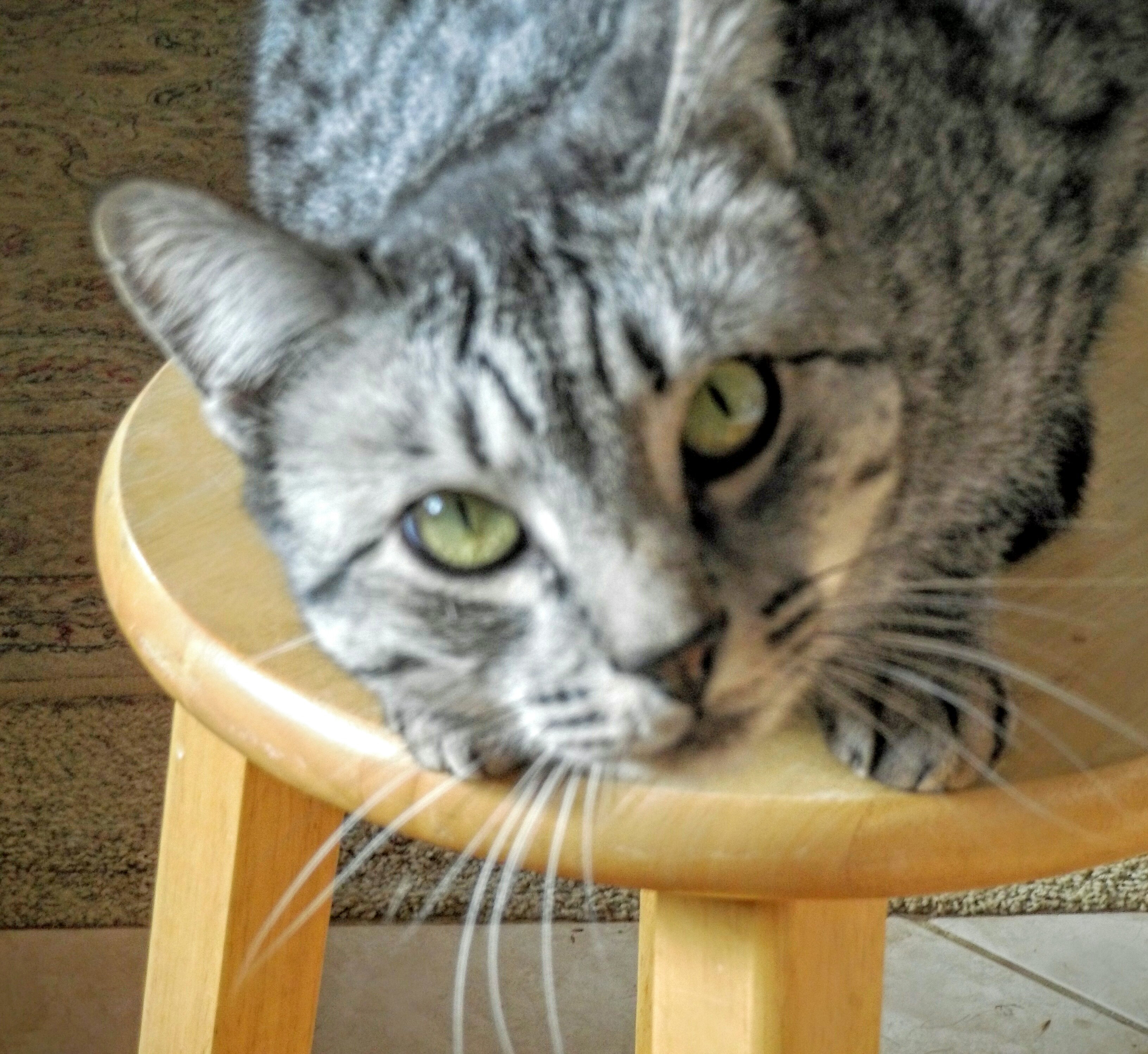
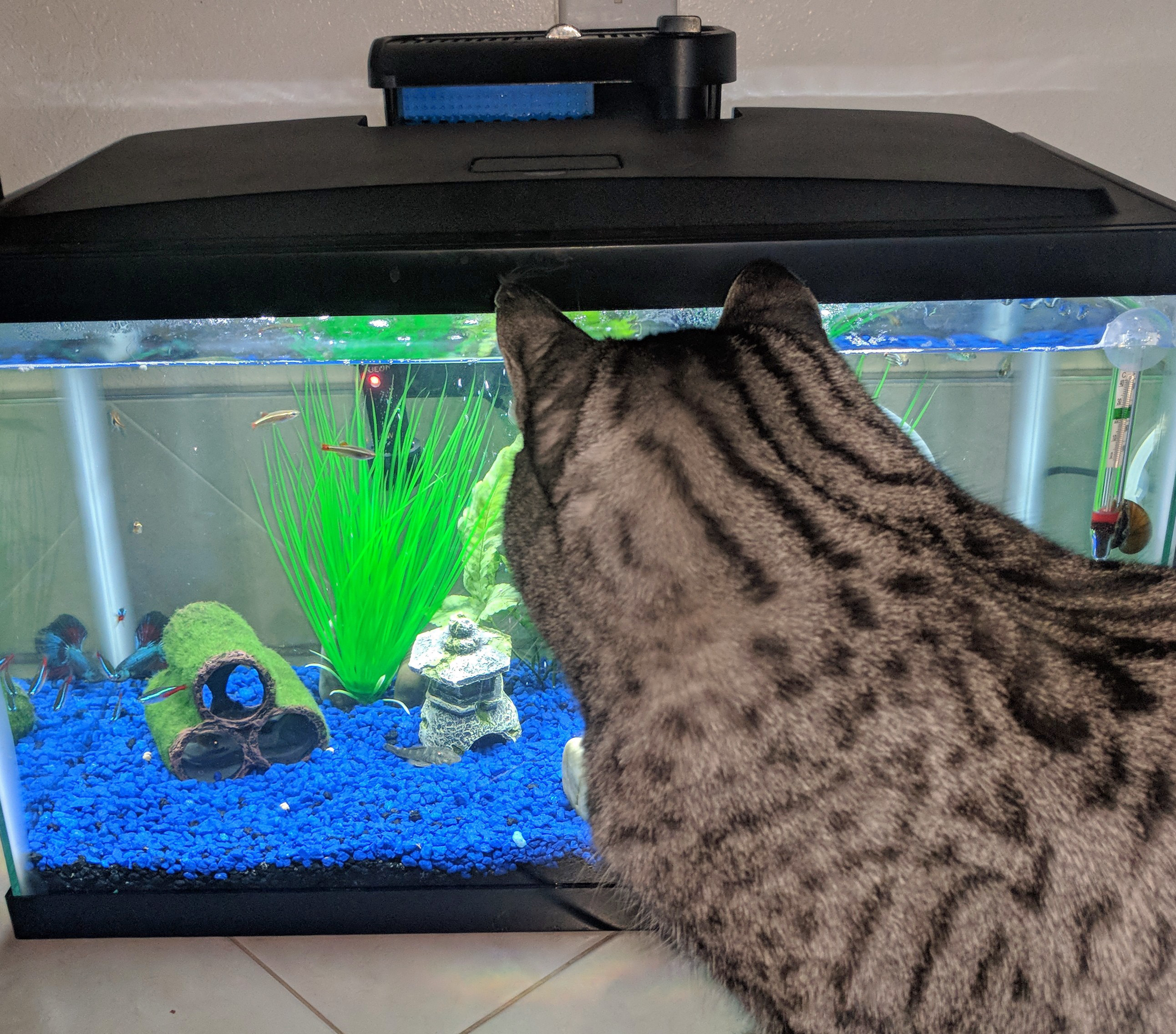
He’s slightly undomesticated and can be annoying–under my feet, grabbing at my socks, pulling on clothing, or worst scratching the woodwork. He loves to snuggle but is a heavy lump and difficult to shove away when I want to change position. For the past several weeks he’s been strictly inside, because I’m feeding birds during this area’s big snows. Max, an expert killer, must be isolated from vulnerable wildlife.

So, he focuses on inside possibilities.

Or hangs around bored.

Before he goes outside again after the snow has melted, I’ll remove the feeders and give the birds a few days to realize there’s nothing left in spots to which they currently flock. It would be nicer and fun to keep feeding them, but Max on the prowl would be a constant worry.

He’s a great cat, cool, and just enough undisciplined to be interesting. During his outside-only years, he stayed close to home, worked a couple of neighbors’ properties, and never was seen near a busy road. I complain about him as a nuisance inside, but if Max doesn’t show up wanting to come in near day’s end, I start looking for him.

Like most relationships, ours through the years has taken various shapes and survived.

Dear Friends, Have a wonderful day. Diana
Potpourri Of Spring

At Bird Feeder (Pixel 1)

Sunday, March 17, 2019

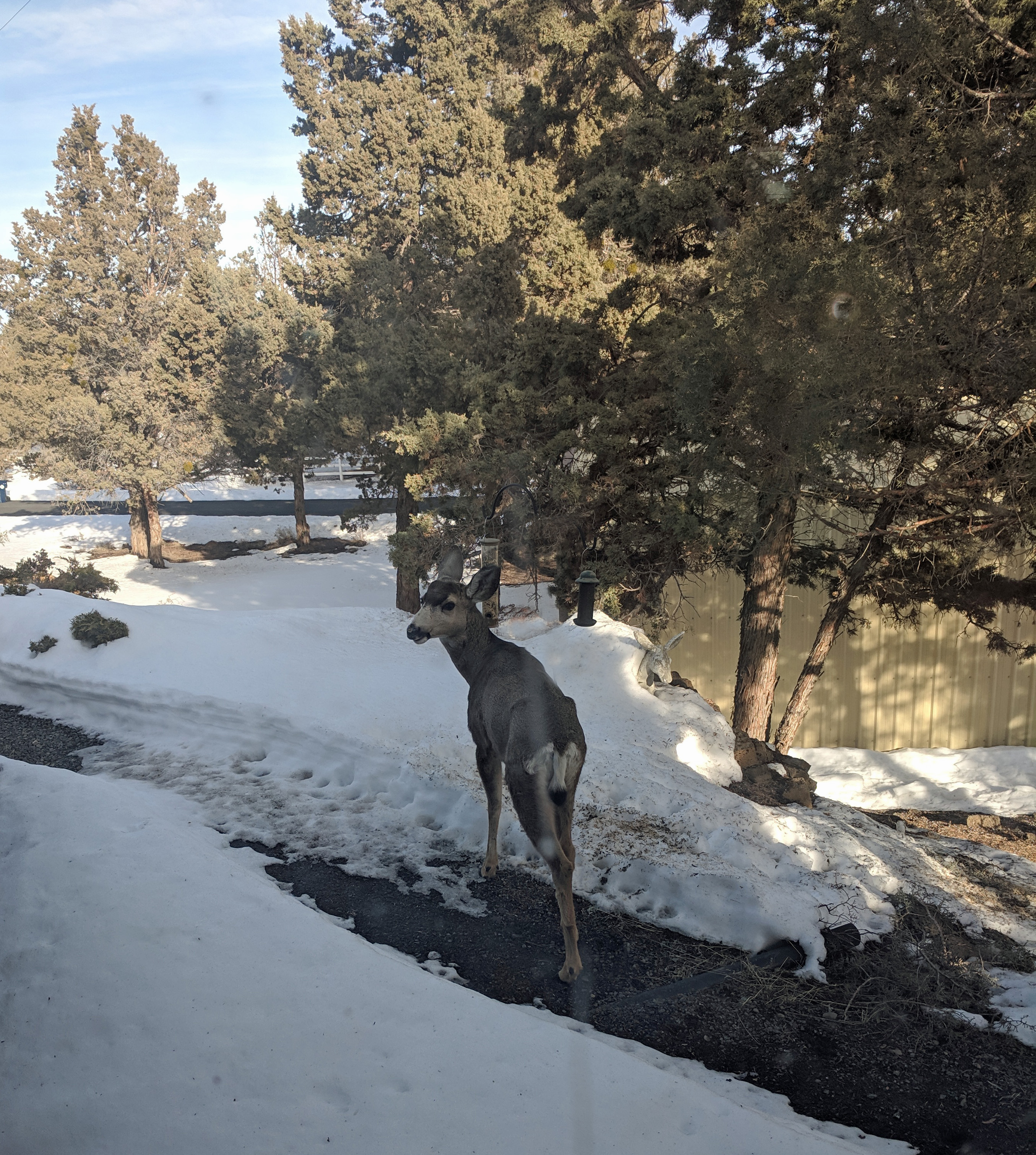
Early yesterday, the dogs began barking, Peaches started screaming, and so, clearly something outside wasn’t right. Aha! Just beyond my window a tall doe nibbled bird seed from a feeder. Coming out of the most severe weeks of winter and looking very thin, she was positioned for a photo op. Just as my finger pressed the capture button, something made her look around and look directly at me. She took off, one of her rear legs not working quite normally. I wished that she had finished that bird seed or anything else she might have found. In case she might return, I filled the feeders.

Just days ago, our temperatures averaged 25 to 35 degrees with snow falling often. Yesterday, the temperature climbed almost to 80 degrees! For sure, the time had come to go outside looking again for spring. I picked up a camera and invited Peaches along. He hopped onto my shoulder, we went searching.

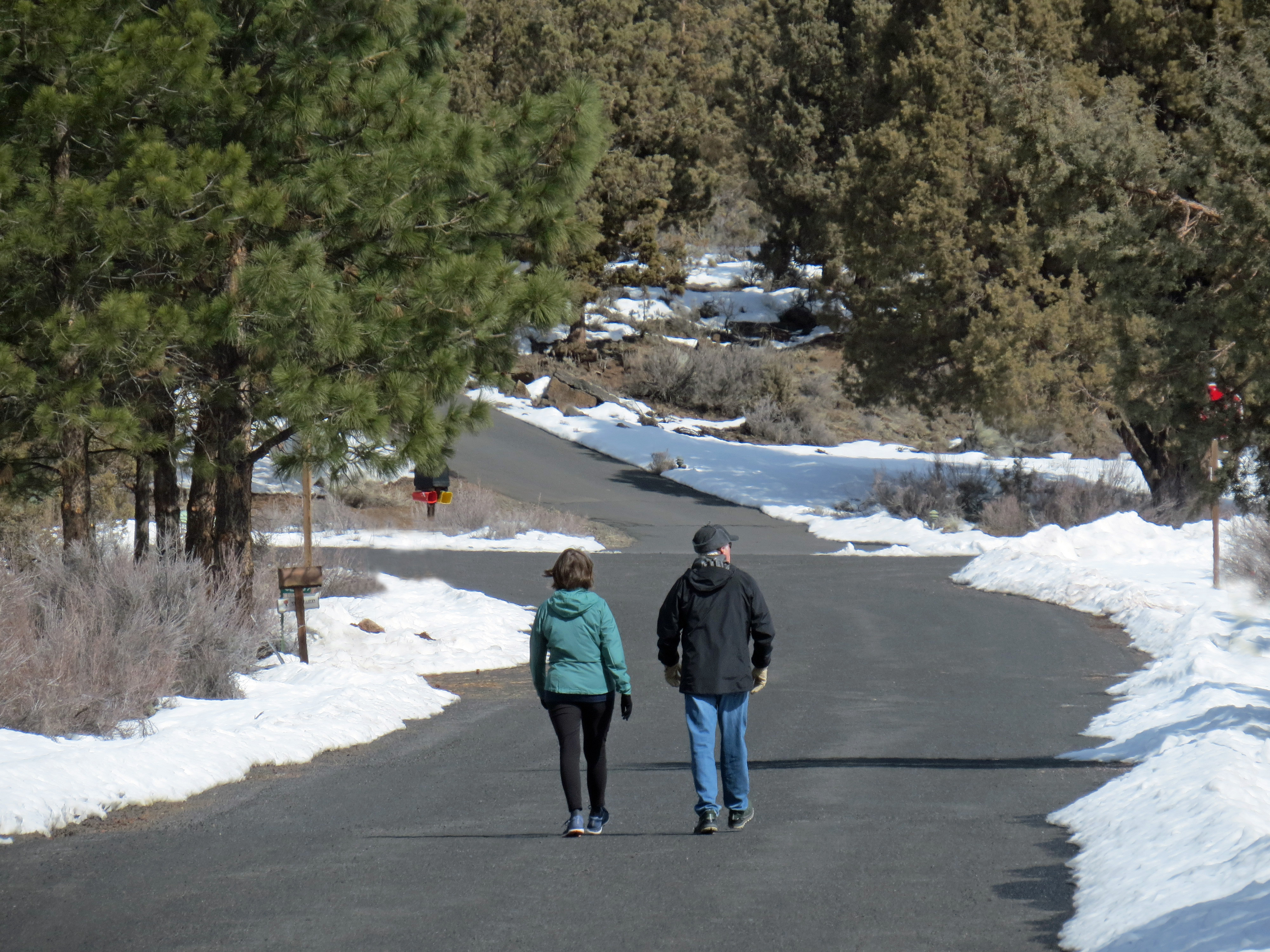
I knew we wouldn’t find anything new and green, so decided that anything I chose to photograph could represent spring. How about this couple, strolling along in the warm weather!

(Canon SX50)

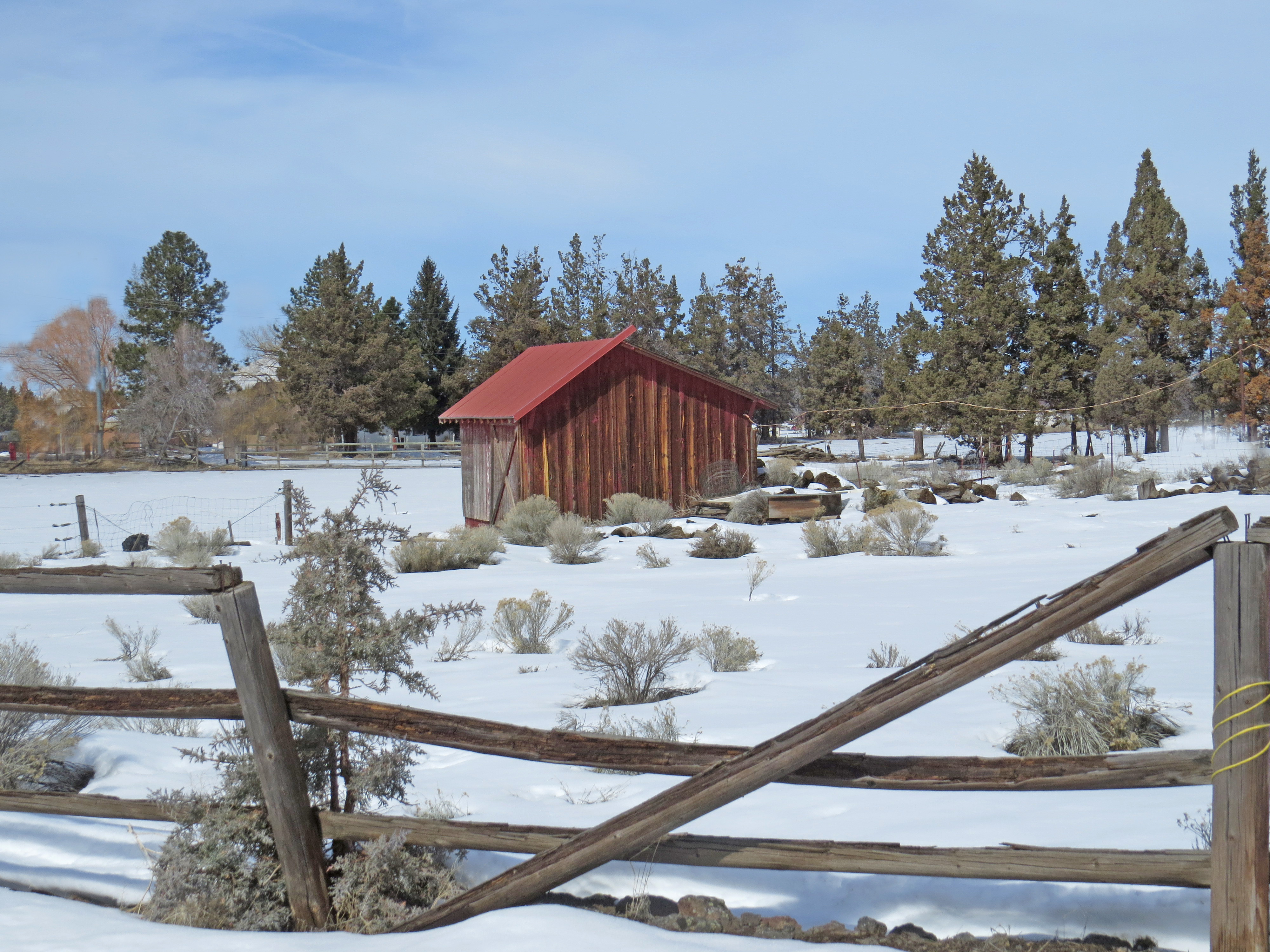
At the intersection, they turned right and Peaches and I went left. I had in mind a nearby old barn which had belonged to a neighbor who raised cattle. I’d driven by it recently on a day with light rain, and that moist light made the wood’s aged and damaged colors seem stunning. On this dry day, they looked a little more bland but still interesting. The building is a relic and I’m happy to have captured it at last.

Patterson’s Shed (Canon SX50)

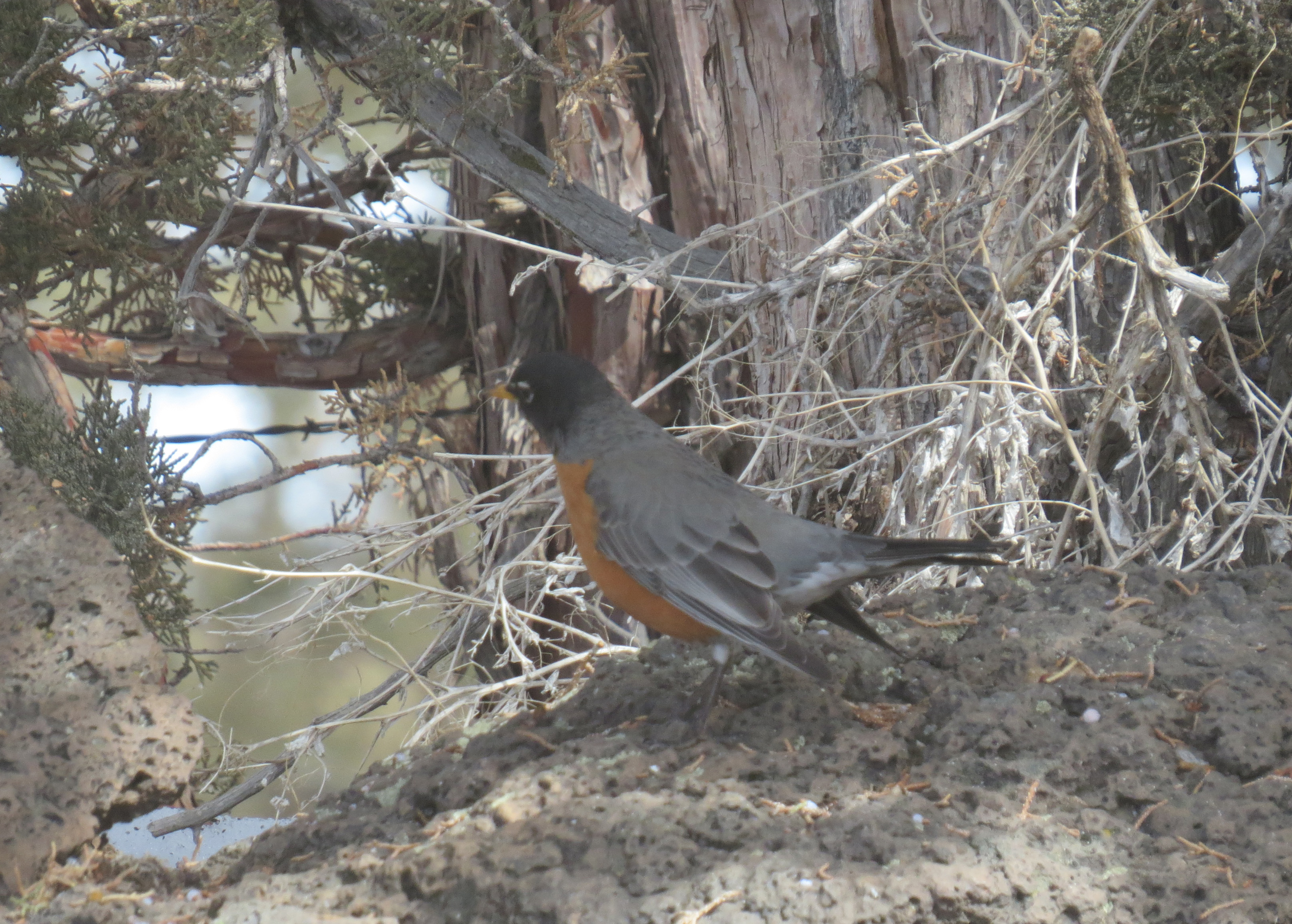
Nearby were signs of spring–a chipmunk and a woodchuck (Marmont), both scurrying away too quickly for me to capture. Peaches, on my shoulder, arm, or hanging off on an article of my clothing, slows the process. On seeing one of my all-time favorites, a Robin, wonderful hunter, doing its thing, I knew its occasional pauses would lend time to aim and adjust a lens.

(Canon SX50)

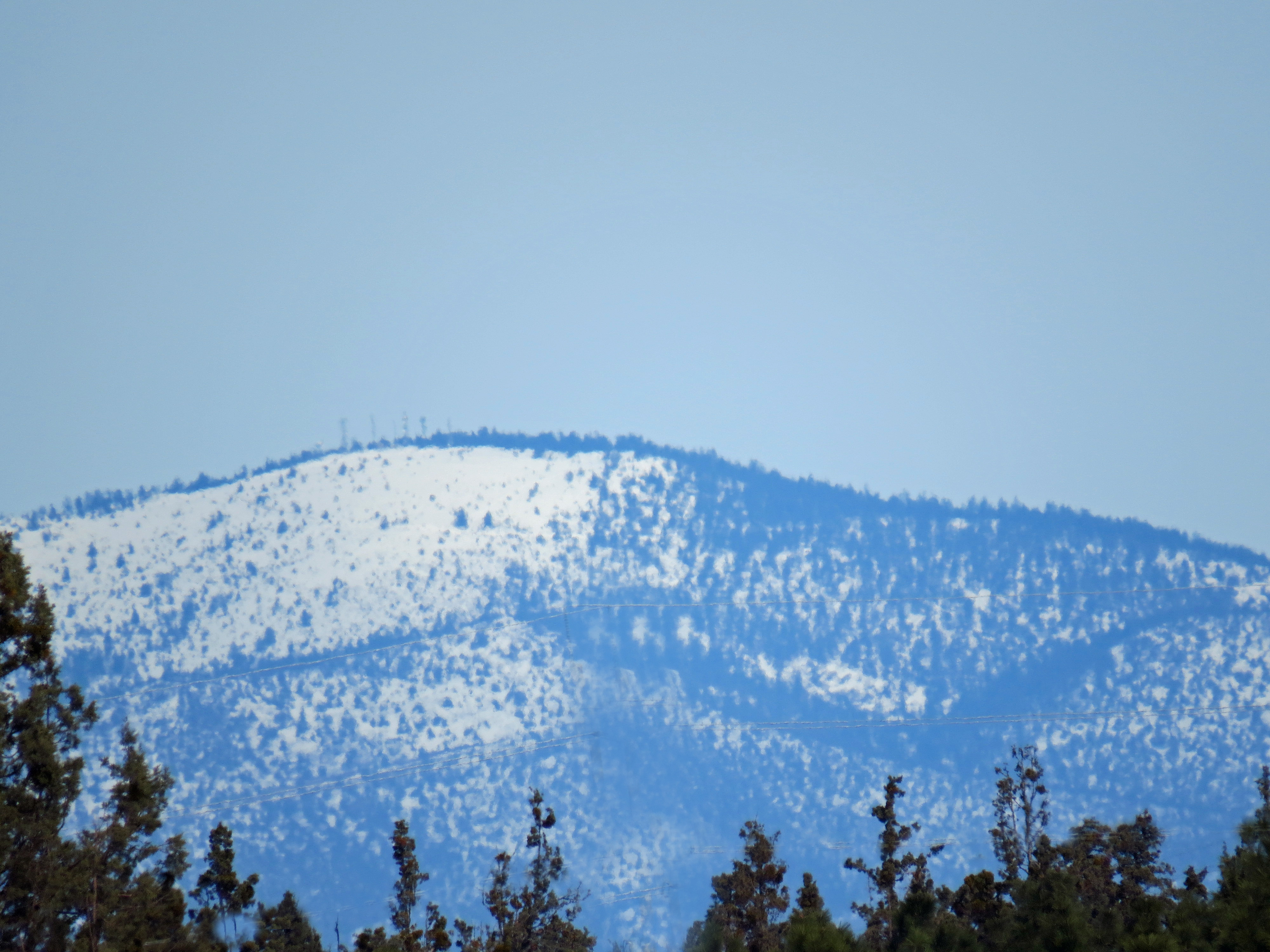
A bit farther along, my camera’s capable z00m lens brought from far north a sight of hulking cinder cone. It didn’t look familiar but I snapped it, would figure out later what the rise might be. Later, at home and looking very closely, I could see on its top line a very faint capture of radio signalling apparatus. Those identified my picture.

Grizzly Mountain (Canon SX50)

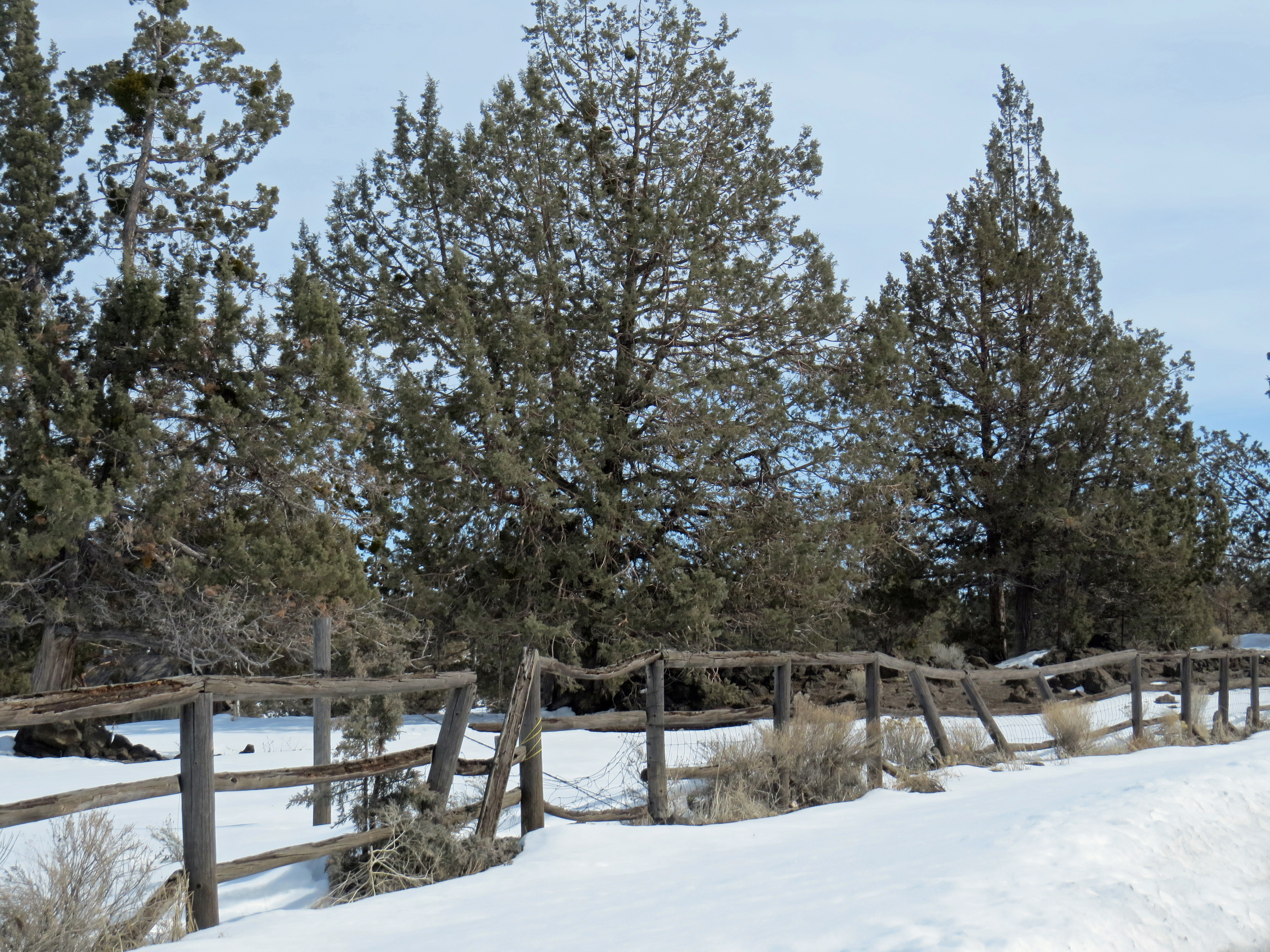
There’s much to see while out wandering around, and on a desperately-needed warm day, just about anything enhances a spring mood.

Patterson’s Fence (Canon SX50)

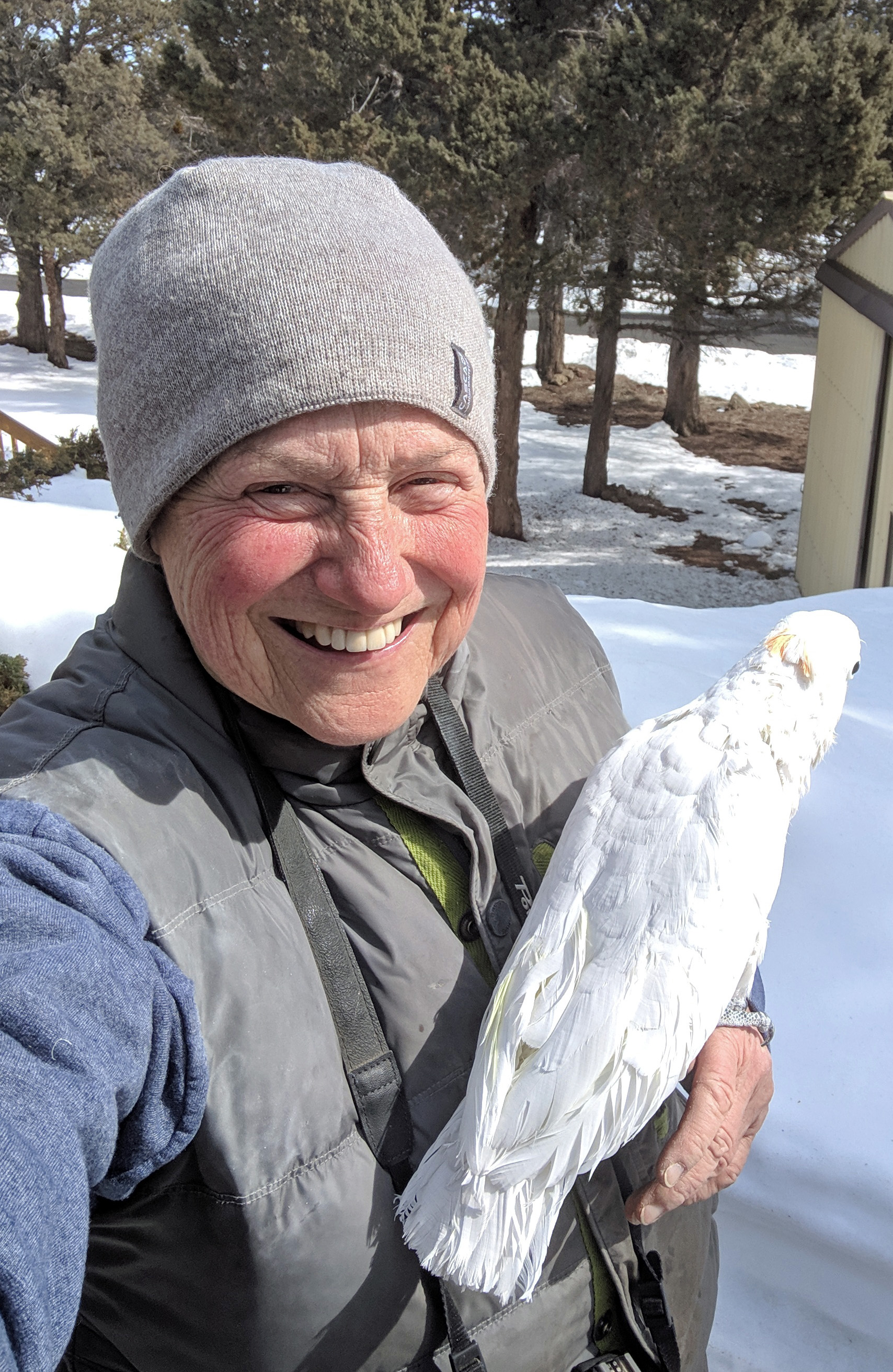
Seeing no green didn’t matter in the wonderful warmth outside. Peaches chatted with passers-by with his repetitive, “Hello, hello!” or “Goodby, goodby!”

Howdy, Spring! (Pixel 1)

Dear Friends, Wishing you a great outside enjoying the many visible wonders. Diana
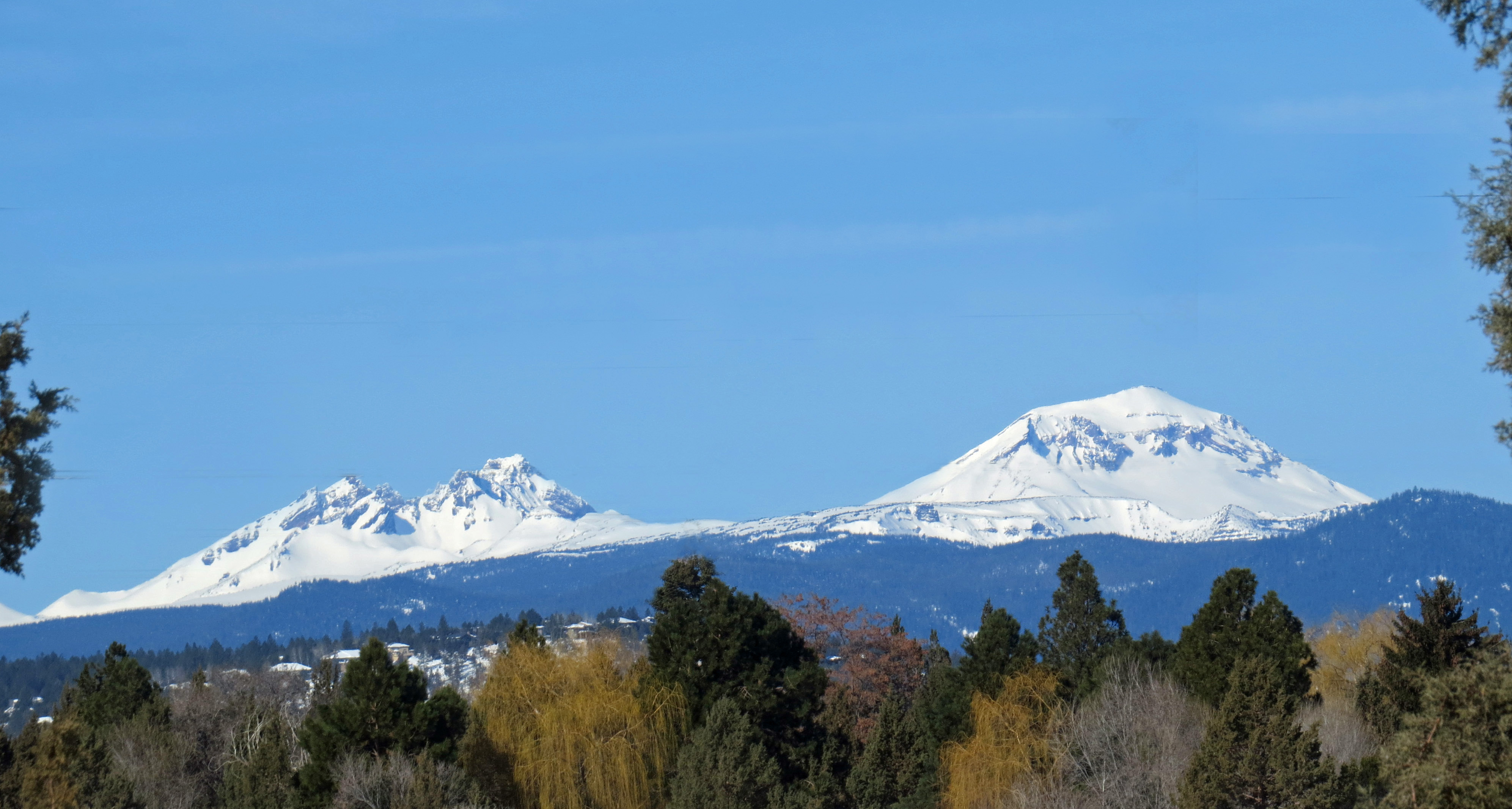
Central Oregon’s Cascades

Broken Top & South Sister (Canon SX50)

Saturday, March 16, 2019

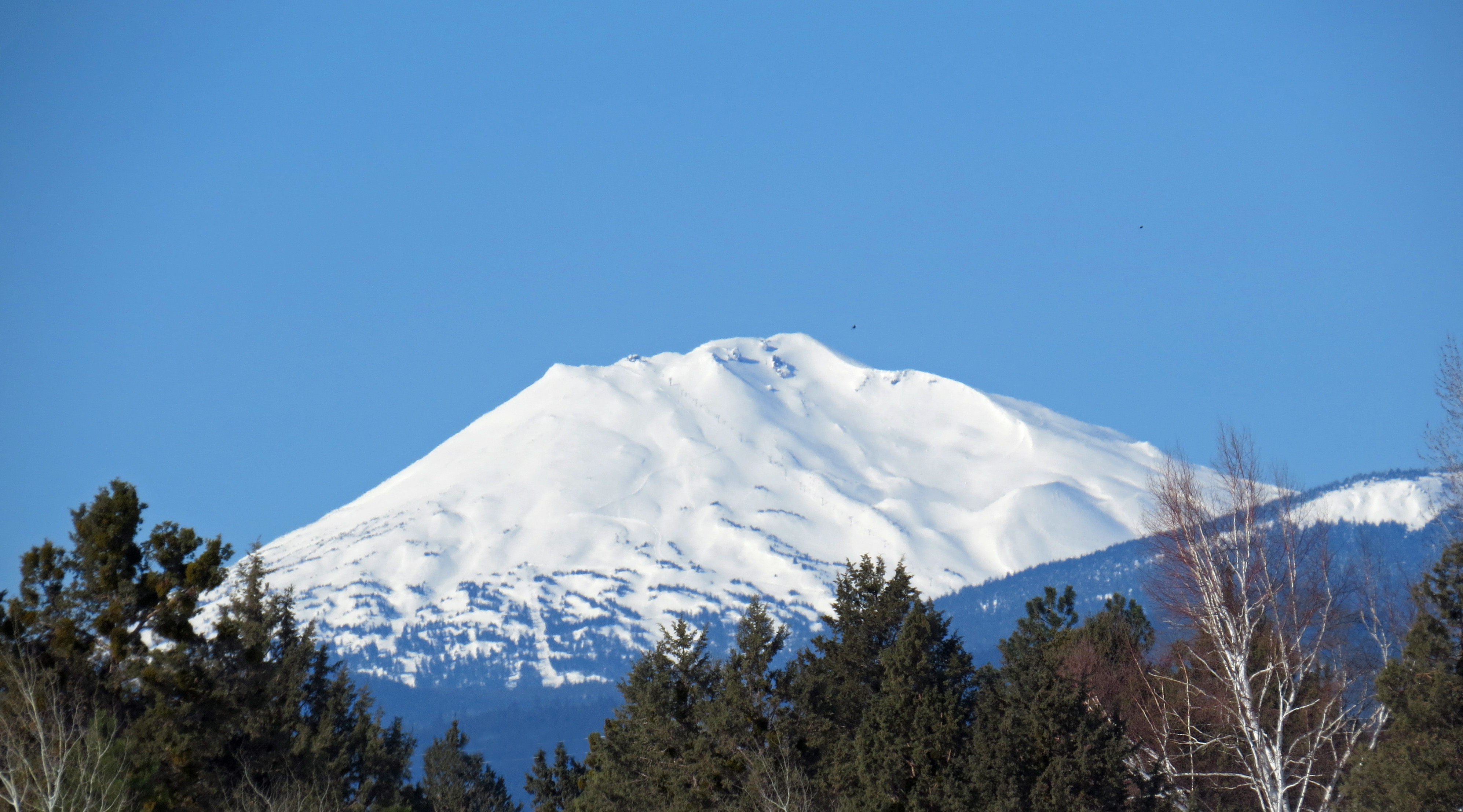
The Cascades are visible once again and now glowing after weeks of being shrouded in show. I couldn’t wait for their re-emergence to photograph them. It hardly matters that over the years I’ve photographed often the portion of that range visible from my property. Each time feels like a new venture, maybe because shifting weather and light affects the view. Maybe because the mountains seem magical.

The Oregon Cascade range is 260 miles long. The peaks most easily visible from my property are Mt. Bachelor, Broken Top, and the Three Sisters. On a clear day, while I might see more northward mountains, my usual captures from Bachelor to the Sisters take little effort. I’m fond anyway of these particular beauties, having covered on horseback many of their trails. Close observation increases their loveliness.

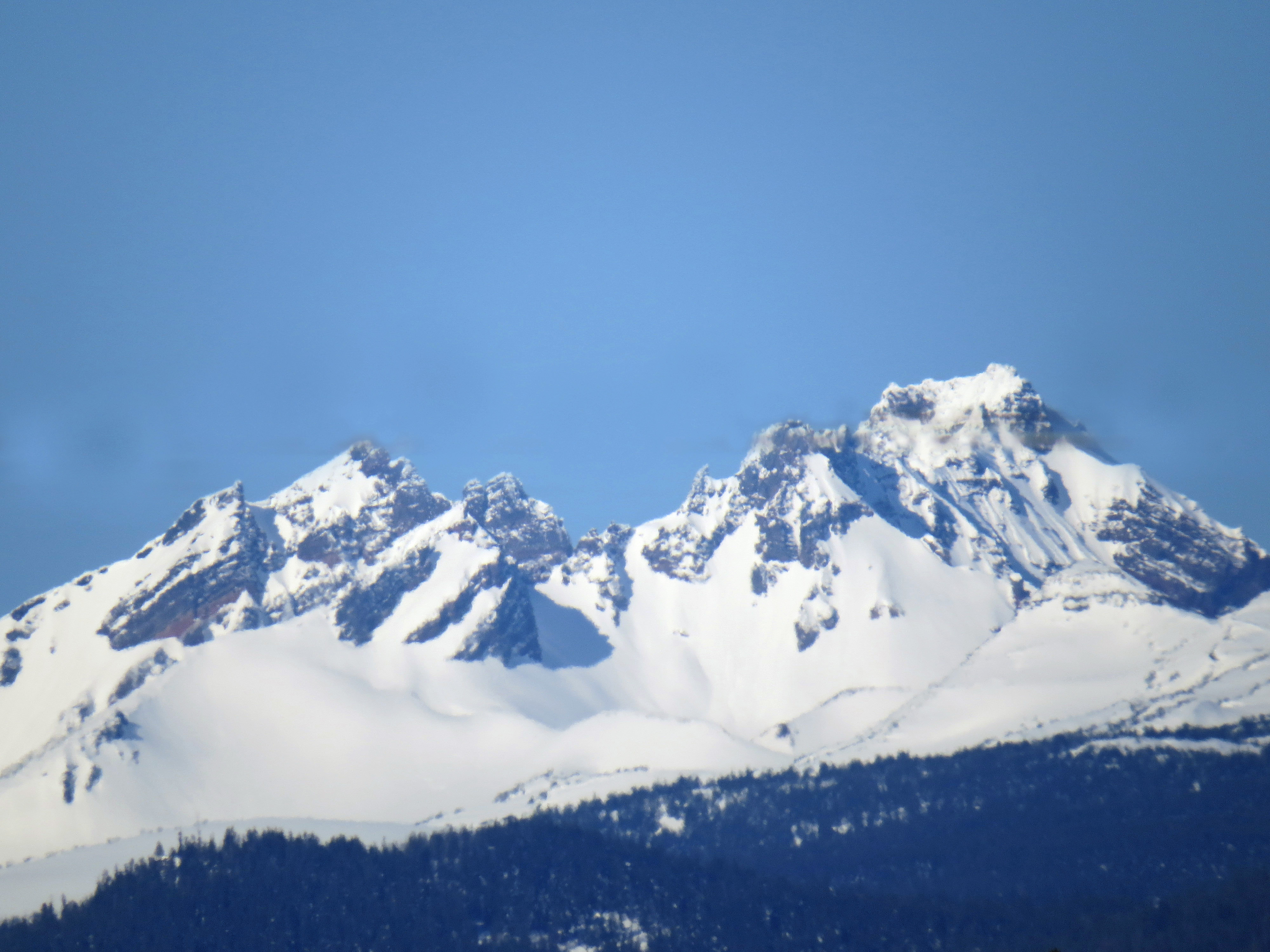
My favorite is Broken Top, a collapsed volcano. It sinks in the middle and demands attention. Wonderful trails cross-cross the mountain itself, and there’s a unique trail from Todd Lake to Green River that takes travelers next to Broken Top’s craggy profile.

Broken Top (Canon SX50)

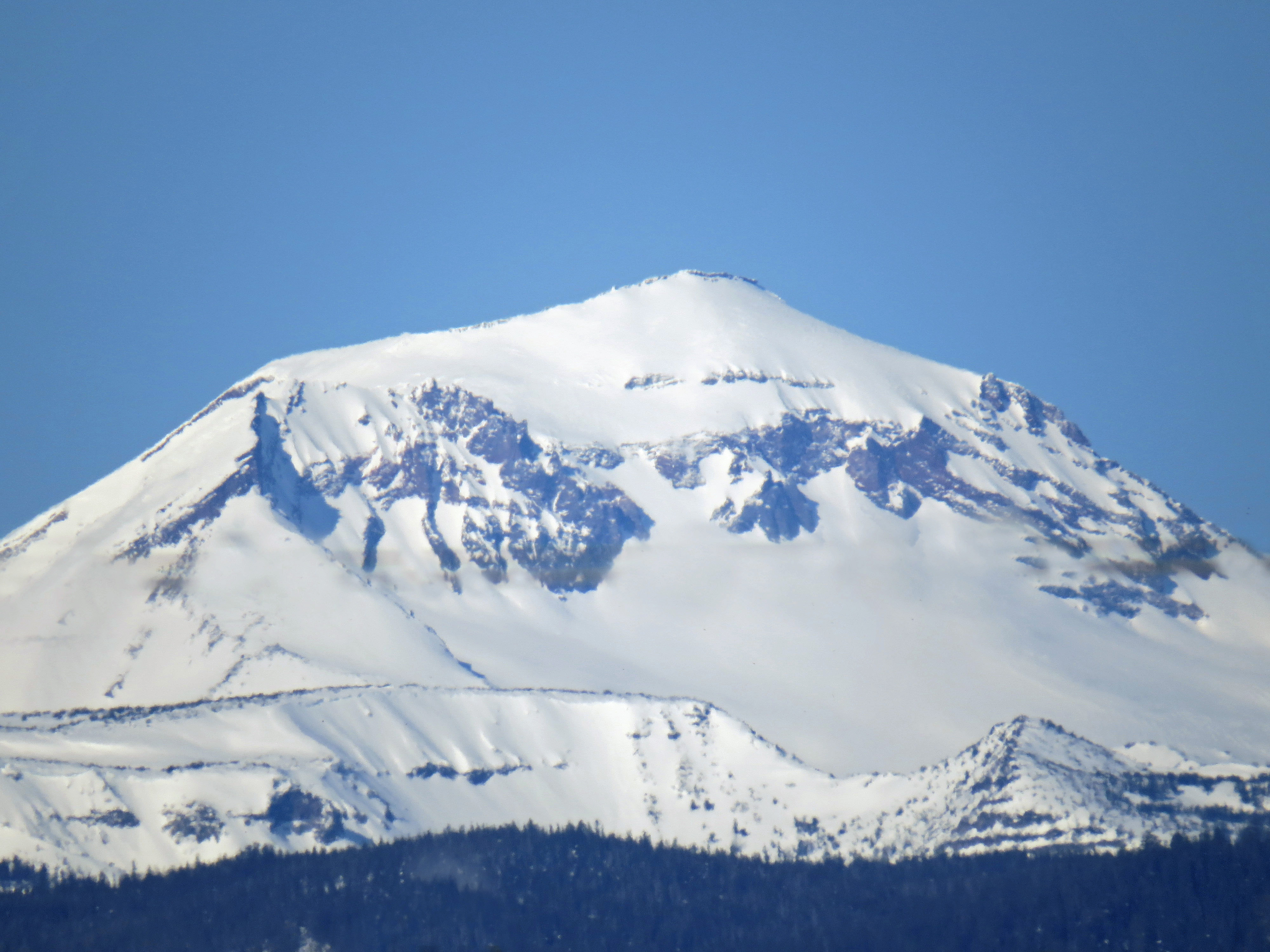
Mountains fascinate, they’re so complex–on the one hand appearing permanent and stable, and on the other having the potential to blow, like Mt. St. Helens in 1980. The South Sister, a popular hiking mountain, is a rather-alive volcano, watched closely because it might erupt someday. I cross fingers that the peak won’t change for many years ahead. Its precarious nature is “the stuff” that generates folk songs and poems.

South Sister (Canon SX50)

Once I tried to hike up the South Sister and this quickly proved too much. Some of my friends do make it to the top, and some climb regularly! I’m happy simply hearing how much effort is required to ascend and about the great views up there.

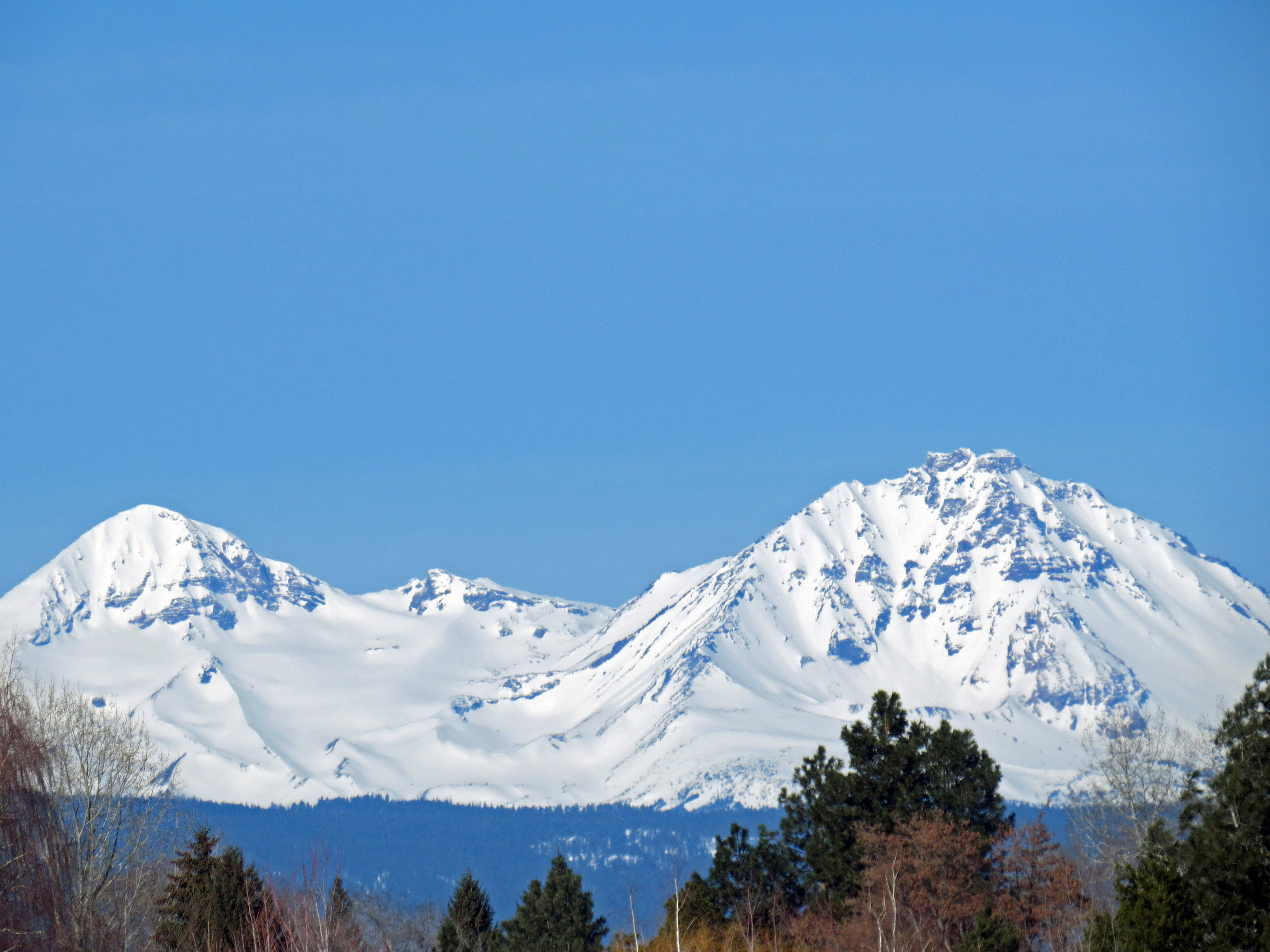
From my vantage point down by the barn, the South Sister is placed in a way that prevents my capturing all three Sisters at once. Photographed separately, the Middle and South Sisters create an image of musical-like symmetry.

Middle & North Sisters (Canon SX50)

Mt. Bachelor is the southernmost of Central Oregon’s Range and a popular skiing destination that helps to keep this area full of tourists. It’s also a gateway to the Cascades Lakes Highway, which provides access to numerous mountain lakes and trails.

Mt. Bachelor (Canon SX50)

Here’s a little local lore from Oregon’s Department of Transportation: “In the mid-1960s astronauts practiced along the Cascade Lakes Highway to prepare for Apollo missions to the Moon. In 1971, Astronaut Jim Irwin of the Apollo 15 mission placed an earth rock from a volcanic dome near Devil’s Lake on the lunar surface. It’s the only earth rock on the moon.”

The Cascades are fun!

Dear Friends, Geology is fascinating stuff both for learning and playing. Diana
Hints of Spring

Invisible Quail

Friday, March 15, 2019

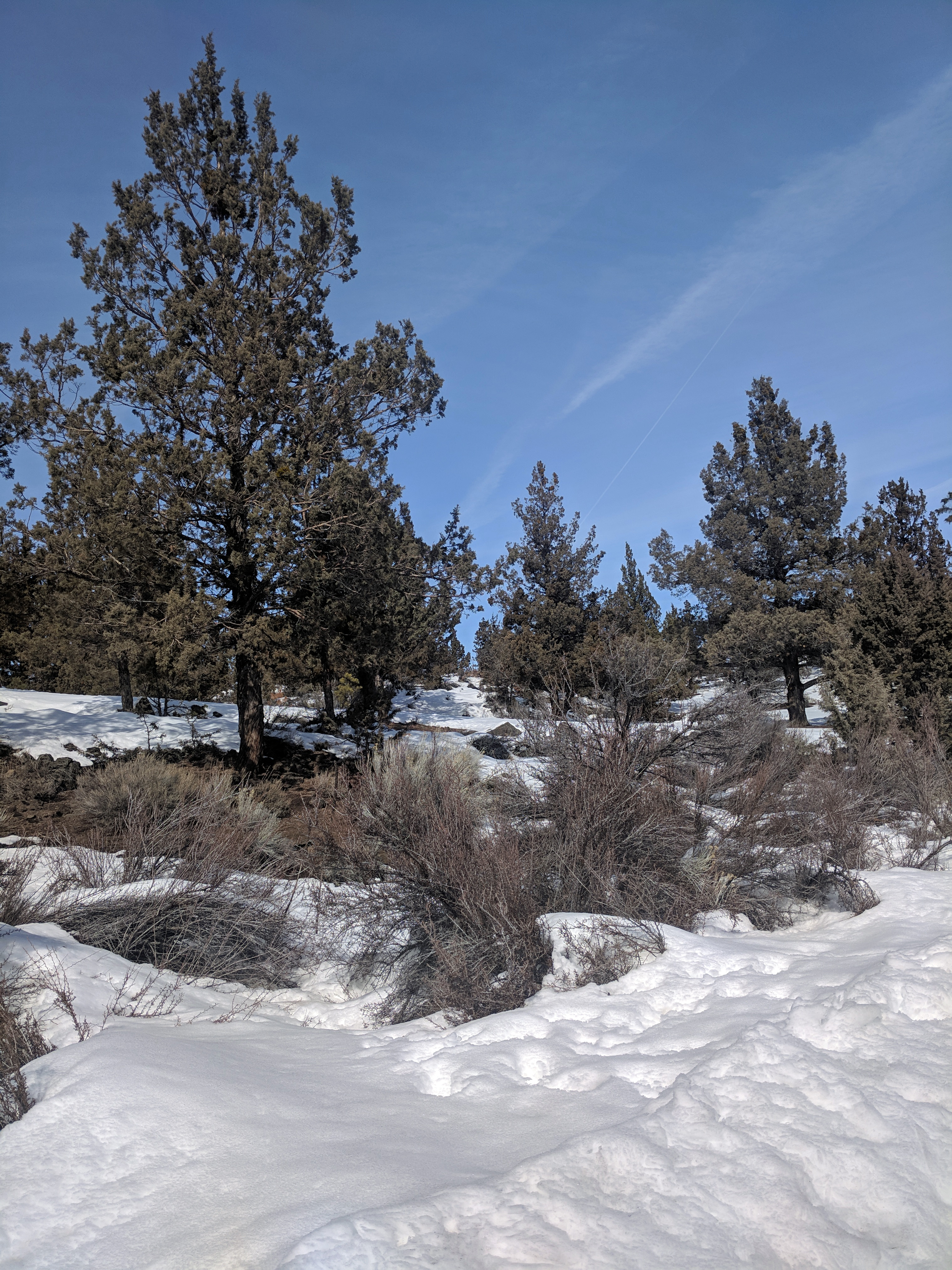
The days are warming up into the high forties and I’m looking for spring’s early signs. Our streets are clear but landscapes remain buried under nearly two feet of snow, which daily melts a little and at night turns icy. Every property looks like the photo above where I spotted my favorite sign so far of spring returning.

The foreground brush housed a covey of quail. Upon seeing me, they flew straight up and away, down the middle of my photo and toward that space between two trees way in the background.

I hung out remaining very still and hoping they’d return, and so, was treated to the sight of more quail across the street. I turned and they hurried to escape, and still, no photos. Using my camera would have meant shooting straight into the sun, and changing my position would have frightened the birds more.

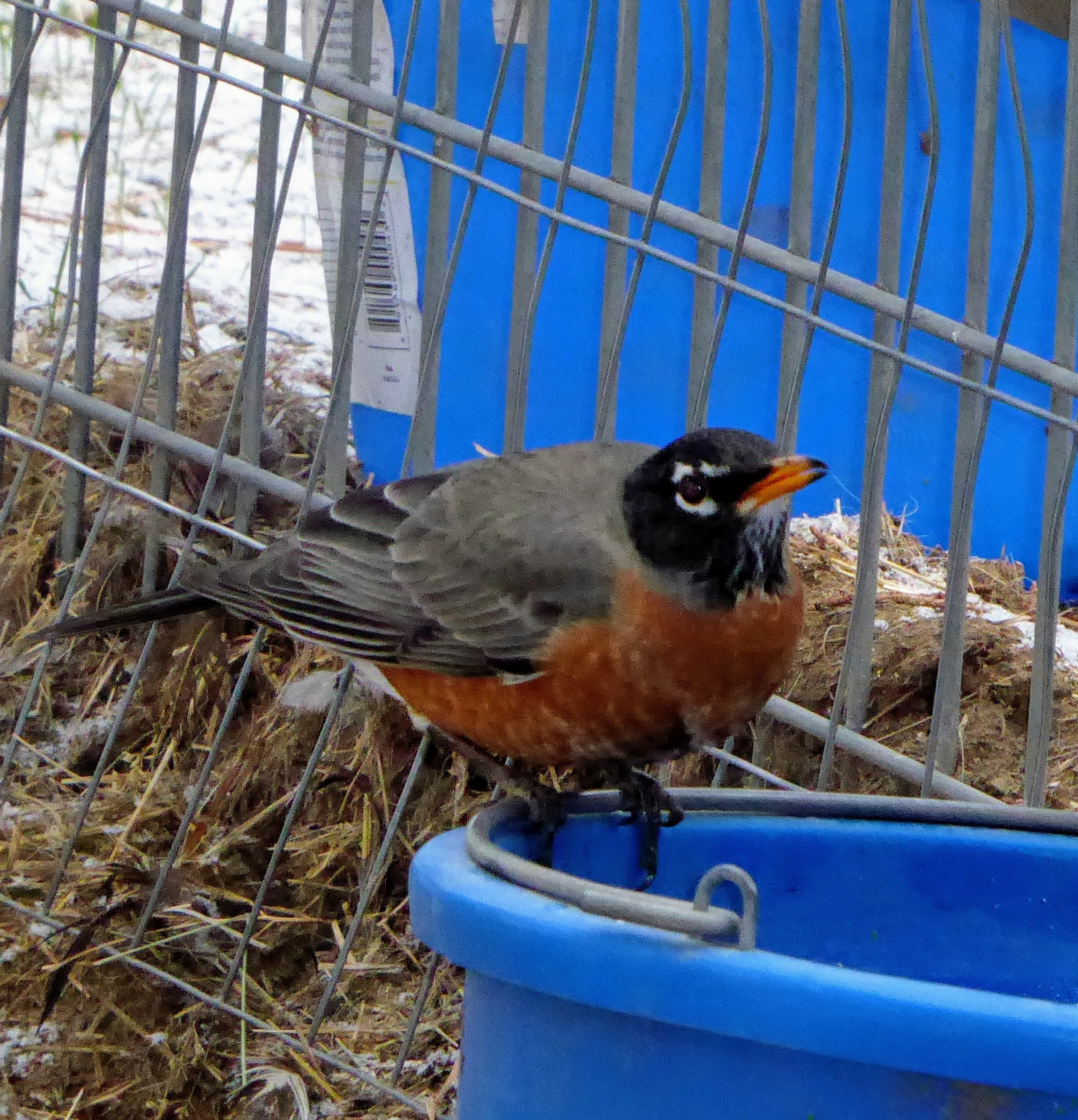
There’s no greenery aside from conifer limbs that are emerging from snow. I wandered home to look around for something that seemed like spring. This lovely Robin caught my eye.

Drinking heated water

The local birds regularly drink from my goats’ heated buckets. Admittedly, Robins are present year round, but they become more numerous in the summers. It’s also appealing to see that some snow in the goats’ area has melted.

Like “Desperately Seeking Susan”, I’m desperately seeking spring.

Maxwell

I let Max outside awhile and he followed me to the barn where he took up residence in his usual spot watching for mice. He’s a lousy mouser, not because he can’t catch them, for oh yes, he does. But because he tosses them around, gets tired and lets them loose, and those that still can, run to hide and resume their lives. Oh, Max!

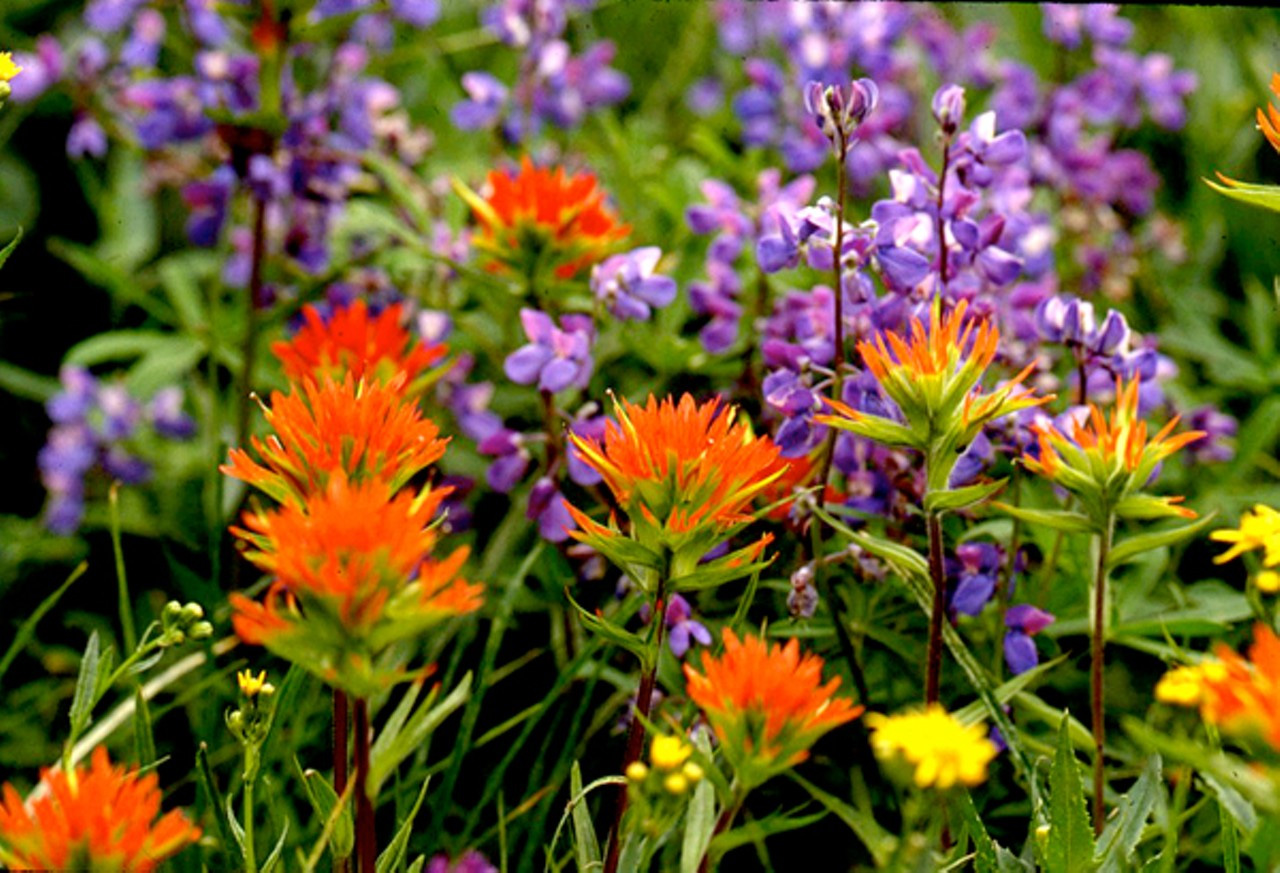
I remembered having seen in a doctor’s office a lovely watercolor of a garden in France. I searched for the artist, finding neither her nor her painting, but became drawn to the idea of borrowing from the public domain a photo of wildflowers. These are abundant in our mountains during spring, and remind me of riding horseback and finding them massed in gorgeous welcomes.

Oregon Wildflowers

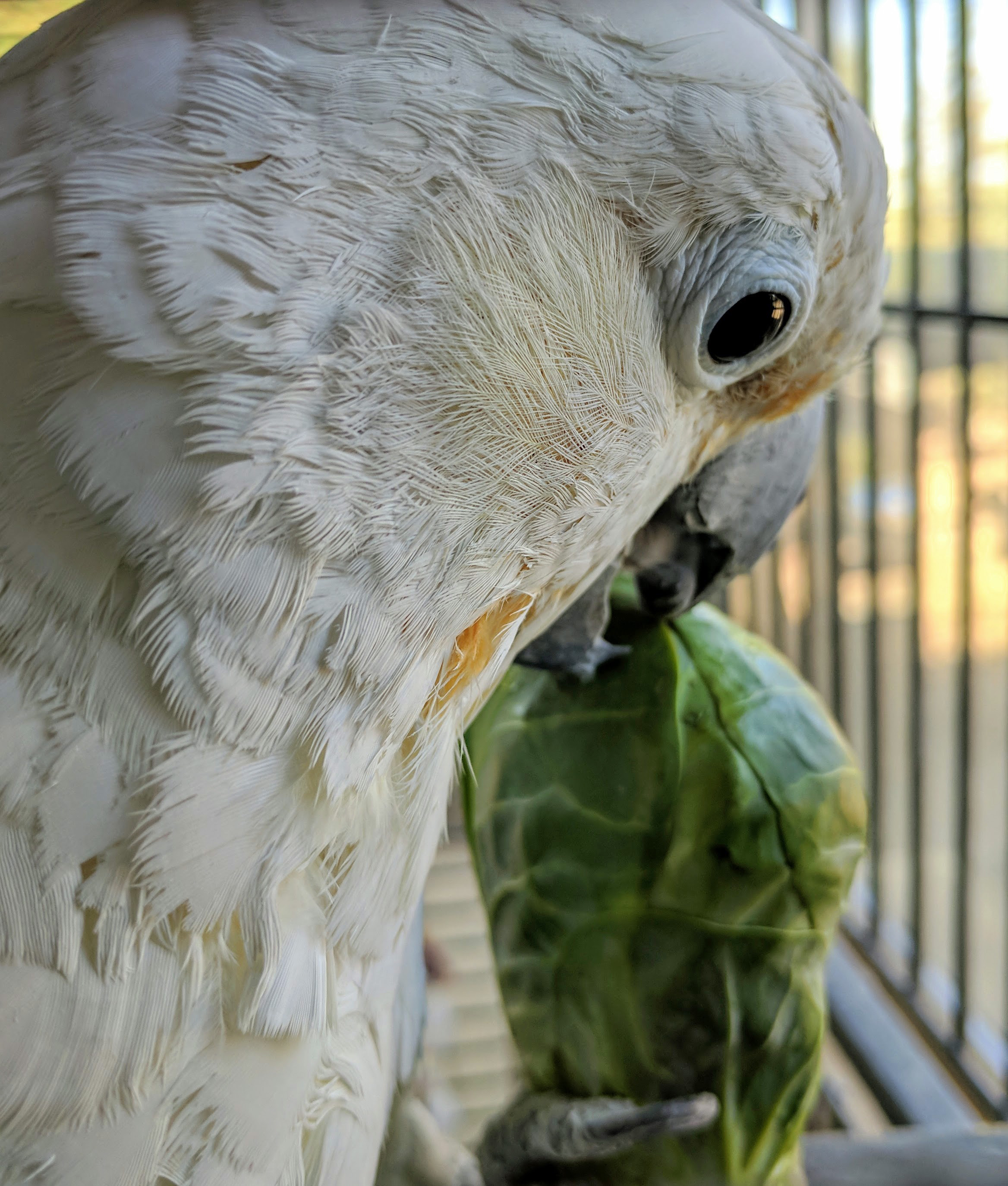
And finally, for some reason, maybe because because I remember that French garden, here’s Peaches with one of his favorites. It’s associated to Europe and deeply green.

Peaches with a Brussels Sprout

I’ll be working at Costco today and looking around there for signs of spring.

Dear Friends, Enjoy this day, let me know if you spot spring. Diana
Local Art

Peaches & Folk Art

Thursday, March 14, 2019

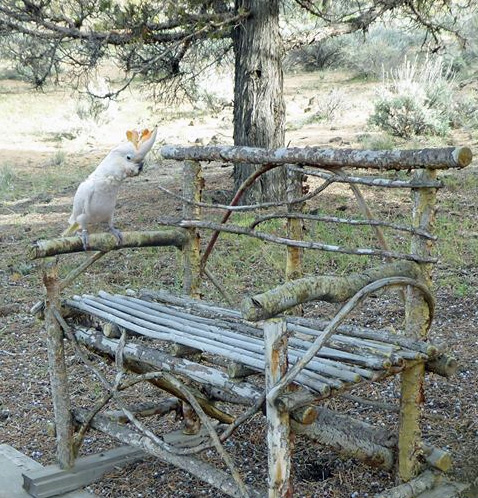
One of the coolest pieces of art in my neighborhood is this handmade bench above, with Peaches. It’s about a mile from my house on someone’s property and near the road. Passerbys can’t miss it, and I didn’t during a summer stroll with Peaches.
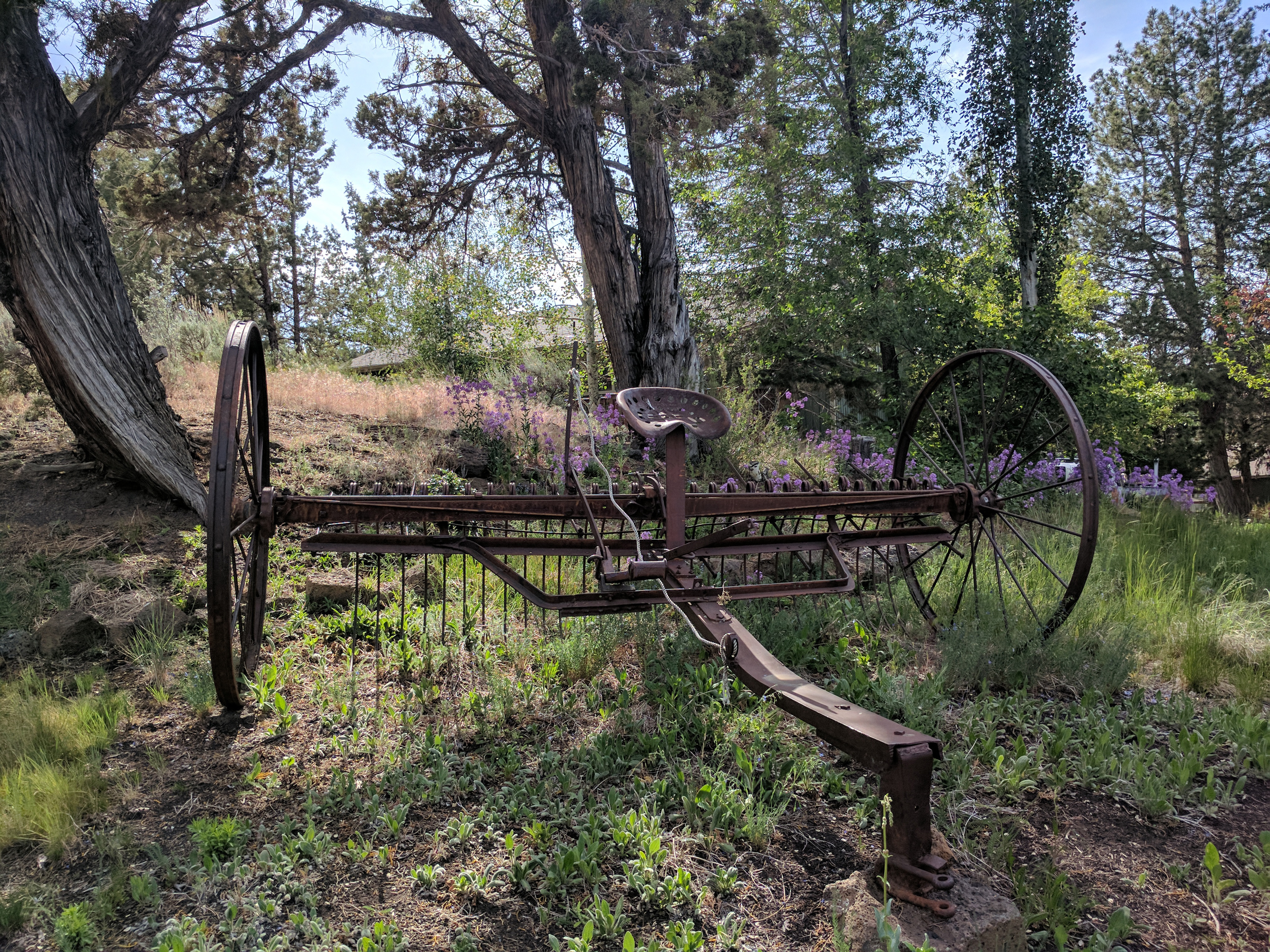
There’s a great deal of art out in the open and easy to see as one walks or drives around on the east (or “desert side”) of Bend. Some folks use ancient farming implements to decorate their properties, like this rake at my neighbor’s home.

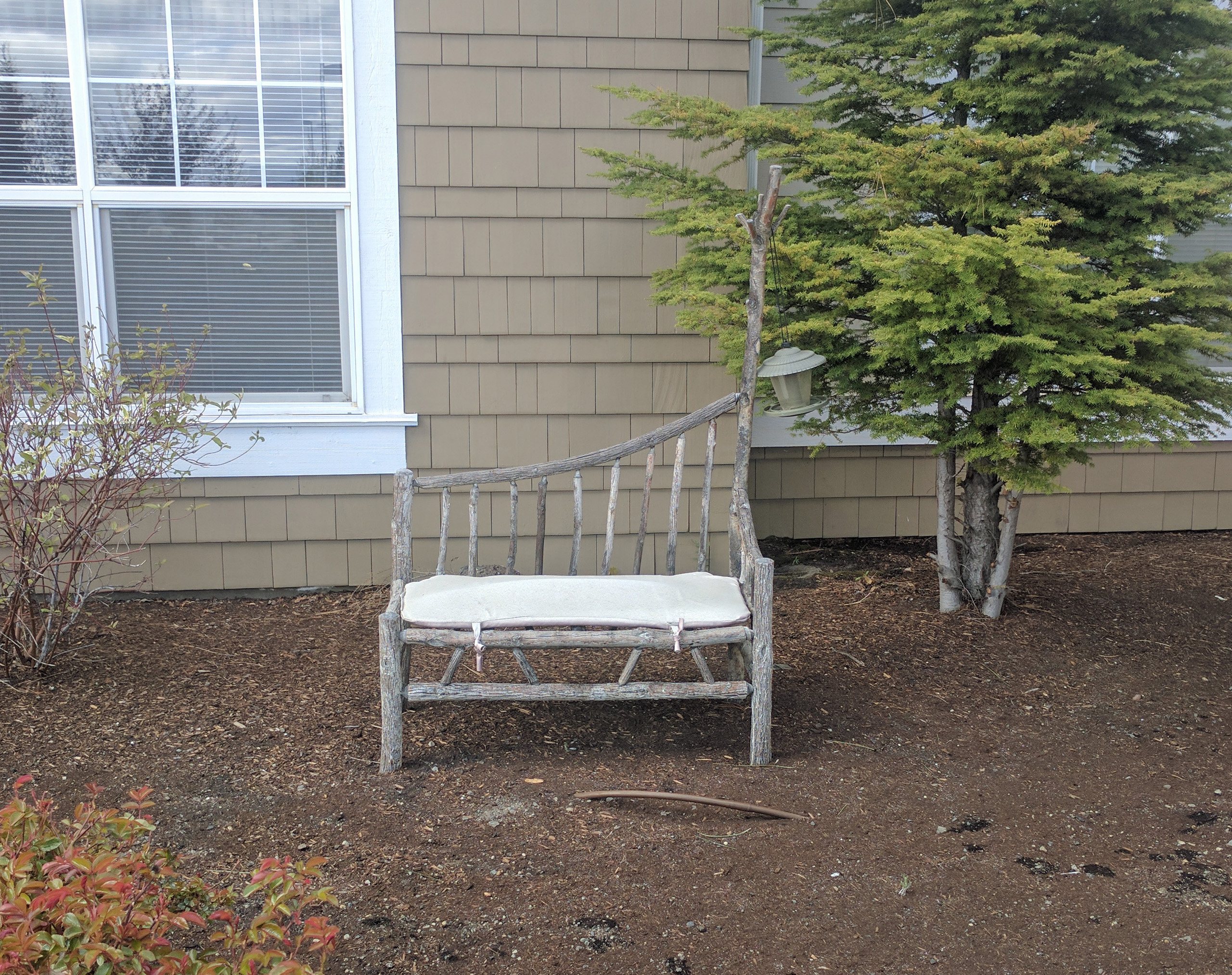
Here’s another bench, a homemade folk art belonging to the memory care facility where my elder sister resides. It invites folks to sit and reflect, and visitors accompanied by their resident relatives often take advantage of it.

These photos were taken in summertime, and now, another season of sunlight is on its way. Starting today, I’ll be out with a camera to capture more local art. I’ll be seeking signs of the snow finally, really disappearing, and allowing the beauty beneath to sprout again.

Dear Readers, Have a great day. Diana

Peaches

Visiting the barn

Wednesday, March 13, 2019

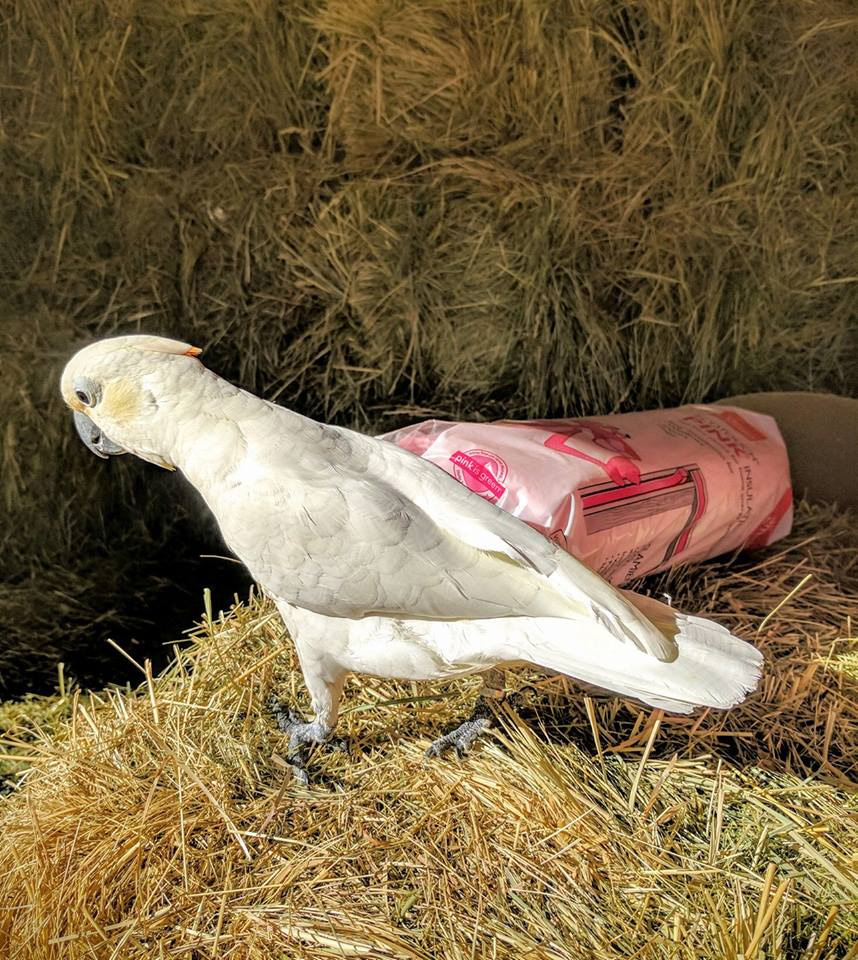
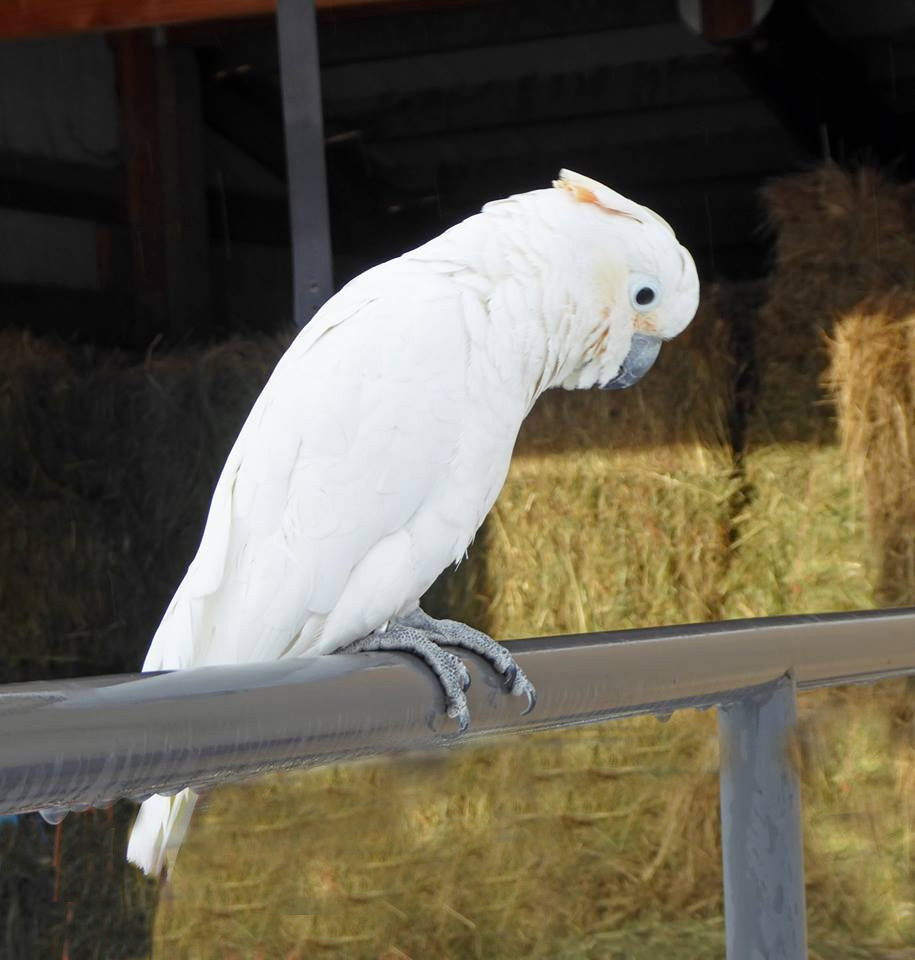
It’s impossible to ignore Peaches, a Citron Cockatoo, bred in captivity and imprinted on humans. He needs his person and that’s me. He makes sure that I listen, and so, snow or no snow, he gets playtime. Often we talk a walk outside, and in snowy weather, might visit the barn. Peaches is a noisy guy with screeches that frighten horses, so we confine ourselves to areas away from them.

Peaches loves the haystack, but his curiosity could lure him into a crevice. I’m vigilant and don’t let him wander beyond my reach.

Hmm, interesting!

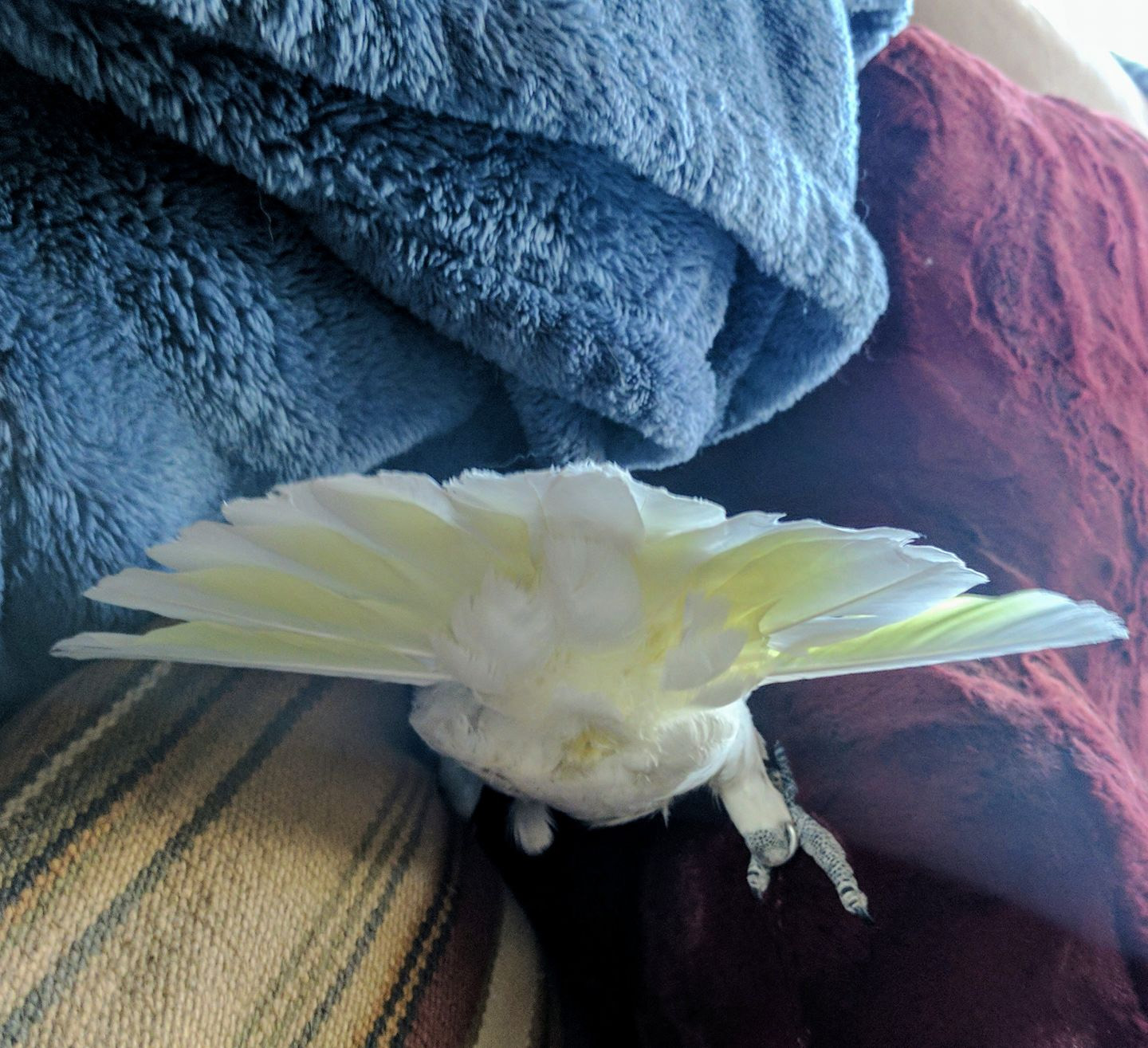
He’s always the same, including inside the house. An out-of-cage playtime invites him to start seeking shadowy spots in which to dive and explore.

The sofa

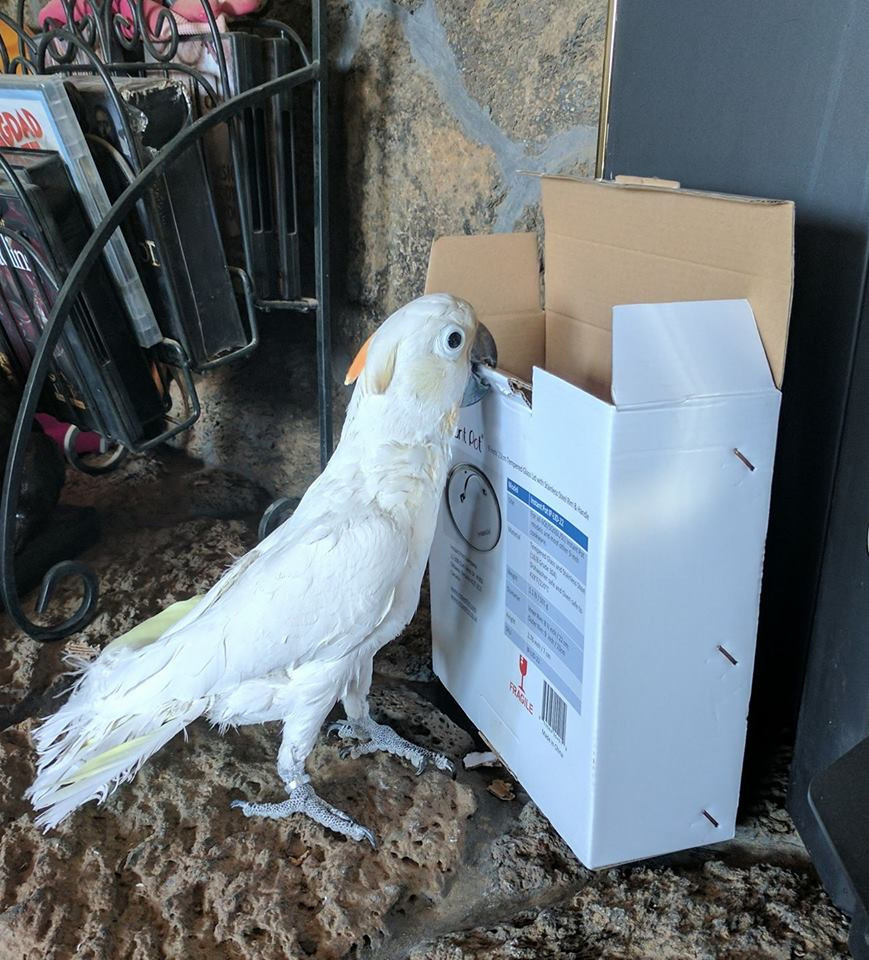
Sometimes, it’s easy for me to distract Peaches. One of his favorite toys is a cardboard box. I save the best for him and remove any tape and plastic. He’s on it!

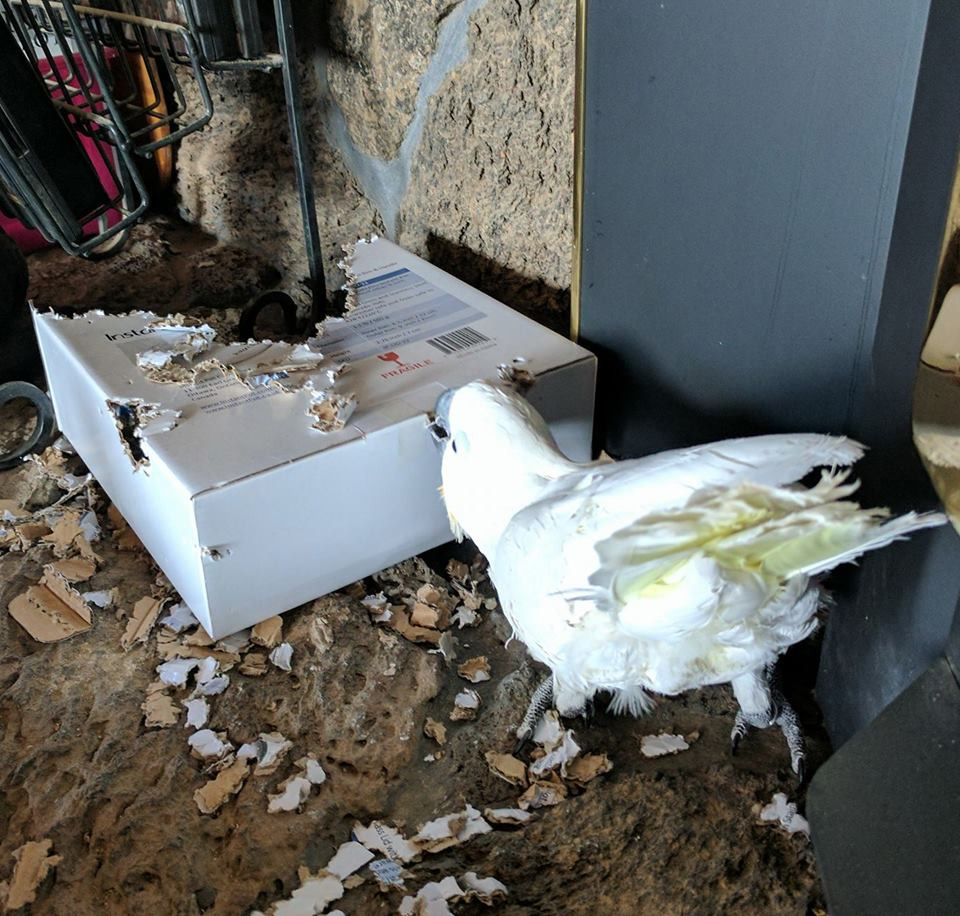
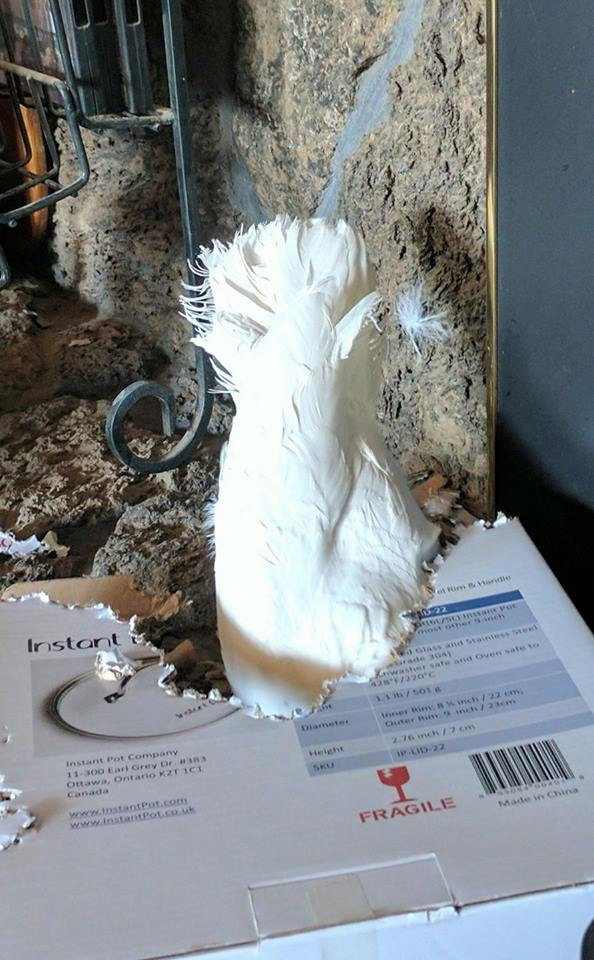
He’s totally obsessive-compulsive and works hard, breaking the cardboard into matching pieces.

I watch and imagine myself gathering those pieces into a bag to market, say on Amazon, as a 1,000 piece puzzle designed by a bird. It might work!

Ah ha!

Peaches who will turn fifteen this year is a very young Cockatoo. These birds can live for 75 years! He’s designed to destroy, with a hooked beak and an ability to focus that sometimes needs countering. During a playtime, I’ll let him carry on until he wears himself out and desires a relief of returning to his cage. If I must interrupt his playing early to re-cage him, sometimes he’s tempted by special foods.

With a chunk of omlet

He is smart, seductive, alert, and fun. He screams long warnings when he sees someone strange or unknown animals on the property; he insists on having one-on-one times with me; he offers occasional periods of hour-long nonsensical screams (woe to anyone trying to hear something on television); and his laughter, just like a human’s, always makes me laugh, too.

For Peaches, every day is sunny and full of possibilities.

My friends, Other species can teach us much about being alive and optimistic! Diana