A Modern Horatio Alger Story: HeliLadder

Tuesday, August 04, 2026

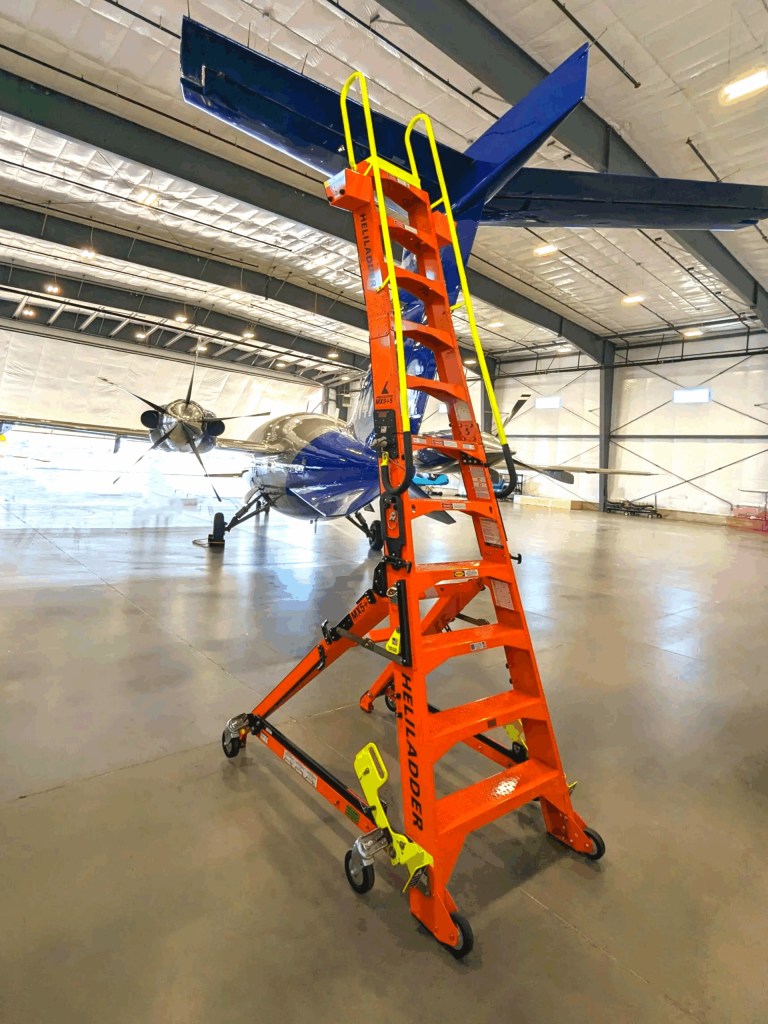
My neighbors and friends, Dale and Susie Neubauer, are often my inspiration. They operate a family business called HeliLadder, and over the years, our social chats have frequently turned to the rewards and challenges of growing a family business while continually expanding its product line.

I am naturally drawn to their story. I grew up in the years following World War II, when America felt a renewed sense of pride and optimism, casting off the shadows of the Great Depression and the war. An encouraging theme of my youth was the ideal of individualism—the pursuit of personal development, ambition, and self-reliance.

HeliLadder’s story echoes those classic ideals. In many ways, they reflect the classic Horatio Alger myth—the 19th-century author whose popular dime novels featured protagonists rising from poverty to success through hard work, determination, and integrity. Those stories helped shape a cornerstone of the American Dream, inspiring people to believe in their own potential.

I hadn’t thought about Horatio Alger in years, but observing HeliLadder brought that archetype back to mind. It’s one of the clearest real-world examples of that spirit I’ve been privileged to witness. The company began when Dale identified a specific problem, conceptualized a solution, and built a business model around it. Combining years of practical experience with self-confidence, he turned an idea into a tangible reality. HeliLadder’s success is the direct outcome of vision, craftsmanship, and steadfast family support.

For many years, Dale worked on aircraft maintenance. As a career helicopter repairman, he knew the physical demands and safety risks of the job firsthand—particularly the hazard of standing atop standard, wobbly A-frame ladders while leaning out to reach elevated rotors and components. His growing concern was not just his own balance, but the safety of the younger technicians he trained and supervised.

In 2010, Dale began tinkering in his garage to design a safer alternative. By 2011, he built his first prototype out of wood, featuring a cantilevered base engineered for stability. The design allowed technicians to stand securely and reach into the aircraft body without dangerous overextension. Dale brought these early wooden models to the airfield, testing them on the job and refining the concept based on real-world use.

To transition the product from wood to high-grade metal, Dale began collaborating with local fabrication experts. Financing these early trial-and-error efforts meant postponing his retirement and continuing his regular job while building the business on nights and weekends. Developing the ladder demanded immense grit, patience, and effort from both Dale and Susie.

Eventually, the industry took notice. Dale’s practical expertise and clear communication helped establish the product’s value, and sales began to grow. By 2018, Dale was able to fully retire from aircraft repair and focus entirely on HeliLadder. Susie was instrumental every step of the way, co-managing operations and logistics.

Shortly after I first met the Neubauers, they invited me to tour their initial rental facility. Even then, I was struck by the precision and build quality of the ladders. My untrained eye saw a beautifully balanced piece of industrial design that was purpose-built for safety and utility.

By 2025, HeliLadder had outgrown its original space. An opportunity arose to purchase a much larger, newly renovated industrial building—conveniently located directly across the street from their primary metal fabricator. I toured the facility with them when it was still just a vast, empty warehouse. Nothing about the open space fazed Dale; he strolled through with Susie and me, effortlessly pointing out where every assembly line, rack, and office would go.

I recently visited their completed facility, and the transformation is remarkable. The once-empty floor is now a fully functioning hub featuring administrative offices, dedicated assembly lines, inventory storage, and loading docks. The company has truly become a family legacy: their sons and niece now work in key roles within the business, allowing Dale to focus on sales and innovation. At the same time, Susie gradually steps back to enjoy her outside pursuits.

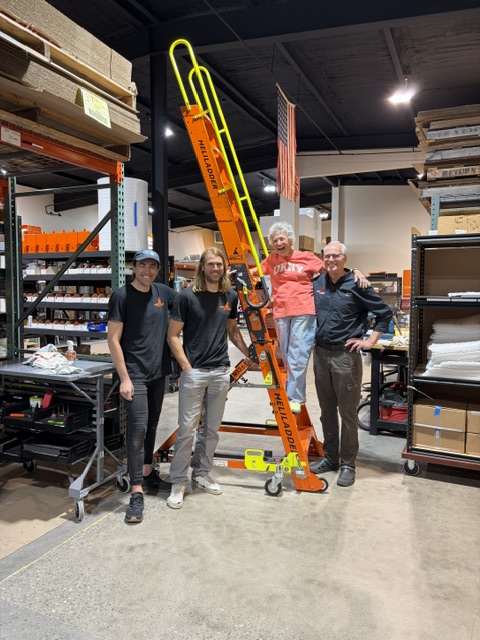
The Neubauers (Caleb, Ian, Susie, and Dale) taking a break.

I’m invited to join the scene.

In an era often dominated by rapid tech trends and social media noise, hands-on ingenuity can sometimes feel like a lost art. Seeing Dale’s practical vision come to life—backed by Susie and their family—is a refreshing reminder of what can be accomplished through persistence, skill, and clear purpose. HeliLadder is a classic, modern success story: identifying a real need, building a solution from the ground up, and seeing it through.

— Diana

Miss Merry

Merry Leggs (2010)

Thursday, February 13, 2025

Years ago, I suddenly lost my young and adorable Welsh Pony, Merry Leggs. She had been stricken by severe colic, and afterward, for weeks, I sat at a computer, fighting my incredible unhappiness by creating a story for young readers that starred a Welsh Pony.

My lead character, Miss Merry, was pretty, intelligent, and devoted to her family. She was courageous, too, and had many adventures. After initially drafting the story, I continued working on it; gradually, it felt reasonably compelling and maybe worthy of publishing.

A couple of drafting components didn’t go smoothly. Most critically, I couldn’t successfully edit my own creative writing. Upon attempting to make a sentence or paragraph more relevant and stronger, I’d find myself, instead, rewriting whole sections, altering the story’s flow.

My inability to self-edit demanded an outside objective editor, and Merry’s story increasingly called for an illustrator. Talented assistants weren’t available for what I could afford: $-Zero. Little Miss Merry eventually floated into the background and drifted from my active memory. I suppose that happened after I overcame my pony loss enough to move on.

Until yesterday, when a bright young colleague, Lily (who recently introduced me to Chat GPT+), suddenly asked if I’ve ever written fiction, I nodded and complained about self-editing until Lily pointed out Chat’s editing capabilities.

Later, I was thinking about Chat’s abilities and suddenly remembered “Miss Merry.” It needed editing and illustration—both are Chat’s capabilities. Additionally, Lily, a makeup specialist, has artistic skills and expresses interest in perhaps working with the story.

Gosh! A dozen years later, “Miss Merry” might be reborn. First, I must locate the saved story—probably on a disc or a thumb drive. Finding its location is one head-scratcher, and accessing a complete version may be another.

I’ll be off my part-time job today and looking for Merry.

Dear Friends: Revisiting my sweet pony vis-a-vis her alter ego–thrilling! Diana

Double Holiday

Sandra Boynton’s art, from her PB posting

Thursday, December 26, 2024

I don’t know why my brain failed to salute Hanukkah yesterday. Its first day this year was on Christmas Day. I was aware of and tuned into that, but only now offering, “Happy Hanukkah!” I’m letting Sandra Boynton’s art speak more for me.

Sandra speaks through multi-talent channels. Here’s a link to her boogie-woogie style video, with Zooey Deschanel, backed by terrific instrumentalists, singing Boynton’s retro toe-tapper, “I Just Want to Dance With Santa Claus.” https://www.facebook.com/sandraboynton/videos/1327490604947470

As I should have yesterday, today I salute two important holidays. (Thanks to my friend Rachelle for catching my oversight.)

A welcome thing happened yesterday. The ex-manager of the department store where I work part-time, and whom I appreciate and admire, sent me greetings from Colorado, where she manages another of the chain’s stores. She’s talented, kind, and fun, and ahead has a great career. Her message is a Christmas gift that puts us in touch again.

Yesterday was a quiet one at my house. I boinged-out on homemade whole wheat bread while watching sewing videos, to learn how to shorten a jacket’s lined sleeves. That’s a new reach for me–one I had never imagined tackling. This is happening because I fell in love with a corduroy jacket–in the Men’s Department! The jacket is a youth cut but too big, especially the sleeves. I’m gonna fix them!

That evening, I lit a candle for Hanukkah and reflected on my loved ones, distant or deceased.

Dear Friends: However you celebrated, I hope your yesterday was lovely. Diana

Happenings

Friday, September 20, 2024

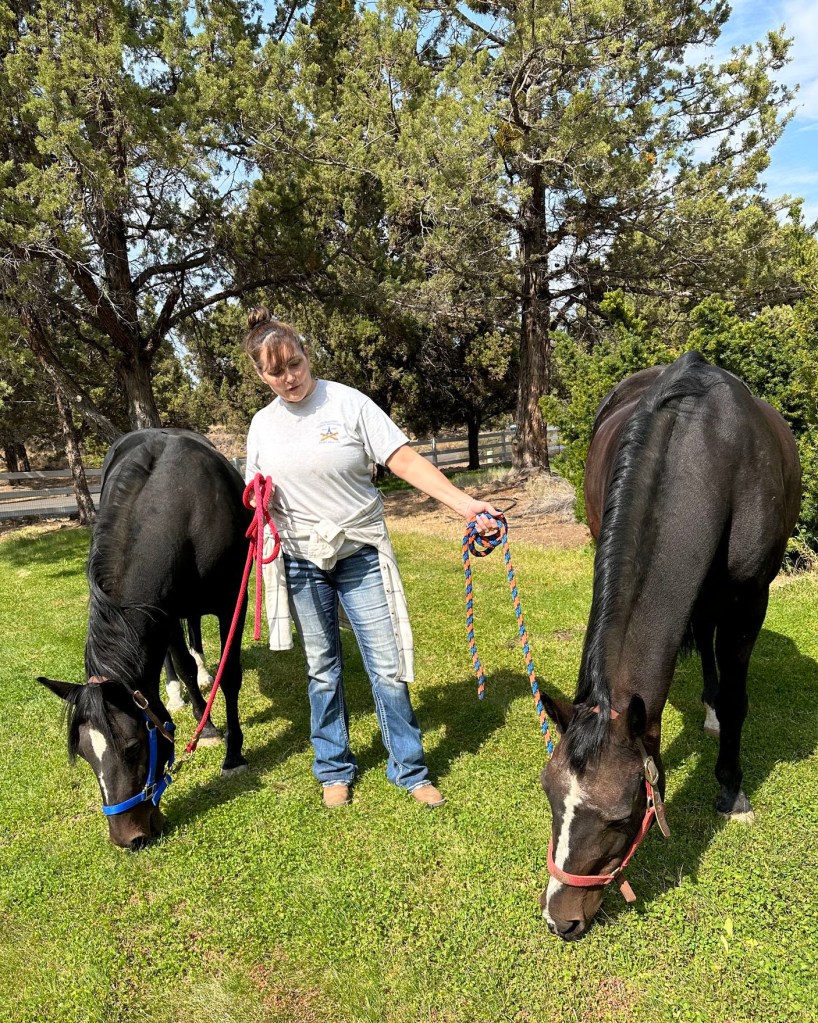
The header shows my co-worker and friend, Angie, holding my horses, Sunni and Rosie. After we took photos on my property, we drifted toward my neighbor’s pretty “golf course” lawn. The horses immediately went grass-crazy, and Angie held the lead ropes tightly.

She was at my place for a photoshoot. Angie is an experienced photographer. She has opinions and imagines what she wants to capture. She asked me to wear “sparkly boots” and an attention-grabbing shirt (that big Rosie kept sneezing on). She wanted in the pictures both my horses and donkey. On finishing our shoot, she anticipated a big editing job.

I appreciated Angie’s quick eye and camera savvy. To my surprise, she’s an experienced horseperson; she grew up riding busy Arabians. Yesterday, she fell in love with my calm, easy-to-handle horses. We will go horseback riding together.

I will travel to Sunriver today for lunch with several long-time friends. For years, long ago, we all met weekly to discuss our health, medicines, doctors, and “general doings.” We were in a long-running cancer survivor group that weekly drew 10 to 20 participants; it connected us family-like. Several years ago, I drifted away and stayed loosely in touch.

Earlier this week, a member of that cancer group was out shopping, and she spotted me in Jewelry. We immediately renewed a mutual closeness, and she invited me to join her and others from the group who planned to meet for lunch. Today is when that lunch will happen, and I’ll be there. It’s an exciting opportunity to reconnect with old friends.

Dear Friends: There could be a “more social me” peeking from deep inside. Diana

Agatha

Tuesday, July 09, 2024

High heat remains the topic locally. Today, I’ll return to work after a couple of days off. Guess what: I’m looking forward to being there. With very hot sunshine covering this area, hanging around the house is too warm. So is hanging around outside, with sunshine heating metal garbage can lids, making them too hot for bare hands.

High temperatures forced me to spend most of yesterday draped in an easy chair, facing a high-blowing fan. I had the self-assignment of focusing on Agatha Christie’s first published mystery novel, And Then There Were None. It’s a suitable read when weather conditions discourage concentrating.

I previously read just one of Christie’s books, and that was many years ago, back when I was a big admirer of Charlotte Bronte. In UCLA’s Library, I discovered and loved a book by Christie; no, not a mystery, but a brilliant exploration of Bronte’s life and talent. I noted Christie’s fine writing skills and appreciated her sensitivity and insightfulness toward Bronte.

I never was much interested in mystery stories, but then decided to someday read at least some of Christie’s fiction. This current story, And Then There Were None, became her first published novel. Reading it reminds me of her sparse and clean writing style. To progress the story, she disravels details carefully, one by one. She had to have planned, step-by-step, the mystery’s development and flow of events.

Experience is a great teacher, and I anticipate her following stories (some now waiting on my reading table) to be better designed with more gripping plots. If I weren’t expecting that to be, another great teacher, History, would help me “get it.”

Here’s why: Agatha Christe (1890-1976) wrote 66 detective novels and 14 short story collections; research ranks her the bestselling author in history, reporting that only the Bible and Shakespeare have outsold her works.

I have learned that small everyday events and casual observations could become Christie’s ideas for new plots. She wove glimpses of life and her quick ideas into novels from endless notes in dozens of handwritten notebooks. She saw in her jotted erratic ideas potential plots and characters.

She reportedly dictated her initial drafts into a Dictaphone, leaving the typing to an assistant. She would then meticulously revise the typed manuscripts by hand and re-dictate the pages. To gauge audience reactions, Christie read chapters aloud to her family during dinnertimes. Her stories quickly moved from scribbled notes to finished products.

Dear Friends: I’m in awe, and will continue reading Christie and keeping you posted. Diana

Unequal

Saturday, March 02, 2024

This is Women’s History Month, and that’s cool. Last night, a PBS piece reopened my memories by covering early and evolving passenger aircraft technology, and the airline passenger business. Particularly, the then new role of Airline Stewardess. Some of my friends became early stewardesses and were envied. They routinely flew to exotic places, met and dated handsome pilots, and often married and moved into new life phases. Those were ladies who accomplished what little girls were programmed to do.

That PBS piece reveals a nasty back story to the enviable stewardess role, in a time when most airline passengers were men. The ladies’ work was to ensure men’s comfort. A stewardess’s training for her role was demanding, and it was abusive. She had to perform her stewardess work perfectly, and also, had always to appear beautiful. She had to be slender and physically fit, well-coiffed and perfectly dressed, always wearing specific makeup, and also well-mannered. Oh yes, she couldn’t be married; a stewardess had to be single.

There was more stress because upon turning 32 years old, a stewardess was considered too old for the role. Airlines pushed every birthday girl out of her job. Some of the early stewardesses were college graduates and felt abused. And some stewardesses were secretly married. The formally educated ladies, and those married to attorneys, began learning about unions. They openly started to question the airlines’ goals and personnel management. The work of those bold stewardesses initiated critical changes in the industry.

I’d go on, but you get it, and the story is easy to stream on PBS. What makes it more fascinating, is that the Stewardess history parallels more changes, beginning in the sixties, that altered women’s roles. Not enough, however, because America still lacks an Equal Rights Amendment.

Dear Friends: March’s videos will remind us of more history and revive our memories. Diana