
Wednesday, September 16, 2027
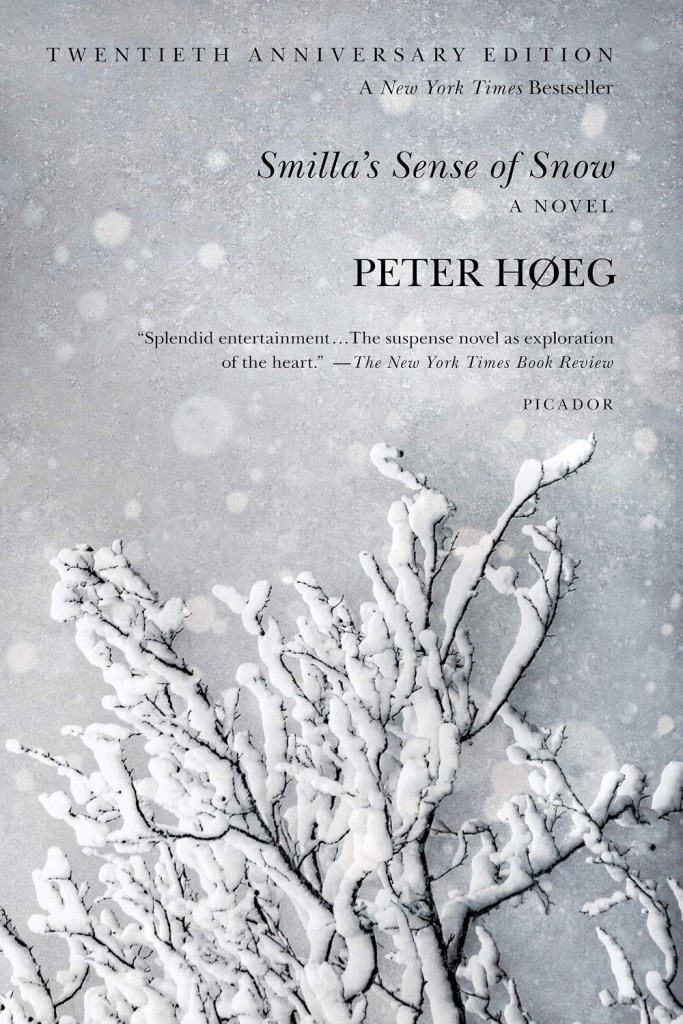
Several weeks ago, I remembered an older favorite book: Peter Høeg’s 1992 novel, Smilla’s Sense of Snow. It’s still widely regarded as an exceptional, genre-bending psychological thriller. The book centers on Smilla Jaspersen, a 37-year-old glaciologist living in Copenhagen. Smilla’s identity comes from two very different worlds, and each shapes her view, making her see her surroundings through a stark lens of light, shadow, and ice.
I read the book years ago, but its atmosphere and Smilla herself never quite left me. Thinking now about her and the plot made me want to rediscover the narrative pieces and understand how they fit together. So, I downloaded a copy and dove back in.
It’s ostensibly a crime novel, but unlike conventional mysteries, nothing in this one is simple. Høeg builds the setting through shades of behavior rather than clever dialogue.
The story opens at the funeral of Smilla’s neighbor—a neglected six-year-old Inuit boy who may have been her only real friend. Authorities have ruled his fatal fall from a snowy rooftop an accident, but Smilla senses that event differently. After the funeral, as she examines his footprints in the snow, her deep, specialized understanding of ice tells her he was running from someone. He was murdered.
Smilla, guided by her senses and logic, sets out to uncover the truth in a process that draws the reader into a web of cultural tension and corporate conspiracy. At the same time, we learn how strongly Smilla’s dual heritage shapes her perspective. Her late mother, an indigenous Greenlandic hunter, was almost primitive and very deeply attuned to the Arctic landscape. At the same time, her estranged father is a wealthy, straight-spined, clinical Danish physician who lives in Copenhagen.
Smilla embodies both sides of that cultural divide. She pairs her scientific rigor with an instinctual, almost sensory connection to the natural world. Her choice of Glaciology is more than a career—it’s a lens through which she deciphers human characteristics. In the story, she’s sometimes prickly and remote, but her sharp observations and quiet grief make her someone readers root for.
Even early in this renewed beginning, I’m finding Smilla’s Sense of Snow as immersive and sensory; it’s still a unique reading experience. I can feel the bite of the subzero air, “see” the subtle textures of sea ice, and gain insight into Denmark’s complex colonial history with Greenland.
Even decades after its debut, Høeg’s chilly, poetic masterpiece lingers with me long after its final page. And I’m diving back into that fascinating mystery.
Diana

