What Friends Are

Friday, May 29, 2026

I had another birthday this week. I’d prefer to forget that this is my 86th year, but so it is. Longtime friends reminded me all week with cards and phone calls. On the actual day, Eva and I met for lunch and discussed activities and issues in our lives.

And then, there were Susie and Dale. Just when I’m not caring much about celebrating another year, Susie steps in.

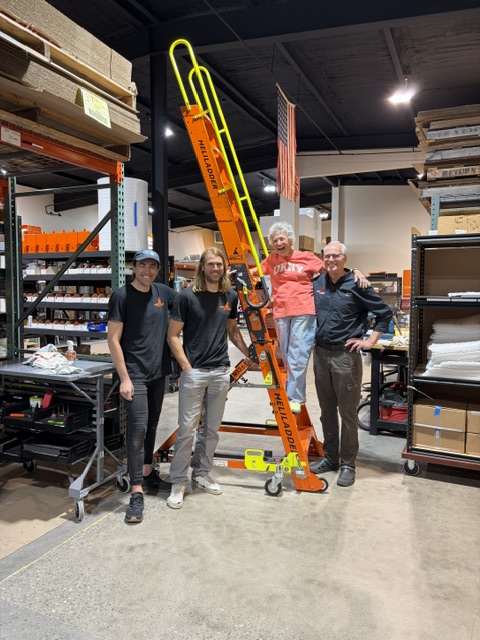
She’s big on relationships, big on caring, and big on birthdays. So is Dale, who stays busy managing his business — his brainchild and creation — HeliLadder. Which, by the way, now occupies a building of its own in this city’s key industrial district. (More about HeliLadder later, in an upcoming blog, as I’ll soon visit to see its new digs for myself.) But, for now, I digress.

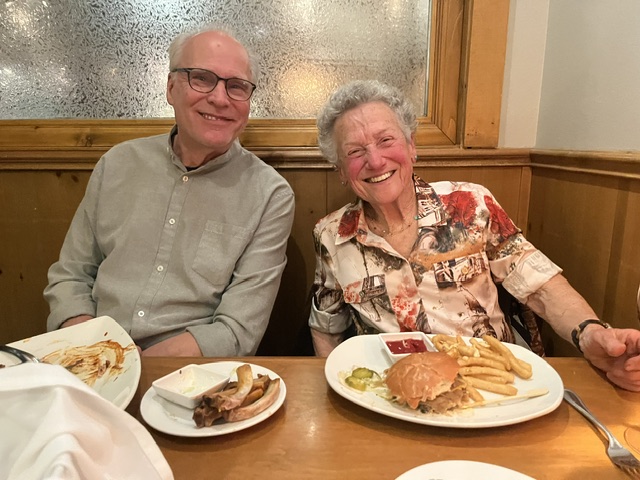
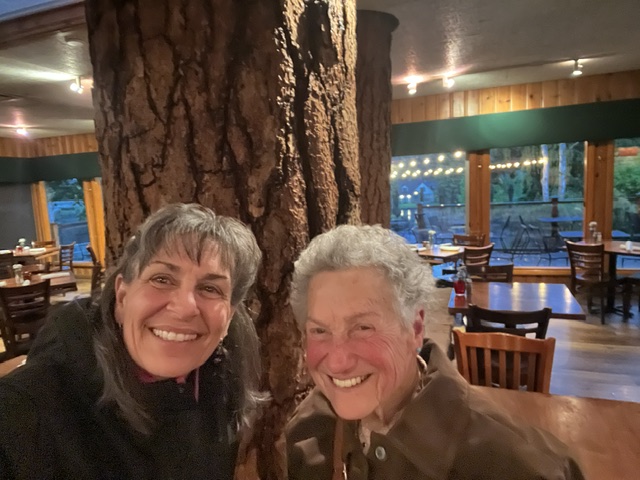
Yesterday evening, on a very rainy day, Dale and Susie hosted a birthday dinner for me. We went to the Pine Tavern, this city’s oldest restaurant — a delightful place — where Dale had ribs while Susie and I dove into gigantic hamburgers, a rare treat for this “casual vegan.” Afterward, we took our desserts back to Dale and Susie’s, where we lingered and talked late into the evening.

I’ve reached a time in life when relationships matter more and more. I’ve never been especially skilled at handling meaningful relationships, for complex reasons, though I’ve forgiven myself for that. I filled many years of my life with beloved pets and, later, horses, which always kept me busy and physically strong. While I’m generally content with the life I’ve chosen, it feels like a mitzvah to have met Susie and Dale — people with whom, over time, I’ve become comfortable and can freely “be me.”

So Susie made certain they shared my birthday. And, in a rare experience for me, they asked for details about my background and listened — without judgment — to my complicated story.

Their kindness has helped me better understand what it means to be a friend. Friends “are there,” unafraid of getting involved, supportive of others’ choices, yet willing to push back, ask questions, and perhaps influence a decision-making process. But whatever decision ultimately prevails, they remain — listening, encouraging, and supporting.

For someone who has always been careful about relationships, they are among “the best” for where I am in life now. They help keep me anchored to occasions, events, and sometimes delights. Speaking of which, Susie and I plan to head east next Sunday night “to chase” the rising Blue Moon.

Punctuating a mature Ponderosa inside Pine Tavern’s Main Dining Room

The best part of my special day was simply this: people who genuinely care “were/are there,” even while busy with lives of their own.

— Diana

Bend’s New Library – Revisited

Tuesday, May 26, 2026

I was excited on my first visit to this brand-new building not long ago, but I became disappointed when I found it wasn’t the kind of “real library” I was accustomed to. A day or two later, I reflected on how the structure is actually meant to be used. Certainly, it will be a popular meeting place — and already is — with its huge, nearly always full parking lot. Still, it wasn’t like the libraries I understood and had known. I left the building with a sense of loss.

Now I see things differently. At first, I was deeply wrapped up in myself and wanting what I expected. Later, my outlook began to recover as I reflected on the larger picture — the social changes that influenced the library’s design and purpose.

I was flummoxed to discover that the building primarily serves as a community gathering space. Although books on display hint at a traditional library, with well-arranged shelves holding the newest and cleanest volumes, they don’t fully counter the sense that the building functions mainly as a hub. Cardholders can go online, search for and reserve desired items, then simply pick them up. A dedicated drive-through even facilitates quick pickup and return of library materials.

Yes, social media and AI have changed our relationship with libraries. Online access makes things easier and reduces the physical need to wander through stacks or seek assistance from librarians. Libraries are adapting by becoming less centered on book browsing and more focused on serving as multi-purpose community spaces.

That realization had me reflecting on my part-time job as a department store cashier. During breaks, coworkers rarely talk with one another. Instead, we stare at our phones — and, personally, I usually prefer not to be interrupted by someone wanting to chat. Not only at work, but also out on city streets, people are absorbed in their phones.

Yet while I check out customers, many seem delighted to share parts of their lives with me — stories about their backgrounds, travels, pets, and adventures. Some even say they’ve appreciated our brief exchanges, and occasionally someone jots down a phone number and suggests I get in touch.

Those brief getting-to-know-you moments are enjoyable, but somehow they feel sufficient in themselves. I don’t follow up. Still, I sometimes think I might enjoy knowing some of those people better, as many clearly have unique backgrounds, interests, and accomplishments. And if we happened to meet in a non-work social setting — perhaps in that new library building — getting to know one another more deeply might seem more natural and appropriate.

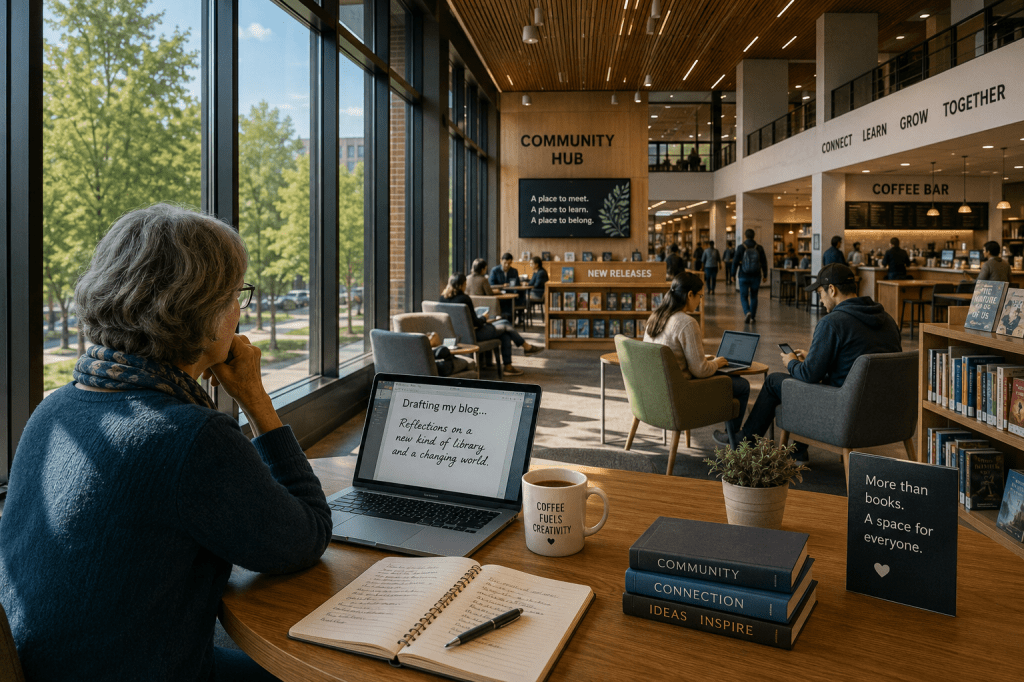
On this second visit, I’m not searching for books. I’m simply enjoying time in an enabling space while drafting this blog. No pressure, no disappointment. I’m sitting beside a large window, feeling creative — and communicative — while occasionally accessing social media myself. Nearby, other visitors are taking similar advantage of the space, working on studies or staring into laptops and cell phones.

This library — designed for meetings and work as much as for books — serves as an alternative to the popular coffeehouse. One can leave home with a laptop and come here to sit, think, and spend time among others in a non-demanding social environment. And there’s even a handy coffee bar.

I’m giving this new library building a great deal of slack. A modern community needs people-friendly spaces — and certainly more spaces like this one.

— Diana

Bend’s New Library

Saturday, May 16, 2026

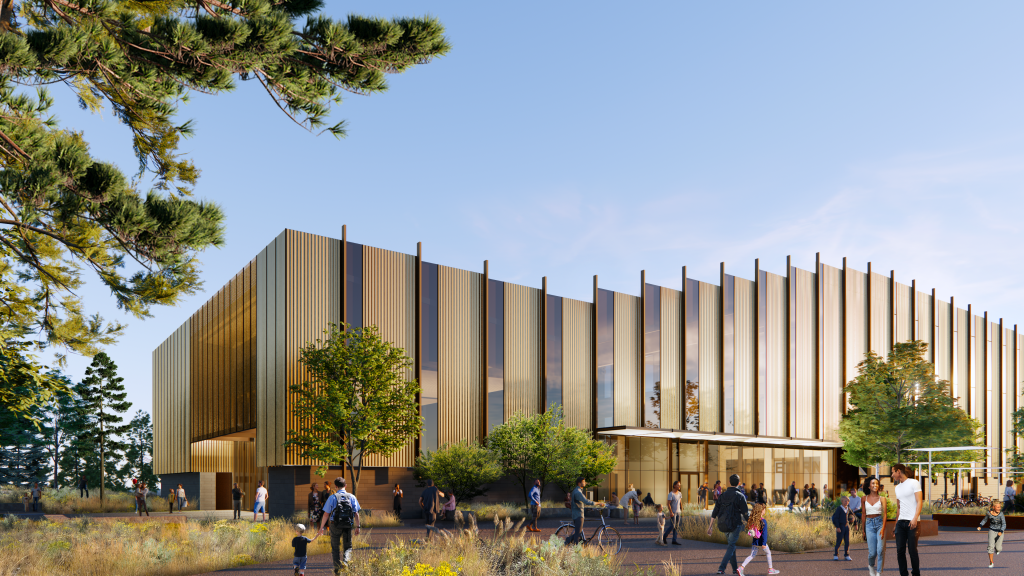
Yesterday, I sat in a “creative cubbyhole” beside a large window with my laptop in our new main library. It opened earlier this week, and inside it is beautiful—spacious, light-filled, modern, and carefully designed. Yet, surprisingly, as I looked around, I found myself missing this city’s old, now-closed main library. That crowded old place felt less curated and more discoverable.

Almost as soon as I entered the building, I began comparing what I saw to the old library’s stacks, which had always seemed endless. I recalled the faint dust-and-paper smell of well-used books and remembered running my index finger along crowded spines—often stumbling upon a surprise: a long-forgotten title, a long-unread author, or an unusual and compelling subject.

Central Oregon is full of readers. We’ve all been curious about this ambitious building, watching it rise and eagerly awaiting its opening. All week, visitors have filled the library, circulating among its attractively displayed shelves. But to me, the shelves feel too tidy, almost merchandised. Shiny book covers face outward in displays that seem heavily edited—perhaps too intentionally curated. Titles are visible, but authors’ names are partly obscured by catalog stickers.

Those displays push the curating system itself into the foreground, suggesting that organization matters more than browsing. I was surrounded by clear, clean order that somehow didn’t feel intimate. I assumed any book I wanted would be available and easily accessible, yet something essential felt absent.

While sitting there yesterday near the large window, I noticed the blinds lowering automatically in response to the changing light outside. I would call the library beautiful in the way airports and modern museums are beautiful: open, bright, efficient, and almost impossible to criticize directly.

The building even includes a first-floor coffee bar. One can order a designer coffee, settle beside a window to work or study, or simply linger over a latte. The interior design encourages community and socialization—a kind of environment I usually enjoy—but it is not quite my idea of a real library.

I found myself reflecting on the libraries of my childhood, my young adulthood, and my more recent past, remembering their narrow aisles and accidental discoveries. What returned most strongly was the feeling of books aging together in those old spaces. There, books were encountered almost physically: by touch, by proximity, by scent. In this modern setting, the books feel staged. There is more emphasis on display than discovery.

Old libraries invited wandering, browsing, and sampling. This new facility is designed for ease of navigation. Perhaps this very modern library optimizes access to materials. But a better building does not necessarily feel like a better library.

Essentially, it functions as a hub. Someone seeking a book, movie, or other item from the library’s non-visible holdings goes online, searches the catalog, and reserves the desired materials. The items are then picked up and returned at the building.

And yet, it is undeniably seductive. Imagine a Starbucks on steroids. Someone—maybe me—can walk in with a laptop, order a latte with an extra shot of espresso, settle beside a large window, think, create, and perhaps even meet new friends.

Diana

My Return to The Physical World

Saturday. February 21, 2026

Surprised & Delighted—By Rediscovering Geography

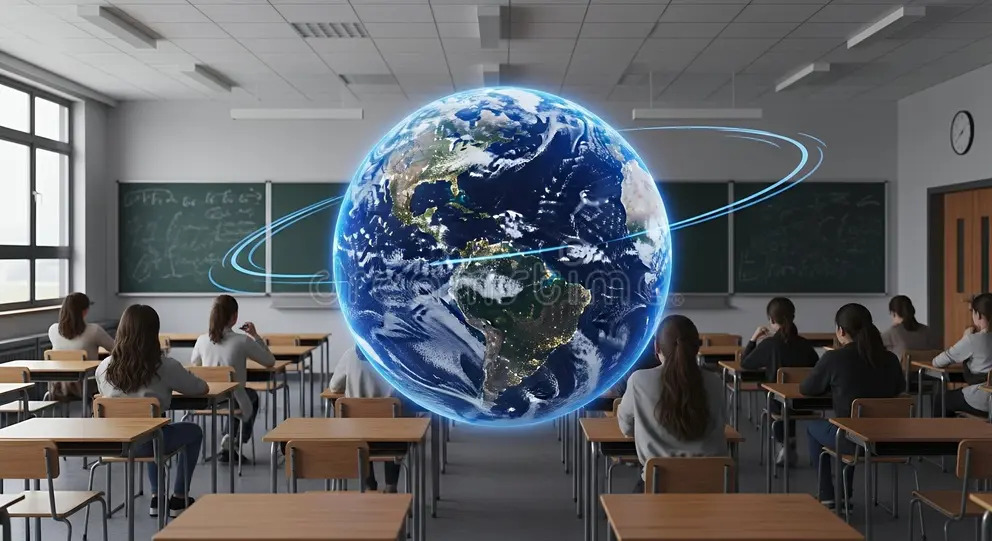
Studying geography is deepening my understanding of world politics by revealing the physical realities that sit beneath international relations. I’ve found that while historical events and charismatic leaders capture our attention, it is the unchanging—or very slowly changing—physical conditions of the Earth that constantly factor into major decisions.

I’m enjoying relearning what I first encountered in grade school. Re-experiencing why a mountain range or a deep-water port clarifies a news story makes my understanding of the world feel more grounded and, importantly, more real.

My most impactful readings so far are Zbigniew Brzeziński’s The Grand Chessboard (1997) and Hal Brands’ The Eurasian Century (2025). Brzeziński sets the geopolitical stage of the 90s, while Brands carries that vision into today’s world. My long-ignored world globe, now dusted off, constantly clarifies texts.

A stack of similarly intelligent books awaits me, and the more I learn, the more I want to share this widened lens.

Why Geography Disappeared

If you are rediscovering geography and are surprised by its relevance, it isn’t because the world changed—it’s our way of seeing it.

Many of us left geography behind in the fifth grade, filed away with pull-down maps and memorized capitals. As curricula shifted toward civics, ideology, and economics, geography faded. Later, the rise of 24-hour streaming news further sidelined our loss by favoring vivid, emotional storytelling over the slow-moving realities of terrain and distance.

Maps vs. Movements

Modern news often favors people over places—focusing on leadership personalities, voter blocs, and moral claims. These stories are intended to capture attention quickly, but they often lack depth.

I have found a few political storytellers who work differently. They explain events by first studying an area’s strategic position, climate, and access. Because geographical conditions move slowly, understanding them requires a level of patience that modern news rhythms rarely allow. We’ve been trained to think of politics through the lens of belief—who is “right” or “wrong”—while the physical world is treated as mere background scenery.

But geography is more than scenery; it’s an active, ongoing force.

The Comfort of Narrative

Geography introduces stubborn realities that can be uncomfortable. Conflicts are often simpler to frame as “bad leaders vs. good values.” That provides senses of clarity and emotional satisfaction.

By contrast, geography focuses on chokepoints, climate, and resource scarcity—complex factors that don’t yield to elections or diplomacy. This reality can feel unsettling because it challenges the comforting notion that history will naturally bend toward a peaceful resolution. It reminds us that persistent conflicts often stem from the Earth’s physical constraints and human struggles to sustain growing populations.

Geography is Returning

Globalization once promised a world where ideas and goods would move seamlessly across borders. But recent years have taught us otherwise. We’ve seen supply chains fracture and energy sources remain unevenly distributed. Technology can compress time, but so far, it cannot eliminate distance.

We are relearning under pressure what earlier generations understood almost intuitively: that ports, islands, and frozen corridors matter. The Earth has unarguable physical conditions, and we are simply the humans debating within them.

Reading the World Again

Returning to geography doesn’t replace my moral concerns; it adds depth to them. I’m slowing down, examining world maps, and asking:

  • Where exactly is this happening?
  • What physical constraints are shaping these choices?
  • Does this mapped position produce courage—or fear?

These questions offset the frustration caused by incomplete news stories. Geography doesn’t belong solely in a child’s classroom; it is a vital lens for refining our understanding of power, conflict, and human behavior. It isn’t a nostalgic return to the past—it is a way to finally see the world we actually live in.

Diana

What The Ground Explains

Saturday, February 07, 2026

I watch politics closely—elections, speeches, conflicts, public arguments. What nations and business leaders say, how they perform, what promises they make, and whether their promises suggest moralities. I hope for straightforward explanations, yet usually feel unsatisfied.

Lately, I’m adjusting how I watch, trying to make new headway. This shift began with something unexpectedly familiar from my grade-school years. I recently read several articles by a respected geography professor, reminding us that geography is a critical factor in nearly everything happening politically. That reminder started filling gaps, making sense of confusion, and changing how I interpret political reporting.

For years, I’ve focused on political performances—rhetoric, personalities, alliances. Now, I’m including geographic realities, and many maneuvers that once felt irrational have started making sense.

I hadn’t thought about geography since elementary school. Those old fifth- and sixth-grade maps had faded long ago. But now, re-educating myself, I’m discovering much that I once memorized without enough understanding, that geography is essential to understanding nearly everything in our near and larger worlds.

Contemporary political reporting rarely gives geography enough due. Yet, geography is all about hard-nosed realities—the earth’s shapes and limits. Mountains block. Rivers guide. Ports matter. Climate dictates what will grow, where people will settle, and how societies endure stress. These shapes and conditions are like energies—moving along known routes that are difficult—often impossible—to reroute. Many borders established long before modern politics simply are, and those substantially influence national choices and behaviors.

Geographic awareness clarifies much of what’s confusing about world politics. Map shapes underlie recurring patterns of wanting, choosing, and leading. Terrain, resources, and location create real constraints, making some desired changes unattainable, no matter how compelling the argument.

Politicians argue intentions. But there’s ground beneath those arguments that dictates—and limits—ambitions. Modern pressures intensifying physical constraints are growing populations, greater social awareness, and tighter margins. Political values and alliances ultimately hinge on coastlines, chokepoints, arable land, and distance.

Geography can seem humbling, perhaps overwhelmed by modern social needs. But contemporary demands still operate within physical boundaries established by ancient populations.

I’m relearning what I once memorized while too uninformed to understand enough. My refreshed geographic awareness doesn’t shout—it simply persists. And shaped by forces that ensure, it’s helping politics feel less like exhausting theater.

For readers who prefer receiving these morning pieces by email, I’m also publishing them on Substack.

Diana

Allowing Journalism To Think

Sunday, January 25, 2026

I’m regularly reading a non-newspaper publication. I follow very few magazines, but these days I always check what’s current in The Atlantic. And I don’t skim its headlines or dip into a single article—I actually read its essays.

The magazine has a tone that feels educated—a better word might be oriented. Its editor in chief, Jeffrey Goldberg, strikes me as intelligent and impressive. He hosts the television roundtable Washington Week in Review, which thoughtfully models observation and discussion without performative outrage. I now try to catch every episode.

I follow a couple of other favorite magazines: The Economist and Foreign Affairs. Both publish serious essays by informed observers and skilled writers.

But The Atlantic, for months, has puzzled me. The magazine has been around for generations. In fact, I read it long ago, then stopped at some point and forgot about it entirely. Several months ago, I picked up an issue someone had left on a table, and was struck by how good it was. Since then, it’s become a favorite again—making me wonder what has changed.

Why did The Atlantic reappear for me? What made me suddenly recognize—again—its excellent writing, capable thinkers, and fine essayists? I might credit taste, talent, and luck. But no dice, because that familiar trio doesn’t explain the continuous, high-quality output I’m seeing.

My questioning has pushed me into social history. It teaches that good writing has always required more than taste, talent, and luck. It has needed patrons. History tells that serious journalism has required both a point of view and money—the two forces that make steadiness, thoughtfulness, and complexity possible.

In earlier eras, aristocrats, universities, and churches underwrote serious thinkers and artists. Today, there are fewer patrons of independence and seriousness. My research—and my renewed relationship with The Atlantic—suggest that point-of-view and money still matter. And today, perhaps, they matter more than ever.

Most contemporary media organizations seem to be running on fumes. They’re dependent on algorithms, advertisers, and relentless speed. Adding political expediency to the mix—consider The Washington Post’s recent loss of subscribers—makes media independence look increasingly fragile.

The Atlantic doesn’t shout or pretend. It’s a magazine that thinks—and thinking costs money. So, I looked for a story behind its resurgence. And, I found it.

In 2017, Laurene Powell Jobs became The Atlantic’s majority owner and fundamentally changed the magazine’s prospects. Jobs did not impose an ideology. Instead, she provided patience and capital. She didn’t demand instant returns, viral hits, or ideological obedience. Her money began funding quality rather than control.

That kind of backing allows writers and editors time—to follow ideas into uncertain or uncomfortable places—and also trusts readers to stay with the writers. Trusting works both ways. Trusting the magazine’s writers has drawn me into The Atlantic’s podcasts and videos as well.

It’s been many years since I felt attached to magazines. Once, there were several that spoke with original voices, and I loved them. Some that still exist feel to me like shadowy reflections of their former selves.

Those of us who love good journalism want to believe it can survive on virtue alone. But that’s unrealistic. Serious work that endures means someone, somewhere, has made a bold, fearless decision that it’s worth protecting.

The Atlantic didn’t become compelling again simply because “it got good.” What keeps its articles relevant, thoughtful, well written, well edited—and alive—is that someone is allowing fine journalism to happen.

For readers who prefer receiving these morning pieces by email, I’m also publishing them on Substack.

Diana

Goals In 2026

Saturday, December 27, 2025

I usually fail at traditional goal-setting. Not because I lack interests—quite the opposite—it’s because I can’t seem to choose just one direction.

Goal setting has always felt artificial to me. I try, but my beginnings drift toward their endings quickly. Time has taught me that my mind works best when I am noticing, listening, and following threads. My lists of desired outcomes tend to harden too quickly into expectations—and expectations often drain my energy rather than organize it.

So in setting goals for 2026, I’m applying personal insights gained over many years. Instead of declaring ambitions, I’m taking another approach: naming practices—ways of living that support curiosity without turning it into a series of obligations.

These are my plans for the new year.

I will take steps to learn basic Spanish, gently—mostly by listening. There will be no fluency deadline and no pressure to perform. I’ll choose programs that allow me to hear the language without strain and give me enough time to absorb vocabulary naturally.

I will keep writing my blog, but with clearer boundaries. I want to practice blogging from multiple perspectives rather than maintaining a single voice that tries to cover everything. A friend has suggested that I experiment with Substack, and I may—using a time-limited trial. Clarity matters more to me than reach.

I will work more with my camera and focus on small, coherent projects—one subject at a time. I won’t try to build a portfolio. What I want is to learn how to see more carefully.

I will do physical core exercises daily for 10 or 15 minutes. My focus will be continuity, not intensity.

Retail work will remain part of my life—not as identity, but as social engagement. I’ve learned that being among people matters, even when the work itself is ordinary.

Property care will continue, emphasizing seasonal, more realistic goals. One improvement per season is enough. I will aim for stewardship, not perfection.

I will finish a back-shelf creative project—Little Miss Merry—which has stayed with me. Finish it this year. Not expand it. Finish it.

I will invest in the stock market by employing a simple strategy: I’ll remain calm. And continue learning how to evaluate possibilities more clearly, stay steady, and avoid reactive moves.

I intend to strengthen my “mental core” by making regular room for intellectual experimentation—reading, listening, thinking—and release any feelings that I must carry everything forward. I will be an interested visitor, not a collector.

Finally, I’m adopting a simple rule to keep my 2026 plans viable:
If a goal or intention begins to demand urgency—something that must be proven, measured, or justified—it’s likely unaligned with how I want to live now.

None of that’s a retreat.
It’s refinement.

Diana

Unique Voices

Wednesday (Christmas Eve), December 14, 1015

I’m delighted to find myself right around Christmas—perhaps the most musical time of the year—thinking about music again and wanting to write about it.

My recent music-related posts have been about listening, particularly to performers with unmistakable presence and unique delivery styles. Their voices cannot be replicated, which leads to questions worth considering.

Why do some voices resist imitation completely? Why do certain singers and musicians remain instantly recognizable, even though there have been generations of covers, tributes, and technical study?

We often say a voice is “one of a kind.” That’s rather vague—almost sentimental. Actually, it’s because listening itself is remarkably precise. We hear a single note and recognize the artist immediately—before melody, before lyric, before context. We know who it is almost at once.

That recognition doesn’t come just from technique. We know that vocal ranges can be matched. Timbres approximated. Phrasing analyzed and rehearsed. And yet, we hear some artists as possessing something essential that never transfers.

There have been countless tributes to Ella Fitzgerald, Nina Simone, Janis Joplin, and Amy Winehouse. Many are impressive; some are genuinely beautiful. But they don’t feel complete. The outer shape may be there, but the interior weight is missing.

It seems logical, then, that a singular voice isn’t built from sound alone. It’s built from a life—and a particular life is audible, in timing, pressure, and its collision with the world.

Louis Armstrong could not have sounded as he did had he been born into comfort. Nina Simone’s music cannot be separated from her intelligence, her anger, her discipline, or her refusal to soften herself. Janis Joplin’s voice—carrying both defiance and hunger—is inseparable from the era that shaped her and constrained her. Amy Winehouse sang with an emotional directness that felt almost too exposed in a culture that practices concealment. Peggy Lee, writing deeply emotional songs, sang in a soft voice, creating impact not through force but through rhythmic shifts and carefully placed pauses.

Imitating artists cannot replicate another’s suffering—or the precise way an individual metabolizes experience prior to releasing it as sound.

And releases aren’t always tidy. Singular voices may include strain, cracks, or unevenness. They often ignore rules of prettiness or balance. In fact, polish can become the enemy of recognizability. Too much smoothing erases the friction that makes a voice distinct.

Many technically perfect performances leave us untouched because they arrive fully resolved—closed, complete, leaving no space for a listener to enter. I’m always wanting to feel a connection, sensing a presence that’s still unfolding.

Unrepeatable voices leave room and feel porous. They allow us to sense the human being “inside the sound”—the one thinking, remembering, insisting, sometimes even breaking.

Social timing matters, too, because certain voices emerge when the world is ready—or perhaps not ready—for them. They arrive as tensions that matter to listeners. A voice shaped in opposition, one that defies erasure, carries an urgency that cannot be rehearsed into existence later.

Voices that last are reminders that originality does not belong only to the past. They show us that originality is fragile, and dependent on conditions—social, cultural, personal—that cannot be mass-produced.

And so I return, again and again, to certain artists. Not drawn by nostalgia, but by recognition. They keep reminding me that music is one of the rare places where individuality can survive intact—and unflattened.

Another post will focus on genre, and why it can fail us when we try to describe what moves us most. Meanwhile, I’ll keep listening for what refuses to be copied—and wondering what it costs, and what it requires, to sound like no one else.

Diana

Letting Go, Mending, Learning

Tuesday, December 09, 2025

Several weeks ago, after leaving my sales job in a large retail department store, I turned my attention back to a long list of needs waiting at home. I contracted for a new roof, got long-overdue electrical repairs done, and—perhaps in the biggest emotional task of all—helped my beloved donkey, Pimmy, transition to her new home.

Fortunately, that new home is nearby and I visit often, which softens the bittersweetness. Pimmy is a “special needs” pet, living with Cushing’s disease and Type II diabetes. Over the past year, I carefully managed her diet, and she lost nearly 200 pounds. She now looks bright, alert, and almost youthful again.

Her “new person” is a retired nurse—gentle, steady, and knowledgeable—who understands Pimmy’s conditions and is both vigilant and deeply caring. Pimmy now wears a grazing mask and spends her days roaming a generous pasture with her new buddy, an aging Arab gelding. The regular movement is doing wonders: she’s walking more freely, her energy has lifted, and her coat is turning fluffier and shinier, as if she’s growing into a chapter all her own.

Meanwhile, life with my two horses has kept me just as busy. With Pimmy settled, I turned to repairing fencing, cleaning the barn, and making a few improvements to the horses’ living space—projects that had been quietly waiting for months. Horses have a way of creating their own to-do lists, and mine certainly did.

Rosie, who is sturdy but sometimes finds trouble, managed to develop a hoof abscess. It needed soaking, wrapping, and all the fussing Rosie insists on not enjoying. And Sunny—sweet, distractible Sunny—somehow scraped a surprising patch of fur off her face. No dramatic story, just the everyday mysteries of horse life. Between meds, bandages, and gentle reassurance, they’ve needed both hands-on treatment and the simple comfort of my presence.

All this work has kept me grounded, but I’ve also become aware of another familiar pattern: the slow return to isolation whenever I stay home long enough. It’s not that I don’t love being here—keeping the property in shape, caring for the animals, tending to the endless little realities of country life. I do. Yet after a while, I begin to miss the hums of human life. Conversations. Laughter. The ordinary noises people make while going about their day.

So, I decided to rebalance things. For this Christmas season, I’m taking a part-time job at a fast-moving retail discount store. A few short shifts each week will give me a little of the outside world again—energy, chatter, and a constantly changing flow of faces. And, for reasons I can’t entirely explain, I have a growing curiosity about retail as an industry. Now that I’ve learned how a traditional department store operates, I’ve also wanted to understand how the bulk discount retailers run their show. My new seasonal role will give me a chance to find out.

What I’ll ultimately do with my expanding retail knowledge is anybody’s guess—mine included. Maybe it will simply satisfy my curiosity. Maybe it will help me better understand the rhythms of modern commerce. Or perhaps it’s just another way of staying engaged with a world that keeps shifting under our feet.

For now, it’s enough that this will get me out among people again—listening, learning, and feeling connected—while still allowing me to come home to the animals and land that make up the heart of my days.

— Diana

The “Third Thirty”

Wednesday, November 26, 2025

My advanced age has me thinking a lot about our aging years—and not as times of decline, but as times of progression. They’re another movement—and a series of choices we can make about who we’re becoming.

Recently, I listened as an “old friend,” Jane Fonda, spoke about believing that our lives unfold in three acts—and emphasized that each act lasts 30 years. Her ideas struck me immediately, both for their simplicity and for their accuracy.

In Fonda’s model, our first thirty years are a period of discovery, in which we figure out how to live, work, love, and become thoughtful about ways to survive our mistakes. Our second thirty years are a period of responsibility, in which we build careers, raise families, create homes, deepen commitments, and steady ourselves. And then—if we’re fortunate—we enter our third thirty years. Then, after sixty, we can finally look backward with clarity and also look forward with intention.

I am adopting Fonda’s view. She’s refusing to “get old” in any traditional sense. She doesn’t deny the body’s changes or the brevity of time ahead, but instead, suggests that by sixty, we’ve gathered enough wisdom to see our remaining years as something like a design project. That’s a new span of years for us to use, to edit, refresh, and refine—much like a cherished home or garden—which we finally have time to tend properly.

I agree with her, and I get her point—that each of us arrives at our third thirty carrying the sum of our experiences. She says that point represents our lessons learned: the habits that kept us going, the relationships that shaped us, and the courage we’ve gained the hard way.

What’s remarkable about our third stage is the sense that we’re not simply living out our remaining years—but actively shaping them. We’re deciding who we want to be in our third act. We might want to be identifiable—and thus, stylish or invisible, curious or complacent, engaged or withdrawn.

The old ideas about “not getting old” harken back to times when people tried to pretend they were younger than they were. Instead, new ideas about getting old have everything to do with staying current, interested, and actively in one’s own life.

Like Fonda, I want my style to say I’m still here. I want my choices to reflect a mind that’s awake. I want to use what I’ve learned from my first sixty—or eighty—years in ways that open and make my third stretch feel richer and more spacious—and maybe even more joyful.

It’s a relief to find myself thinking this way! To be imagining my third-thirty as not needing to be a “fading-out,” but instead be a revision—a reinvention—and a “creative third act.”

How extraordinary that the cycles of aging can lead to and allow us this—a moment when we have finally shed enough expectations to become more fully ourselves.

I sense others around my age feel similar rumblings. A sense of not being finished—not even close. Jane’s view captures what our third-thirties are meant to be—a time to show up dressed, interested, and ready to be the next version of ourselves.

— Diana