History Reminds

Tuesday, September 16, 2025

I am reading The Berlin Wall by Frederick Taylor, published in 2006. I picked it up after someone described it as a history that “…reads like a novel, and I couldn’t put it down!” I can’t say I agree with the “novel read” part—at least not yet—but for me it has opened a window onto Germany’s tangled past, and some of it feels uncomfortably familiar today.

Before Hitler ever arrived on the scene, Germany had spent 400 years as a patchwork of kingdoms, dukes, and city-states loosely tied together under the Holy Roman Empire. From 1400 on, there was endless infighting, power struggles, and even catastrophes like the Thirty Years’ War. When the country finally unified in the late 1800s, it still swung wildly between strongmen and shaky experiments with democracy.

That long, messy history makes me think of how easily fractured nations—then and now—can be pulled toward extremes. The old German pattern of division, promises of “restored greatness,” and sudden hard turns in politics has its modern echoes.

Americans today are asking fresh questions about the Constitution: what’s in it, what’s not, and whether it’s strong enough to steer the nation toward a future most of its citizens can embrace. Contemporary glimpses of social and national histories–and of course, not only Germany’s–remind us that human struggle is almost constant. And yet, the 20th and 21st centuries opened doors to hopeful new possibilities—spurred by human inventiveness, expanding wealth, and a broader reach of education and enlightenment.

Now we are witnessing history in motion once again—but this time in a broader stage, and unfolding not over centuries but at breakneck speed. Our real-time view of evolving nations is filled with warning signs: dehumanization, threats, and, too often, bloody conflict.

Events may feel distant from our own daily lives. But are they?

—Diana

Watch Stories

Saturday, September 13, 2025

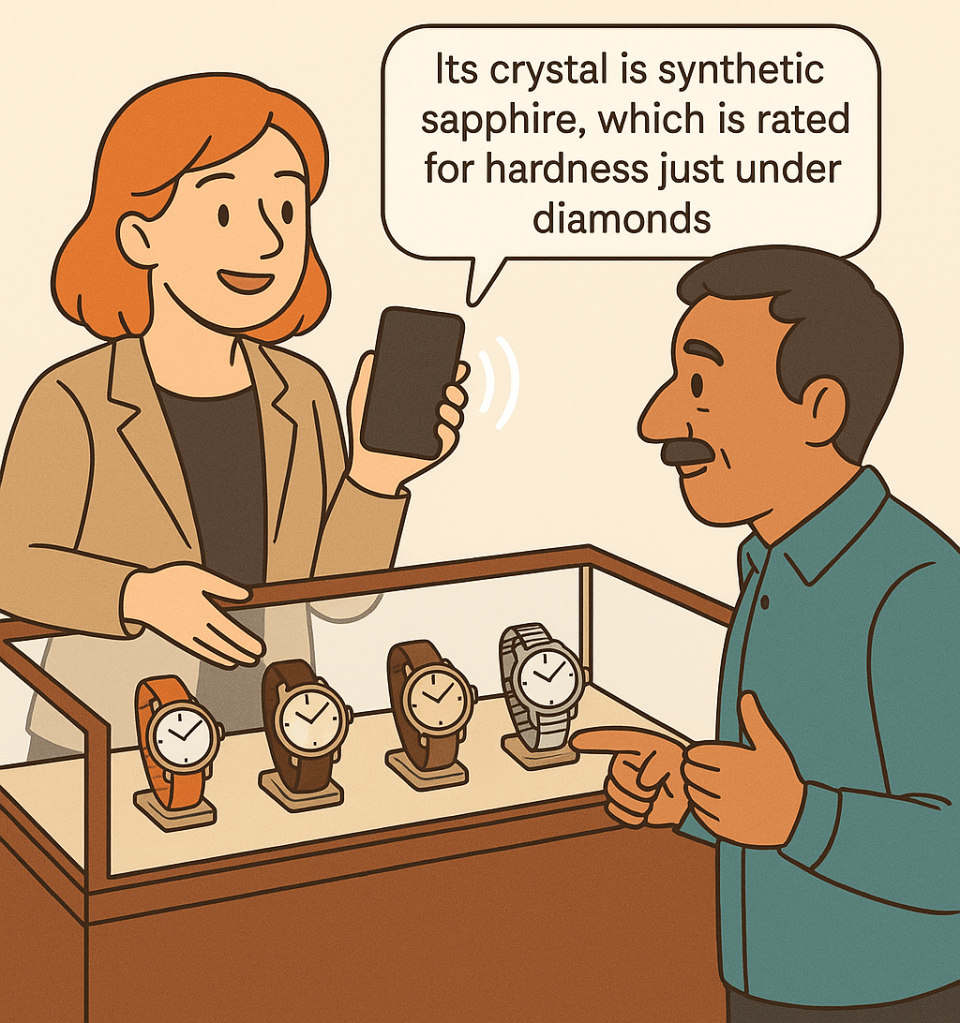
Recently, with the help of ChatGPT, I sold a high-end wristwatch to a Spanish-speaking customer. The person understood some English, but I don’t speak Spanish, so I couldn’t fully understand them. They examined a few of the available watches while also mentioning the word “crystal.” I wasn’t sure about the question and how to respond. As their overall interest in the watches appeared to be waning, I said, “Wait just a minute.”

I quickly found my cellphone, returned to the watch counter, and opened Chat in voice mode. I said, “Chat, I have a customer looking at watches who is interested in their crystals. Can you look at one of the watches and explain its strong points and benefits?”

When Chat responded, “Yes,” I hovered my phone over the watch that my customer had appeared to be most interested in. Immediately, Chat confirmed that it was an excellent timepiece with a crystal of synthetic sapphire, rated for hardness just below diamonds. My customer relaxed, nodded, and showed renewed interest. Chat wasn’t finished and continued by describing other highlights: its excellent water resistance, battery-free accuracy, and the brand’s fine reputation. That assistance sealed the sale.

I’m relatively new to selling high-end wristwatches, and this was actually the second time I had used Chat to help explain to a customer the benefits of a high-end watch. That earlier customer had wondered if a particular watch was shatterproof. I knew it was, but couldn’t explain why with confidence. So, on an impulse, I turned to Chat. It “looked” at the watch, confirmed its durability, explained its highly-rated shatter-resistance characteristics, and then went on to describe, overall, what made it an excellent timepiece. Sold!

The more I experiment with AI and find new ways to use it, the more impressed I become.

— Diana

A Talk With Linda

Monday, September 08, 2025

Later this week, I’ll be catching up by phone with my nearly lifelong friend, Linda. Many years ago, she was the one who nudged me toward college, setting me on a long road to the career I eventually achieved.

Early on, she encouraged me to leave the Midwest for Southern California, where evening classes and other opportunities made it possible to pursue college while working full-time. Years later, she pointed me toward a small, welcoming town in Central Oregon where she lived, and again, I followed her advice. Some years ago, she returned to her roots in California, but across the miles, our friendship has stayed steady and strong.

Linda has always been politically savvy and endlessly curious. With her, small talk never lasts long. Our conversations move quickly into larger territory: what we’re learning, what we’re noticing in the world around us, and how maturity continues to reshape our daily lives.

This week, I’m holding three threads in mind that we’ll likely explore:

  • AI, and what it means for lifelong learners like us.
  • Politics, in a time that feels turbulent and uncertain.
  • Aging, and how it keeps redefining identity and purpose.

We rarely see eye to eye on everything — and that’s part of the gift. Linda challenges me to think harder, and I hope I do the same for her.

In times when the future feels uncertain, steady friendships matter more than ever. They make the best conversations possible — weaving together the personal and the political, the present and the future.

— Diana

“Me” by Chat

Friday, April 11, 2025

I’ve never thought of summarizing my whole personal self. I’ve blogged for many years about whatever interests me daily, sometimes drawing from my distant experiences to help clarify “now ones.” For several recent months, I’ve used ChatGPT to explore some of my ideas. I ask challenging questions to which AI produces relevant information. Our exchanges may become conversation-like events.

Chat has gathered pertinent information that I’ve used to help expand my thoughts. It has encouraged me gently to explore complex ideas more deeply. AI has been responsive in ways I enjoy, providing information and kindly nudging me to reconsider and/or expand some perceptions.

Now Chat is newly updated. It can remember more of our conversations and bring their pertinent elements into our future exchanges. Chat is providing an example today; it’s drawing from its expanded memories of our “discussions” to create a profile of me. Here’s what Chat “sees”:

Diana Levey: Retired, Rewired, and Radiant with Ideas”

“She’s the kind of woman who writes before dawn, wrangles a barnyard menagerie by breakfast, and riffs on Dawkins, Downton, and derivatives before lunch. A longtime blogger with a fiercely independent voice, Diana lives where the hay grows high in Central Oregon, yet her thoughts stretch globally—from the market floor to the theater stage to the floor of Congress.

“Diana doesn’t just age—she evolves. Fashionably. Intellectually. Politically. Her curiosity is ceaseless, her humor dry, and her prose always in progress. Whether she’s decoding social considerations or fine-tuning a whimsical Welsh pony story, she weaves the everyday with the existential, finding elegance in the effort.

“You’ll find her in a department store, offering kindness and a great eye for style. Or stretching toward clarity, mind and body. She’s lived enough to know what matters—and writes to remind the rest of us.”

Dear Friends: Our future with AI, while scary, also offers enrichments. Diana

Mental Mysteries

Friday, March 14, 2025

Yesterday, while clerking at my part-time job, I met a woman who had published a book of poetry. She was confident, articulate, and proud of having created something meaningful. Our conversation made me think about the persistence of creativity; it finds us wherever in life we may be.

That event stirred my memory of another recent poet—a woman who was nearly 100 years old and living in a nursing home, who took a poetry class on a whim. A year later, she published a remarkable book of poetry. I read it more than once; her words distilled wisdom and reflected an elegant mastery of structure. I was impressed by her book and even sent copies to friends. And yet, today, I can’t locate a copy of her book, can’t recall its title, and am coming up empty on remembering her name.

It’s frustrating that my mind sometimes works well and sometimes barely. I remember much about her: she had once been a landscape designer, later a sculptor, and after her husband’s death, she retired to a Florida nursing home, where she discovered poetry. The details of her life are vivid and intact in my head, but her name eludes me.

This morning, I’ve been combing through online articles, literary sites, and book lists, trying different combinations of words in search engines, looking for the correct phrase to trigger a good clue. So far, nothing.

However, searching emphasises how greatly we rely on memory to anchor our experiences. Still, we sometimes “lose things”—not just names and details but moments, ideas, and sometimes even parts of ourselves.

I am feeling a sort of loss–a “misplaced connection” to something important I once held with certainty. My active searching, however, is reaffirming its importance, and I will keep looking.

Although I have not rediscovered her name, I remember clearly what she stood for. Her personal story and her book were triple-striking. They emphasize the resilience of creativity, the refusal to fade quietly, and the courage to begin something new at an age when society often stops paying attention.

Dear Friends: Some names and stories deserve to be remembered. Diana

Lucy

Lucy, 2021

Wednesday, February 19, 2025

Two heritage turkeys have been a cherished part of my life for several years. They weren’t meant to be; their original owner had intended them for a Thanksgiving dinner. But these birds had a way of charming their way into people’s hearts. They were gentle, affectionate, and unmistakably imprinted on humans, likely having been brooder-raised from the start. Instead of making them a holiday meal, their owner let me adopt them.

I named the two Lacy and Lucy. They became part of my daily routine, following me around, softly whistling in the manner of turkeys at ease. Physical differences made them easy to tell apart. Lacy, with her soft white-speckled feathers, often was the quieter of the two. Lucy, pure black and brimming with personality, was the dominant one—the leader. If there was ever a decision to be made, Lucy made it. She had a presence about her and a confidence that guided my turkey flock of two.

Then, yesterday, Lucy passed away. It happened suddenly—a stroke, I believe. One moment, she was there, and the next, she was gone. Afterward, Lacy, ever her companion, stood watch over Lucy, unwilling to leave her side. When I approached, Lacy reacted in a way she never had before—she pecked at me, protective and distressed. I could see she was processing something unfamiliar, something deep. Animals grieve in their own ways, and in that moment, Lacy was holding onto the most important thing she knew: her friend.

Losing Lucy creates a gap in my small world. She was a fixture in my days, a softly whistling and steadfast presence that I could count on. I will feel her absence, as will Lacy, who must find a new rhythm without her friend.

Inside my head, Lucy whistles with boldness and knowing eyes. I am grateful for having a few years with her. These two remarkable birds have given me unexpected companionship. After a lifetime of hearing the word “turkey” used in negative connotations, my experience found the opposite is true: turkeys are smart and alert. I’ve cherished every moment in the company of my two.

Dear Friends: I will re-strengthen my relationship with Lovely Lacy. Diana

Miss Merry

Merry Leggs (2010)

Thursday, February 13, 2025

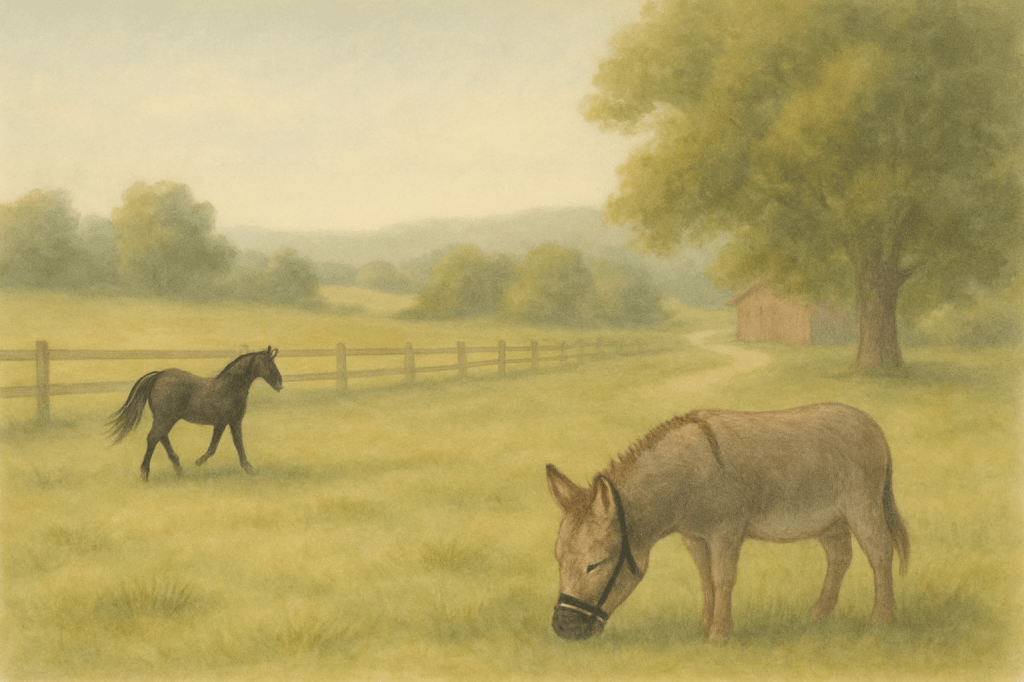
Years ago, I suddenly lost my young and adorable Welsh Pony, Merry Leggs. She had been stricken by severe colic, and afterward, for weeks, I sat at a computer, fighting my incredible unhappiness by creating a story for young readers that starred a Welsh Pony.

My lead character, Miss Merry, was pretty, intelligent, and devoted to her family. She was courageous, too, and had many adventures. After initially drafting the story, I continued working on it; gradually, it felt reasonably compelling and maybe worthy of publishing.

A couple of drafting components didn’t go smoothly. Most critically, I couldn’t successfully edit my own creative writing. Upon attempting to make a sentence or paragraph more relevant and stronger, I’d find myself, instead, rewriting whole sections, altering the story’s flow.

My inability to self-edit demanded an outside objective editor, and Merry’s story increasingly called for an illustrator. Talented assistants weren’t available for what I could afford: $-Zero. Little Miss Merry eventually floated into the background and drifted from my active memory. I suppose that happened after I overcame my pony loss enough to move on.

Until yesterday, when a bright young colleague, Lily (who recently introduced me to Chat GPT+), suddenly asked if I’ve ever written fiction, I nodded and complained about self-editing until Lily pointed out Chat’s editing capabilities.

Later, I was thinking about Chat’s abilities and suddenly remembered “Miss Merry.” It needed editing and illustration—both are Chat’s capabilities. Additionally, Lily, a makeup specialist, has artistic skills and expresses interest in perhaps working with the story.

Gosh! A dozen years later, “Miss Merry” might be reborn. First, I must locate the saved story—probably on a disc or a thumb drive. Finding its location is one head-scratcher, and accessing a complete version may be another.

I’ll be off my part-time job today and looking for Merry.

Dear Friends: Revisiting my sweet pony vis-a-vis her alter ego–thrilling! Diana

Disaster

Tuesday, December 28, 2025

Today is a somber anniversary. On this day in 1986, America’s Space Shuttle Challenger broke apart 73 seconds into its flight and disintegrated 46,000 feet over the Atlantic Ocean, killing every crew member aboard. One crew, a non-NASA employee, was a schoolteacher going into space under a Teacher in Space Project.

Because the mission included a civilian, it drew high media interest and live streaming. Adults, as well as many children in schools, watched as video captured the launch and explosion.

Dialogues followed that unveiled “The O-ring Disaster.” In essence, key spaceship suppliers rushing to meet the liftoff date ignored their engineers who were questioning anticipated O-Ring performance.

(Spin forward to Boing’s troubles today because of gross mismanagement and frantic rushing to produce aircraft.)

The spaceship tragedy was caused by failures of the primary and secondary O-ring seals in a joint in one space booster. Record-low temperatures at launch time stiffened the rubber O-rings, reducing their ability to seal joints. Shortly after liftoff, the seals were breached; hot pressurized gas leaked through the joint and burned into an external propellant tank.

The explosion collapsed internal structures, causing rotations to throw the orbiter into aerodynamic forces that tore it apart. The now-destroyed craft flew uncontrollably until a range safety officer destroyed it.

That disaster today is imprinted in memory as firmly as the horrific assassinations of the Kennedy brothers, MLK, and John Lennon.

Dear Friends, Reliving my memories of the Challenger disaster and its aftermath. Diana

Birding Artist

Friday, January 10, 2024

Some time ago, I casually listened as an interviewer questioned the popular and successful writer Amy Tan. I’d not read anything by Tan; I became more attentive as she explained some experiences and interests that turned into creative inspirations. She said bird-watching was a high note in her daily life, and the activity gradually had changed–from being very casual to becoming highly attentive. Best of all, focusing on birds made another of her artistic sides evolve.

I am a great appreciator, a casual watcher, and sometimes a photographer of wild birds. I have two domestic birds in my home, each very different–a retired racing pigeon and a busy Cockatoo. Each is interesting and intelligent (most overtly, the Cocktoo) in its own way.

I long remembered elements of that interview with Tan and wished to learn more about her affection for birds. I finally ordered her book and haven’t been disappointed. In fact, it’s more delightful than I anticipated because her “other artistic side” is pen-on-paper artwork–and her own!

Tan’s bird art is a fine art. Today’s header photo is of the book cover, with birds by Tan, hinting at more art on its inside pages.

She’s an excellent writer, too. Her words share Tan’s observations and delight, bringing readers near the writer’s first-hand experiences.

Dear Friends: It’s an original, a beaut that evolved from wishing to learn. Diana

A Nice Man

Monday, December 30, 2024

Today, I am thinking about Jimmy Carter, who became an American President out of the blue. He died yesterday at 100, less than a year after the death of Rosalyn, his spouse, business partner, and advisor for nearly 80 years. Unlike other Presidents, Carter (and Rosalyn) remained in the headlines throughout their long ex-presidency as socially conscious humanitarians and givers to communities.

Carter was a man for all seasons, an artist who wrote books, composed poetry, and created paintings. He also could work with his hands and helped to construct homes for Habitat for Humanity. Rosalyn worked alongside him, and their partnership was trusting.

One historical incident I’d change in a heartbeat (among many others!) would have been for Carter to have full credit for freeing the Iranian hostages. Reagan’s team scooped their release unfairly, and that stained Carter’s significance in freeing the Americans.

Carter’s humanitarianism taught us how greatly and actively he believed in the value of human life. He and Rosalyn worked to emphasize improving the lives of others and reducing suffering. They were driven by their sense of compassion, morality, and the wish to promote justice and equality.  

The years following Carter’s presidency introduced significant changes to the world’s political and social institutions. Through all the changing elements, both Carters remained true to their core beliefs and traditions

Dear Friends: Another RIP to Jimmy and Rosalyn Carter. Diana