
Tuesday, January 20, 2025
At first glance, I was certain I knew what I was seeing.
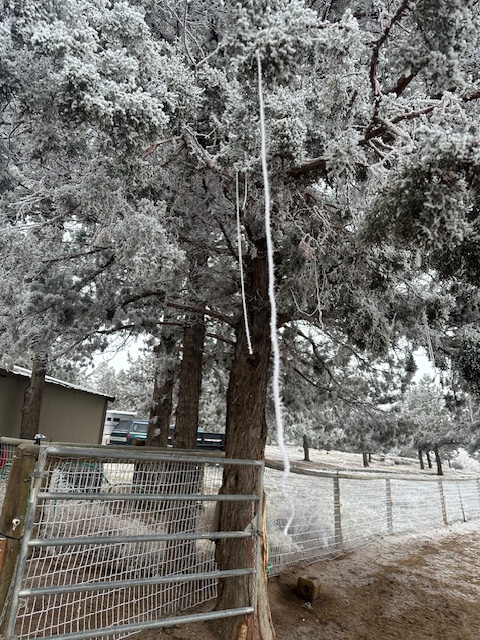
Two pale strands hung straight down from the branches of a juniper, each coated in frost. They were white, linear, and unmistakably rope-like. Our minds are quick that way. They reach for the nearest familiar explanation and settle in. We just go with it.
Like me, then—not questioning whether the frosty objects were rope, only wondering how they had gotten there. I reached up to pull one strand free from its branch, and in that instant, the scale shifted.
In my fingers, what had looked sturdy immediately shrank into something improbably delicate. I expected resistance. Instead, frost slipped away, and I found myself trying to grip emptiness. I paused and looked more closely.
You’ll never guess what I discovered. The “rope” I was trying to hold was a single hair from one of my horses’ tails. Looking up again, I noticed several similar strands—long, pale, impossibly fine—each thickened by frost and hanging, rope-like, from the branches.
The experience startled me. These fine hairs had likely been carried aloft by nest-building birds, caught by chance in the tree, and layered again and again with ice. The moment felt slightly dramatic and, at the same time, utterly ordinary. I had misread the evidence—and it had been astonishingly easy to do so.
I’ve been thinking about deciding and misassuming. These happen more often than we realize. We believe we’re seeing what’s there, when instead we’re seeing what our experience tells us ought to be there. Our brains—efficient and decisive—are always working to help us make sense of things quickly.
But efficiency may also be a kind of blindness. When we label something too fast and move on—without lingering long enough to reconsider—we miss the chance to see it differently.
The object I mistook for rope wasn’t merely a variation of what I expected; it belonged to an entirely different category of reality. It was something once living—shed, carried, and repurposed by chance.
Only later did my mind begin to imagine a quiet collaboration among animals, weather, and time—a whole story I had nearly missed before I paused, looked again, and wondered.
This experience reinforces something I’ve been learning: that deciding well often requires more than one look. Not because first looks are careless, but because they are incomplete. The longer I live, the more I understand wisdom as less about sharp eyesight and more about patience. Wisdom is staying a little longer with what we think we understand, allowing ourselves to be surprised by what else might be there.
Here’s today’s small example. A single strand of horse tail hair is usually barely visible. Yet here were several, transformed—fluffed with frost and suspended in front of me. I mistook them for rope. I tried to pull one down. Instead, I learned again that what appears solid may, upon re-examination, be lighter, finer, and less obvious than we first believed.
Seeing—really seeing—asks us to pause, reconsider, and sometimes admit that our first understanding was wrong. That lesson, offered by a few horse hairs, humbled me. And because of what it taught, it was also comforting.
If something as slight as a single horse tail hair can—against all odds—hold its place in the world, suspended and briefly transformed, then perhaps our own uncertainties deserve a little more time in the light as well.
Taking more time means looking again. Reflecting longer. It’s a practice that can help move our perceptions closer to what actually may be there.
— Diana
 Diana's Morning Blog
Hi Diania, I love this ! I also forwarded my son the one about AI. So interesting! Take care & I hope all is good with you!♥️🌺
LikeLike