High Technology

Friday, October 18, 2019

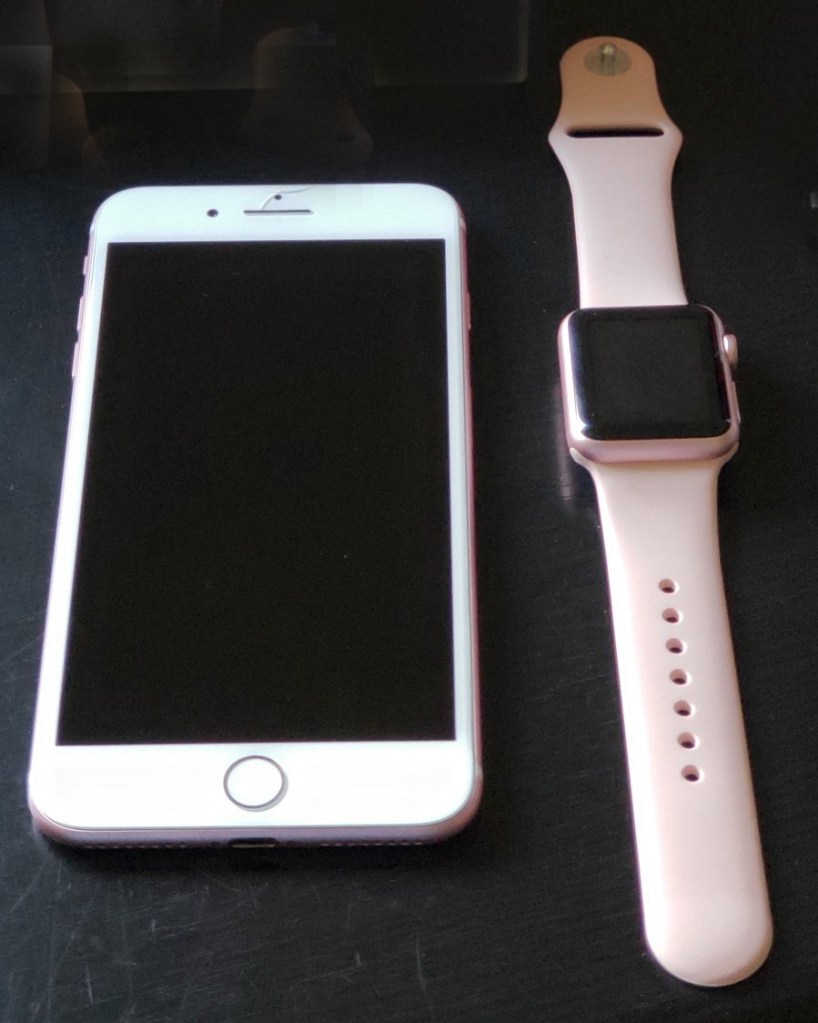
I’m struggling with the transition from droid to IOS after going for a trio of Apple products, including a Watch, iPhone, and just for the heck of it, an iPad, and why not? After all, these items are designed to communicate seamlessly. The rub is that the desktop computer I always use runs on Microsoft. The droid and Apple systems differ enough to be confusing. Particularly in a user’s early learning stages.

In years before, I’ve gone for IOS because Apple is so touted by users, but always returned the products. I’ve just preferring droid software. Maybe droid is less innovative and flexible, but after years with it I’m quick and achieve what I want…mostly, until now.

Recently, Apple leaped ahead with me because it fills a space that’s needed. As a person who works daily around and with horses, I worry about stumbling and falling, maybe doing enough self-damage to need help. If I fell and were too dazed to operate my cellphone, what might happen? The Apple Watch and iPhone can provide emergency assistance. The watch has mechanisms to sense when a wearer lands hard and in an horizontal position. A fallen wearer has a few seconds to tell the watch there’s no problem; otherwise, the watch through its associated iPhone alerts designated helpers and emergency personnel, and its GPS capabilities add an accurate location.

So, I’m slogging through a transition, and hopefully for a long while won’t have to do this again.

Dear Friends: Technology makes nearly everything we use impermanent. Diana
Seasonal Challenges

Thursday, October 16, 2019

I’m feeling the weather change, sensing it in every pore. It mutes nature’s colors and blows winds against me, here in this dry lot, from shifting directions. I see occasional stronger gusts making clusters of bare dirt rise and circle to resemble little tornado-like swirling dervishes. Here inside the horses’ loafing shed I’m nailing chicken wire over bare wood that’s been embattled by restless horses. I’m trying to chew-proof the shed’s structural elements. The unremorseful culprits banished so I can work unbothered, stand beside a gate waiting patiently with heads lowered and rears toward the most aggressive winds. Now, the dirt shows the tiny plugs from early rain drops and I turn to the ladder to finish quickly.

I climb with tools–hammer, pliers, a metal cutter–two steps up (my feel-safe limit), but this puts me at a height to reach, grab, and heft chicken wire to unroll from it’s heavy body on the floor. My hands brace the wire at a ceiling support, while I manage to position a nail and fender washer before grabbing a hammer and starting to pound. Here’s a confession: I hammer like a girl, pounding ten times to drive a nail, whereas a guy can finish in three swings. Anyway, after securing my nail and fender washer combo, I move the ladder to the next overhead support, and so on until most of the exposed wood is wire-covered.

All the while, I must wrestle with anger about chewing damage and acknowledge self-guilt for not exercising the horses adequately. This season of cooler weather has brought chilly days that sometimes are downright cold. It’s not conducive to riding against wind in an open vehicle pulled by a horse. This has meant minimal exercise for the well-fed and ready-to-go horses, now chewing wood to relieve energy. Next week, I’ll have their shoes pulled for the winter, and today will start adjusting their feeds to accommodate less activity.

In several weeks when the grasses freeze and stop growing, the horses and I will take daily walks down the road to a neighbor’s large dormant pasture. There they may graze and wander freely. They will enjoy moving around on pasture and less will need more exercise.

At this point, I stop and start loading tools, leftover wire, and ladder into the Gater’s bed, and at the sound of its motor the horses look over and watch me drive out of their dry lot. In a few moments, I open the gate and they filter into the larger area and move toward their windproof shelter now papered with chicken wire. What’s been instructional to me is that this shelter has stood for years housing horses and never before showed teeth damage.

Such problems of horse ownership go beyond horses. While choosing to live with animals is fun, it’s also work. Simply, the critters doing what they do without malice causes destruction in various ways. Some problems that begin tiny easily are ignored, but if left untouched may become too-big challenges that consume precious time, energy, and money.

Dear Friends: Daily, more learning from a semi-rural-life with animals. Diana

A Species to Draw To

Wednesday, October 16, 2019

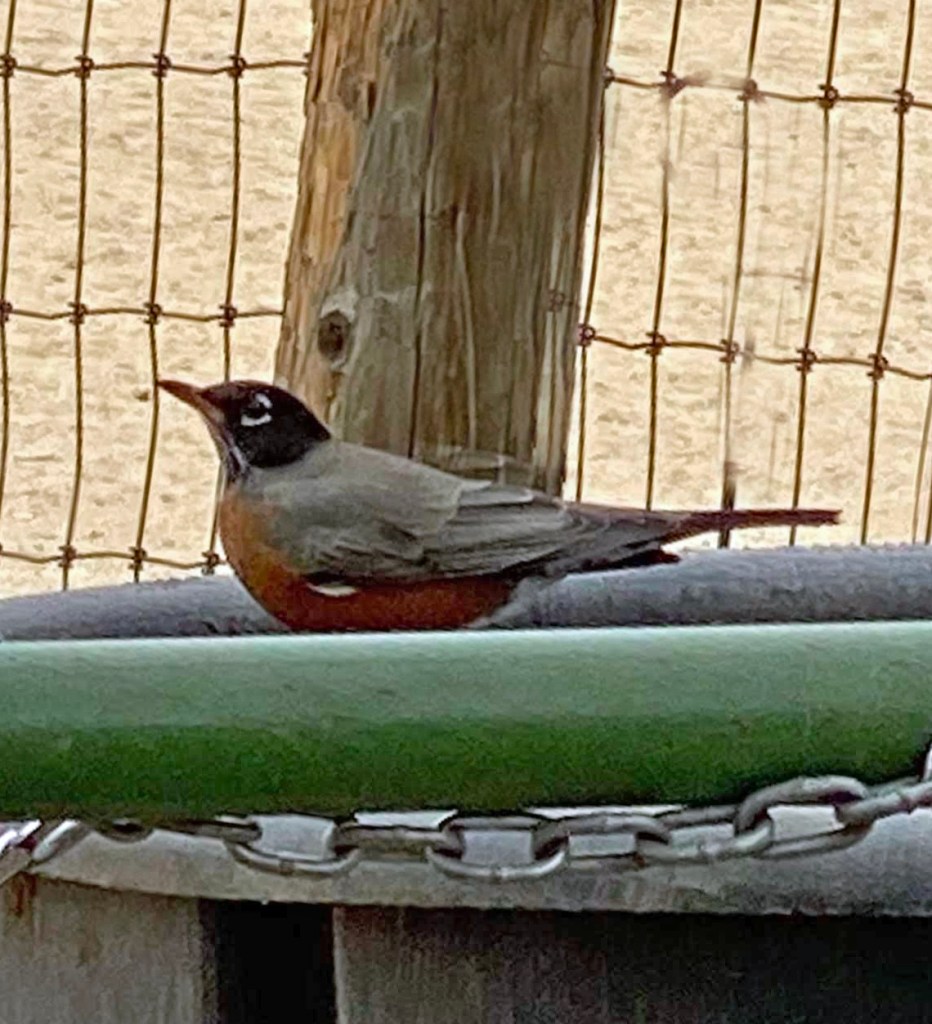
One of my delights is seeing a bird land nearby on my horse’s trough. Among the birds that most interest me are Robins, bold and confident creatures who keep an eye on me but usually don’t fly away before dipping and drinking. This fellow perched on a chunk of wood floating in the trough and for awhile bobbed to capture water and with each sip lifted its head skyward so gravity could do its job.

Robins are such common year-around birds it seems odd to find them so enjoyable. You’d think that by now I’d ignore these birds, but not so. To me, Robins are the “Border Collies of birds”. On the ground they hop rapidly, with purpose and acute hearing, pausing frequently to listen for underground movements. Suddenly a ground hopper scurries a short distance and hits a target. Yes, they’re common birds, but here at my Central Oregon location many Robins that migrated do return to winter. Now they’re arriving again.

As much as we’ve all watched Robins, they are very beautiful birds and as distinctive to the eye, as say Magpies. That Robins immediately are spottable makes them more fun. The influx begins now and by spring I’ll be a witness to these birds drunkenly stuffing themselves on juniper berries.

Dear Friends: Our friends the birds are lessening in numbers, so sad. Diana

Goats

Tuesday, October 15, 2019

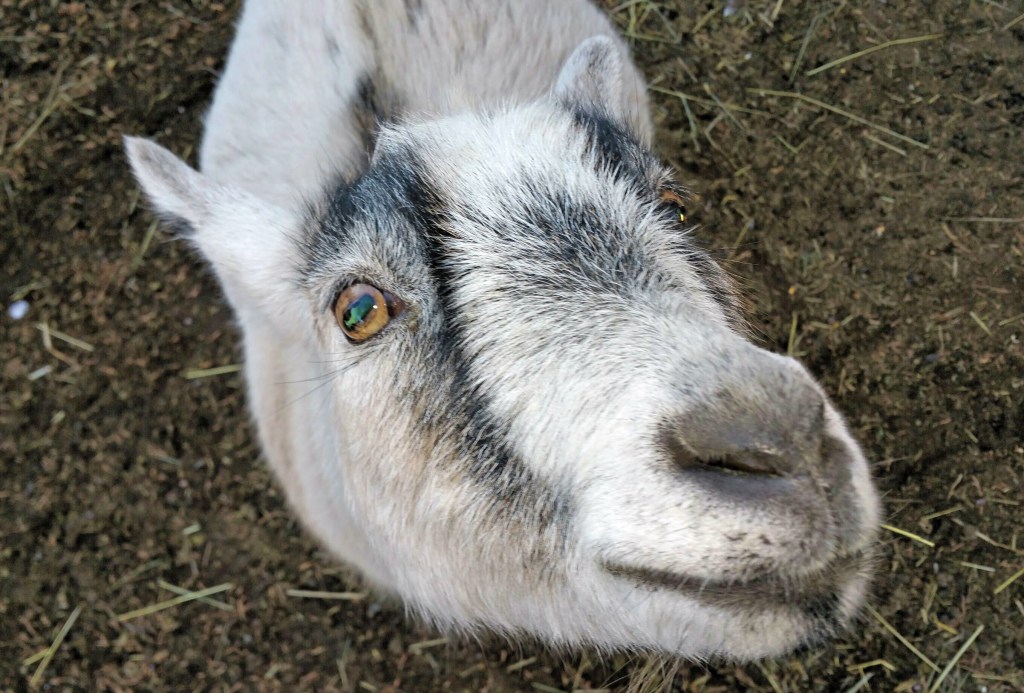
I didn’t plan to write about goats before this photo of Breeze popped up–a cool capture that I can’t recall snapping a shutter on. This photo is a head-scratcher, like, why did I overlook or simply ignore it? It also puts in mind my three goats–a mom, who’s grown old, and her twins, who have matured. It’s nearly 10 years ago that I brought home this little trio of the smallest-breed goats, African Dwarfs, on a whim. They’ve always been together and are so bonded that I worry about losing mama goat and how it’ll affect the twins. Through the years these three have taught much to me about goats and most of it is lovely.

Bringing them home was an on-the-spot impulsive decision and I hadn’t prepared. The only safe space for mama and her then-babies was an enclosure adjacent to my new young chickens. I spent the next week or so working to create a safe place where the goats could escape wind and rain. I got busy reading how-to-care books, asked questions of the feed store’s “goat guy”, and spent lots of time observing the goats relaxing or playing.

They proved themselves to be aware, smart, and great fun. Mama who started life as a rescued herd goat never developed a trust for humans matching that of the twins who were handled by people from their birth. Over time, mama and I developed a mutually-trusting relationship, but she remained always cautious and avoided me if something worried her. Like when I would bring another person to help trim their hooves.

At the sight of a stranger, mama heralds an alarm and all three goats rush in varying circles and are hard to capture. It takes time to catch them, but I’ve learned how, and while trimming hooves on a 75-lb. goat, holding it is harder than you’d think. These little critters are incredibly strong. Even a goat that’s being held steady still can kick and deliver a wallop, plus its little sharp hooves are dangerous.

Goats are members of the Bovidae family, of cloven-hoof and ruminant animals, including bison, buffalo, wildebeests, antelopes, and others. Early on, a veterinarian who raises goats insisted to me that goats are in the deer family, but I eventually learned this isn’t so. Deer are in the Cervadie family of even-toed animals.

Goats are trainable and some folks have taught them to pull a cart, which I’d love to do. A couple of outdoorsy folks in this area have taught their goats to carry packs, and the animals carry supplies while accompanying on treks.

Mine love to play by faux-attacking and butting one another. Otherwise, they move around bonded as a unit of one, while keeping watch on the property and always showing eagerness for my visits.

Dear Friends: What would we be like, if we couldn’t know other living species? Diana

Adjusting, Again

Monday, October 14, 2019

It’s in the high thirties, and overhead an almost cloudless blue sky heralds the opening of a lovely fall day. Too bad for me, yep, for I’m scheduled to be inside and working at my part-time job. Yesterday was the same, I missed a beautiful day while envying hoards of customers, watching them fill shopping carts and hurriedly escape to the outside.

The weather forecast suggests that after today we might get one more really nice day before rain starts falling. I’ve much to repair and winterize where the horses stay before real winter hits Central Oregon. Then, it’s nearly impossible to work outside (except to shovel or snow-blow). I’m certain my furnace is operating properly and have a good supply of wood pellets in easy reach.

There’s also the task of swapping out clothes, moving all the cottony summer stuff to the backs of closets and drawers and filling newly-opened spaces with winter items. This process has fun moments, like on rediscovering articles of apparel that I liked but had forgotten. It’s amazing how much several months of no-see and no-use can alter perceptions and opinions.

My biggest conflict in seasonal change-overs of clothing is about cotton. In winter, cotton is bad, bad, bad. Since it’s a fabric that absorbs and holds cold, it’s lovely to wear in summer, but in winter becomes a no-no that must retreat to the backs of closets and drawers. A knawing problem is that clothing manufacturers have learned to make many iterations of cotton clothing, and some garments can look winter-heavy and warm but actually turn out to be 100% cotton. It’s sad to put away really nice and warm-looking items.

Natural products are expensive and so clothing manufacturers are creating more and more artificial fabrics. Many of my newer winter clothes are made from those alternative fabrics. They’re pretty good barriers to cold air, except that when I walk into a freezer at work, there’s a faux-fabric freezing against me.

Please, I say to the sky above, give us another day or two of this great weather! There’s so much that needs doing and so little time.

Dear Friends: We who love the seasons do learn to face these recurring battles. Diana

Variety In The Field

Sunday, October 13, 2019

I’m taking turns reading several books at once–ancient history and current politics. I know, it’s some kind of combo, but offers ideas that I hope to absorb, understand, and synthesize. Now, I’m about to set them aside, for awhile, after receiving a book by the Polish author Olga Tokarczuic. Two days ago, she won the 2018 Nobel Prize for literature. This award, announced a year late, got delayed because a 2018 scandal that involved someone on the Nobel Board shut-down the award process. To make up for that lapse, this year the Nobel granted two prizes, one for 2018 and another for 2019. The board member is history who last year misbehaved and threw the Board off its tracks.

Since the award, I’ve sought information about this writer. Apparently she’s very talented, has written many books, and some published in English are marketed in America. Honestly, prior to the news of this prize, I didn’t know of her. Her American translator, in interviews, says that Tokarczuic’s writings, all in Polish, are specific and fine, making her work easy to translate without sacrificing either meanings or art. That’s surprising, for it would seem very difficult to translate complex writing. That’s why I tend to avoid translations. Anyway, I chose an early-2000s book that’s popular in America and am eager to read and feel what this winning author communicates.

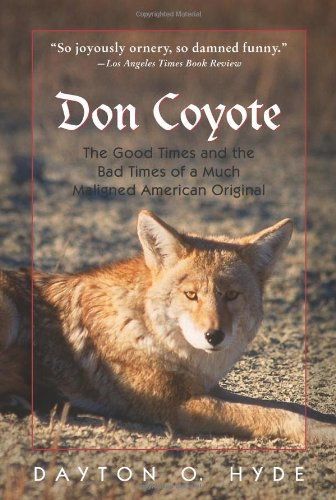
Serendipitously, my friend Susie swung by on her bicycle and brought an easier-to-read book, dealing with some of my favorite subjects–cattle ranching and coyotes. It’s a first-person work by an actual Southern Oregon rancher, a naturalist, who managed to develop a connection to a wild coyote. That led him to become involved with other coyotes and to gain more understanding of the species. His story will be fun and an appropriate counter-balance to the Tokarczuic work.

Coyotes, interesting and amazing creatures manage to live in close proximity to humans and still remain wild. Here on the high desert, and especially, like now during fall, they often wake me (and the dogs!) around 1:00 or 2:00 a.m. The pack is out, hunting and drawing nearby, communicating frequently its presence and intent with strings of howls–high-screaming and stretched.

Reading and writing are incredible gifts that expand human knowledge and friendships. I can think back to my third grade classroom and starting to learn cursive, that chore of repetition. In those days, without a smige of comprehending how written words would greatly affect my world.

Dear Friends: Enjoy this lovely fall day, and if possible, include some reading. Diana

A Continuing Journey

Saturday, October 12, 2019

I’m drafting this on my new iPad to expand into the IOS world. Typing is challenging on a small keypad which won’t easily accommodate my usually-speedy fingers. Although ignoring a few clicks and cues, my first paragraph is moving forward.

Yesterday, I dashed to the Verizon Store after my Apple Watch suddenly stopped and completely disassociated itself from the iPhone. My usual Verizon helper wasn’t working and another person restored my watch which reconnected to my phone. This person seemed not-enough familiar with Apple products, but anyway, there’s time to work through all this. The purchasing process allows two weeks before new equipment becomes non-returnable. This morning begins my day-3 with Apple products.

If asked now whether I prefer droid or IOS, I’d still favor droid. For IOS seems less flexible. Here’s an example, the apps on iPhone screens can’t automatically be alphabeticalized. This forces a close examination of each app on several screens to spot and move certain ones. Sure, apps can be adjusted, but only individually. It takes lots of dedication to move and reorder manually many apps on various screens.

I’ll probably ask my friend, Buzz for help. He’s totally into Apple products and could guide me through this confusing process and make going forward easier. Oddly enough and only yesterday, I remembered that several years ago I decided to drop my droid, and did select an iPhone. While trying out the new phone, I disliked it and opted for a familiar droid. That old choice still seems a reasonable option.

My struggles to change and learn recall my failed foray into ham radio. On an impulse, I studied for a series of ham tests, and passed them to achieve the high-level ham license. In local ham clubs, I discovered that most hams while growing up had learned ham radio technicalities from their dads. Radio electronics became their second nature. Those fellows were welcoming and kind, they spent time trying to explain radio, but as I listened, they might as well have been trying to teach how to understand Mandarin.

This time, the choice of Apple products was less impulsive, and instead, in appreciation of Apple’s emergency capabilities. These offer peace of mind while I’m working on rocky acreage or playing with and caring for large animals. Although my attempts to become a ham weren’t all positive, the reassurance of passing tough tests has suggested that anyone can learn anything by getting into the right mindset and studying with diligence.

Good news! This earlier-drafted article actually flew across space, moved from IOS to droid, and correctly opened on my laptop. Moving ahead!

Dear Friends: My ongoing interconnected theme might be, “never give up”. Diana

Tripping Into IOS

Driving training

Friday, October 11, 2019

Since early yesterday, I’ve been studying YouTube, to learn the workings of my new bundle of Apple products, including the iPhone, Apple Watch, and iPad. My first time with something besides a droid universe is a slow-going transition.

These components have an unique Apple app, that lets a wristwatch wearer who happens to fall, through his/her phone, call or elect not to call for assistance. It always worries me in working with horses that while “dancing around” with them (horse-folks will understand), it’s possible to trip, hard, over something. For years, I’ve researched wearable devices with push-buttons that call for help, but none meet the needs of one who frequently handles horses.

That is until recently, when my friend who’s an avid Apple guy, explained Apple’s watch-to-phone capabilities if the user suddenly falls. The watch has position and velocity capabilities that recognize a quick, horizontal, hard-landing. The watch allows several seconds, for the alarm to be turned off, before it signalls the iPhone to call for help from back-up contacts and rescue (police) persons, and to provide a GPS-precise location.

To me, switching from droid to IOS is akin to moving into another world. The iPhone has the droid capabilities and much more. It’s technology is amazing, and if I wind up using only part of what’s available, that’ll be a big win.

Right now, I’m not alluding to the phone’s three cameras! YouTube demonstrates that nearly all the other iPhone apps are adjustable in many ways. Even the phone’s outer-case, its push buttons are multi-function. To a wowed newbie, the settings and possibilities seem endless.

All will come together, and meanwhile, though I’ve never tripped badly, I feel more comfortable wearing a cool iWatch. Besides my horses, there are dogs that circle my heels, a cat who “figure 8s” around my ankles, and other unexpected things that may interfere with a hurrying person. Now, if it’s ever necessary to need help, my equipment is right. Besides easing my minute-to-minute mind, the watch/phone might boost my confidence.

Dear Friends: Sure, I’m eager to “get into” those cameras, but first-things first. Diana

Visiting Elaine

Delivering a punch line!

Thursday, October 10, 2019

Yesterday, I dropped into the nursing home to visit my sister, Elaine. She was in a quiet mood but very alert and we had a long talk. Of course, much of the time while she talks, the key subjects are movies, actors, dancing, and music. That’s where she prefers to keep her head most of the time, as an appreciator or critic. We also spoke some about our mom and dad, well mostly she did and shared some memories.

She’s repeatedly told me how much our dad loved plunging into the polar plunge at Sulpher Springs, OK, not far from the small town where my family lived. The family’s frequent getaway trips to the plunge occurred before I was born. Elaine tells me about accompanying his dives into freezing water when she was six or seven years old. When I wonder how that felt to her, she quietly says, “The water was cold.”

Yesterday, she continued, saying that afterwards, the family (our mom and eldest sister were in the group) piled into the car and traveled to Weewoka, OK, also not far from home, to eat fried chicken. The Weewoka restaurant always closed on Sundays, but it’s owner, a close family friend, always opened for a couple of hours to provide the swimmers with wonderful chicken dinners.

Elaine describes that fried chicken like a child ready to lick her lips. For many of her adult years she strictly was a vegan, but remembering those childhood special events seems to move her words closer to the action. She’s spoken of the polar plunge a few times, and only yesterday added those chicken-trip endings.

The family lived in Seminole, OK, where I was born, and whatever I’ve known about those years were the bits and pieces that my two big sisters described. Just weeks after my birth, our father died in an auto accident, and growing up for me was very different from my sisters’ early life experiences.

These days, I can hear differently Elaine’s words and cherish her reflections. It’s lifting to picture more our family’s early days. At this point in my sister’s life and mine, we can share instead of battle. I relish her best memories and will hold onto our good moments.

Dear Friends: It’s about adjusting to the inevitable, and saddening beyond words. Diana

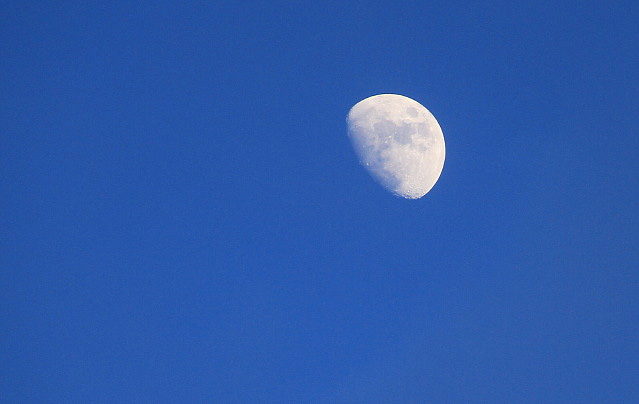
Waxing Gibbous Gorgeous

Internet photo

My fingers feel too stiff to work these keys after failing to thaw adequately while encircling a mug of coffee. Outside, in brrr 20 degrees, I’ve already traveled to the barn and back. No surprise to find the horses’ water troughs iced over, and so, it’s time to drain them and install heating devices. Soon, of great interest for this keeper of horses, the grasses will freeze, which means that my animals may graze to their hearts’ content without gaining weight.

The overcast sky hid this morning’s moonset which made me unhappy. As often happens, I was awake and reading, super early, and saw the moon up high through a bedroom window. There it was, a glowing 3/4 shape, soft and huggable, a photographer’s dream, except for the surrounding too-dark night sky. Maybe the dawn would offer a chance to capture the moonset, but alas no luck. Anyway, sighting it is a pleasant memory.

I began searching high and low for my Kindle and couldn’t find it. Not long ago, it seemed impossible that I’d ever read another book on it, hadn’t used it in years. Maybe I went ahead and tossed it. Anyway, my phone has a Kindle app that’s easy to use. While rumbling around, I found that a little-used tablet also has a working Kindle app. I read from the tablet’s larger screen.

Online reading is working out satisfactorily. I’m finding it possible to read quickly, remain focused, and retain information. As one who’s always cherished print books, I’m surprised, but also feel encouraged to download several more books to read. The Kindle versions are less expensive and arrive in seconds. The downside is that it’s hard to remember what’s in my library when I want to transition to another title. Although one can go to the Amazon Kindle Library and see the titles available, it’s easier and more fun to read the spines of books stacked on a nearby table. Well, I’ll get better at handling Kindle because familiarity with technology does change us.

Oh yeah, as an aside, I understand that computers are getting much faster and more accurate at translating voice to text. Thoughts about this make me wonder if manual handwriting eventually might drift into history–say like, Sanscrit.

Dear Friends: Lopsided moon, frozen fingers, 20-deg thoughts, oh dear. Diana