Max Cat

Maxwell

Saturday, June 22, 2019

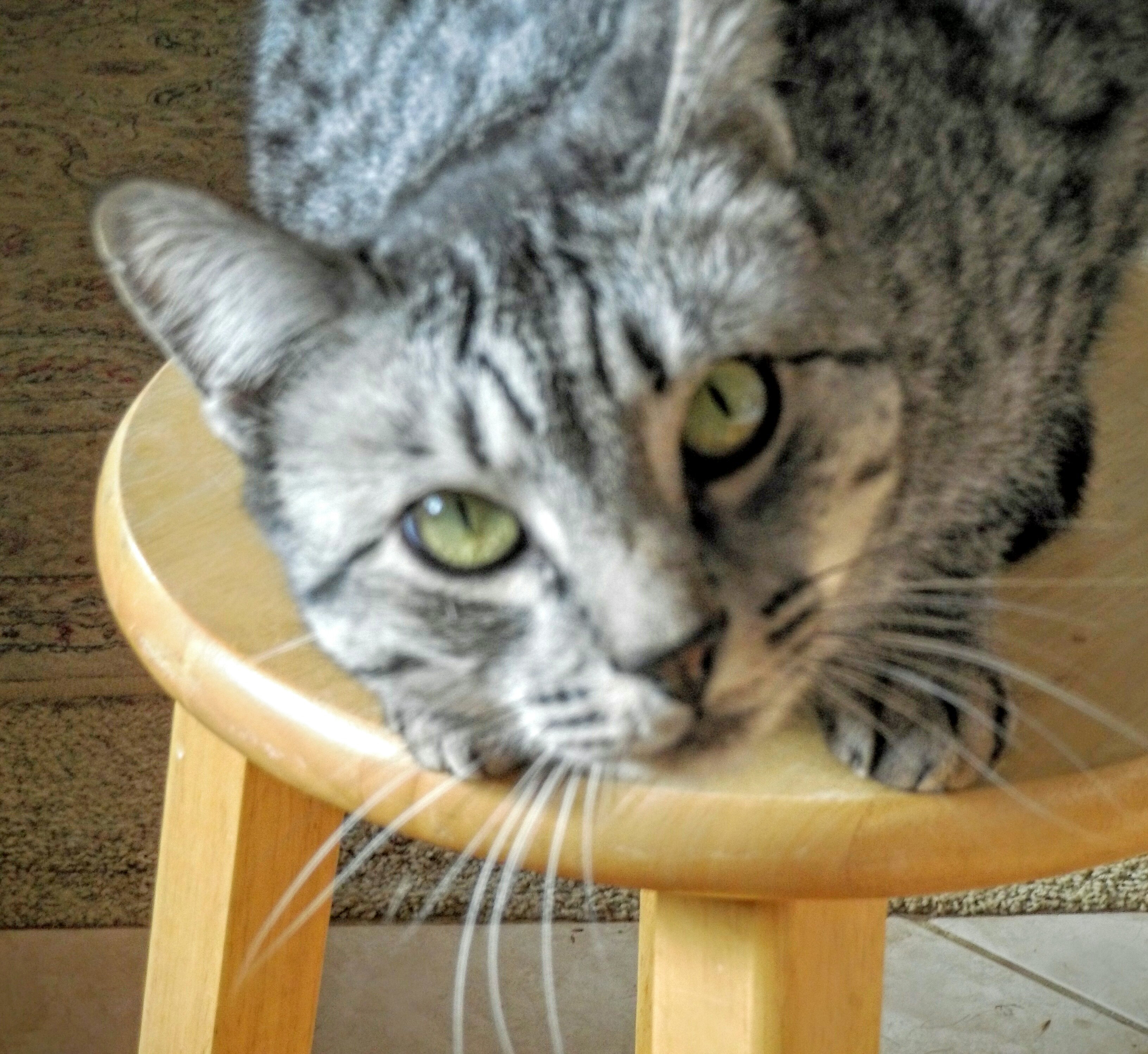
He can drive me nuts, this cat (an inside-outside guy) who’s lived with me for 10 years. When he’s outside I worry, because he’s a capable hunter, and hopefully, not capturing critters that I love, like birds, chipmunks, lizards, and bunnies. When he’s inside I worry, because he’s under my feet–easy to be stepped on or tripped over. When I’m exhausted from hard physical work and want nothing near me, he insists on cuddling in my lap. At bedtimes, I find the sound-sleeping lump on my favorite pillow or somewhere on my side of the bed. Oh, Max!

As cats go, he might be one of the coolest, unafraid of my dogs and human visitors. Outside, he knows my property’s every nook and cranny and attends to spots where he anticipates finding victims. He leaps onto the top edges of my horses’ watering troughs and expertly balances to drink. He scoots past the goats to avoid getting butted, and slips into the chicken coop to hunt mice. (He’s a lousy mouser, plays with the critters until he gets bored, and often then releases them.)

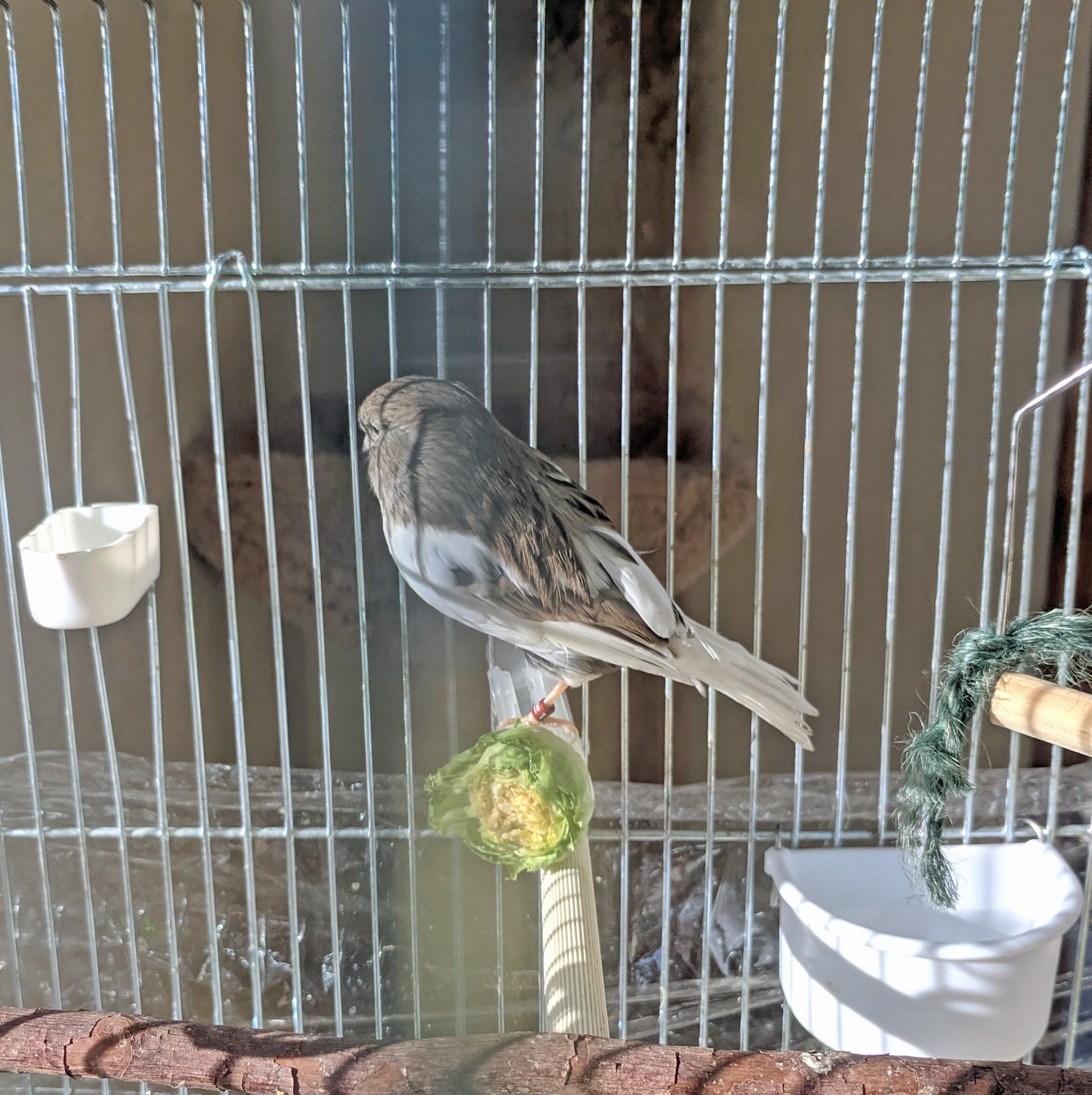
In harsh winters when I feed birds, Maxwell must stay indoors. He’s always on a window sill, watching the feeders with desire written all over him. In summertime, I feed only hummingbirds with feeders hanging too high for Max to reach. He’s smart enough to stay way clear of Cockatoo Peaches’ capable beak. Recently, I adopted a young canary–she’s tiny and flits around in her cage, while he’s fascinated, can’t stop trying to get to her. This summer, the easy fix is that Max goes outside and Stella (the bird) perches safely near a window. By winter, I’ll have figured out how to keep both inside and her absolutely safe. One option is a high-hanging cage.

Although Max gets to spend lots of time outside, I’m against it, for there are many dangers, like cars, coyotes, owls, and other overhead predators. Many years ago, I participated with a cat rescue organization and had “never outside!”) drummed into me. With this lucky guy, so far, so good.

Despite the worries and inconveniences of having Max around, I admire and enjoy him. At 12 years of age, he’s close to entering “kitty old age”, and hopefully, will stay healthy, vigorous, and close to me for many more years.

Dear Friends, to top it off, a purring kitty can lower a human’s blood pressure. Diana

Reviving My “Rosie Project”

Driving Rosie

Friday, June 21, 2019

Several years ago, Rosie came to live with me. She was an experienced driving horse that hadn’t been driven in years. Between her early life of driving and her arrival at my place, she’d been ridden as a trail horse. Her little sister, Sunni, already lived with me. My friend Elaine had owned Rosie, and sent along Rosie’s old driving cart on long-term loan.

I wanted to learn to drive and had joined a local driving club. Participating in the group put me in touch with folks who could help when I began searching for a capable driving trainer. They pointed me to Megan (in Lebanon, Oregon) who became our trainer.

I left Rosie with Megan and returned weeks later, barely recognizing my horse. She had transitioned, from looking soft and slightly overweight, to looking lean, strong, and almost like a racehorse. Rosie loved her job, was high-stepping, pretty-moving, and lovely to watch. I learned the basics of driving her, but while holding the reins felt very green, for Rosie wasn’t reassuring. In harness she’s ready to go and a lot of horse.

Long story short, after bringing Rosie home and feeling inadequate to drive her, I put the effort on pause. I also got sidetracked by being diagnosed with breast cancer, and so, didn’t do much with horses for several years. As my medical issues became resolved, I thought again about playing with my horses.

Lacking enough experience to drive Rosie successfully, and luckily having another horse to work with, I sent Sunni to Megan. In several months, she had my kind and steady pony driving willingly and easily. I re-learned how to drive, and after coming home drove Sunni on neighborhood streets. She stayed in great physical condition and gave me driving experience.

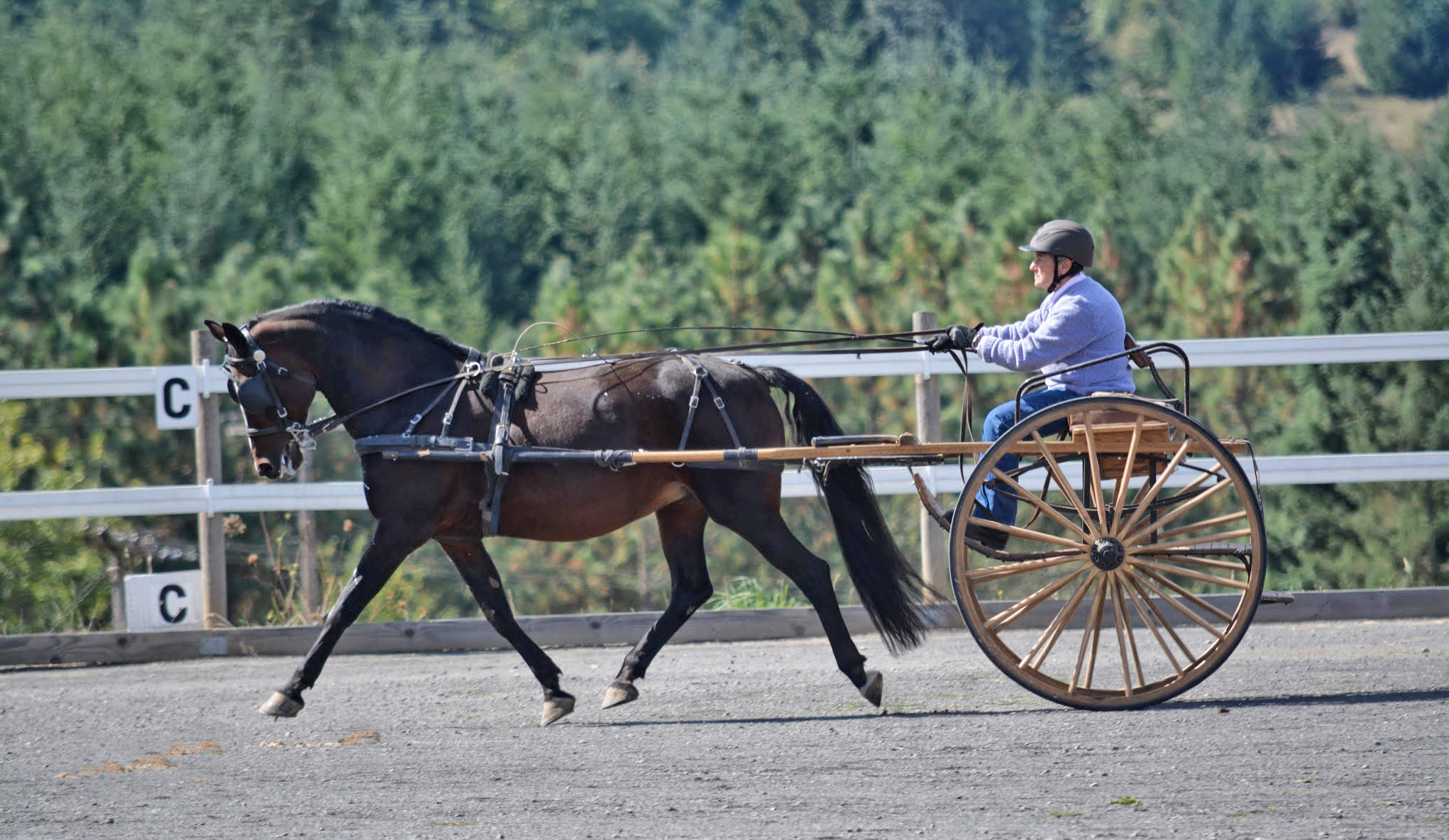
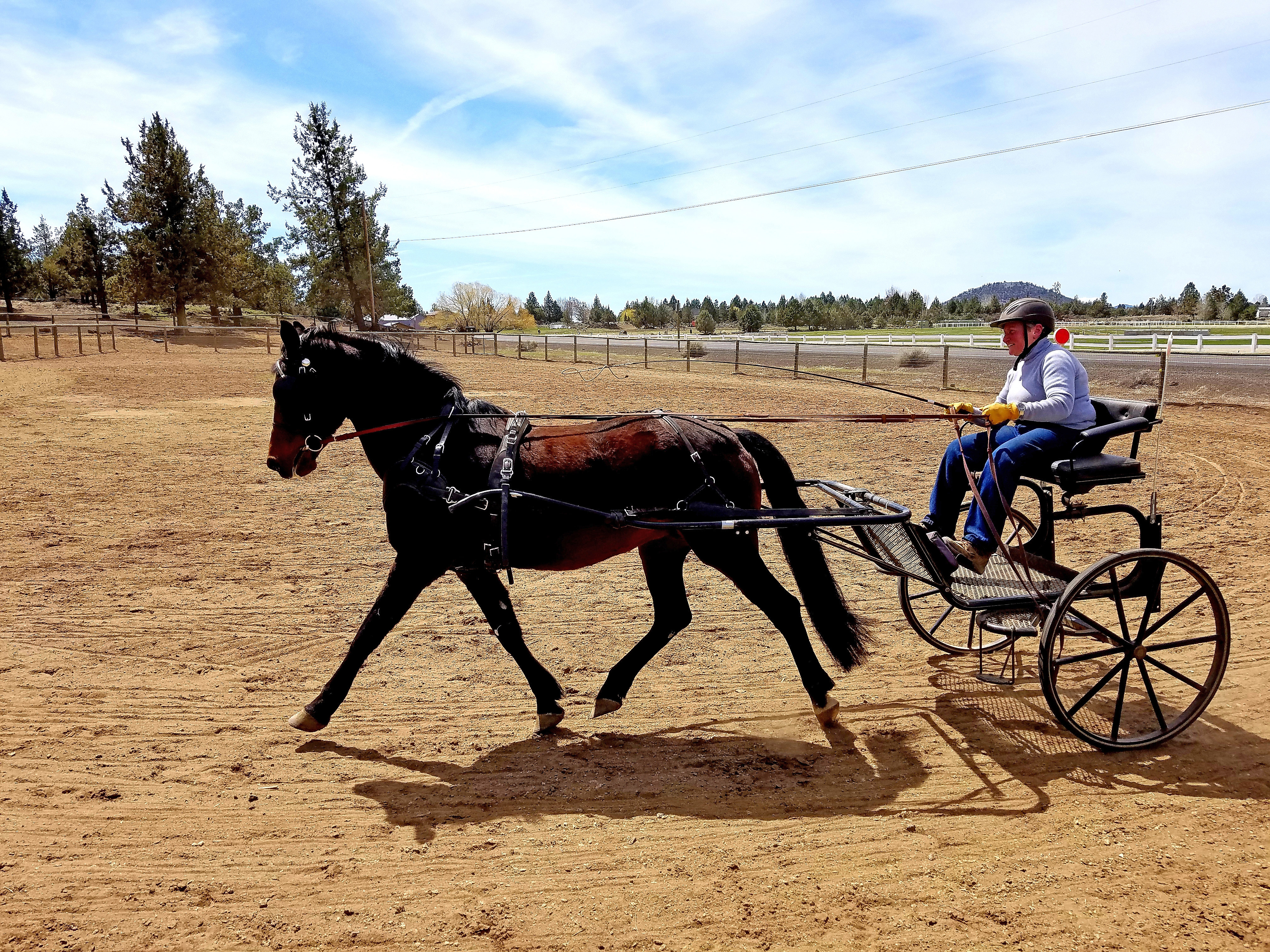
Now, Rosie and I have begun teaming again. While threading through old pictures, I found today’s caption photo. It shows me first learning to drive Rosie and captures her beautiful movement. She’s still a very energetic horse, but thanks to Megan and Sunni, I’m prepared to drive Rosie and return her to the work she loves.

Dear Readers: It’s the first leg of a journey, and no telling where it’ll take us. Diana

Horses & Fancy Hats

Sunni & Rosie in Lebanon

Thursday, June 20, 2019

Yesterday, a new level of driving training, after a sudden decision to enter my first competitive show, and before changing my mind. The actualitiy of being away from home with a horse for three days, and leaving assorted other critters behind, requires mega-logistics. My newness as a competitor adds confusion. Thoughts of showing bring many pressures, and after reflecting, preparation would be stressful in this short summer’s remaining weeks.

Meanwhile, my lesson with Sunni was about performing in a competitive dressage ring. We had to enter the ring at an appropriate speed, get correctly into position, salute the judge, and embark on a beginner’s pattern. This meant trotting at a consistent speed while making a perfect 40-metre circle. Then we had to cross the arena, trotting in a perfect diagonal, and then, make another perfect 40-metre circle (in a direction opposite our first circle). After making that second circle and trotting along another diagonal, we had to fine a center-line and move on it to the area’s center. There we stopped momentarily, to (again) salute the judge, before taking two steps backward, and then going forward–walking briefly and transitioning to a trot. Following all those moves, we could exit the ring.

In a real competition, a driving team competes in dressage and also must complete a timed cones course. The dressage and cones arenas require drivers to wear fancy hats and scarfs–clothing representing formal driving attire, in the early 20th Century, when driving was the way to get around. Oh yes, and clean shoes (heels not required). Our driving trainer says not to worry for she has a collection of appropriate hats and clothing articles.

I want to continue practicing dressage patterns, they’re great exercises in discipline for horse and driver. By next summer, my horses and I ought to be more capable of performing in a competitive environment. This would make it easier to embark on the showing-leg of our journey in driving.

Happy eye

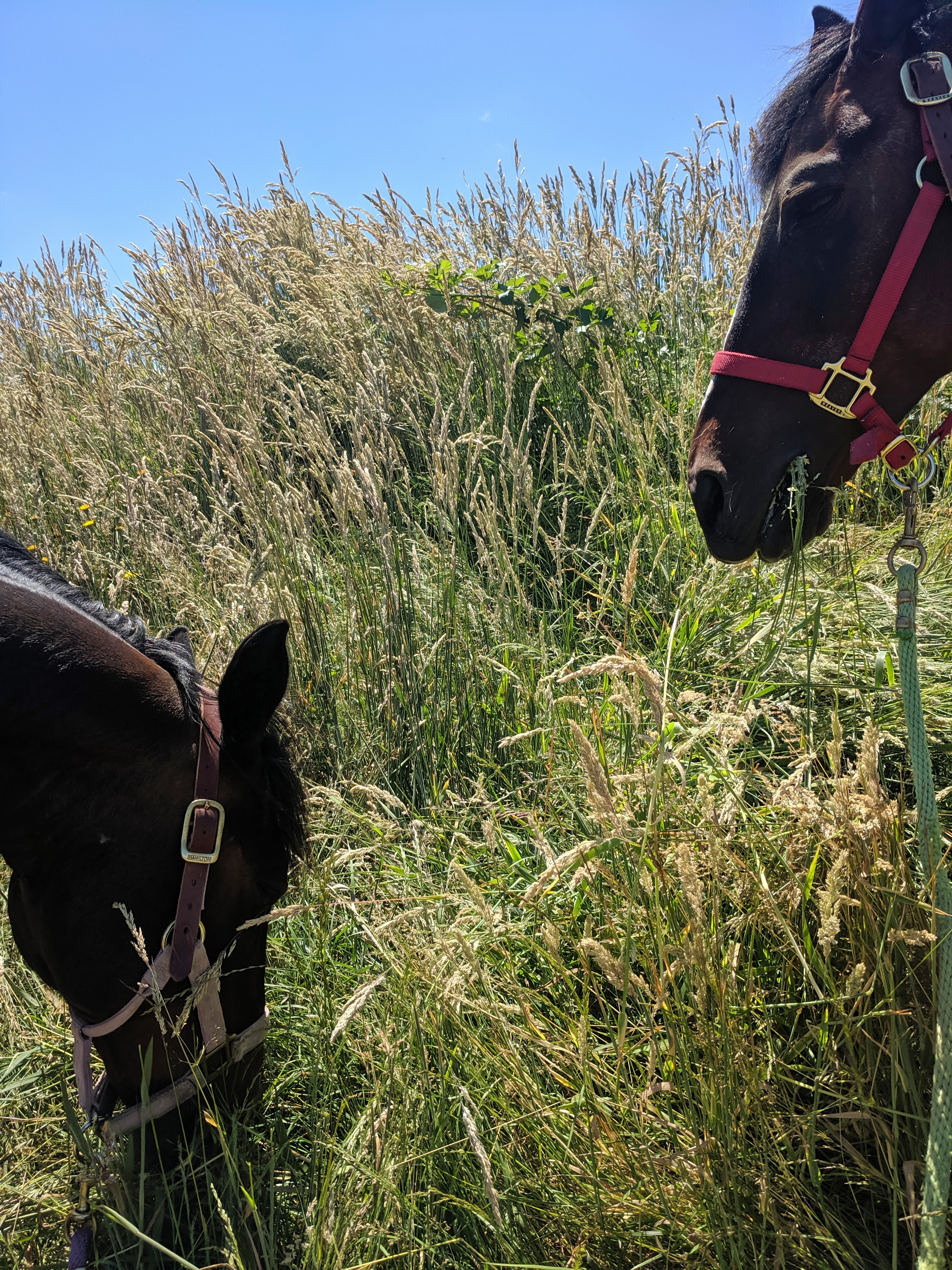
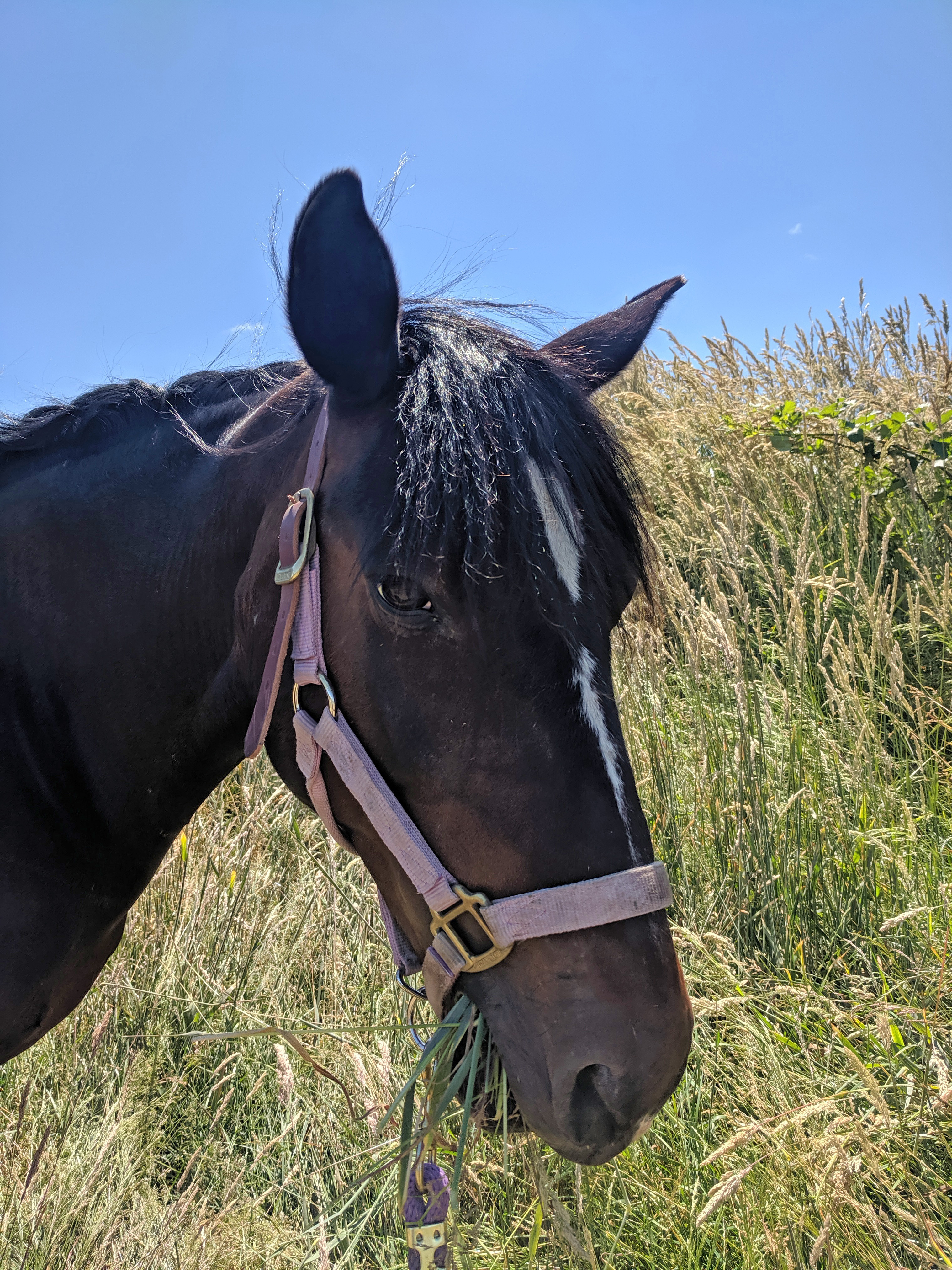
Dear Readers: Horses grazing always make chewing grass look fun! Diana

Foot Notes

Wednesday, June 19, 2019

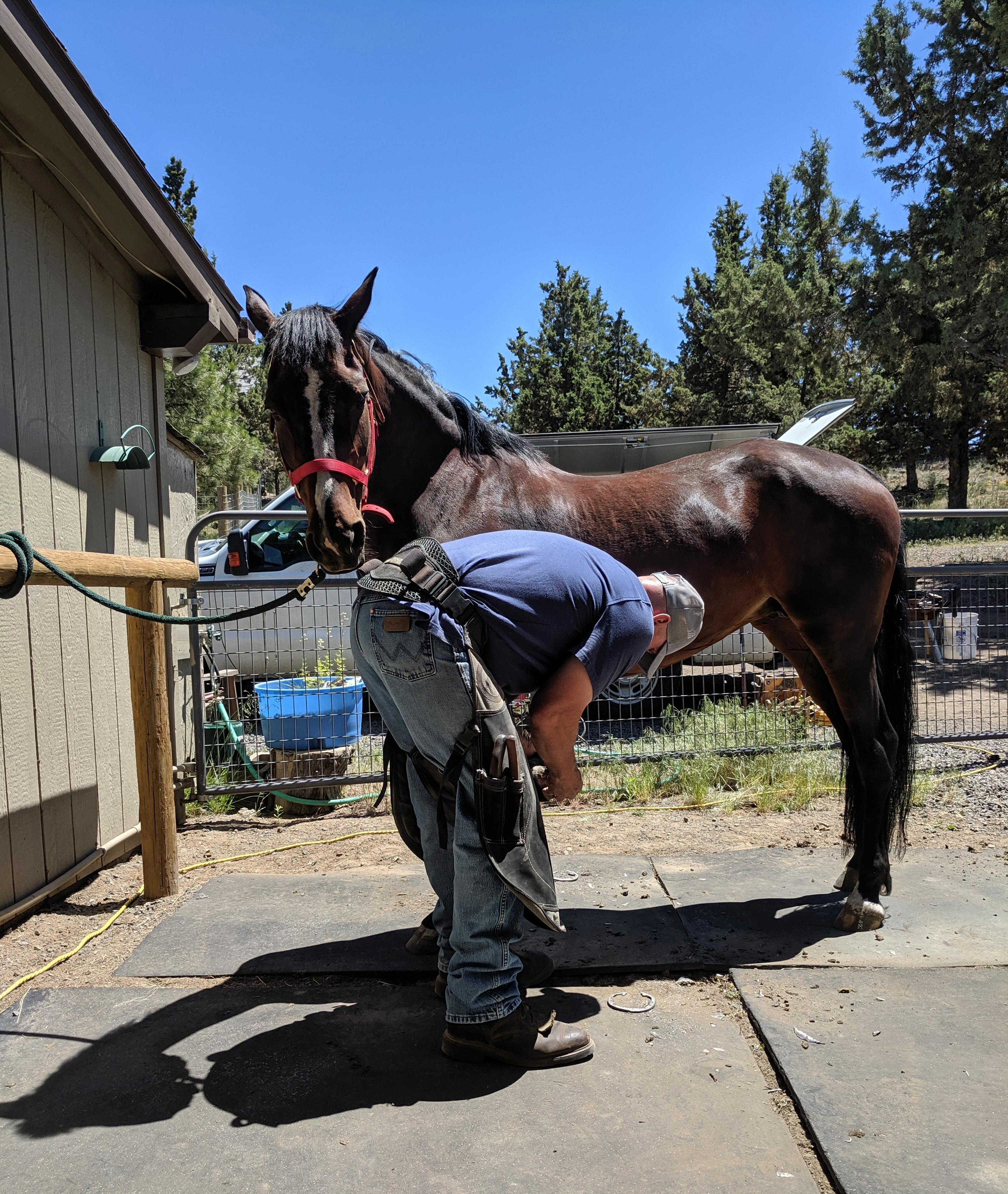
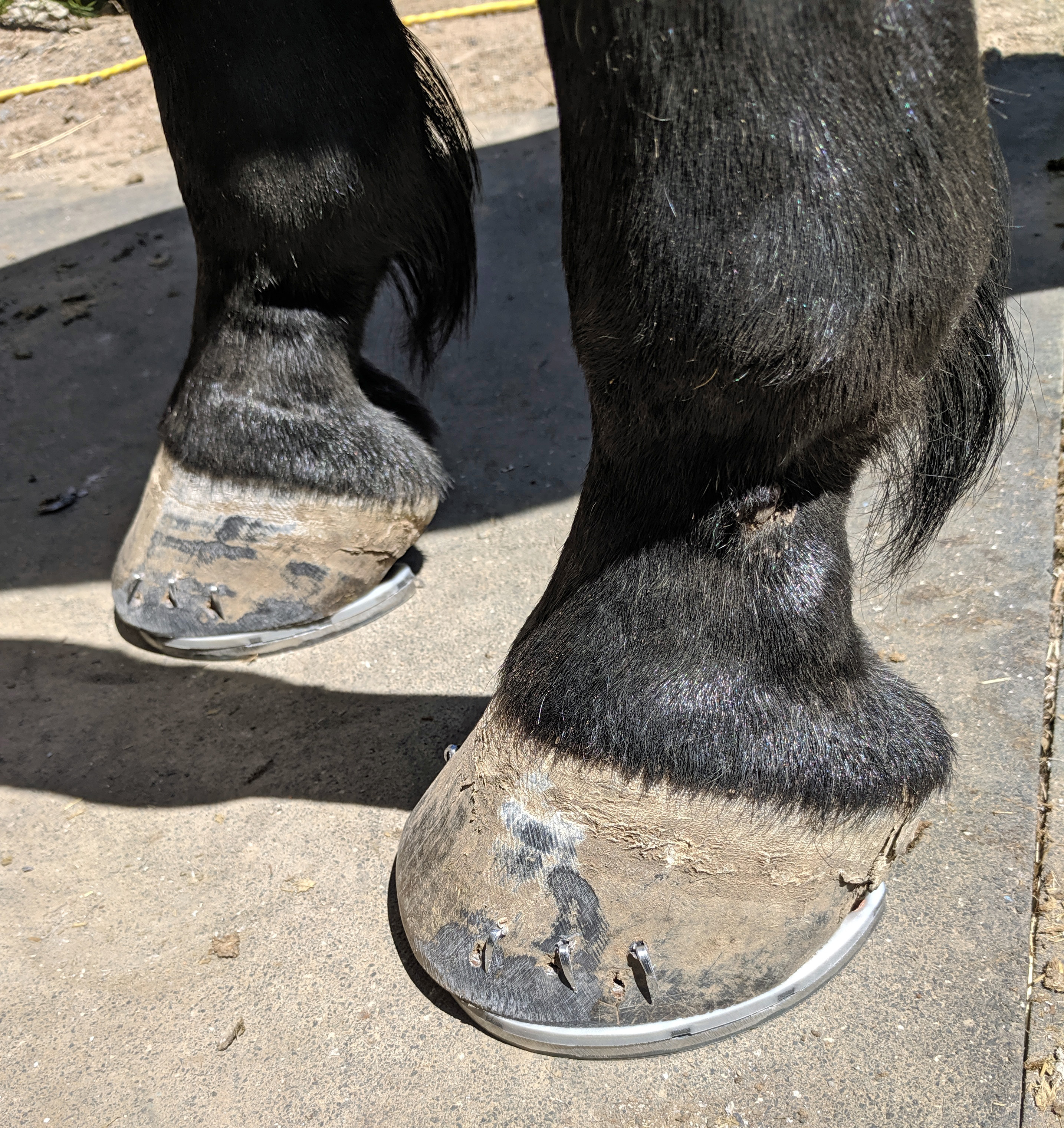
Our capable farrier this week put shoes on Rosie. Now her hooves, like Sunni’s, are armored-up, with extra padding for joint-cushioning, while she trots on hard surfaces. Yes, Rosie’s returning to work and will be moving on the neighborhood streets.

Our farrier is a very experienced fellow who can tell by looking at a leg and its hoof how a horse lifts and lands its foot. He knows how to improve physical action by correctively shoeing. In Rosie’s case, she tends to pressure the outsides of her hooves more while both springing off and landing. Over time, the insides of her hooves tend to flare from less use. Her new shoes are built-up on their outsides, with a little extra length at the back, to help her hooves push off and land more evenly. Eventually and hopefully, her muscles will readjust and change her footwork, and gradually, her shoes would be adjusted to suit the new action.

Shoeing (in progress), note the extra side and back support, and an absorbent pad between shoe and hoof

Our farrier builds Sunni’s shoes also, according to her conformation, but she moves well enough and is less worrisome. Rosie’s special needs are associated to an old leg-muscle injury that we’re trying to work her through. And fingers crossed, so far so good.

This farrier is the first so experienced and knowledgeable in my experience. It’s a little awesome all that I’m learning from him. He’s fairly new in Bend, and divides his professional time between Bishop CA and Bend.

Anyway, I’m about to load up and head over the mountains again. Both girls will get good workouts, while I’m learning more about how to manage their driving reins.

Dear Readers, have a wonderful day. Diana

Lessons From The Birds

Tuesday, June 18, 2019

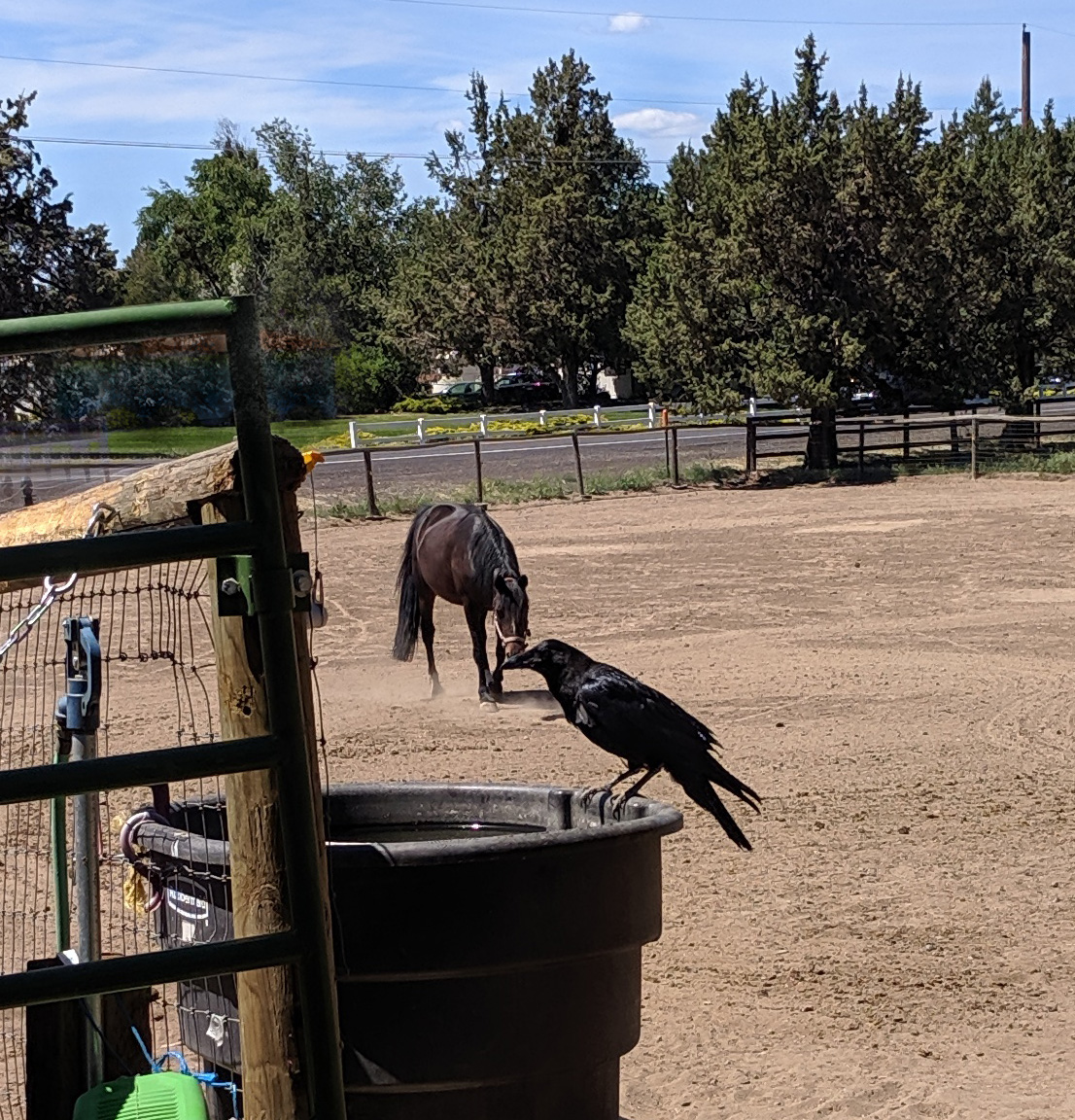
Our annual circus is in full force. The resident adult Ravens are busy with fledglings and noisily teaching those newbies. We watch the babies learn to hunt by floating on breezes and circling high above (beautiful flyers!). I see them assuage thirst in my horses’ watering troughs, clean and soften food by dunking it (leaving organic residue for me to clean). This adult pair has three juveniles, a communicative bunch. Yesterday, all five were squawking, parked on my horses’ troughs. I wasn’t quick enough to capture all the family in a photo.

This season, these birds particularly are interesting as they shift from caring for a nest to caring for fledglings. Consider the Ravens: They’re gathered, perching around the troughs, as I pass nearby. They watch closely but ignore me. The adults, accustomed to seeing me, don’t consider me a threat. Interesting, because I’m thinking about my recent resident Mountain bluebirds.

That bluebird pair annually nests in my barn where hay is stored. I’m there lots gathering food for the horses. During past weeks, the birds built a nest, sat on eggs, and fed their babies. We took turns entering and leaving the barn. When I gathered hay, the adults didn’t fly in, but sat on an entry gate with food dangling from their mouths and making noises to alert each other and me. I graciously left the barn, not re-entering, until they’d flown inside, up to the nest. Like the Ravens, those bluebirds were cautious and not particularly afraid of me. Then their babies fledged.

As I entered the barn, sudden vicious screams turned me around, in time to see a Mountain bluebird (daddy, for it was very blue) rapidly swooping toward me–feathers spread wide as possible, claws pointed forward–the thing seemed bigger than a Raven! I ducked into hiding. What had happened? On peeking out, I again became under attack. That bird (weighing maybe 3 gms.) appeared bigger-then-life, his mind full of “GTF out of here!”, without any fear whatsoever of me.

The babies must be fledging, I realized, and in a few minutes it was over. The birds had disappeared, parents and babies. I entered the barn, peered cautiously toward the nest, but eerie silence from a spot that had for weeks been noisy. I gazed around–no adults with food, nothing to stop me from being inside my barn–and oh, I missed them.

Often, I’ve watched tiny birds successfully chase big birds. The other day, I saw a couple of Starlings chasing a Red Tailed Hawk. They were threatening enough to keep the hawk scrambling to move away. In previous years, my resident Ravens have teamed to relentlessly chase a Red Tailed, frightening the predatory bird nearly to death. My experience with a seemingly not-so-tiny bluebird illustrates that “smaller and more powerful” does happen.

I suppose at the bottom line, it’s about how our many living differences manage to survive together: the powerful and the less so, the rich and the poor, the happy and the sad, those who’ve learned and those who are learning.

Dear Readers: We’ve who’ve learned realize that learning never ends. Diana

With Rosie

Driving Rosie

Monday, June 17, 2019

My mare Rosie has been coming around, after months of working to help her recover from an old injury that had stabilized. Aided by veterinary treatments and exercise, she feels better, and now, while being driven is less stressed, responds easier to physical demands and moves more flexibly.

Rosie is responsive and fast-moving, sometimes hyper-alert and worried, and does some challenging for leadership. Before Rosie came to live with me, my horses had been elderly and easy, turning me into a lax handler. In my early days with Rosie while learning to ride her, she tested me with sudden faux-spooks at innocuous objects like tree stumps. Success with Rosie meant having her understand and accept that it wouldn’t be she making the decisions. Once we were in sync, she became a dependable trail buddy.

Fast forward, and in order to drive Rosie, we had to reestablish a partnership. Still responsive and fast-moving, she wanted to decide speed and direction. Before seriously attempting to drive her, I had to take lessons, learn how to drive from scratch. Fortunately, my second mare Sunni, moderately tempered and easy to work with, could become my driving horse; she helped my confidence grow.

Finally, I harnessed and drove Rosie. We started by endlessly circling in the dry lot. Eventually, we began practicing on a quiet section of neighborhood street, and then, slowly extended our street work. At last, Rosie recently has trotted my cart entirely and well through the three-mile loop of our neighborhood.

Today, our farrier is coming, and this time, he’ll add pads to Rosie’s shoes. Like Sunni, Rosie will have cushioning for her travels on hard surfaces.

Dear Readers: Step-by-step, toward more success and newer goals for these two. Diana

Adventures In Learning

Sunday, June 16, 2019

My friend Julie–a long-time athletic-horse owner and dedicated rider, who also encourages my driving activities–loaned me this book. Over the years, its author, Bernice Ende, has made many trips, partially and fully across the United States, on horseback, finally logging some 30,000 miles. From her home in Montana, she travels alone, accompanied by her loyal dog (rescued when Ende stumbled on a puppy, forsaken and dying in a snowstorm).

I’m not far into Ende’s story, yet feel involved with her struggles while traveling alone with minimal equipment, on unfamiliar trails, in unpredictable weather. My perspective is of one who only recently learned to ride, and often went alone with my dogs, in the challenging Oregon outdoors. I’ve been in unexpected situations, without adequate equipment, like medications, maps, communication devices, and shelter in inclement weather. Each stressful situation taught me more how to prepare and what to carry. Every outing added new wisdom, more than I could have anticipated–about my horses, dogs, and most of all, myself.

Ende carries a diary and writes in detail about her experiences, struggles, conflicts, and learnings. Although she’s a lifelong horseback rider, those long rides taught her more about horses. She writes about people she met along the way and the kindnesses they offered. I’m too early into the book to speak adequately about her adventures, but do identify greatly with her early learning experiences, on that initial long ride from Montana to New Mexico.

Ende carries a diary, writes in detail about her experiences, struggles, conflicts, and learnings. Although she’s a lifelong horseback rider, those long rides have taught her more about horses; and she writes about people she’s met along the way and the kindnesses they’ve offered. I’m too early into the book to speak enough about her adventures, but do identify greatly with her experiences, on an initial long ride from Montana to New Mexico.

Recently, I’ve been struck by the Facebook page of a savvy and adventurous young woman, Emma Massengale, who’s posted her travels by bicycle, through Europe while pulling a special wagon built by her boyfriend. It carries her two newest ponies and has an overhead compartment for her dog. She photographed and videoed images of the trip that include many folks who greeted and assisted her.

My own perspective draws on the excitement, anxiety, and satisfaction that I’ve felt while learning to drive my two very different horses. One with a calm, easy manner, and the other anxious and worried. Yet, both are superb in their own ways, and forcing me to learn how to accommodate their differences.

Dear Readers, perhaps living is much about taking risks and learning well. Diana

The Cart Before A Horse

Saturday, June 15, 2019

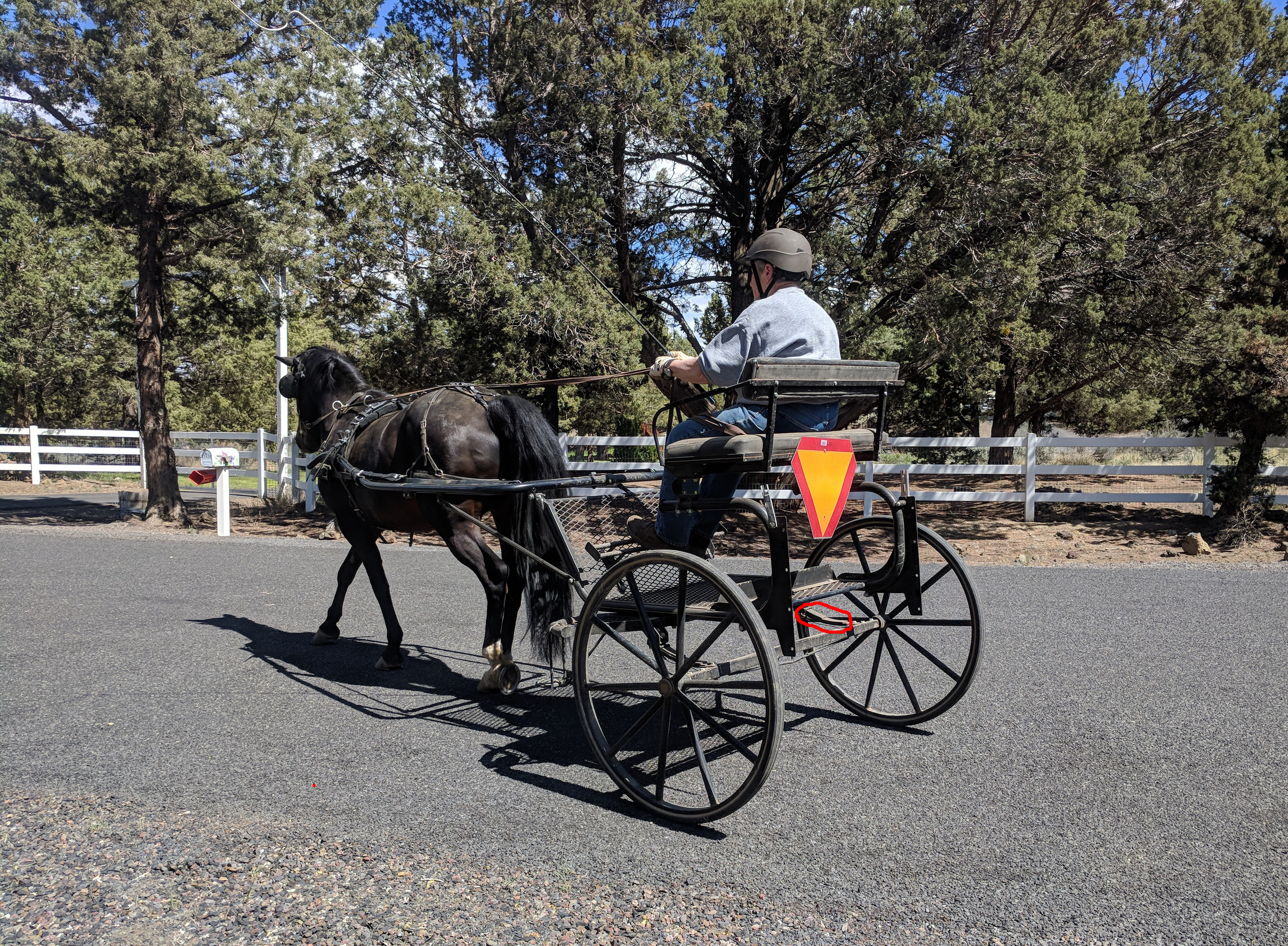
The photo above shows Sunni pulling my driving cart. I’ve inserted a red circle around one of its shock absorbers, a critical part not easy to highlight. The other day, as Rosie trotted and pulled my cart along a neighborhood street, I felt a jolt and heard the ping of metal hitting pavement. In the couple of steps it took Rosie to halt, my experience in the cart felt really weird.

I stepped out and saw under the cart a support strap hanging freely, and found in the road a sheared-off heavy bolt. The cart was mobile and Rosie pulled it home (my ride was high-bouncing). Finally, I stood staring at the heavy steel cart, at the sheared bolt in my hand, and felt reluctant to send the cart somewhere capable of fixing it. Because for some period I’d have no cart. Keeping a horse fit and relaxed means exercising it, and for me, this depends on driving regularly. The situation forced my emergency option of calling on Frank, my kind neighbor. His ongoing hobby is restoring from scratch a classic English (Morgan) sports convertible.

Frank grasped what needed doing and I became his go-to for tools and parts. Although replacing bolts is an easy job, not for these. This cart has a slanting stance, its offsetting pressures make it difficult to align holes. Frank found the added problem of another sheared bolt, partly jammed into its hole by the cart’s slanting weight. Although the unjamming was challenging, Frank got it done, and as a caution, he replaced the bolts holding in place a second (companion) shock absorber. Thanks to him, my cart suffered only one down-day.

It turns out that each of the cart’s shock absorbers has two holding bolts and all under enormous pressure, for the absorbers bounce over smooth and bumpy terrains alike, eventually weaking the bolts. I’d not noticed, that previously, one of the damaged shock’s bolts had sheared off, leaving a single bolt holding. That’s why I so felt it break.

Thanks to Frank, my horses promptly began pulling on the roads. And thanks to that (relatively) inconsequential accident, I’ve learned to examine regularly the components holding together the cart, and to change periodically those that receive the greatest stresses during routine use.

Dear Readers: We who like to be independent also need a community. Diana

High Desert’s Spring Colors

Friday, June 14, 2019

Yesterday afternoon’s temperature was high, and as it evolved became too hot for my dogs during a spontaneous color-hunting outing. Following this high desert’s unusually frequent rains, the area is full of wildflowers in many colors and sprouting in sand. I try with a phone app to identify plants, but accuracy depends on a photograph’s clarity, meaning light’s direction and strength, and a plant’s steadiness (or not) in breezes. Often my app delivers a mixed-bag of identification–maybe right-on or way-off. This lack of total specificity is okay, for flowers simply speak for themselves.

After tossing aside specificity, I began searching for color mixes, looking for plants set naturally and inspiring a desire to frame them. There were many opportunities from some plants very tiny and others tall enough to wave in that afternoon’s mild wind.

If my wish to focus on small plants continues, there’s another and more technical consideration. Good as my current lens may be, it’s probably worthwhile to seek another that’s more capable in close-ups of capturing minute details and color variations.

If one looks at the larger area where the dogs and I hiked, the varieties of plants and colors aren’t quickly visible. From horseback in past high desert outings, I rarely focused on flowers (except Sego Lilies which pop up briefly and are stunning). But these days I’m on foot and closer proximity makes a great difference.

My ruminations were interrupted by quirky dogs. Osix wasn’t eager to follow, making it clear that she felt hot and insisted on returning to the car. I urged her along, until before long and realizing that Miles already had disappeared, I gave up and turned around. Almost instantly, Osix, too, was gone. As always, my loyal trail buddies, Louie and Ranger, stayed with me until the bitter end.

Happily, my camera had captured cool portraits of the territory and dogs.

Louie
Osix

This capture isn’t special, but illustrates just who he is….

Ranger

A couple more favorites while heading back to my car:

And, finally…more monkey faces:

Dear Friends, for the next round of plants, I’ll use a more specialized lens. Diana

Daisies & Orchardgrass & Sweat

Thursday, June 13, 2019

En route to Lebanon for sessions with our driving trainer, I usually pause near Sweet Home, to enjoy a few minutes at Foster Lake, where this time, I stumbled upon an almost hidden path leading down to the water. There I found another path and felt my way along, until standing next to the water, I looked around. One feels tiny among the tall stalks of sunflowers, orchard grass, and blackberry bushes. Many times I’ve stood and admired Foster Lake without noticing a footpath that allows one closer to the water.

Water is magical and I found myself enjoying rare tranquility. The only interruptions to this unexpected peacefulness were a speedboat, and overhead, a Raven carrying food for its young.

I worked my way back to the rig and continued to Lebanon where I unloading the horses and lead them to an overgrown area to let them graze awhile. I was delighted to find us literally wading in orchard grasses, plentiful and tall, like those surrounding Foster Lake. The horses pigged-out on it.

Afterwards, each horse had a strenuous training session, and then, received well-deserved baths. Our trainer points out that Sunni’s in such good condition, she barely sweats. On the other hand, Rosie emerged from training a foamy mess. After baths they were pretty again.

Each training event clarifies better to me one or more elements of handling the driving reins. Yesterday, what got through is how much driving effectively is about “feeling a horse” through the reins. In other words, noticing if a horse “drops” the bit or “is seeking” direction. Driving is a complex and subtle process. Mastering it could heighten the overall experience by tons, for driver and horse alike.

Dear Friends, A hot, sunny day in the Valley, and home again to an after-rain. Diana