Energy-Bringing Rain

Barnglow through rainy predawn

Saturday, April 20, 2019

The overnight rain is invigorating, even if it’s just another downpour during weeks of more rain in this area than we’ve seen for years. In these early hours and to the bewilderment of my sleepy dogs, I tiptoed outside with a camera to capture some dripping, tapping loveliness.

Not long ago, our local stores began bringing in flowers. It’s always exciting and I purchased a few, even knowing that for awhile I’d be too busy to plant them. Fortunately, they’re enjoying this damp balmy weather. One on my small deck needs re-potting, the other should be in the ground and attached to a trellis, but now, in this early morning they’re happy, soaking in atmosphere.

So am I, for the whole outside, though dim, feels comfortable and beckoning. From my deck, the shadowy trees are alive with sleepy, watchful birds. Upon seeing me, they began calling, warning of disturbance in this normally quiet, very early morning.

Enhanced image from west deck

This week’s days were wonderful–warm and sunny with voluminous clouds–and the evenings relatively warm. Sleeping hasn’t required a heated blanket. Already now, the overnight rain has diminished and today is beginning as another lovely.

Yes indeed, it’s a Central Oregon springtime.

Dear Friends, have a marvelous day. Diana

From My Kitchen

Pink Moon

Friday, April 19, 2019

From a kitchen window I can see the sky, and when clouds are right a moon that rises above the treetops. Last night as I fixed dinner, the moon that appeared in a cloudless sky was close and beautiful, bright and spellbinding. It compelled me to stop what I was doing, grab my camera with the strongest zoom lens, and hurry outside to capture that view.

A little research told me that it’s called a “pink moon”, or otherwise the full moon of April. This full moon, like all the others was named by early Native Americans. It represents the time in spring when there are growths of pink ground phlox, or moss pink. The moon itself doesn’t change color, not even when we see a “blood moon” or a “blue moon”. Those colors that seem to be actually are reflections of atmospheric conditions affecting the moon’s appearance.

Moss pink is a flowering ground cover that grows in almost every kind of soil, blooms on for several weeks, and some of its species are invasive.

Wild Pink Ground Phlox, a native flower to N. America

And so, the April pink moon tells us what’s growing wild and widespread. Last night’s moon isn’t yet gone. This morning, it’s at its fullest, and this evening will be visible still as Good Friday’s full moon.

Forever it seems, we’ve heard that full moons affect the behavior of living beings. It’s telling that the words lunacy and lunatic derive from “luna”, the Latin word for moon. There’s no scientific evidence that relates full moons to behavioral extremes, but it’s thought that gravitational influences may bring about social tension and disharmony.

I’m pretty sure that last evening some force larger than myself pulled me outside to capture that moon, as if its image would reveal deep meanings. Well okay, but I’m a drop in the bucket of all living beings. Everything alive feels, and in their various ways, responds to the powers of full moons.

Dear Friends, tonight look upward, and experience that incredible moon! Diana

Beauty And The Beats

Northern Flicker in a juniper

Thursday, April 18, 2019

They’re back! So beautiful those Flicker Woodpeckers, and such nuisances. One year, long ago, I ignored a Flicker’s hammering until seeing clearly that the bird had drilled a huge hole high on the side of my house. That hole stood out for years until finally a house painter repaired and covered it.

Afterwards and always upon hearing the Flicker’s distinctive hammering, I try to determine a direction it’s coming from, and if it seems near my house, I hurry over there, waving a stick, jacket, or towel, and yelling for that bird to go!

The thing is, they remember where they’ve been working and may return to the site. So, knowing they’re back, I stalk around my property, at-the-ready to try and frighten them away, while at the same time enjoying each sighting of the absolutely gorgeous birds.

The Flicker’s voice is as distinctive as its appearance. I’m not sure how to describe well enough its loud, single-note call that ends with a distinctive drop in sound. A visit to the Cornell Lab’s terrific bird site explains that a woodpecker’s drumming session continues for about 25 beats, before the bird slightly shifts away to start a new beating series. Cornell Lab explains that a woodpecker’s drummings are the communication equivalents of a songbird’s singing.

Ah, and mostly happily, they’re back!

Dear Friends, have a wonderful day. Diana

Feasts For The Eyes

Wednesday, April 17, 2019

This season’s Mountain Bluebirds have arrived. I followed one around while trying to take a photo with my cell phone as the bright fellow hopped mostly beyond camera range. The bird I watched hunted for a while near a busy Robin, and each did its work undisturbed by the other’s close presence. No surprise, for bluebirds are members of the thrush family and thus closely related to Robins.

Last year, a pair of bluebirds built a nest inside my barn and slightly above where I enter and exit while working. They watched me closely, but not seeming particularly bothered by my nearness to their nest. I very carefully remained as quiet and nonthreatening as possible. The two were a hardworking team, taking turns hunting and watching their nest. While caring for their eggs, the two alternated hunting and nest-setting. After the babies emerged, both parents stayed busy, and I loved hearing cheeping sounds from that nest.

I hoped that this year the original pair or at least one of their offspring would nest-build in my barn, but not so. They’re nearby though, high in trees except for hunting expeditions. Often they’re sitting quietly and watching me closely, same as last year.

The beautiful males sport more blue feathers than the females whose undersides are somewhat tan. In previous years, I’ve seen blues with red bellies that suggest their close relationship to Robins. I’m wondering if the blue- and red-bellies alike are members of the same batch. One or two Blues in an area suggests the presence of many more as they tend to migrate in flocks, and this year I’ll be alert to see whether reddish bellies are in the mix.

Dear Friends, some of the loveliest beings enter with spring. Diana

Prelude to Summer Fun

Exercising on the long lines

Tuesday, April 16, 2019

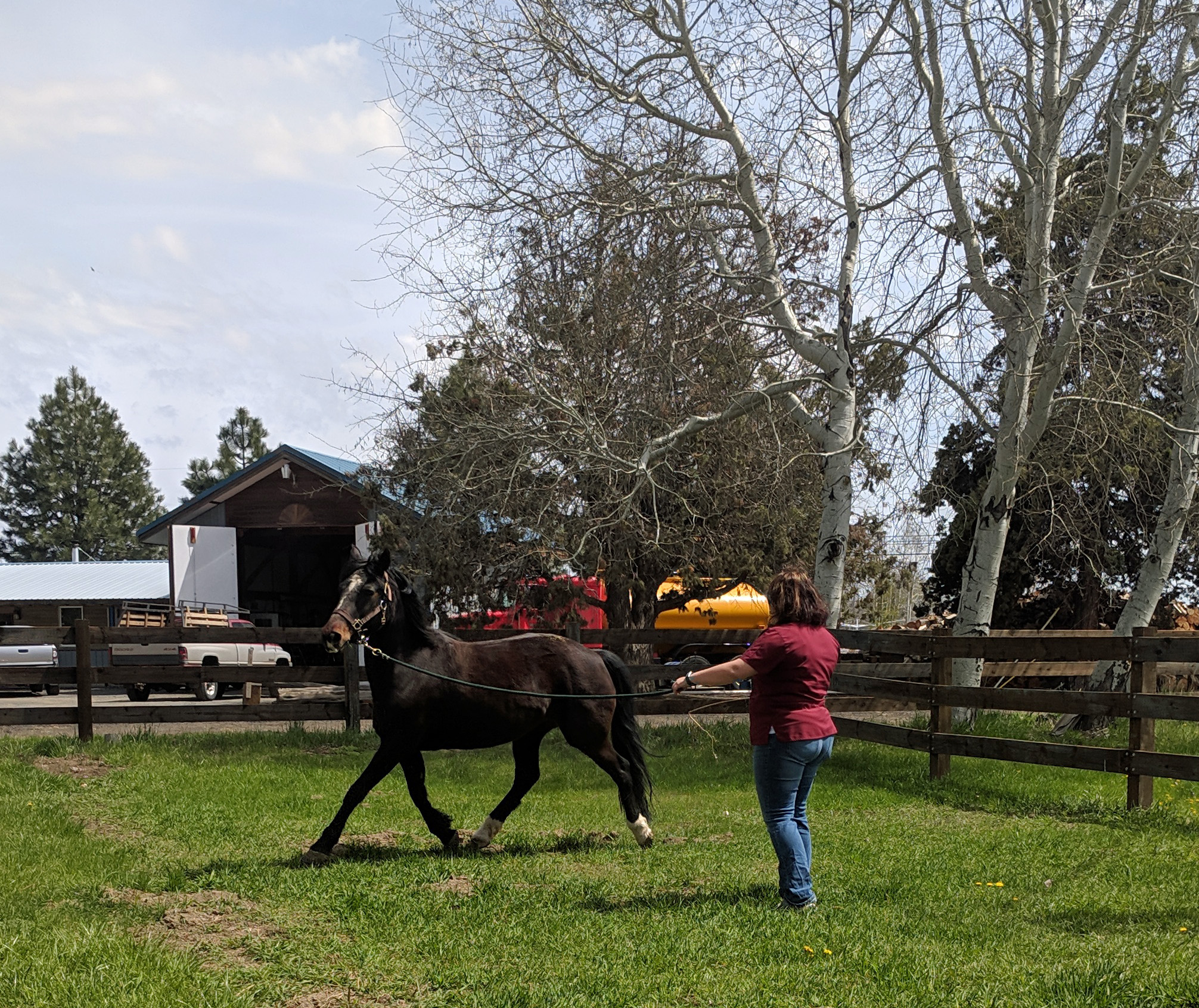
Thanks to my neighbor, Frank, for the photo of me working Sunni with long lines while Rosie hangs out on the side. Both girls got their workouts, it’s the beginning of getting them into shape for cart-pulling days ahead.

This year, instead of hauling horses over the mountains to our trainer for sprucing up, I’m taking on the work of reacclimating them to harness and handling. Constantly working the ropes and keeping a horse moving correctly takes strength, in my case it also means swallowing dust.

In long-lining, the trainer uses two 30-foot ropes to simulate rein handling while driving a horse. The near rope guides the horse to move in a circle, and the off rope allows the horse to move out and maintain a wide circle. While sitting behind a hitched and moving horse, a driver’s hands and elbows constantly are busy and guiding. Long-lining an exercising horse requires a handler’s similarly active arms to guide and control.

I’ll long-line as often as possible considering our somewhat unpredictable weather and my part-time job schedule. These experienced horses need only a week or so of this routine before they’re ready for hitching. Sunni will restart her conditioning workouts in the neighborhood. Rosie’s somewhat higher energy takes slightly more handling, and we’ll practice in the workout arena before moving on to local streets.

Dear Friends, our pets with jobs love working, and they keep us young. Diana

Donkey Daze

Monday, April 15, 2019

What’s this character thinking about? She’s just finished rolling, having a good scratchback, is about to rise onto her feet, and what’s next? As it turns out, she comes to me looking for treats, but instead gets some good ear-scratching which she loves.

I’d never even seen a donkey in person before Pimmy showed up several years ago to become a companion to my horses. After my initial wondering about this pony-size, horsey-looking creature, I began recognizing her as a tough critter who quickly became devoted to her horses. Finally, with me, she became rather dog-like, loving attention and petting.

Folks driving past that part of my property with the equines sometimes stop and ask about Pimmy. They’ve not previously known donkeys and wonder about her personality and challenges in caring for her. I explain that she’s not, as she might appear, sleepy and slow. She’s incredibly intelligent, highly aware, and easy to care for.

Pimmy is a wild-bred donkey from the California BLM, adopted as a yearling by a couple in Oregon. When Pimmy was 12, that couple, with a newborn child, downsized their animal population. That’s when Pimmy came to me. Since she’d spent her first year in a wild herd, Pimmy is savvy to herd behavior. She’s integrated herself well with my two horses. One of these, Rosie, is a dominant mare who brooks little tolerance for those lesser in the herd’s hierarchy. Pimmy has become Rosie’s constant companion. She’s allowed to share Rosie’s space in the loafing shed, shares Rosie’s hay, and generally stays near the mare. Yes, Pimmy knows where her bread is buttered. At the same time, she gets along equally well with Sunni, the lesser-dominant mare.

This donkey is protective, sweet, smart, and generally undemanding. My learning has been, that among large animals, donkeys rank at the top of the heap. They can be ridden and trained to dressage levels, harnessed and driven, packed and ponied. In a nutshell, they’re easy-care, smart, protective, and like cute puppies, just plain lovable.

Dear Friends, have a delightful day. Diana

Shaking Off Winter

Sunni

Sunday, April 14, 2019

While outside, walking in circles to lunge Sunni, I managed to grapple for my phone, and surprisingly, caught a photo. After months of not moving around, that was her first time being asked to exercise. I didn’t push beyond insisting on a steady trot, and she responded lazy-like as the photo suggests.

Early on that slightly chilly and very windy day, I decided to start working toward a goal with the horses. An initial problem was getting myself out of the house, which did happen. Before lunging Sunni, I first worked with Rosie who’s a little higher strung. She volunteered some minutes of cantering before settling into a trot. Exercising is a necessity, and happily for both horses (soon also Pimmy), we’re getting into action.

There would be no workouts for the girls before each received a serious session of brushing and combing, during which enough winter hair came off the two to create an entire sofa. From where they were tied outside, high winds blew their coat, mane, and tail discards straight into my barn.

Coming out of those lazy winter months, the equines are in good condition, and although soft from standing around, their weights are appropriate. My original intent was to harness and ground drive the horses, and start preparing them for cart driving, but the gusty, chilly winds were discouraging. As it turned out, lunging them without making many demands was the right ticket for us all.

As for me, it’s about time to start moving after months simply of bringing the horses in to feed and afterwards turning them out. The handling of them while ground driving and later cart driving is hard work. Those recent months of inactivity might push me back to a public gym for necessary self-strengthening.

Yesterday, several lots of deer, in little herds, roamed through the property. While starting toward the barn to begin working with the horses, I was surprised to find eight does grazing beside my path. It especially was nice to observe that since early spring they’ve gained weight, no hipbones sticking out. They watched, not seeming very worried as I slowed, and in an easy, nonthreatening manner pulled out my phone and took their photo.

Dear Friends, I hope you’re having fun, greeting this new spring. Diana

Late Daylight Drama

Broken Top

Sunday, April 13, 2019

Yesterday was beautiful, a “shirtsleeve day” (requiring me to wear only two sweaters!), with sunshine and a dazzlingly clear sky. Clouds were so thick they almost stumbled over one another. By late afternoon, the mountains fully had emerged, ghostlike, clear, and seeming to arise straight out of the clouds. My camera couldn’t capture nearly enough craggy details, but it did catch the overall drama.

South Sister

Slightly north of Broken Top stands the bold South Sister. By yesterday evening, it had emerged, icy and serene, with sparkling highlights. Among the Sister Mountains, the South Sister is the most climbed, as it’s easily accessible. One can park at Devil’s Lake and by crossing the Cascade Lakes Highway find a sudden climbing path that ascends sharply.

The late compelling sky over Broken Top and the South Sister provided that duo with a fluffy backdrop.

Broken Top & South Sister

Which brings me to the sky itself, where an amazing array of immense clouds over the northernmost mountains covered and mimicked them.

Clouds with aspen

Dear Friends, In spring weather, new variations abound of skies and mountains. Diana

Threading A History

Friday, April 12, 201e

I’m pleased after many years of not knitting to find it easy to regain the basics, or almost to where earlier self-teaching efforts had advanced my skills. This week of practicing to create a dishrag has my needles casting on, knitting, purling, and casting off. So far, only a portion of the rag is knitted, and to be honest what’s done doesn’t much represent the instructions and pattern. To my chagrin, it’s easy to lose track of counts, to slip stitches, and to create odd workarounds, but this dishrag eventually will be an item that’s useful. It’s very good and freeing that I alone might ever see the finished product.

This act of knitting makes watching television easier while trying to follow the political mishegoss, wanting both to know what’s going on and blocking some details. This knitting forces me to remember differing row patterns, so I half-hear and half-miss the talking-heads’ perspectives. Besides, my mind, busy in the directions of yarns and weaves, has dredged up an old college course led by a couple, with doctorates, who specialized in the history of clothing and had primary expertise in women’s wear.

I think about the broader history of yarns and cloth. We know that ancient Romans wore togas, so in those days cloth and various connecting materials existed, but when in times prior did people first create body coverings? Apparently, cold weather had much to do with this. The earliest “yarns” might have been leather cords connecting animal skins to adequately cover humans. The making of fiber has been dated to before 10,000 BC, and the weaving into cloth of threads from animal fur, plants, and silkworms began about 35,000 years ago.

The complex history of fabrics and clothing goes hand in glove with changing social norms in developing populations. The story of clothing itself weaves a broad tapestry, and its possibilities consume, helping me lose track of row and stitch counts in a dishrag-to-be, while watching television and reflecting on ages-old sociology and geography issues.

Dear Friends, it’s an incredibly complex mix, social norms and human nature. Diana


Catching Up Over Coffee

Thursday, April 11, 2019

A casual friend I’d not seen in a while came shopping at Costco on a day I worked there. She’s politically savvy, and I’d been thinking about her, wondering how she views our particularly dynamic environment. Besides, she’s a person kind and considerate whom I enjoy. We agreed to meet for coffee and catch up.

She’s a native of Salem, Oregon, went to college in California, became a social worker and spent most of her adult life in Alaska, while married to an attorney and raising children. Several years ago she and her husband retired to Bend. This is a sketch of her life–informed by education, geography, sociology, and experience–and the story of one who has gained wisdom and patience.

We shared political perspectives. Some of her observations felt surprising, but were thoughtful and current, informed by immense challenges in today’s public leadership. She’s open to learning more, assured that the future will expand her ideas. Where we didn’t see eye-to-eye, we listened and respected one another, and in political discussions that’s a win-win.

People who think in similar ways often are open to sharing some of their histories. My friend explained some of the sociological aspects of life in Alaska, and I associated her observations to my own past visits to a dear friend who for many years resided in Arizona’s Navajo Nation.

It’s refreshing how an hour or so over cups of coffee gives folks opportunities to learn more about each other. And it’s reassuring that no matter how many variances may exist among individual life stories, we all share similar desires, to strive, achieve, gain a philosophy, and cherish.

Dear Friends, have a wonderful day. Diana