Perfect Portrait

Monday, May 11, 2020

At last, my deep passion again is alive for the few great films that can tap fully into a viewer’s vision, intellect, and feelings. It’s because of a new film streaming on Hulu, “Portrait of a Lady on Fire”. This work is well-scripted, -directed, -photographed, and -performed. The film might be perfect. It’s spoken in French with subtitles. New to me is the writer/director, Céline Sciamma, whose catalog of work I intend to explore.

Maybe this isn’t a film for everyone. It’s a woman’s story, set in the late 1700s when few women had any independent rights or a path toward having income, unless she had a husband. The primary four characters are a painter, a promised bride, a housemaid, and the bride-to-be’s mother. The mother wants a portrait to present to the daughter’s suitor, a Milanese nobleman. In those days, a well-married daughter can stabilize a family’s finances.

This daughter will replace as a bride her older sister who, refusing to marry, committed suicide. This daughter is objecting and has refused to pose for a portrait. A male artist failing to capture her has departed. The mother now hires a woman, asking her to pretend to be a “walking companion” to the daughter. This will let the artist secretly observe her subject and paint the portrait.

The woman artist is cultured and relatively independent (she’ll ultimately inherit her father’s successful art gallery). She’s very talented and does manage to produce a painting. When it’s seen by the intended bride, she becomes angry over the secrecy and portrait. That painting is decent, but uninhabited by reality and disappoints. Here’s where the story pivots.

The mother wants to fire this painter, but the bride declares suddenly that she will pose. Thus, the painter stays and will work during a period when the mother is away traveling. This leaves on their own three young women, the painter, the bride, and a housemaid. The portrait painting continues, now with both artist and model. All three women become casual housemates, equal without rank, cooking for and reading to one another. The housemaid is pregnant and the others help her try lose the baby. Ultimately, all three become involved in a typical 18th Century abortion process.

A deep closeness between the painter and subject turns into a beautifully presented love story, with each bringing the other more alive. They’re a creative, spontaneous, joyful couple.

I’ll leave it there, but will add that I’ve re-watched this film, several times. I’ve wanted to absorb better its dialogue, lighting, and mood, and wanted to comprehend and sort its multiple themes. A film that attracts me so greatly is one I recommend without reservations to other serious viewers.

Tap on this link for the New York Times review: https://www.nytimes.com/2019/12/05/movies/portrait-of-a-lady-on-fire-review.html

Dear Friends: The upshot is that it pays to thumb often through our streaming options. Diana

A Careless Instant

Sunday, May 10, 2020

Today is another that’ll have me loading and dumping. It’s also Mother’s Day, a holiday I’ve not celebrated since my mom passed years ago, but the timing suggests that today dumpers might be a sparse group.

Yesterday all went well at the city landfill. Both my truck and trailer behaved. A problem occurred though and it was my fault. On first arriving, a guide flagged me toward a complicated space. After swinging my rig into position, the truck’s rear view mirrors didn’t show clearly how to back correctly into an open position between other rigs. When a young site worker offered to back my rig, I accepted gratefully. As he climbed into my truck I zeroed-in, that he was without gloves, had a mask hanging under his chin. He accurately backed the rig, easing my next steps, but I’d let my truck be exposed to possible contamination. And then, couldn’t find my hand sanitizer.

These days at home, we’ve learned steps for personal safety from television and computers. We’re alert to self-isolating guidelines, go into public infrequently, and at the grocery wear mask and gloves. Yesterday I learned that performing an unusual activity blocked my alertness to Corvid-19. At the dump site there were signs that reminded people to stay at least six feet apart. And yet, I let an unprotected stranger into my personal space.

He’s probably no disease spreader, but that situation taught me a lesson. My impulsive acceptance of help and afterwards doubts, were painful reminders to maintain a rigid vigilance during this active disease period.

On my next trip there and successfully backing the truck and trailer, I vowed to do my own driving always.

Dear Friends: As opportunities open to be among others, remember to practice safety. Diana

Endless Challenges

Western Junipers

Saturday, May 09, 2020

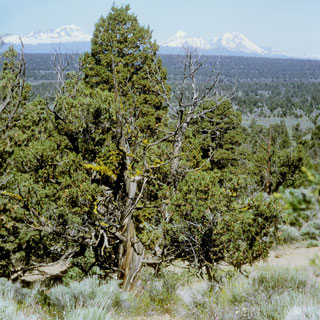
This is the first of a series of no-charge dumping days at the local trash site. For days, I’ll load piles of trimmed branches and greenery and haul to the landfill. To visualize my waiting piles, imagine the trash after six weeks of chainsaw work on trees. Half of my small acreage is covered in trees, mostly junipers, previously untouched for years.

This trimming began like a simple project. My kitchen window focuses my attention on a couple of tall trees. They’d been too-close together with tangled branches, and had half-sawn limbs from a previous owner’s clean-up. Those tangles and shortened limbs bothered me and I vowed to get rid of them someday. Viola! Corovid-19 and stay-at-home, I’m laid-off from work, and now, it’s time to wield a chainsaw.

Cleaning trees turned into a large process. My window hadn’t revealed that most other junipers, too, had dead limbs and tangles. I learned that improving sections of trees is like painting the inside of a house. One area that suddenly looks better highlights the neediness of another–or regarding my trees, all others. From then on, every afternoon, with chainsaws–one for reaching high and another for cutting low, I stayed busy. The discards grew into another challenge that required attention. Fortunately, my trimming frenzy ended in time to take advantage of the Landfill’s free spring clean-up days.

This morning, I’d feel more confident about dumping if it hadn’t been years since my big trailer last saw action. I’ve tested its hydraulics which seem to work, and am crossing fingers that at the site the bucket will lift and lower. My truck last summer hauled horses weekly back and forth over the Cascades, but it’s sat unused throughout winter. Years ago when I hauled frequently to the dump, I’ve had the trailer get stuck straight-up and refuse to lower. I’ve had the truck motor fail to start so I could leave the dump. Those times meant calling for a mobile repairman and waiting while blocking other dumpers until finally help arrived.

These days with nearly everybody stuck at home, we’re all probably cleaning properties. The lines for dumping will be long–and now, I’m on my way, too.

Dear Friends: Please keep a good thought for my being speedy and all going well. Diana

Riding

Friday, May 08, 2020

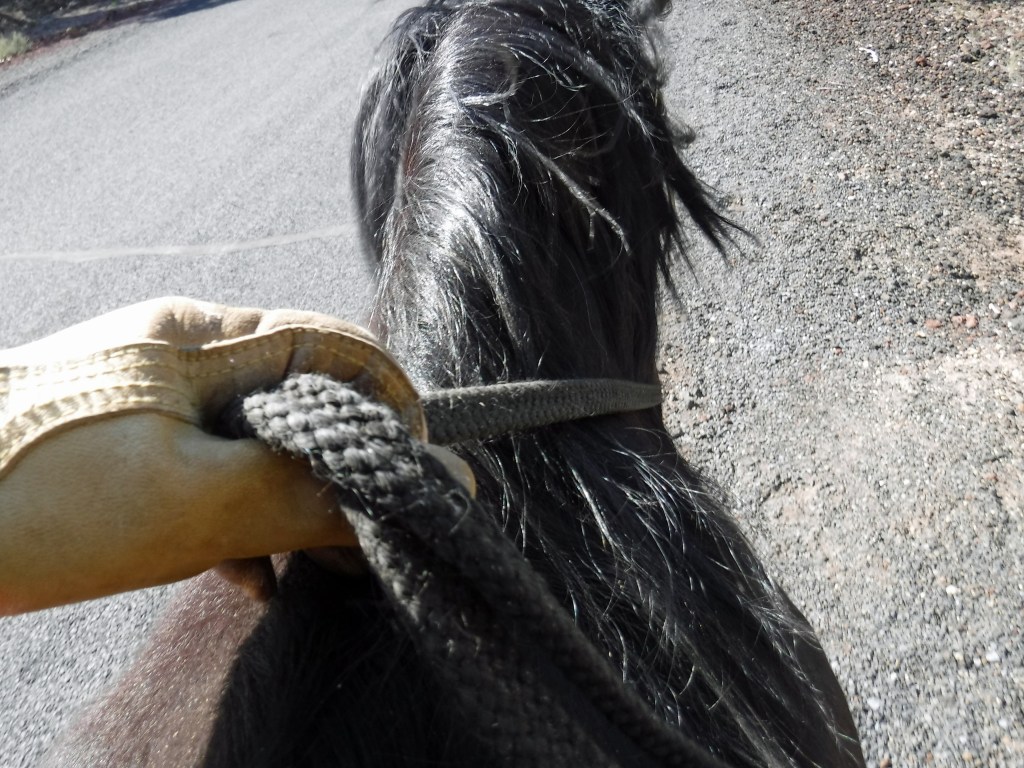
Sometimes accidental shots turn out to be the best photos.

This season I’ll be on horseback instead of riding in a carriage or cart behind a horse. It’s a tough decision, not starting to drive again. The sport is fun and mine are wonderful carriage horses. I’ve experienced the see-saw, and mostly downward trend, of our economy, weighed it against the costs of having a horse in pulling condition. Since my horses must travel frequently on pavement, they need special horseshoes, with shock-absorbing pads, and all replaced regularly. Until the economy picks up with positive effects trickling to my level, I’ll choose to play less expensively.

My initial disappointment faded once I climbed into a saddle after years of riding only rarely. By now and several times, my horse has carried me through the local neighborhood. Riding again shows me another style of pleasure trip and lets me appreciate surroundings anew.

It helps to ride a trustworthy, unflappable horse that ignores vehicles passing or sudden loud sounds of construction work and airplane motors (we’re near the airport). My body is in tune to the horse’s energy, senses her attention to terrain and surroundings. Her memory is incredible. If once allowed to pause and chew on roadside gasses, she’ll remember the spot and I’ll feel her starting to move toward it when we’re nearby. Mostly she chooses to walk on the gravelly roadside instead of on pavement. Her regular hoofbeats put me into zen modes.

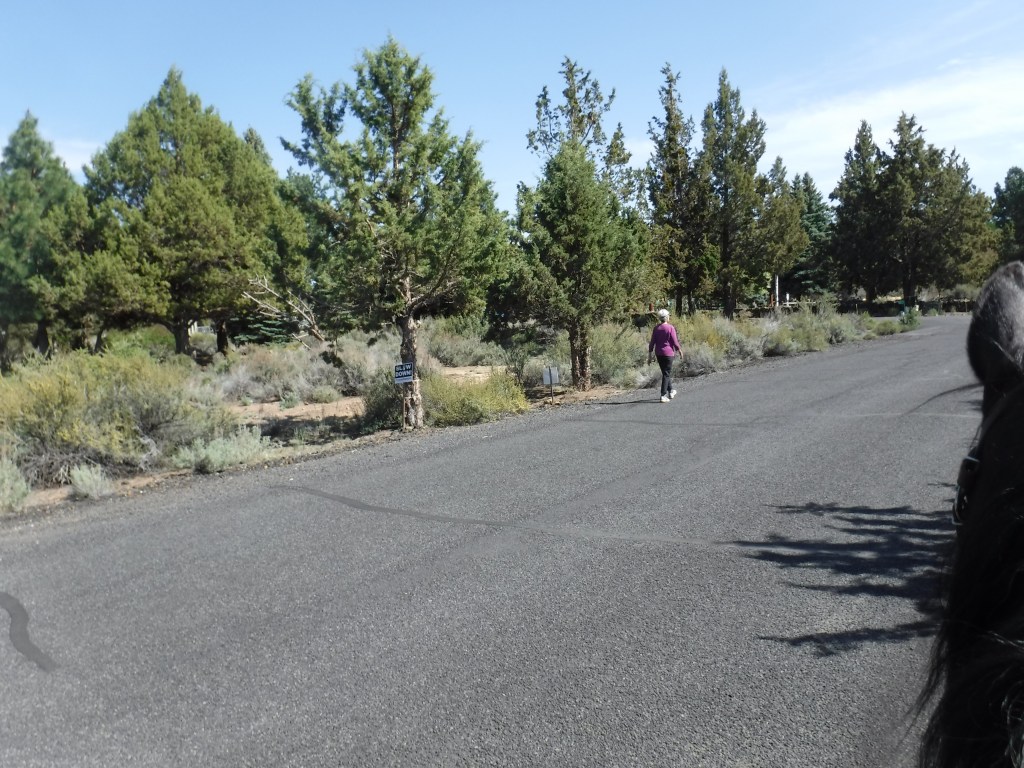
These days of semi-confinement cause many living in the area to go walking. The neighborhood loop where I’ve previously driven my horses and now ride has little traffic. It’s a popular area. Here, we’re approaching a lady who’s often out walking. When we catch up, she’ll slow down. We’ll walk alongside and chat with her.

My truck is about to become tied up for a string of days. It’s hitched to a large trailer, to haul brush and limbs to the dump. After all the needed disposing, I’ll hitch to the horse trailer, load up, and we’ll head off to public lands. There, I’ll ride one horse while ponying another. Our loyal donkey will follow loosely. The four dogs will run alongside. Those dogs! Out again on horse trails, beyond delighted!

Dear Friends: The ongoing, dipped economy forces us to adjust and simplify. Diana

Masking Ourselves

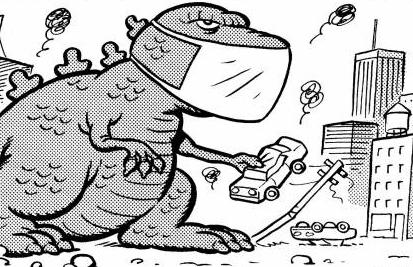
Sarszilla.

Thursday, May 07, 2020

I’m walking toward a market and masked as are most others around. This scenario makes me wonder why newstories aren’t full of robbery-related incidents. Until recently, an individual entering a store masked as mostly we are today would have appeared threatening. Where I live, in most places it’s legal to carry a firearm openly. In big box stores, I’ve seen on some individuals a holstered gun. It’s frightening, for even if a wearer’s overall attitude isn’t overtly threatening, the visual message is clear.

Think about data from scientific studies on human communications. The general consensus is that seven percent of our communications are verbal. The balance, or ninety-three percent of our communications are nonverbal–they’re visually transmitted. We may use full body language like dancing to communicate stories and feelings, or may express feelings by moving our arms and hands in various ways, or may elect to carry openly a highly destructive weapon in a typically non-threatening gathering. Everything we do expresses elements of our individual stories.

About masks, which we hope everyone in public wears, they cover facial features we’re used to seeing and evaluating. We accustomed to seeing maybe relaxed features with a kind mouth, or perhaps facial tension with jaw-clenching, tight lips. An individual’s Greek profile or Roman nose may create wonder about someone’s heritage, and are reminders that great art has made prominent features classic, ageless, interesting.

Our casual observations provide information about an individual’s demeanor, focus, and general intent. Someone who appears way different and out of the ordinary may become an object of concern.

These days, masks are more ordinary, making us try to understand what eyes convey while peering at one another over our masks. Sudden crinkles at eye corners may suggest a smile. With nonverbal communications increased, we acknowledge another in passing with a nod. We’re learning new ways of looking, unhelped by typical visuals.

So far maybe no masked robberies. Perhaps because most retail establishments have been closed, or because of orders for people to stay put. Even so, there’s an onslaught of gun-buying, and out on the streets many objectors, some with arms, are opposing orders to stay at home.

Dear Readers: These interesting times both invite questions and punch-up awareness. Diana

Smart Birds

Wednesday, May 06, 2020

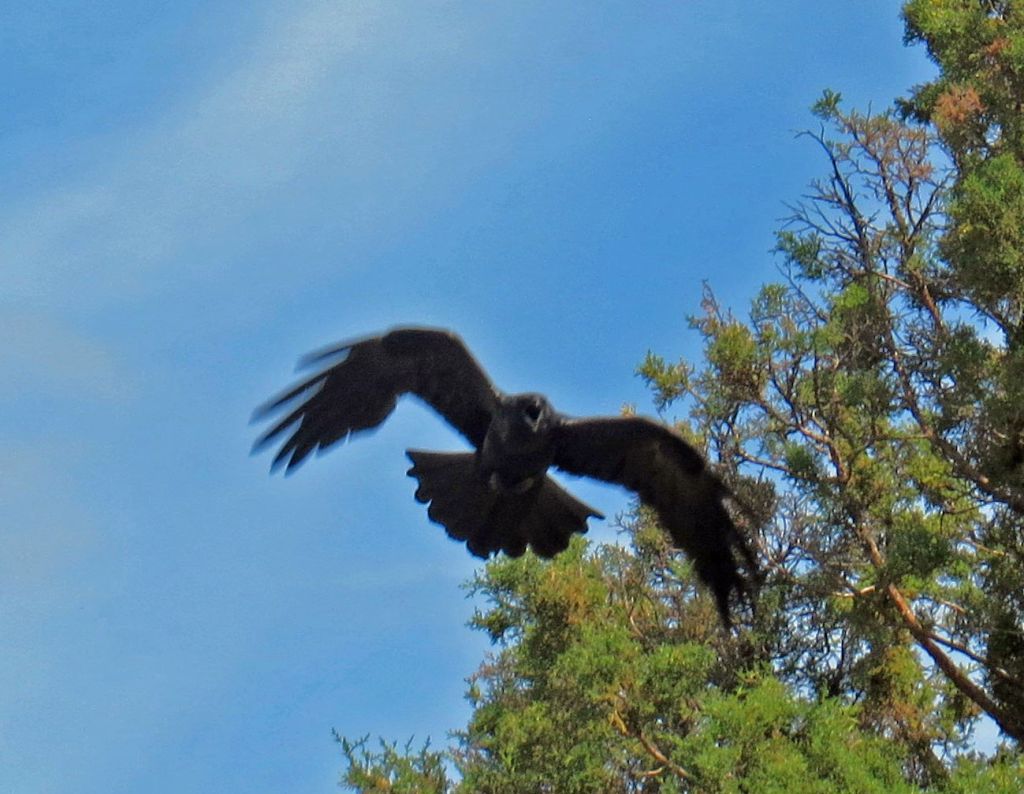
The caption photo shows a local raven lifting off from my watering troughs. In that bird’s wake and floating on water were the furry remains of a catch he/she had dunked. It’s almost common to find unwanted body parts in the watering trough. So far, none have harmed my horses or goldfish and I try netting out visible pieces best as possible.

Our resident ravens constantly are overhead companions, especially nowadays while nest-building. They fly and communicate noisily while preparing a nest in some high tree. Which tree isn’t easily identifiable, but their highly apparent activities mean it’s nearby.

The ravens visit my watering troughs frequently and over time have learned I’m no threat. They drop in and drink while I’m nearby, but aren’t comfortable enough to stay put on a trough’s edge if I become active and search pockets for a camera. So it’s difficult to capture those adult ravens’ watering antics. Photo taking of ravens is easier when they’re training babies. Juvenile ravens aren’t eager to fly from where their parents park them before an adult goes off to hunt. If I’m careful while photographing, the babies hang around although the watching parent from afar makes warnings.

Raven noises are part of the deal and more so during baby-training. Those big birds have so many sounds that experts categorize them into 33 different categories. Experts say that the sound most common is a classic gurgling croak. It’s audible for over a mile. Ravens from far away hear this sound and respond in like. These birds varieties of noises include shrills, rasps, and knocking sounds. Our locals make them all.

This summer as in years past, I look forward to baby-training days. Especially when the parents teach how to soar into the air and then float on breezes. The wonderful vision is of them as a family winging upward, high and higher, and then descending easily to a sweet spot where they simply float. It’s beautiful to behold.

Through this summer, I’ll be hearing these birds, enjoying their antics, cleaning up after them, trying to capture their images, and welcoming that post baby-hatching phase and close-knit family.

Dear Friends: Bird intelligence never ceases to amaze, if only we could comprehend more. Diana

Powder & Passings

Tuesday, May 05, 2020

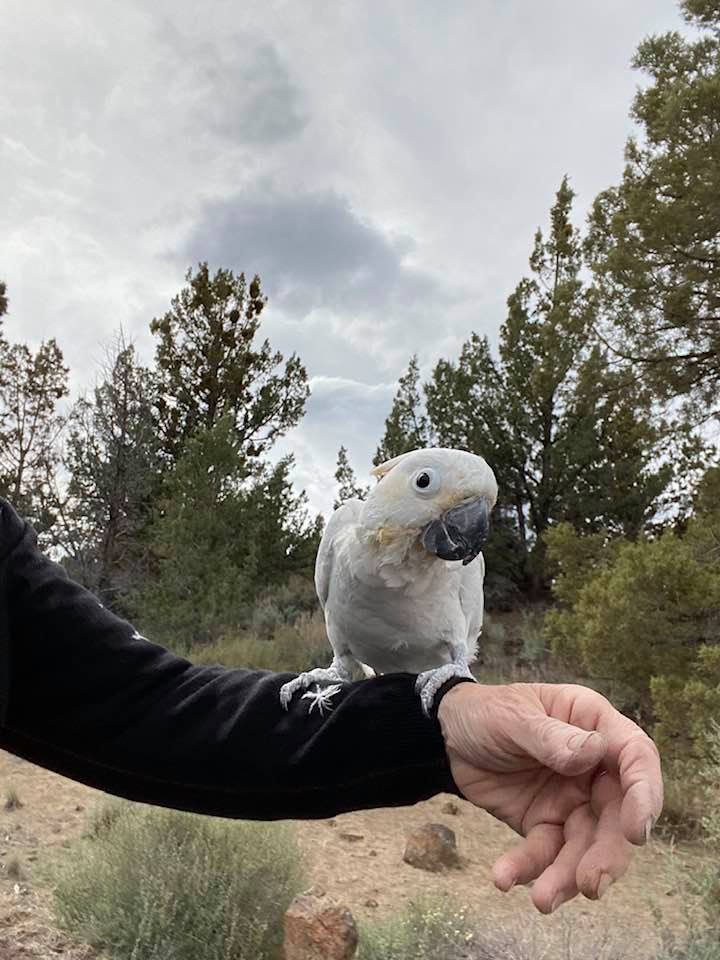
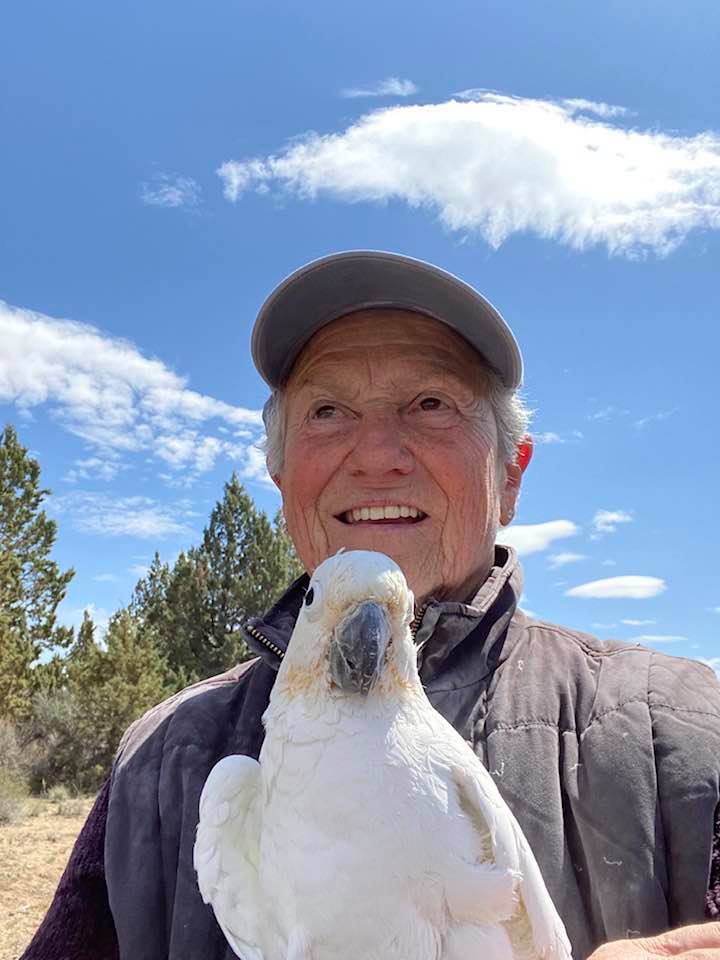
Walking with a smart bird perched on a shoulder or arm is a slow process. For starters, it’s about trying to get that bird to talk or simply talking to it in a one-way dialog. The bird’s listening for a smart bird doesn’t miss a beat. If my bird, Peaches, is silent, he responds physically by cuddling and nuzzling. Sometimes he feels like participating in a conversation. That’s how Peaches and I stroll together.

These days we bump into many neighborhood folks on the streets. Some are old friends like Susie who wondered about all the white that coated my black sweater (it’s powder from parrot wings). Strangers who pass may pause and greet Peaches, with “Hello”. Despite my urging he often refuses to answer. After they pass and are beyond earshot, he pipes, “Bye, bye!”

We’re an odd couple, me and the very white parrot on my arm. As we’re walking, I must appear to be talking to air. There’s no telling why I patter nonstop to a bird that’s also in his own world. Maybe trying to keep him tuned to me, or to teach him a new sight or a word, and to encourage responses in his language or mine.

Suddenly, two geese flying low and passing nearby make Peaches scream for several seconds. Those strangers surprised and frightened him. Something interesting is that Peaches doesn’t appear to scan the sky, as I’ve noticed other smart birds doing, to look for overhead predators. Well, Peaches’ wide vision is incredibly accurate so who knows where he’s looking or what he’s seeing?

Anyway, with Peaches I keep an eye on the sky, after warnings from bird fanciers that a hawk might drop and grab Peaches from my shoulder. That seems unlikely but our neighborhood does have resident hawks. Helpfully, Peaches enjoys standing on my forearm and snuggling against my chest, more protected than when he’s on my shoulder.

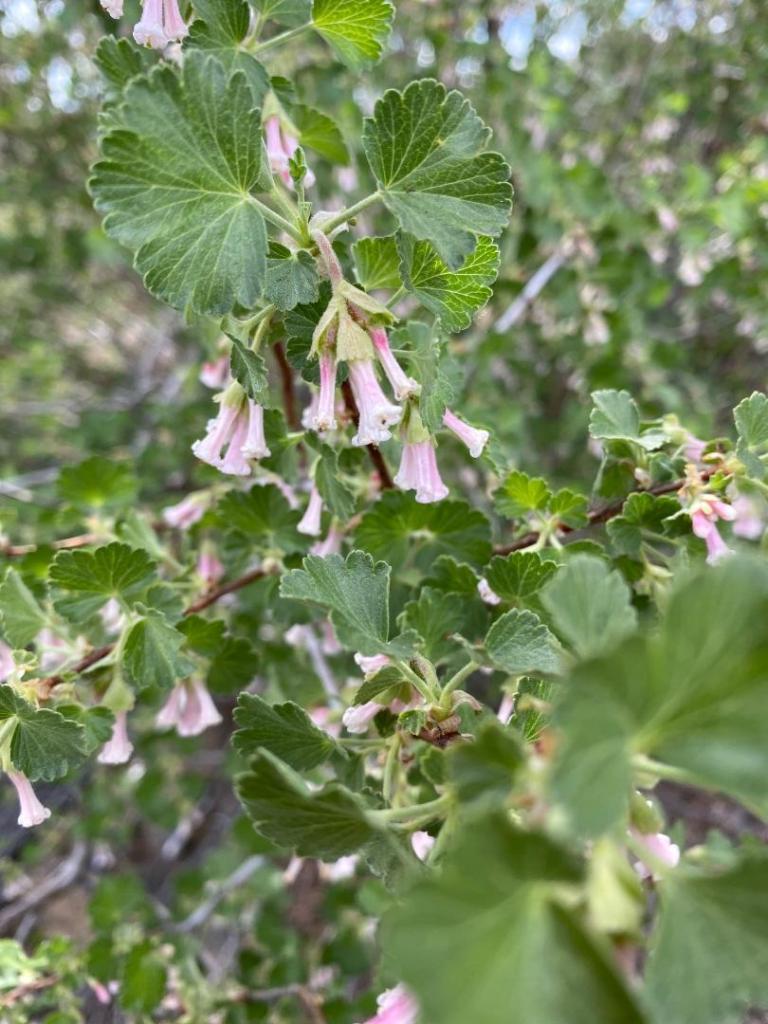
Walking slowly and entertaining the bird keeps me looking closely at our surroundings. Here’s a plant that surprised me. I’d never seen it. “Look, Peaches, at this giant Lily of the Valley.” Afterwards, I see it frequently, including on my property. According to my phone app, it’s a currant, interchangeably called a Wax currant, Squaw currant, or White-flowered currant.

Arriving at my small acreage, Peaches and I enter in a new spot–and voila!–directly beside one of those currants. And now it’s a sight beyond wonderful, for on the plant a huge honeybee working hard hops from flower-to-flower draining them. A fat and healthy bee, probably from a nearby well-kept hive, and I need a picture. Hastening for my cellphone while juggling Peaches is disruptive, and before I can organize, alas, the bee has flown.

I’m hopeful and said to Peaches, “That bee lives in our territory, knows this plant, and will be back. We’ll watch and wait.”

Dear Friends: Outings with Peaches capture so much, we’ll share more with you. Diana

Transitional Demons

Monday, May 04, 2020

Just as we consider putting away heavy coats and head warmers comes a string of days too cold to be outside without. Yesterday for example, we had periodic sunshine (no coat) and overcast (bundle up). More such weather will hit before summer settles in, when we’ll start jamming heavywear into closets already probably stuffed full.

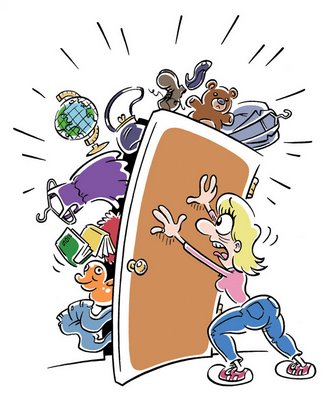
There’s a lack of closet space in my house where jackets hang on the backs of chairs and over the upstairs bannister. I grit my teeth to jam something into a closet, or to create space for removing an item. I blame homebuilders (mostly men with less clothes than women) for having little respect for space needs in closets.

The exception in my experience was a house long ago with a huge closet in its master bathroom. For sure, my closet was jam packed but held nearly everything–and so convenient! I’d enter that bathroom, fulfill morning rituals and exit fully dressed, ready for the day. I’ll always miss that bathroom with closet.

Fast forward to my current home, larger and ranch style–long, flat, with lots of cabinet spaces, but oddly, few and too-small closets. In the beginning, I ignored inadequate closet space, but my first high-desert winter changed that. I suspect the closet-packed issues began with my part-time job at Costco.

Working in a huge warehouse means being surrounded by impulse items. Costco’s merchandising policy is to move products in and out, regularly and within short periods. Shoppers tend to buy on the spot if they see and like, while it’s available. Most of us working there know what’s immediately available and joke about leaving our paychecks in the store.

The intensity of our winters varies, but always there are extremely cold periods, short or long. Working in Costco teaches its many varieties of cold weather wear. Toward the end of winter heavywears go on sale. After weeks of seeing what’s available as items rotate to on sale, it’s hard to resist purchasing. So, I’ve tons of winter wear, sometimes finding accidental duplicates.

Could over-purchasing not be the most-primary cause for a lack of closet space? Is the villain technological improvements enabling rapidity and quantities of cheaper fabrics and finished clothing? There are many questions about over-purchasing, like does it symbolize something deeper like a basic human impulse to hoard?

Hoarding has been rampant over our six-weeks, or so, of Corvid-19. Newspapers report such as antiseptics, toilet paper, and baking supplies disappearing from shelves. They claim that hoarding makes haywire our traditional supply chains. Oh, sure, let’s blame the problem on consumers instead of leadership and planning (I won’t continue in that direction).

My closets are full. Winter jackets are strewn around. Today it’s chilly outside and lets me stall a resolution to this problem. The best way to correct my spaces is to start discarding. Many pieces I could live without, but oh, deciding which hurts.

Dear Friends: I’m not a hoarder, I’m not a hoarder. Oh dear, am I a hoarder? Diana

Heavy Heads

Sunday, May 03, 2020

Yesterday, our high desert weather was a mess. The temperature dropped noticeably and daylight hours alternated between brief sunlights and shadowy periods with very high winds. One moment I might be outside in short-sleeves and another bundled in a warm jacket. The day felt more winter-like than spring. So, I brought in the dogs and let Netflix take over.

It’s been hard for me to find new shows streaming that I feel like watching. Maybe it’s because my moods aren’t good enough these coronavirus days to find writers’ fantasies appealing. Maybe it’s because watching again shows I’ve seen and enjoyed is easier. Unfortunately by now, I’ve too often re-watched and need something new.

So, I’m returning to “The Crown.” Yes, I know, almost everybody but me has enjoyed it. I tried a few times to watch it and always became bored. Yesterday, I started-up again, and from scratch, determined to stay with the series. Actually, it’s good–well scripted, acted, and photographed. But still boring. Let’s face it, an entire episode that focuses on whether to (1) “invite to the wedding or not”, or (2) “let Margaret marry or not”, or (3) “see if hubby will decide to kneel or not” aren’t particularly compelling. Even if they’re presented well-enough.

I suppose the whole point is how over time the monarchy is changing. It’s evolving from following stodgy family traditions to showing signs more of modern outlooks and behaviors. We do see this happening in real-time before our eyes. There already are on film four seasons, and the producers probably are rushing to capture today’s shift forward with Harry’s & Megan’s escape.

Many of my friends enthusiastically have recommended “The Crown” and its careful production lets me see better now why they’ve appreciated it. I suppose that upcoming episodes will grow more complex with Elizabeth’s increasing capabilities in her Queen-role. Actually, the series highlights complex questions, like why do the Brits continue supporting very high-pageantry and an incredibly expensive monarchy, when the country’s Prime Minister actually runs things?

Oh, what the heck: maybe another series is about to crop up that examines very closely our own confusing, and uber-expensive, political and social trends.

Dear Friends: If only “a Freud” were around to illuminate us on today’s social complexities. Diana

Talks With Peaches

Saturday, May 02, 2020

We went for a long walk, Peaches and I. We crossed a couple of adjoining properties that I’ve permission to pass through and continued over the mile-and-a-half loop encircling our neighborhood. I watched the sky intending to pull Peaches from my shoulder if an area predator were scouting above. My bird made our whole walk easy though by staying on my forearms and leaning against my chest.

In Cockatoo terms, Peaches, a Citron Cockatoo, is a little guy. Citrons are smallest in the genre. What my bird lacks in size, he compensates mightily in sounds. Until yesterday, we’d not gone walking in too long, for his grown-out flight wings were worrying me. If Peaches suddenly became frightened and leaped from my shoulder, maybe he’d fly to who knows where. In caution of coronavirus, we waited to visit the bird veterinarian until this week.

Maybe because he’d not been outside in a long while, Peaches stayed silent for the first half of our walk, and although quiet, he was totally alert and active, nuzzling my hands and chin. Finally, I wondered what would happen if I made the first move. I verbalized a couple of “Hellos!”

The bird responded immediately, “Hello!”

After we exchanged “Hello” several times, I moved on to “Goodby!” So did Peaches, and now, we’re walking down the street with loud, “Hello, hellos!”, “Goodby, goodbys!” For the bird, that was “game on”! He let loose with some amazing vocabulary that he shares only at his choosing, and added wilder sounds that reverberated in my ears.

Peaches made me laugh out loud, and does so even when he’s annoying, like last night at bedtime. When I said “Goodnight, Peaches”, he let loose a big squak. Remembering our earlier exchanges, I squaked back. Peaches immediately squaked twice, and I echoed. Our “conversation” got louder and more varied, until finally, my best option was to blow a kiss and walk out on him.

Dear Friends: It’s easy to get so lost with a smart bird that you’ll forget it’s just a bird. Diana