Eight Pines Emerging

Winter at Eight Pines

Friday, October 23, 2020

How brave I’ve felt finally to have named my little ranchero. An identifiable name changes my perception by encouraging a sense of having boosted the status of this small horse property. It’s situated in a neighborhood and near a cul de sac. Besides not earlier giving it a name, I’ve thought it slightly grandiose to name four acres. This began to change during this year’s early months.

The early pandemic ended my outside part-time job, and like others I searched for ways to stay interested and busy. It was winter and daily my horses went to a neighbor’s pasture to graze (winter grasses don’t increase their weight). I wasn’t, as usual, driving them, and hadn’t yet begun thinking of riding horseback.

For weeks, I explored online learning opportunities, bought books, tried knitting, practiced drawing using colored pencils, spent time online and texting, and of course, Netflix, et al, became buddies. As the weather warmed, I wandered onto my property and for the first time focused on its trees.

I saw many old junipers with overgrown hanging limbs. It seemed that if the tree limbs were removed, say up to about eight feet, my horses might move safely among the trees to graze here at home. A pure fantasy for this property is very rocky with little grass. But I needed a project.

I bought lightweight battery-operated long and short chain saws and went to work. It took weeks to cut, pile, load, and haul limbs away. Unlike my neighbor who counted his trees (about five-hundred of them), I didn’t count but estimated mine as around three-hundred. Bottom line, the sawing and related work got me out of the house, physically distanced me from others, and kept me busy. That work made my property somewhat park-like.

It also made me acutely aware of a few pine trees among my junipers. I had known of them but without much interest and for years had ignored them. Suddenly it seemed right to strengthen those unique trees, survivors of my neglect. I began watering, dragging hoses, situating sprinkling apparati, and paying them serious attention.

All eight trees. It was surprising that only very recently did “Eight Pines Ranch” pop into my mind. Immediately, that felt right, and also immediately, my brain battled its sense of “the place” vs. “Eight Pines”. Happily, Eight Pines won, and has trees to support an unique identification.

Dear Friends: A street address does the job, but a real name is swell. Diana
October Frights

Halloween Horse

Thursday, October 22, 2020

This morning I’ve tried to set music to a video of my pony, but matching the video length with a fitting bit of public domain music has left me stymied. So with apologies to opposing perspectives, I’ll speak to another looming topic: politics.

This day will offer a couple of biggies. Tonight there’s a final presidential debate that might turn into a debacle. Today in the Senate, McConnell is determined to seat a Supreme Court next justice, and the Dems are planning to boycott.

A big part of me is very tired, wishes to avoid these proceedings and that was my plan. But like a moth drawn to flame or a bee to a flower, I’ll watch everything. Because ahead are fascinating “monkey wrenches”. First, there’s Trump angry, desperate, and who knows what he’ll do in front of a dead mike? Or if he’ll show up for the debate? Second, Democratic senators are resisting the high court nominee and won’t be present, nor vote, but their non-participation could be overridden by Senate rules.

The senate situation is most interesting. A justice cannot be elected by the Judicial Committee without at least two members present from the opposing party. Apparently, McConnell without Judicial Committee approval could accomplish his goal, by calling for a full-senate vote and getting fifty-one yesses. Romney apparently didn’t vote Trump for president, but is likely to vote for seating Amy.

Ahead today, two full dramas!

We can’t assume Trump won’t be re-elected, because a very large portion of American voters prefer bold, take-charge, do-or-die types. We can assume that Amy will be voted into RBGs empty seat by Republicans, sidestepping established Senate rules and tradition.

We can assume that if Trump is re-elected, the beat will go on. On another hand, if the Dems dominate by achieving the presidency, senate, and house, there’s no assuming what might happen.

Because it’s all new politics.

Dear Friends: I toss my lot with the t-shirt that says, “Please, end 2020 now!” Diana

Eight Pines & More

Wednesday, October 21, 2020

Our weather is changing from t-shirt-go to jacket-at-ready. My friend Anna loves riding my mare, Rosie, and recently joined me to ride horseback through the neighborhood.

In this lovely neighborhood it’s possible at various points to leave paved streets and enter a nearby country-like area. It’s semi-wild with dirt roads running under power lines and surrounded by unkempt brush. One sights browsing mule deer, screaming Redtail hawks, and swooping owls. There are signals of nearby civilization, like infrequent distant rooftops and dirt-impressed hoof- and dog-prints.

Anna and I have ridden through all the local streets. Each trip away from and back to my house on pavement is three miles. Travel miles are more on the dirt beneath the power lines. A couple of hours riding in the neighborhood exercises the horses for six or seven miles. Our neighbors are friendly, their vehicles pass slowly, they smile and wave. I feel lucky, able to mount and ride safely without first having to haul a trailer.

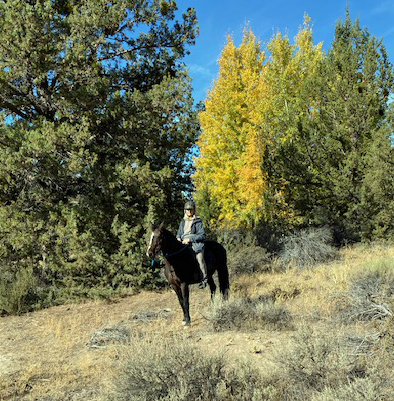
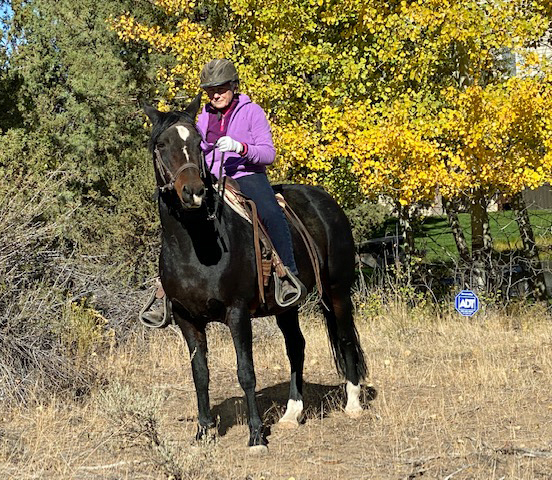
The fall offers fresh beautiful changes. The other morning Anna and I were captivated by trees in fall glory and sometimes punctuated by sparkling water features. We took photos. In the header taken from a distance, Anna and Rosie appear very relaxed. The below close up of me on Sunni isn’t relaxed, the rascal in a bitless bridle keeps trying to dive for grass.

Both fun captures show some of this lovely neighborhood.

Dear Friends: At last, my small acreage has a name, “Eight Pines Ranch”. Diana

Butt Strapped

Tuesday, October 20, 2020

It’s about trailering horses, a process that can be complicated and for years foiled me.

My beloved Quarter Horse, Dolly, on reaching her mid-twenties became arthritic and eventually couldn’t step high enough to enter my large “three-horse slant” trailer. She was rideable if one didn’t ask too much and I searched for a second trailer, with an entry ramp. I found an older trailer in good condition, a two-horse, straight-in, with a ramp. Dolly’s young years were prior to slant trailers and she traveled in straight-ins.

Dolly easily loaded into my new trailer, and I liked pulling it. Smaller than my three-horse, easier to maneuver, and best of all could fit in small parking areas. I’d unload, ride, reload, and without much effort circle the rig to leave.

Needing a healthier horse to ride in complex, somewhat strenuous areas, I went looking and wound up with two full sisters, Sunni and Rosie. Neither had been trained to a straight-in and vigorously refused to enter the small trailer. The big slant suited them, that seemed okay.

For years after I lost Dolly, her little trailer sat, parked, unused, neglected. Occasionally recalling how easily it pulled, I wished to use, but getting Sunni and Rosie inside required a trainer. I didn’t know who to ask to train my mares, especially Rosie who’s sensitive and can be challenging. Getting them correctly into a straight-in seemed impossible.

My friend, Noell, who raises Appaloosa horses, popped up at Costco while I was working. During our quick catch-up, I told her about the long-ignored trailer and my horses’ dislike of it. Noell said she could train them and that she’d do it.

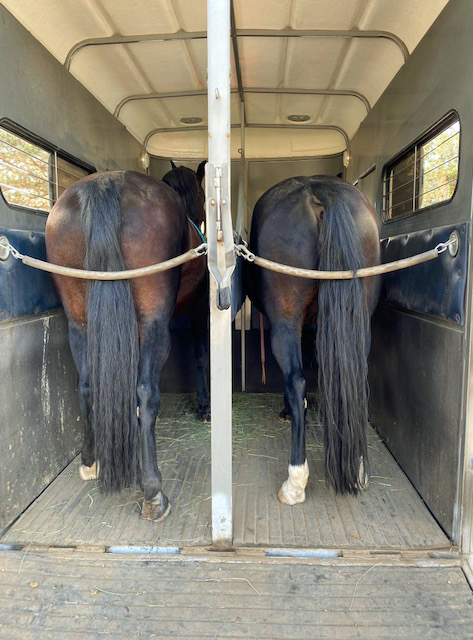
For several hours split into two days, Noell worked patiently and softly, beginning with the easier Sunni. She encouraged Sunni step-by-step onto the ramp, wasn’t upset during numerous back-ups and re-starts, and taught Sunni words, like “Step forward”, “all the way in”, “wait now”, “step back”, and “okay out”. Finally, Sunni felt brave, stepped inside and stood awaiting instruction. Noell let her stand several moments before hooking a confining butt-chain. Sunni backed into it and calmly stopped. She was trailered!

Rosie was very resistant and challenging. Noell worked more insistently but no less patiently with her and finally managed to reduce Rosie’s defensiveness. We decided to pause training and to resume the next afternoon. That evening, my friend Anna and I rode both horses, and rode them again the next morning. We got home with exercised, calm horses just before Noell arrived.

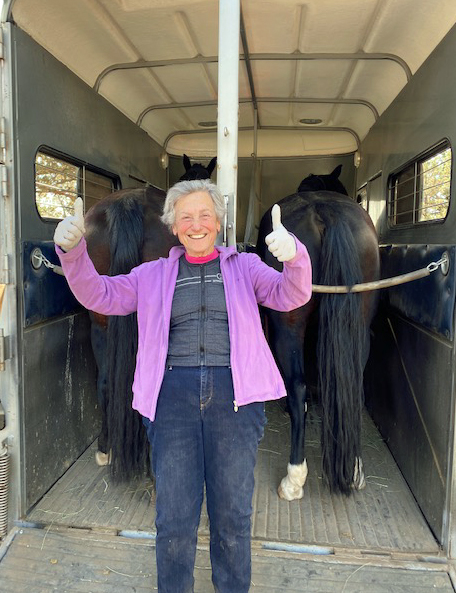
She began working with Rosie as before with Sunni. At first Rosie resisted, but less so, and before long, she began to listen and enter fully before quickly exiting the trailer. Noell worked until Rosie slowed down, watched for signals, listened for commands. In little over an hour, Rosie was standing calmly in the trailer and confined by a butt strap.

I set hay on the trailer’s feed shelves and fetched Sunni. She at a hand signal entered the trailer, and the two side-by-side munched grass hay. They appeared relaxed and happy.

I’m impressed about Noell’s confidence and competence during that training. She points out to me that Sunni is a very easy horse, she’s willing to please. On the other hand, Rosie is highly sensitive and more cautious. Noell cautions me to remain very calm in working with Rosie. She responds in a heartbeat to her handler’s nervousness by becoming nervous, too.

Dear Friends: Maybe it’s less about “trailering” and more about “relationships”. Diana

Red Bull Morning

Monday, October 19, 2020

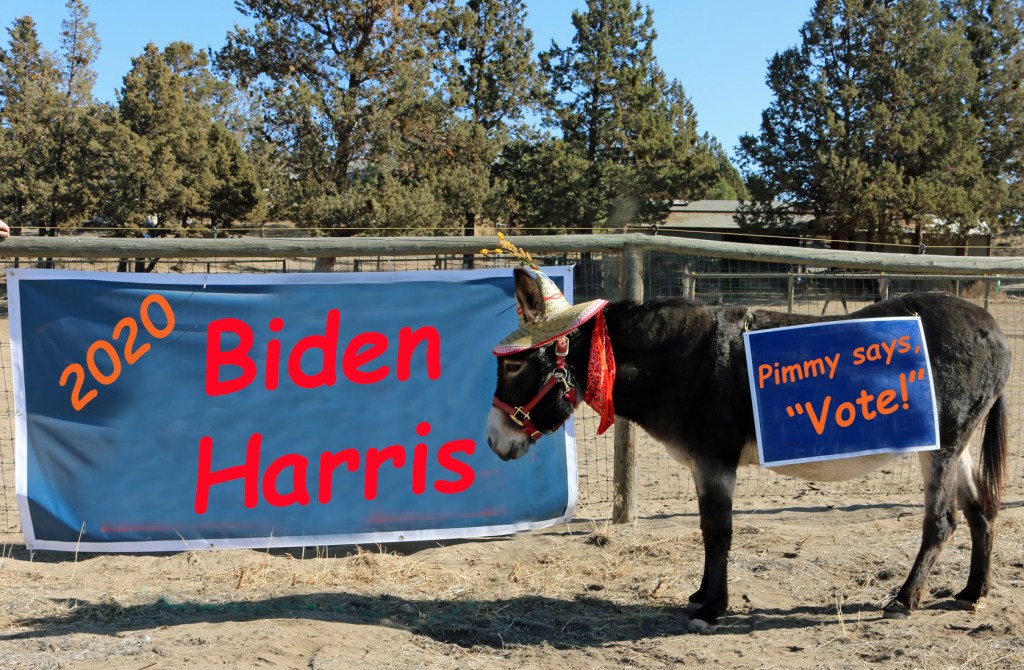
The idea came from my artist friend Janet. She suggested costuming Pimmy in her July 4th outfit and creating a photo to promote our preferred candidates. This morning, I thought loosely about her suggestion but felt lazy, uncreative. Needing help, I explored the contents of my garage refrig. and discovered a single Red Bull. I downed it (ugg), and moved into action.

Pimmy’s great July 4th costume had been designed, piecemealed, and sewn by Janet and her (also) very artistic daughters a couple years ago. Since, it’s been un-piecemealed and is stored in various boxes in my garage. Recostuming Pimmy means I’d gather Janet, et al, to help unpack, piecemeal together, and redrape Pimmy. Everybody’s busy, we’re not quick ‘n easy to collect for a project.

Red Bull energized, I decided to adopt Janet’s idea and activate Pimmy in the current election cycle. Using a photo taken by my neighbor Frank a couple years ago, I wiped out its original words and substituted ones that bring alive a version of Janet’s idea.

About collaborating with Janet, there’s more. She reminds me that it’s October, almost year-end! We’ve blown both time and our wish to create a “Pimmy Calendar”! We have imagined a design that shows Pimmy outfitted in various “Janet, et al, costumes”. It includes fun photos of the donkey and her many fans. Our design in the thinking process also needs smart captions. Okay, Janet, there’s still time, if we can get our moves on!

Anyone else up for a Red Bull?

Dear Friends: We’re corralled by the ongoing struggles of dreaming-to-doing. Diana

Role Model

David Louk standing vigil over RBG’s coffin

Sunday, October 18, 2020

I’m re-posting this photo from my long-time friend, Linda, of her son David during the RBG memorial proceedings. Before Justice Ginsburg’s death, and after a year of looking forward to the role, David had begun clerking for her.

It was impossible to avoid mentally re-living the RBG phenomenon as I read an article in this week’s New Yorker Magazine. Its writer, Jay Wexler, formerly clerked for RBG and is a law professor at Boston University. In the article (link below) he explains the final mission for many of RBG’s law clerks.

Wexler explains the ritual of “never leaving a departed Justice alone”. He describes some of the previous clerks, their current roles, their courtrooms, their classrooms, and from where they traveled. Until soon, there were “One hundred and twenty clerks gathered…to receive their instructions….” During that highly-emotional reunion, individuals selected from a spreadsheet two shifts of twenty-minutes each, during which he or she would stand vigil, two clerks at a time.

Following the tribute to Justice Ginsburg, her clerks returned to their homes in time to watch the first presidential debate. That debate, after an initial question (about the Supreme Court), quickly went off the rails. Wexler quotes former clerk, Nick Bevin, “I never saw Justice Ginsburg try to shout down an adversary or drown out an opposing view…. And I worked for her during Bush v. Gore.”

Justice Ginsburg has been credited with many “past firsts”. And still they come.

She’s the first woman to lie in state in the Capital.

According to the New York Times, “As…mourners took turns bowing their heads or making signs of the cross to honor Justice Ginsburg, Bryant Johnson, an Army veteran who served as her longtime trainer, honored her with a different kind of gesture: He dropped to the floor before her coffin and did three full push-ups.

The Times reports, too, that Brooklyn where Ginsburg grew up is making plans for a memorial statue of her.

Enjoy this Wexler article: https://www.newyorker.com/magazine/2020/10/12/ruths-army-rbgs-former-clerks-show-up

Dear Friends: The Justice in public service was a model of intelligence and civility. Diana

Perspectives

Amanda Gorman

Saturday, October 17, 2020

I have learned that America has a National Youth Poet Laureate. The young person holding this title must demonstrate skill in the arts, particularly poetry and spoken words, also be a strong leader committed to social justice and actively advocate for it. The national competition for Youth Poet Laureate has been held for four years, and finalists usually are Poet Laureates for their cities or regions.

I happened to be listening to NPR during a recent interview with America’s first Youth Poet Laureate, Amanda Gorman of Los Angeles who received the title as a teen in 2017. She recently graduated from Harvard, is twenty-two years old, and still is an active writer, speaker, and community organizer. While interviewed, Gorman was personable, interesting, bright, and has written poems socially on-target and reader accessible.

The first stanza of this poem underlines Gorman’s scholarship. It explains the concept of “race” as a social description and reveals her skill with words.

What Words Begin

By Amanda Gorman

The word ‘race’ first arose
In the English language in 1508. Of course,
It appeared where all
words are born:
a poem. when
A Scottish writer
Spoke of a long line of kings,
And the dancing deadly sin of envy.
So what is a poem, if not a beginning?
An announcement that heralds itself?
Moments of air molded like melted wax.

I’ve spoken often of the one-hundred-year-old American poet, Sarah Yerkes. I admire her poems which look backward and stretch forward to the present. Her age-wise voice describes her younger self, compares her past and current perspectives, and concludes with a wise acceptance of the present.

It’s refreshing to learn of a Generation Z poet who’s recognized as aware, thoughtful, and active. She looks backward through social history at how social orders evolved. She writes using word skills that enlighten, impact, and teach the rest of us.

Relative to worldwide current social, political and climate upheavals, we are dependent on younger generations to grasp the magnitude of dangers now and opportunities ahead. It’s up to them to find pathways for smoothing, repairing, and resolving worrisome major issues.

It’s fabulous how a strong young voice illustrates an emerging greater intelligence about the social, political, and environmental conditions. The poet’s wise voice hints of upcoming generations aware and interactive. A large youthful dedication to making meaningful and widespread changes keeps us hopeful.

Dear Friends: Generational intelligence used to evolve slowly, now it’s on warp speed. Diana

Humanity

Friday, October 16, 2020

Working at Costco, I find most customers happy that we sample servers again are working, even if we mostly don’t serve samples. Instead, we show products and describe them. Occasionally, like yesterday, someone who appears becomes abusive. A customer I didn’t recognize became indignant when I couldn’t let her sample a pumpkin dip. She angrily waved her hand at me and yelled, “They’re paying you to do this!” I nodded as she stomped away. A woman nearby muttered, “She was so rude!”

What’s usual is that customers tease us. They see us standing around, appearing not doing much. Actually, even without cooking and handing out samples, our presence generates product sales. I have fun interacting with customers, figuring out who might accept encouragement to purchase a product and who would prefer being left alone.

Weeks ago, a woman pushing a cart had a couple of books in it. I asked what she was reading. It turned out mysteries. Anyway, the books got us talking and moseyed on to our families. We both were highly influenced by elder siblings. She has a sister nine years older, and I did have a sister nine years older. Her sister, now in her mid-eighties, is a wannabe writer. That made me mention the artist-poet Sarah Yerkes. She published her first book of poetry at the grand old age of one-hundred-years. I love Yerkes’ book, often give it to friends, and refer lots to it.

During her early years, Yerkes was an accomplished artist who designed landscapes and later became a sculpuress. In old age, on joining a beginning poetry group and already with a solid grasp on structure and form, she quickly understood how to write poems. What makes her work unique are her views of the past, her musings about relationships and work–what she did well, might have done better, and couldn’t have altered. Reading her book is as close as I’ll ever come to talking, really talking with a very senior, still highly alert individual. Sarah Yerkes is wise and reflects.

Recently, a woman stopped me in the aisle saying she’d read the book I had recommended. In a moment I clicked in, delighted that she had heard and acted. She had enjoyed reading Yerkes and intends to send her sister the book as an encouragement to continue writing.

She and I are among Sarah Yerkes’ circle of appreciators. Our own circle, which consisted of two meetings, basically reinforced why folks talk. Little else influences as greatly as exchanged thoughts and ideas. Spoken exchanges equate to mental and emotional handshakes.

Dear Friends: While out and about, the “goods” overcome occasional “bads”. Diana

Revisiting

Thursday, October 15, 2020

It’s striking the impact of places where for chunks of our lives we lived. Over time a location that becomes very familiar leaves lasting impressions. Regardless of whether we engaged in relatively quiet country areas or in very complex city environments, places very familiar become sort-of family-like ties to our pasts.

I began thinking about this while reading a biography of Eleanor Roosevelt. She spent most of her life, before reaching her mid-thirties, in NYC. When Franklin’s political ambitions moved his family to D.C., Eleanor went to work there and helping him had to learn the new city. She wrote in her diary and to friends how greatly she missed New York and the variety it affords to those living there.

Recently, music by Bach flashed me back to a long ago Kansas City life. Annually between Thanksgiving and Christmas, a major insurance company dedicated a large windowless side of its building to evenings celebrating the holidays. A camera hidden in brush operating from dusk to dawn flashed onto the building a slideshow. It consisted of religiously-oriented paintings accompanied by Bach’s music, a lovely gift to the community. I remember evenings when my young self paused my car, to see, listen, and for the first time fall under the spell of classic arts.

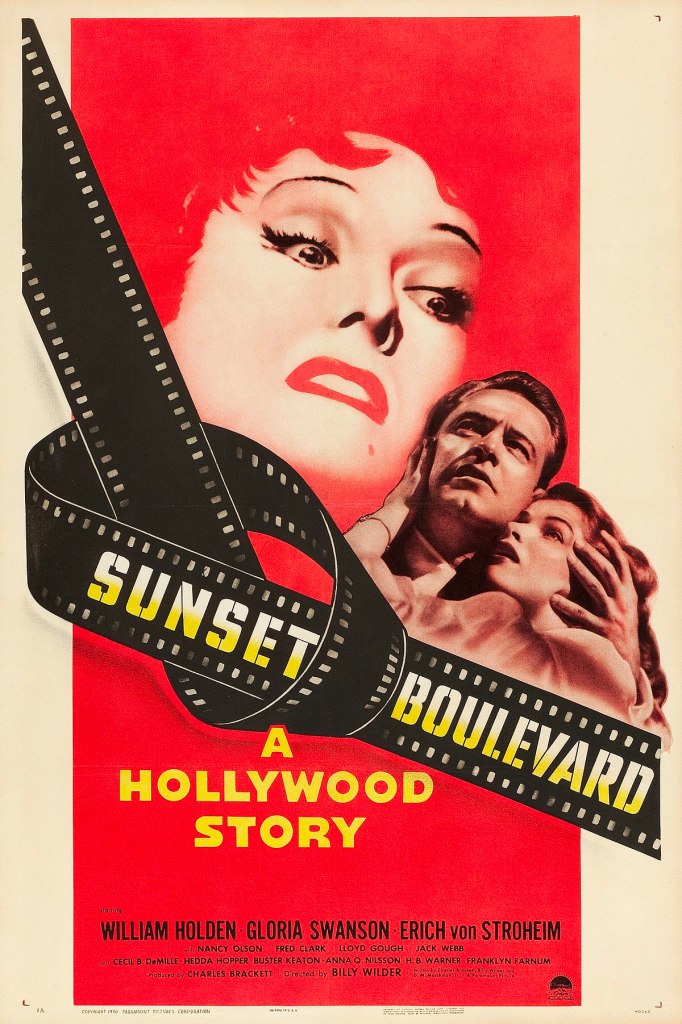
My casual musings about Eleanor’s NYC and old Kansas City opened my mind to an article from the Getty Museum’s blog, about Los Angeles’s Sunset Boulevard, that long-lived iconic major street. The article describes the boulevard’s beginnings and how over time the street has been altered by changing populations and cultures. The article is made more cool with captures from a photographer who long focused on the street.

I lived many years in Los Angeles, the article hits a homer. That city and boulevard were big in my life. We living in L.A. during the 60’s remember Sunset Boulevard’s wild “Music City corner”, and our disgust as Sunset Blvd. transformed from elegant to seedy, and then to something in between. This article makes me wish to drive right now entirely along Sunset Boulevard, from beach to beyond downtown, to relive the spell of that area’s cultural changes on my young adulthood.

Here’s a link (it’s a 6-minute read): http://blogs.getty.edu/iris/timeline-explore-a-changing-sunset-boulevard/

Dear Friends: Places as almost-family, there’s lots to remember and reconsider. Diana

On Fire

Hilma af Klint’s Dove, No. 02 (1915)

Wednesday, October 14, 2020

I’ve been majorly impressed by the fine 2019 French film, Portrait of a Lady on Fire, written and directed by Céline Sciamma. Her excellent script (nominated for an Oscar) set the film’s action in the year 1775 and detailed the creation of a work of fine art by a talented woman artist. In preparing to write, Sciamma searched for works, dating from before modern times, by women artists. She discovered that many women had produced fine art, been known and recognized by their peers and contemporary art critics. She came to realized that women artists working in past centuries have been overlooked or ignored. In contrast, male artists working in past centuries have been celebrated.

Sciamma’s film teaches much by illustrating many factors that support good writing and informed directing. Its scenes boast superb close-ups and wide-screen cinematography, illustrate creative lighting techniques, intrigue viewers using unique sound technology, and focus on carefully-timed actors’ physical activities and expression changes.

Its brave and independent woman artist is a model for unrecognized women who produced in years (roughly) between the 1600s and early Twentieth Century. Sciamma’s work influences more by alerting interested viewers to news popping-up here and there about early women artists. For example, a recent article in “The Guardian” about Hilma af Klint (b. 1862) suggests that she might have invented abstract art.

Like Sciamma’s film artist, af Klint came from a wealthy family and thus could choose to learn art and find ways to self-support as she wished. Af Klint is interesting to learn about, and moreover, her long-ignored art works are exquisite. She’s gradually being recognized as a fine artist. Included in this article is a film trailer previewing an upcoming lovely documentary about her work.

True art is a multi-layered canvas, it’s visual, idealistic, passionate and speaks to a broad audience. Wonderful art keeps speaking, and both Sciamma and af Klint offer fascinating insights that increase awareness.

Here’s a link to “The Guardian” article: https://www.theguardian.com/artanddesign/2020/oct/06/hilma-af-klint-abstract-art-beyond-the-visible-film-documentary

Dear Readers: It’s expensive but there is a hardcover book with the art of af Klint. Diana