Smart Birds

Wednesday, May 06, 2020

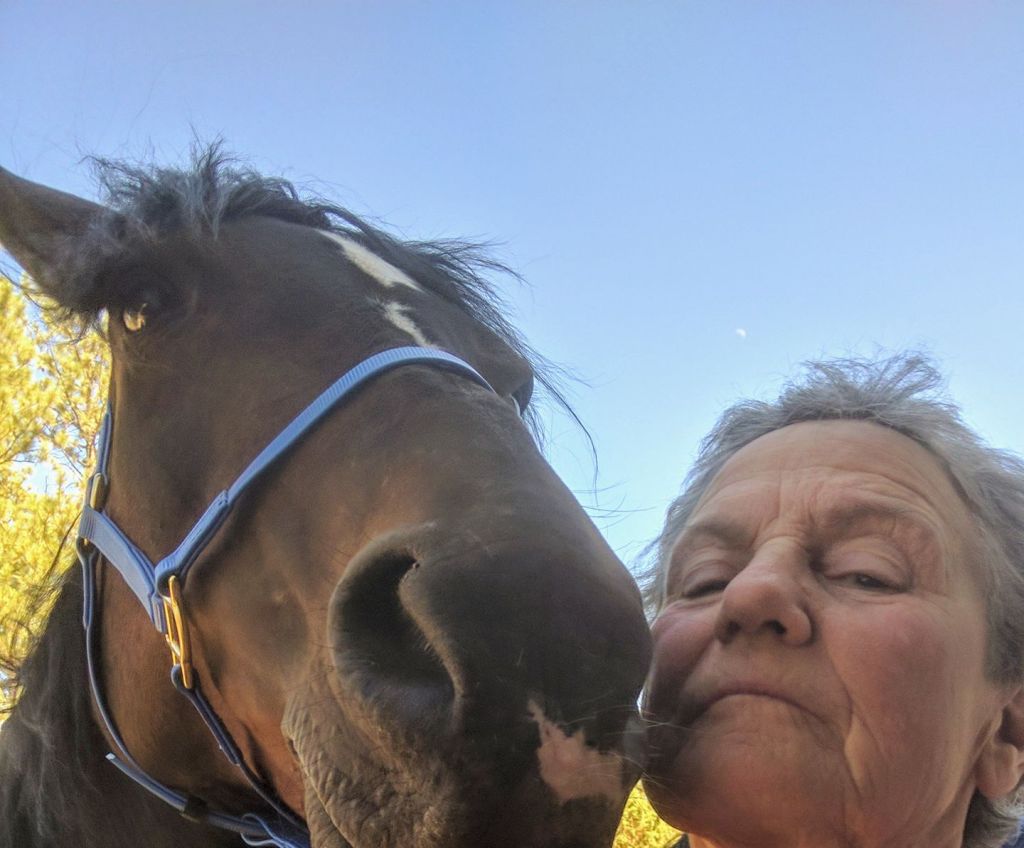
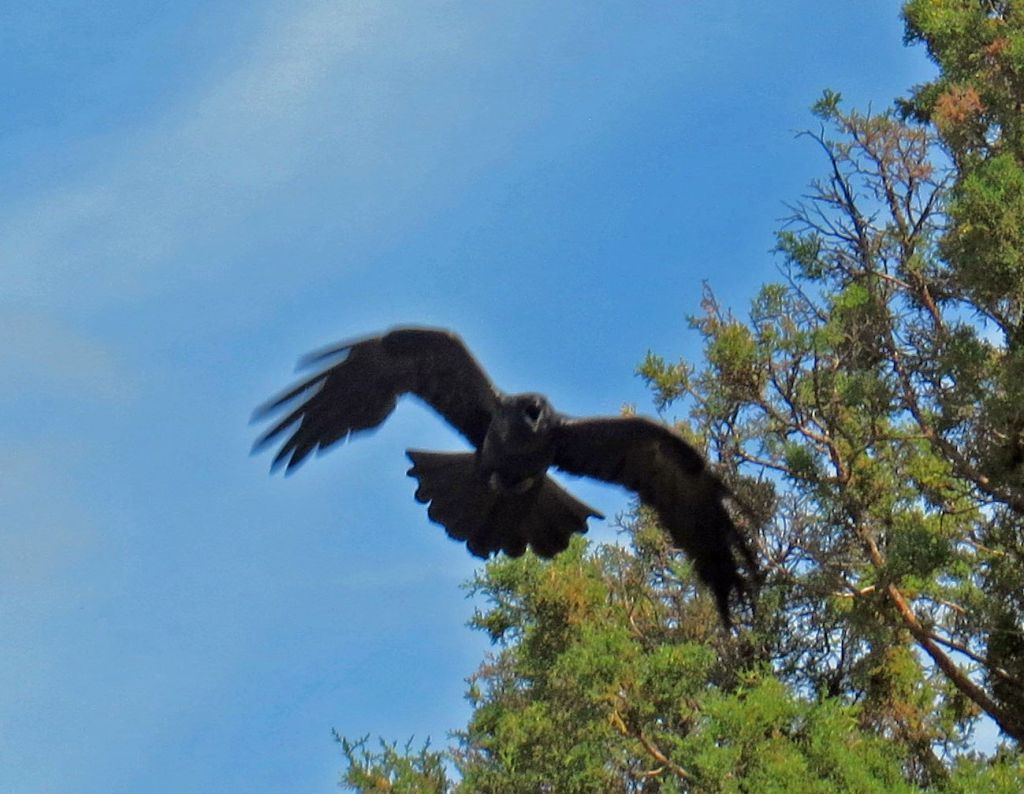
The caption photo shows a local raven lifting off from my watering troughs. In that bird’s wake and floating on water were the furry remains of a catch he/she had dunked. It’s almost common to find unwanted body parts in the watering trough. So far, none have harmed my horses or goldfish and I try netting out visible pieces best as possible.

Our resident ravens constantly are overhead companions, especially nowadays while nest-building. They fly and communicate noisily while preparing a nest in some high tree. Which tree isn’t easily identifiable, but their highly apparent activities mean it’s nearby.

The ravens visit my watering troughs frequently and over time have learned I’m no threat. They drop in and drink while I’m nearby, but aren’t comfortable enough to stay put on a trough’s edge if I become active and search pockets for a camera. So it’s difficult to capture those adult ravens’ watering antics. Photo taking of ravens is easier when they’re training babies. Juvenile ravens aren’t eager to fly from where their parents park them before an adult goes off to hunt. If I’m careful while photographing, the babies hang around although the watching parent from afar makes warnings.

Raven noises are part of the deal and more so during baby-training. Those big birds have so many sounds that experts categorize them into 33 different categories. Experts say that the sound most common is a classic gurgling croak. It’s audible for over a mile. Ravens from far away hear this sound and respond in like. These birds varieties of noises include shrills, rasps, and knocking sounds. Our locals make them all.

This summer as in years past, I look forward to baby-training days. Especially when the parents teach how to soar into the air and then float on breezes. The wonderful vision is of them as a family winging upward, high and higher, and then descending easily to a sweet spot where they simply float. It’s beautiful to behold.

Through this summer, I’ll be hearing these birds, enjoying their antics, cleaning up after them, trying to capture their images, and welcoming that post baby-hatching phase and close-knit family.

Dear Friends: Bird intelligence never ceases to amaze, if only we could comprehend more. Diana
Powder & Passings

Tuesday, May 05, 2020

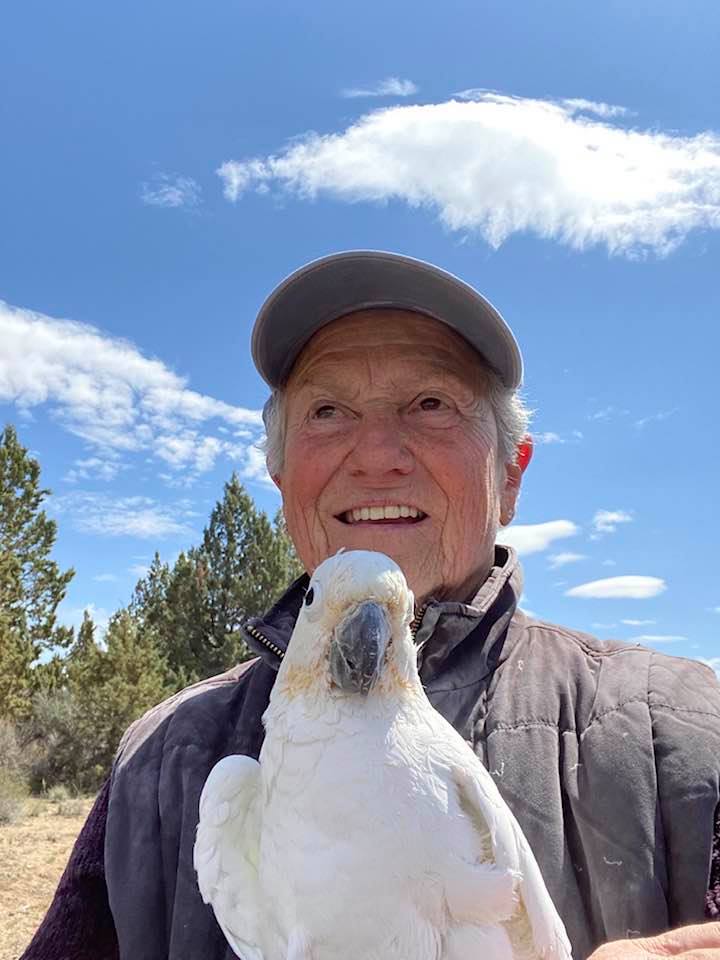
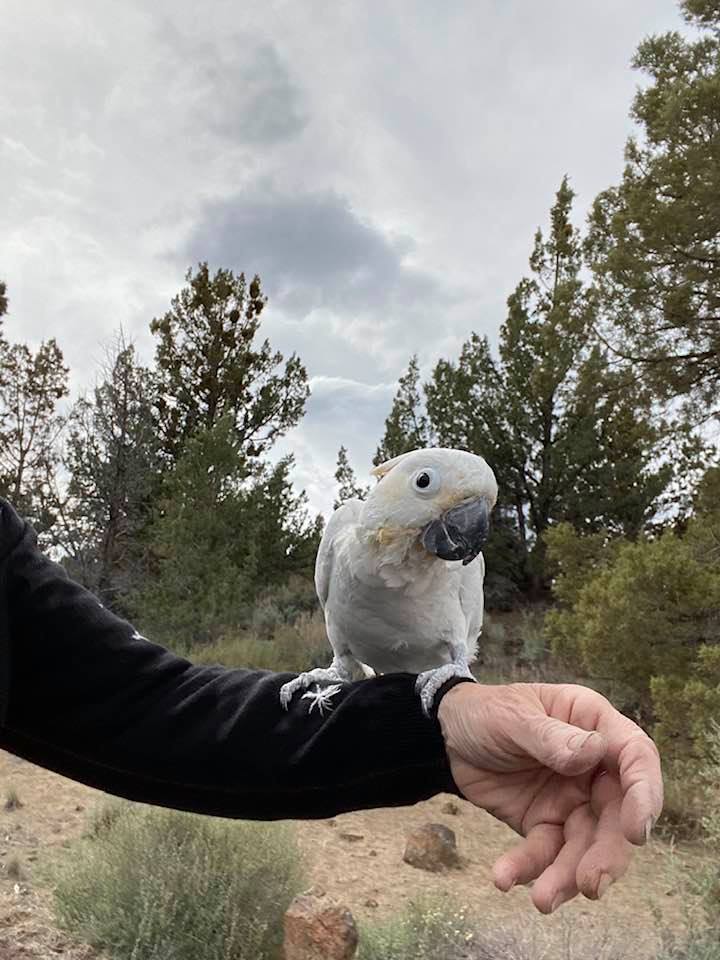
Walking with a smart bird perched on a shoulder or arm is a slow process. For starters, it’s about trying to get that bird to talk or simply talking to it in a one-way dialog. The bird’s listening for a smart bird doesn’t miss a beat. If my bird, Peaches, is silent, he responds physically by cuddling and nuzzling. Sometimes he feels like participating in a conversation. That’s how Peaches and I stroll together.

These days we bump into many neighborhood folks on the streets. Some are old friends like Susie who wondered about all the white that coated my black sweater (it’s powder from parrot wings). Strangers who pass may pause and greet Peaches, with “Hello”. Despite my urging he often refuses to answer. After they pass and are beyond earshot, he pipes, “Bye, bye!”

We’re an odd couple, me and the very white parrot on my arm. As we’re walking, I must appear to be talking to air. There’s no telling why I patter nonstop to a bird that’s also in his own world. Maybe trying to keep him tuned to me, or to teach him a new sight or a word, and to encourage responses in his language or mine.

Suddenly, two geese flying low and passing nearby make Peaches scream for several seconds. Those strangers surprised and frightened him. Something interesting is that Peaches doesn’t appear to scan the sky, as I’ve noticed other smart birds doing, to look for overhead predators. Well, Peaches’ wide vision is incredibly accurate so who knows where he’s looking or what he’s seeing?

Anyway, with Peaches I keep an eye on the sky, after warnings from bird fanciers that a hawk might drop and grab Peaches from my shoulder. That seems unlikely but our neighborhood does have resident hawks. Helpfully, Peaches enjoys standing on my forearm and snuggling against my chest, more protected than when he’s on my shoulder.

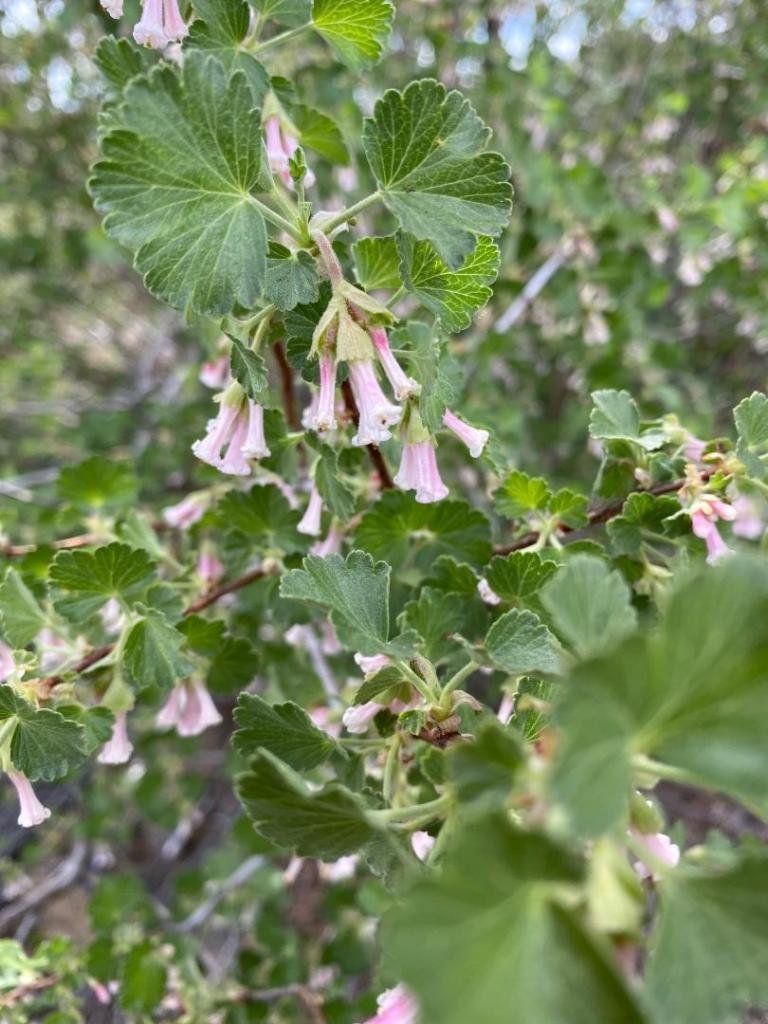
Walking slowly and entertaining the bird keeps me looking closely at our surroundings. Here’s a plant that surprised me. I’d never seen it. “Look, Peaches, at this giant Lily of the Valley.” Afterwards, I see it frequently, including on my property. According to my phone app, it’s a currant, interchangeably called a Wax currant, Squaw currant, or White-flowered currant.

Arriving at my small acreage, Peaches and I enter in a new spot–and voila!–directly beside one of those currants. And now it’s a sight beyond wonderful, for on the plant a huge honeybee working hard hops from flower-to-flower draining them. A fat and healthy bee, probably from a nearby well-kept hive, and I need a picture. Hastening for my cellphone while juggling Peaches is disruptive, and before I can organize, alas, the bee has flown.

I’m hopeful and said to Peaches, “That bee lives in our territory, knows this plant, and will be back. We’ll watch and wait.”

Dear Friends: Outings with Peaches capture so much, we’ll share more with you. Diana

Transitional Demons

Monday, May 04, 2020

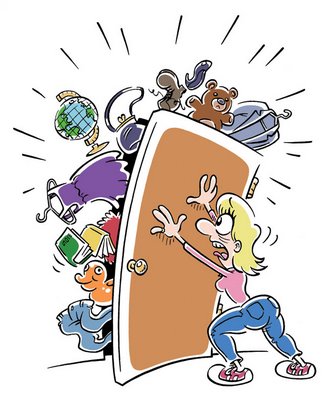
Just as we consider putting away heavy coats and head warmers comes a string of days too cold to be outside without. Yesterday for example, we had periodic sunshine (no coat) and overcast (bundle up). More such weather will hit before summer settles in, when we’ll start jamming heavywear into closets already probably stuffed full.

There’s a lack of closet space in my house where jackets hang on the backs of chairs and over the upstairs bannister. I grit my teeth to jam something into a closet, or to create space for removing an item. I blame homebuilders (mostly men with less clothes than women) for having little respect for space needs in closets.

The exception in my experience was a house long ago with a huge closet in its master bathroom. For sure, my closet was jam packed but held nearly everything–and so convenient! I’d enter that bathroom, fulfill morning rituals and exit fully dressed, ready for the day. I’ll always miss that bathroom with closet.

Fast forward to my current home, larger and ranch style–long, flat, with lots of cabinet spaces, but oddly, few and too-small closets. In the beginning, I ignored inadequate closet space, but my first high-desert winter changed that. I suspect the closet-packed issues began with my part-time job at Costco.

Working in a huge warehouse means being surrounded by impulse items. Costco’s merchandising policy is to move products in and out, regularly and within short periods. Shoppers tend to buy on the spot if they see and like, while it’s available. Most of us working there know what’s immediately available and joke about leaving our paychecks in the store.

The intensity of our winters varies, but always there are extremely cold periods, short or long. Working in Costco teaches its many varieties of cold weather wear. Toward the end of winter heavywears go on sale. After weeks of seeing what’s available as items rotate to on sale, it’s hard to resist purchasing. So, I’ve tons of winter wear, sometimes finding accidental duplicates.

Could over-purchasing not be the most-primary cause for a lack of closet space? Is the villain technological improvements enabling rapidity and quantities of cheaper fabrics and finished clothing? There are many questions about over-purchasing, like does it symbolize something deeper like a basic human impulse to hoard?

Hoarding has been rampant over our six-weeks, or so, of Corvid-19. Newspapers report such as antiseptics, toilet paper, and baking supplies disappearing from shelves. They claim that hoarding makes haywire our traditional supply chains. Oh, sure, let’s blame the problem on consumers instead of leadership and planning (I won’t continue in that direction).

My closets are full. Winter jackets are strewn around. Today it’s chilly outside and lets me stall a resolution to this problem. The best way to correct my spaces is to start discarding. Many pieces I could live without, but oh, deciding which hurts.

Dear Friends: I’m not a hoarder, I’m not a hoarder. Oh dear, am I a hoarder? Diana

Heavy Heads

Sunday, May 03, 2020

Yesterday, our high desert weather was a mess. The temperature dropped noticeably and daylight hours alternated between brief sunlights and shadowy periods with very high winds. One moment I might be outside in short-sleeves and another bundled in a warm jacket. The day felt more winter-like than spring. So, I brought in the dogs and let Netflix take over.

It’s been hard for me to find new shows streaming that I feel like watching. Maybe it’s because my moods aren’t good enough these coronavirus days to find writers’ fantasies appealing. Maybe it’s because watching again shows I’ve seen and enjoyed is easier. Unfortunately by now, I’ve too often re-watched and need something new.

So, I’m returning to “The Crown.” Yes, I know, almost everybody but me has enjoyed it. I tried a few times to watch it and always became bored. Yesterday, I started-up again, and from scratch, determined to stay with the series. Actually, it’s good–well scripted, acted, and photographed. But still boring. Let’s face it, an entire episode that focuses on whether to (1) “invite to the wedding or not”, or (2) “let Margaret marry or not”, or (3) “see if hubby will decide to kneel or not” aren’t particularly compelling. Even if they’re presented well-enough.

I suppose the whole point is how over time the monarchy is changing. It’s evolving from following stodgy family traditions to showing signs more of modern outlooks and behaviors. We do see this happening in real-time before our eyes. There already are on film four seasons, and the producers probably are rushing to capture today’s shift forward with Harry’s & Megan’s escape.

Many of my friends enthusiastically have recommended “The Crown” and its careful production lets me see better now why they’ve appreciated it. I suppose that upcoming episodes will grow more complex with Elizabeth’s increasing capabilities in her Queen-role. Actually, the series highlights complex questions, like why do the Brits continue supporting very high-pageantry and an incredibly expensive monarchy, when the country’s Prime Minister actually runs things?

Oh, what the heck: maybe another series is about to crop up that examines very closely our own confusing, and uber-expensive, political and social trends.

Dear Friends: If only “a Freud” were around to illuminate us on today’s social complexities. Diana

Talks With Peaches

Saturday, May 02, 2020

We went for a long walk, Peaches and I. We crossed a couple of adjoining properties that I’ve permission to pass through and continued over the mile-and-a-half loop encircling our neighborhood. I watched the sky intending to pull Peaches from my shoulder if an area predator were scouting above. My bird made our whole walk easy though by staying on my forearms and leaning against my chest.

In Cockatoo terms, Peaches, a Citron Cockatoo, is a little guy. Citrons are smallest in the genre. What my bird lacks in size, he compensates mightily in sounds. Until yesterday, we’d not gone walking in too long, for his grown-out flight wings were worrying me. If Peaches suddenly became frightened and leaped from my shoulder, maybe he’d fly to who knows where. In caution of coronavirus, we waited to visit the bird veterinarian until this week.

Maybe because he’d not been outside in a long while, Peaches stayed silent for the first half of our walk, and although quiet, he was totally alert and active, nuzzling my hands and chin. Finally, I wondered what would happen if I made the first move. I verbalized a couple of “Hellos!”

The bird responded immediately, “Hello!”

After we exchanged “Hello” several times, I moved on to “Goodby!” So did Peaches, and now, we’re walking down the street with loud, “Hello, hellos!”, “Goodby, goodbys!” For the bird, that was “game on”! He let loose with some amazing vocabulary that he shares only at his choosing, and added wilder sounds that reverberated in my ears.

Peaches made me laugh out loud, and does so even when he’s annoying, like last night at bedtime. When I said “Goodnight, Peaches”, he let loose a big squak. Remembering our earlier exchanges, I squaked back. Peaches immediately squaked twice, and I echoed. Our “conversation” got louder and more varied, until finally, my best option was to blow a kiss and walk out on him.

Dear Friends: It’s easy to get so lost with a smart bird that you’ll forget it’s just a bird. Diana

Swim On!

Friday, May 01, 2020, Corvid-19, partially-unlocked Day #01

It’s May and here we go! For weeks of mornings, many of the news bits arriving in my early emails have focused on the hardships and related impacts of a serious active pandemic. Now there’s changing news, it’ll begin addressing real-time impacts, socially and politically, of reopenings among American public places. I’ll choose to stay home and read all about the changes.

For me, aside from boredom this period of social isolation hasn’t been too uncomfortable. Kind neighbors have been willing to fill my list while they’re out shopping for themselves. I’ve learned to obtain online and painlessly much of what’s needed, to run my household, feed me and my pets, and handle outside efforts on the property. I’m more involved with this small acreage than ever in my years living here and do lots of outside work. If I were a gardner and creating fresh produce, that would close the biggest loophole, but my growings are at beginning stages.

I’m assuming that for most of us it’s been similar and a little lonely through this inconvenient but okay period. We’ve been forced to stay inside, to sit back and see differently the world and ourselves. I keep trying to assess the positives for myself. For example, I’m more aware of and sometimes surprised by my preferences in books and hobbies. I’m discovering stamina for physical work, more than I figured possible. I’ve found creative ways to interact with my large and small pets, and understand better their importance in my life. And I appreciate more how blogging daily challenges my thinking skills and how writing helps to keep friends in my life.

What will our oncoming new normal–nationally and internationally–look like? Will we carry forward and find time for newly-found personal activities? Will we remain on the alert for potentially-bad international situations, say beyond wars, like new viruses? Who can tell, who can tell?

Dear Friends: On this May Day, holding our noses and diving into tomorrow. Diana

Deciding Time?

Thursday, April 30, 2020, Corvid-19 Lockdown Day #43

There’s a huge push to re-open the American economy, assisted by the appearance of a drug that might ease coronavirus suffering. There’s lots to consider, and many are debating about whether it’s appropriate now for businesses to reopen and people to come together. I’m in the camp that says wait longer, but I haven’t much of a vote. My option is to decide what to do personally based on whatever seems right in my head.

We’ve all tried through the months of this pandemic, to make sense of the many frights, realities, and handlings of it. World leadership has proven a mess! Perhaps one of the most powerful illustrations of reality was that the hardliner Boris Johnson was stricken. His condition was severe enough to warrant emergency and ventilator care. After Johnson recovered, and now fully aware of corona’s impact, his position seemed to soften toward managing both the scientific and social needs in Great Britain.

I’m not sure what’ll become more right in my head. For one thing, it’ll make sense to keep staying home until the safety of reopening is proven. For another, staying in-home limits our activities, can be uber-boring, and continues to promote distancing from other humans. When businesses start to re-open, tomorrow in fact, we’ll remember the old ad’s words: “Should I stay or should I go?”

My decision may simply go on hold for another couple of weeks. I’m near finishing my chainsaw project of liming trees and now have huge and unwanted piles of brush and limbs. The city dump will be offering days of free yard debris dumping. I’ll be there often bringing trailer loads of discards. Not until mid-May will I seriously assess the odds of staying or going. Anyway, by that time, who knows what more we might know?

Dear Friends: Have a creative, enjoyable, and hopefully another, shirt-sleeve day. Diana

Hugs Alot!

Wednesday, April 29, 2020, Corvid-19 Lockdown Day #42

In the last 41 days, I’ve taken a vehicle and left my property about four times. Two to shop for groceries, once hauling a trailer to our local dump, and finally, so Peaches could visit a veterinarian. Okay, maybe we’re all in this together, but we’re sure feeling alone.

Today, I read that the skin’s “need” to touch and be touched scientifically is proven. That tossed my thinking back many years to when I knew a young and talented engineer. He was fascinated with skin’s attraction to skin and illustrated why by pointing his index fingertips near one another in a straight line, but preventing them by a tiny fraction from touching. The fingertips couldn’t be steadied completely against “miniscule dancing”. They seemed wanting completely to draw together. He intended someday to study this phenomenon. I wondered why then, and occasionally have since.

Today, an article in “Neuroscience”, about “skin hunger”, helped clarify that scientist’s focus on his fingertips’ mutual attraction. The “Neuroscience” article cites data from Miami University’s Touch Research Institute about the ways touches affect humans. Under our skin are pressure sensors, which respond to touching by sending messages to the brain, where then a nerve slows our nervous system. Responses to touch are relaxations in blood pressure, heart rate, and brain waves. (I’m including below a link to the article.)

During the past 40-some days of practicing human social distancing, and as it continues, maybe our animals have and will help more than we’ve realized. Of course, they get us outside for walks, but we also touch our pets lots. Some touches are for planned purposes, but most often, they’re thoughtless stroking habits. In any case, our brain pressure sensors respond to these skin contacts by relaxing us.

I’ll quit pushing away my dogs when their pleas for strokes interrupt my involvement with an intense Netflix series. Now, appreciating more our mutual needs for those strokes, I’ll pause Netflix and hug the dogs.

This amplifies the importance of a huge variety of pets. Horse-handling for example demands lots of touching and grooming. My dwarf goats, ditto. As for my hens, they’re always mutually in physical contact of one sort or another and enjoy being near me but don’t need my handling. They greatly need one another.

I’m reminded of the annual Pet Parade where folks show up with healthy lizards, snakes, and all varieties of well-cared-for pets. So, in Day 42, I’m doffing my cap and recognizing more, both why we need touching and in appreciating pets of all sorts.

(https://www.wired.co.uk/article/skin-hunger-coronavirus-human-touch?ncid=newsltushpmgnews)

Dear Friends: It’s been notable how greatly animal adoptions have increased in this period. Diana

Bird Talk

Tuesday, April 28, 2020, Corvid-19 Lockdown Day #41

Yesterday, I took Peaches to Dr. Maas for wing and toenail trims. I had elected for “curb service” and while waiting for a tech person to come out for Peaches, a couple of fellows were leaving the clinic, and on one’s shoulder stood a gorgeous parrot.

“What kind of bird?” I asked.

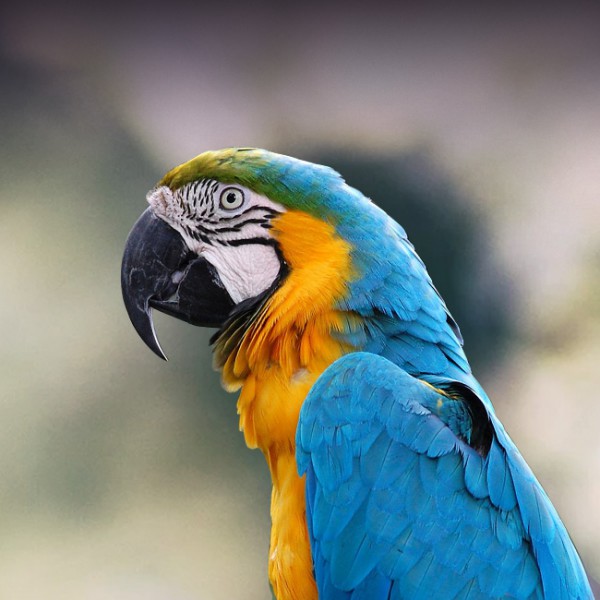
“Blue and gold Macaw,” he replied. They got into their car before I could ask more.

I realized they saw me as a casually curious onlooker. So, I quickly opened my Jeep door and removed Peaches’ cage, setting it on the ground and hoping they’d spot my bird. They did while backing their car. They made a big circle and paused, now grinning wide-eyed, and happy to chat about birds.

“I’m so glad you could spot Peaches,” I said. “Please tell me more about your parrot.”

Their Macaw still is an infant, only 3-years old, and she can talk up a storm. They have had her since she was three months old. Yesterday, they were excited that she’d get to see another parrot, a first for her.

I held Peaches up, and suppose the two birds looked at one another–hard to tell since each bird eye has a wide range of vision. Their eyes don’t necessarily move directly toward what they’re seeing. We all knew parrots though and believed that those two effectively were sizing up one another.

Actually, I’ve found that it’s stressful for a bird accustomed to being the “only one” to be near another bird. A few years ago, we had a Cockatoo visitor while its owners were on vacation. That bird visitor, a Cockatoo more mature than still-juvenile Peaches, didn’t seem at bothered in strange surroundings near another bird. But Peaches soon began picking at his feathers. That’s a stress sign, never good to see, for once it starts the picking is difficult or impossible to stop. Anyway that was different from yesterday’s situation, which we humans enjoyed.

The three of us exchanged stories about living with our birds. Sharing experiences and affection made us forever friends, even if we don’t again meet–although we might, at the veterinarian’s.

About Peaches’ visit. First and to my great relief, he behaved well. Dr. Maas himself brought the bird out to my car. He said, “Peaches is in very good health, but there’s been a little feather picking.” I’m hoping that now, without flight, Peaches may be on my shoulder and outside more, which might counter his stress.

Even fully feathered and able to fly, Peaches is good about staying on my shoulder, but if frightened he’ll take off into flight. I worry that maybe he’ll land high in a tree and won’t descend readily. The last time we went walking, something made him fly. As I chased, a passing car nearly hit us.

Peaches could use a couple more ounces of weight. Dr. Maas said it’s okay to give him occasional seeds. (Seeds are high-fat, cause rapid weight gain and must be limited). He cautioned against feeding Sunflower and Safflower seeds, highest in fat. Otherwise, Peaches may have seeds. Eating what he loves also alleviates a little stress.

Dear Friends: Appreciating beautiful, smart, and alert birds opens new vistas to humans. Diana

Howdy, Spring!

Monday, April 27, 2020, Corvid-19 Lockdown Day #40

The winds this morning are moving and making treetops wave. Soon I’ll go outside to feed the large animals, and afterwards hang out with a water hose to sprinkle newly emerging flowers. Oddly, in this spring, the little bluebirds that for years have nested in my barn haven’t returned. Although I love them, it’s okay that they’re elsewhere. They’ve always chosen the worst, most dangerous spots to build nests. Either their nests are on ceiling boards, spaced so that babies may fall through, or they’re too-easy to reach by Maxwell, my barn cat, who knows when babies are in the barn.

In this nesting season, I’ve been hearing and watching our local Raven pair, always busy, noisy, and relatively unbothered by humans. They often park in nearby trees, chattering, or they swoop around overhead, near enough for me to hear as their wings break the air. Or, they’ll settle on the ground and wait to drink while I’m filling a horse trough.

As I’m working on the property, it’s fun listening to the quails sounding off. But my favorite bird calls might be those of Mountain Bluebirds. Their “Hi, Baby” reminds me of years riding horseback and returning aloud their calls. Even today, I smile and reply, “Hi Baby”.

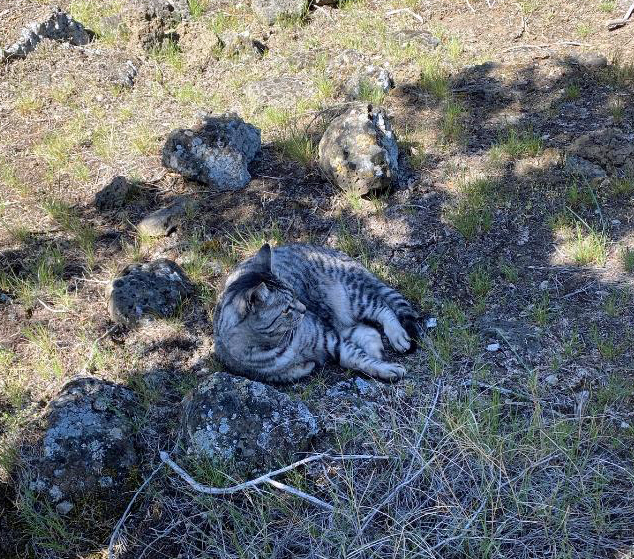
It’s all good, as long as I don’t discover Maxwell’s mitts having grabbed a critter. If he catches a bird (brings them into the garage), he’s automatically grounded a few days, is miserable housebound, for he loves being outside. Yesterday, he stayed nearby and in today’s header photo, you’ll see his hunting method. My camera caught him in a cozy spot, nestled against a rock, hanging out quietly and unmoving. Woe to a critter that might land or try to pass nearby. He reaches and grabs, the lazy opportunist!

Dear Friends: Netflix’s new one-segment piece, on Corvid-19 (2020), is worth watching. Diana