Tricky Mind

Sunday, September 13, 2020

My brain plays tricks on me. Recognizing each makes me laugh and feel irritation and anger at myself. Okay, everybody suffers brain tricks. For example, “losing keys”. Recently held and somewhere set down, they’re where! Not lost and must be nearby, forcing searches in all the usual places. On finding our keys, we acknowledge a brain trick and go on with our business.

Recently, my brain’s trick was a lulu. While working at my part-time job and feeling bored, I put pen to paper and started creating a story. I’ve yearned to start writing creatively, imagined my scribbles as beginning what might become a novel. My writing was rapid and tiny, my hand seemed moving on its own, and from my mind words flowed. I felt on my way. Upon folding that paper and putting it into my apron pocket, it seemed my creative aspect was being realized, and about time!

I got busy and forgot the writing until later that evening when I looked for the paper. Certain to have set it with the day’s mail, I searched but to no avail. I looked in all the usual places but no story-start to be found. Might I have left it in the apron pocket?

Because of the pandemic, on arriving home from work I remove all my outerwear and toss it into the washing machine. The next day I again wear everything, and with two gains: first, all’s clean, and second, no time wasted looking for an acceptable outfit. Upon remembering my apron, I hurried to the dryer. It’s open door revealed bits of dried paper floating, and for sure, my story.

My brain was protecting me from work I’ve been avoiding. Frankly, I’m an untrained writer who lacks confidence in my ability to create a long fiction. Plus, I’ve minimal time to focus on the great effort of writing decently. My heart wants to write a story, my mind doesn’t think it possible. That had been a surprising moment, finding myself putting pen to paper and scribbling. It signalled a big want.

Those bits of paper floating in the dryer told a story that may stay short or go long. After a couple of days thinking, I’ll move on and use what’s been learned. This morning, I began a new version of my story. It’s being written and saved on the computer, and in random moments, may be continued on my iPhone or iPad.

Dear Friends: Your inner-self gives clues to a mighty struggle of moving forward. Diana
Adjusting….

Saturday, September 12, 2020

Smoke thick enough to cut with a knife, all day yesterday, and still hangs darkly as this day begins. The fires haven’t crossed the Cascades. We on the east side keenly are aware of blazes and hope they’re contained over west, especially before an occurrence of big winds.

Staying indoors doesn’t help, it’s equally smokey. Yesterday, while in Costco and masked, a smoke-smell was strong. In a short time my eyes were burning. Everybody inside the store said smoke was affecting them. Some customers had managed to cross the Cascades to Bend before that highway’s shut-down. They described devastation they’d seen and concerns about families and friends with threatened homes.

I think about preparing to escape in case Bend residents receive a Level Three evacuation notice. While that seems unlikely, who can say? Yesterday, the contents of shopping carts suggested that residents are uneasy. Those carts carried (besides many cases of wine) large boxes of survival foods packaged to retain a half-life of nearly-forever. Also carts full of storage containers went out, maybe destined to move supplies quickly.

Maybe it’s not mostly from our collective fear of wildfires? Maybe it’s because we’re forced simultaneously to cope-on through this never-ending pandemic? Together, can’t these inspire humans to fill shopping carts with such as booze, storage containers, and sweat-clothing.

It’s about our attempts to work through an ongoing panic mode that we now recognize has enlarged. It’s about humans struggling against nature’s most aggressive elements. They are confronting humans to the limits of our current preparations and capabilities.

Dear Friends: The wildfires are add-ons to an already lengthy, exhausting panic-storm. Diana

Memories

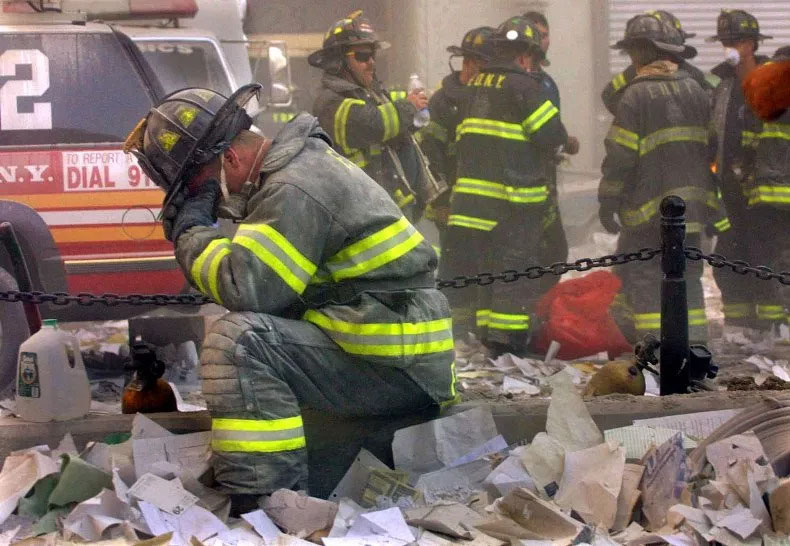
from New York Times archive

Friday, September 11, 2020 (Nine-Eleven)

Today, we remember one of those remarkable events that within us are a lifelong “memory series”. This one begins exactly at the moment we became aware of airplanes attacking New York’s Twin Towers. We’ve frozen that moment in our memory banks. For me, living in Los Angeles and early in the morning talking with a close friend, I learned that on-the-spot video had captured the collapsings of New York’s tallest buildings. Those moments, of sudden awareness and my after-the-fact witnessing on TV, and the bravery of passengers on American Airlines 77, are etched in my memory and still painful.

Associated experiences over many years also are well brain-etched. There are instants of murderings that took away America’s JFK, RFK, and MLK. I remember MM’s sudden death, the OJ trial’s oddly-effective glove-defense, the disappearance of Natalee Holloway, and the mass shootings that killed many gathered at school and in public events.

My earliest etched-memory is of a very old 1949 event, when three-year-old Kathy Fiscus fell into a narrow well in San Marino, CA. The newspapers for days reported on rescue attempts, all failed. Then a little girl myself, that locked me into a lifelong fear of old wells hiding in open areas. Even today, while riding horseback and occasionally bushwacking across natural landscapes, I fear evidence of previous dwellers and undiscovered wells.

We are social beings who participate in smallish family and work-related groups. We’re also highly connected to the whole human social system. In essence, what happens to any of us impacts all of us. After nine-eleven, Americans became highly aware of what is happening worldwide. A current international case in point is the terrible murdering of Jamal Khashoggi–a shocking social travesty, it is bolstering an humane outcry for social justice.

Dear Friends: Remembering events, implications, feelings, and lessons-learned. Diana

Flaming Fury

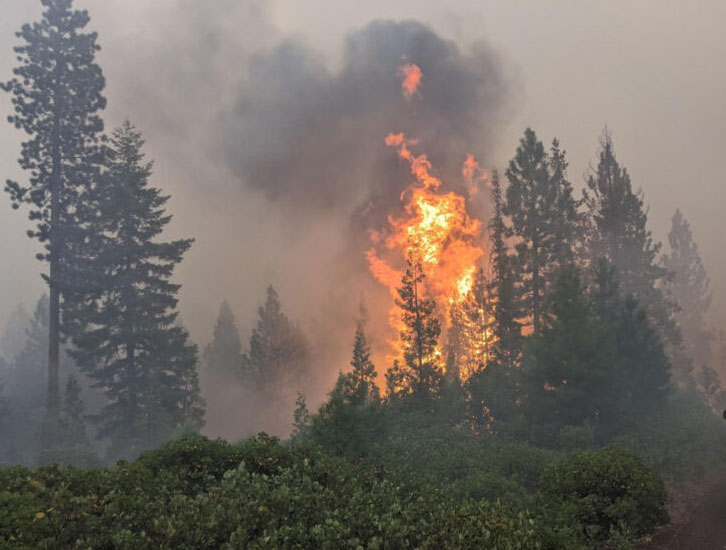
Oregon Wildfire (KTVZ News)

Thursday, September 10, 2020

The skies over Central Oregon are murky gray from wildfires raging over west. After burning small towns just across the mountains, those fires have closed the Cascades highway. Our local air quality is poor and the changing weather confuses. Many active blazes up and down the west coast have slimmed available resources for firefighting rapidly.

I’m thinking about how to evacuate. I’d pack my small horse trailer with supplies and if there’s time would hitch quickly and depart. But above all, my animals must be saved. In a case of very little time, I’d load the horses and stuff the big trailer’s tack-room (and my truck’s back seat) with pets. Off we’d go, and depending on circumstances, I’d return for the supply trailer or forget it.

At least, that’s a plan and seems easy enough. But in real time evacuating would be chaotic.

The thing is, it’s not fires usually that worry me. I more often wonder about a possibility of escape if the South Sister’s rumbling increases until that mountain explodes. While it’s not a likely happening, at least soon, we musn’t forget that not so-long-ago Mt. St. Helen’s rumbling fronted a sudden explosion that devastated a large area. If hot lava from South Sister suddenly rains on our area, there’ll be no time to escape. Periodically, I consider this.

I’m not a doomsday predictor. I’ve met many who are during my years of working part-time at Costco. It’s surprising the number of people who shop actively for “what if supplies”. They seek nonperishable items, that will over time will remain edible, or could become negotiable in periods of shortages.

These current unusual times fueled by pandemic and fire are the tip of an iceberg. Worldwide, nations have wasted resources. Instead of developing infrastructure, equipment, know-how, and manpower for emergencies, our created world is unable to communicate, collaborate, cooperate, and agree to apply resources in a manner to assure longevity. Instead, our world is a victim to known forces of nature that for too-long were ignored and underfunded.

Whether any planning works appropriately depends on what’s foreseeable vs. what ain’t.

Dear Friends: Let’s think ahead without going overboard, and for sure vote. Diana

Reality Bites

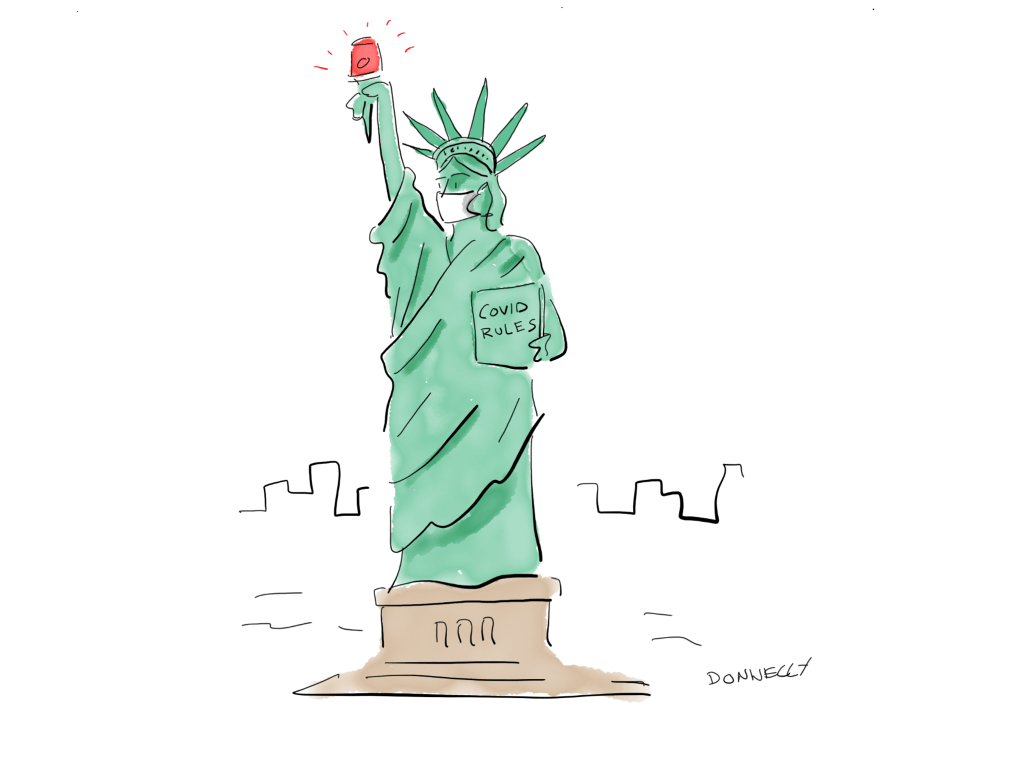
“New Yorker” submission, by artist Liza Donnelly

Wednesday, September 09, 2020

I’ll be bored on this day at work while representing a new product. Customers only may look at it, and so will ask few (if any) questions about this product’s worthiness or otherwise. Instead, they’ll ask lots about why we’re not serving food samples.

I’ll have to stand for hours in one spot. So, I’ll amuse myself by reading t-shirts. It’s actually fun, for many are adorned with clever designs and messages. One of my favorites was, “Man Beer (the one you’ve been practicing for).” I checked the internet and discovered Man Beer is really a brand. I’m starting to carry a small notebook and intending to record some of the better t-shirt messages.

Mainly, I’ll be watching people’s masks, observing how they’re being worn. Many folks are doing the right thing by covering completely their mouths and noses with masks. I’ve been hearing shopping mom’s reminding their masked kids to lift the masks over their noses.

On the other hand, many adults, and of course their kids, are rejecting the idea and purpose of masks. They wear them below their noses, or worst, leave them hanging loosely around their necks. The store’s employees often remind shoppers to reset their masks properly, but to little avail.

It’s a sad situation.

Some customers who pause and want to talk, want to try convincing me that the pandemic is a hoax, doesn’t exist, and that all about it is BS. Well, I disagree. I step back from them, and from others improperly masked, who try engagine me in conversations.

This part-time job keeps demo folks focused on sanitation. We keep our tables and the big plastic shields well-sanitized, change our gloves and masks frequently, don’t touch our faces before washing our hands. As for me on arriving home after each workday, there’s the extra step of tossing all my work-related outerwear (including sneakers) into the washing machine.

Stay away coronavirus.

Dear Friends: “Reality is in the eyes of the observer.” As for this virus, I’m a believer. Diana

Hunting Season!

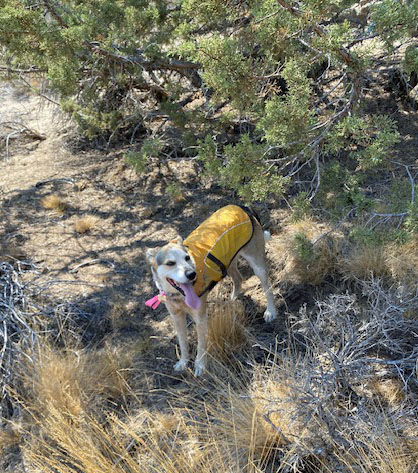
Ranger, wearing pink & orange

Tuesday, September 08, 2020

Central Oregon’s having a coldslide! It’s chilly out after yesterday’s mega-windy late afternoon. This evening, I’ll pull from storage an electric blanket and have it at-the-ready. So amazing, how quickly our weather changes. Just a little experience with its patterns teaches locals to pay attention.

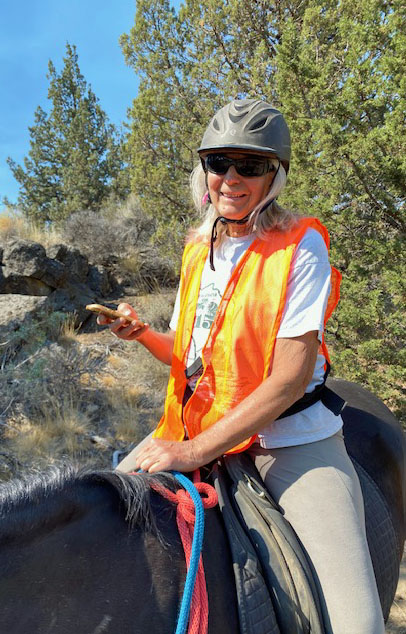
Yesterday, Anna and I rode in an eastside public land. We got started late, after suddenly remembering that hunting season has begun, requiring us all to be outfitted colorfully. I have for Pimmy a set of bright red pack bags, but she’s too fat, and we couldn’t secure the buckles. So Pimmy had to stay home. I found a gold outdoor jacket for my Ranger, hounddog, and he went along. Anna figured out how to brighten the horses and I dug out for us a couple of bright vests.

Anna on Rosie

Becoming more colorful needed this practice session. Our next preparations will be more efficient. Hunting seasons are frights for us who enjoy playing in the forests. Mostly, we fear newer hunters, those eager beavers impatiently wanting to take shots. I worry less for easier-to-spot horseback riders than for my entourage of dogs and lagging-follower donkey.

We escaped hunter issues yesterday while en route by making a sudden decision to nix the forest. Instead, we turned toward a safer desert area. If we’d thought ahead, all the dogs and Pimmy could have gone along, but c’est la vie, and “next time”.

Hey, ride with us! 27 seconds of Sunni following Ranger & Rosie: https://youtu.be/1eCu3zvp5Sc

Dear Friends: Yesterday, late afternoon turned huffing-puffing, smokey and dim. Diana

Sound Meanings

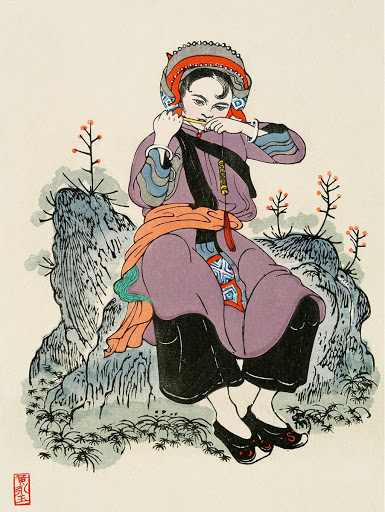
Girl Playing Harmonica (Huang Yongyu)

Monday, September 07, 2020, Labor Day

This day is of appreciating labor, and our progress, socially and affluently, attributable to the historical trio–innovation, production, and labor. This particular Labor Day also is one of remembering labor, because of the pandemic. Many manufacturing processes are truncated or shut down and it’s uncertain as to when a manufacturing revival may occur. We question if things could resume as in the past for much has changed over a brief time.

I want to labor at learning, and have checked online for free courses in the arts and humanities that seem interesting. Lately, I’ve focused on a variety of music-learning. I’ve considered courses on appreciating music and on how to play a harmonica. Wondering about my attraction to these has made me aware that listening to music is like listening to spoken words.

In particular, I’m recalling what it’s like listening to customers while at my part-time job. When someone speaks, I hear tones, rhythms, pauses, high and low sounds, and punctuation forms (coughs, sighs, and throat-clearings). The rates and pitches of these quickly offer insight to a speaker’s state of mind and focus.

Without thinking much about how we listen, we do tune closely as others speak. We hear beyond mere words and sense a speaker’s meanings and suggestions. We listen for openings that may invite our responses. Essentially, technical words applying to a musical scale apply equally to a listening scale: tempo, meter, dynamics, rests, and all.

As to my wanting to learn to play a harmonica, the instrument seems easy for a beginner to approach. That’s superficial though, because learning to play well any instrument eventually requires the comprehension of a technical musical idiom. That is, unless one wants to stick with the primaries: “Happy Birthday” and “Mary Had A Little Lamb”. You get the picture.

Dear Friends: Wishing for you a happy Labor Day with lots of interests. Diana

Cup’a World

Sunday, September 06, 2020

I love learning, and this morning am sipping a cup of Arabica bean coffee, a Cuban roast. All this after yesterday’s coffee-aisle stint and my job of selling a Kirkland coffee. I read closely all the coffee packagings to understand if mine differed and somehow was better. Most coffees (except for Folgers) contained 100% Arabica beans. Some claimed to be “Colombian” (Arabica beans grown in Colombia). I got curious about roasting processes and especially packages marked “Cuban” and “Sumatran”.

Nobody asked about beans, but we know that a seller of coffee should know something beyond taste. During my lunch, with cellphone and the University of Google, I learned lots. Who knew that centuries ago coffee originated in Arabia? Modern Arabian beans, known as Arabica, are in our modern expensive coffees.

Before America’s introduction to new smooth-tasting coffee varieties, our coffees mostly were from robusta (canephora) beans. Robustas are less costly to grow, can be cultivated at lower elevations, are more resistant to pests and diseases (their higher caffeine content is a natural pesticide). These beans have a stronger, harsher taste than the Arabicas, and today mostly are in Folgers, espresso, and instant coffees.

Arabica beans have a taste that’s sweeter and softer, with tones of sugar, fruit, and berries. Their acidity is higher, and a winey taste suggests excellent acidity. These beans are expensive to cultivate, as they’re sensitive to the environment and produce less per acre than robusta. They’re also more are in demand. Production challenges and consumer demands make them costly.

My hot cup of Arabica Cuban-roast smells good, tastes smooth, and is enjoyable. More of the beans are ground-rough and in the frig creating cold-brew coffee. Yesterday’s customers and I fantasized about a time when Cuban coffees were thick, dark, and accompanied by cigars. This cup of mine doesn’t copy that era but pleasantly hints.

Colombian coffee is a class of its own because the country’s high elevations and climate are perfect for growing Arabica beans. The higher the altitude, the better those beans taste. Colombian coffees are lighter, taste richer, and mildly fruity with a chocolatey flavor. All because of Colombia’s ideal weather conditions.

I’ll look forward to brewing Sumatran coffee. It’s Arabica beans are described as producing a smooth drink with lower acidity, but darker and more intense. Sumatra is in Indonesia, its population historically Arabic and predominantly Muslim. Sumatran coffees might more nearly represent earlier Arabic brews. I’ll be learning.

So much fun while focusing on coffees, to be absorbing more about places and products.

Dear Friends: It’s a horse-travel, the forest, and a coffee-travel, the world. Diana

Time Crunch

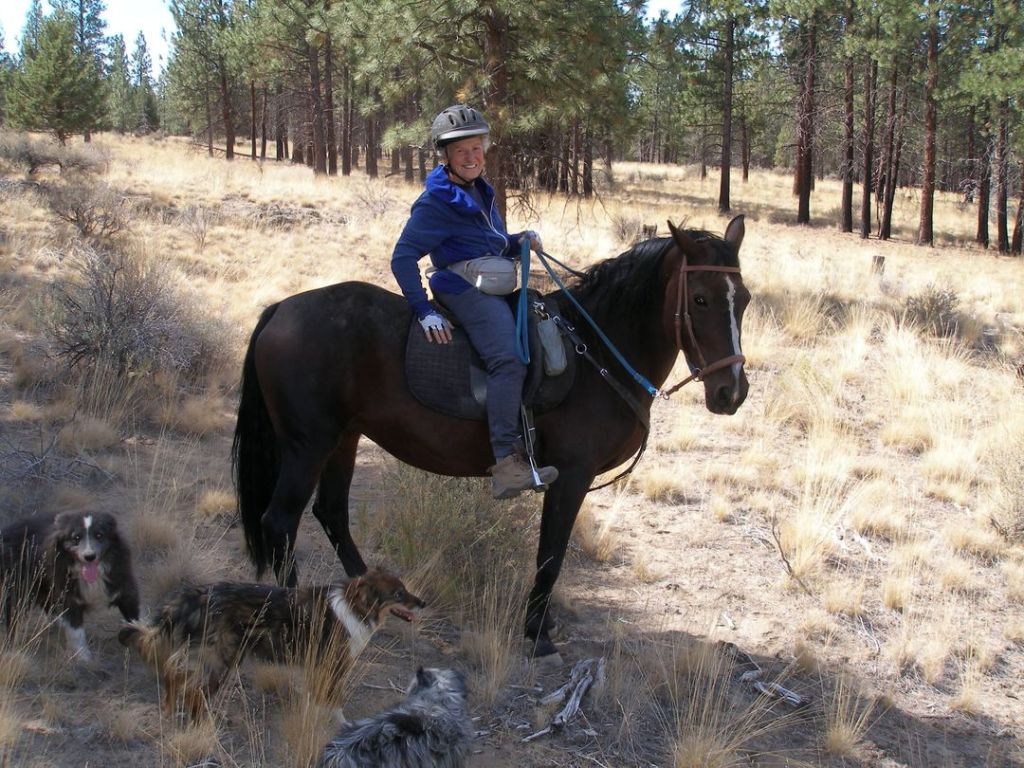
On Rosie, with our dogs

Saturday, September 05, 2020

This morning I can’t focus enough on what topic to write about. I’m due at work a little earlier and must complete animal-related chores before leaving. This forces me to calculate and recalculate the likely amounts of time before leaving to handle this and that.

I began preparing for this last night. Worked until after dark in the barn getting stalls ready for the morning’s animal feedings. Came up to the house later than usual to feed the dogs. I know better than to make Peaches wait for his dinner, for as natural light settles he thinks about roosting.

I apologize in advance to any pets short-shrifted today, and to friends for my brain’s pitiful morning.

Dear Readers: Have a wonderful day, and keep cool if possible. Diana

Learning Again

Friday, September 04, 2020

Returning to work forces me to create time for riding horseback. Yesterday I hurried home, let the horses have hay before riding one and ponying another out to neighborhood streets. We “bumped into” our neighbor, Susie (driving a brand-new car), who said we could cross her property. It’s an easy and quick way to reach a back road going under local power lines.

Her back-property is in a natural state, I’ve crossed it on foot, a rocky acreage with lots of rabbit brush and lacking a well-beaten path. One must decide where’s best next to step. The horses and I crossed moving toward the power-lines, a couple of times mistakenly walking on private properties. Fortunately, nobody complained and we reached our goal.

We first stopped beside a canal where I let the horses graze on their favorite, green and very-sugary grass. Reluctantly, they moved away to walk a mile or so walk beneath power-lines. The animals were agreeable, my ride nice. But returning to the canal and sweet grass area was another story.

I rode Sunni, she was outfitted in a bit-less bridle. This sort of bridle offers a rider at best minimal control. Sunni is kind and easy to get along with, but the green grass ahead made her want to hurry, and of course so too, our ponying horse, Rosie.

Heading toward that grass, I kept us together, and while there allowed time for grazing, before asking them to cross the canal. As we headed toward Susie’s again leaving the grass, both horses were reluctant. As we crossed that natural acreage with no a clear path and me worried about where best to walk, my tension communicated to the horses. They jigged and jogged, Rosie too little appropriately behind, and Sunni’s minimal headdress making my guidance nearly zero.

Upon reaching the street and heading toward home, the horses settled.

Lessons learned and future steps: (1) Cross Susie’s property on foot, tying ribbons to identify a horse-pathway; (2) separately ride each horse across the natural acreage, accustom each to departing and returning to the sweet canal-grass; (3) and have each while in training wearing a headdress that gives a rider appropriate control.

Dear Friends: Whew! Success with horses requires a willingness to cope. Diana