Changing Times

Saturday, May 16, 2020

Our world is changing and it’s only begun. I wonder if our evolving world will offer, at least for the majority of people, any improvements over the pre-pandemic world. Much we’ve grown up with and depended on is changing. Globalism is breaking down, huge retailers filing for bankruptcy are closing their stores, commerce is turning heavily online, and educational processes are in chaos.

That larger picture already has impacted our little worlds.

My recent trip to a grocery store showed prices shooting up because of disrupted food production chains. Modern commercial food production depends on vigorous international trade and abundant workers. The increased squabbling internationally and the Corvid-19 surprise have impacted negatively the needed components for food processing.

We learn about bulk food processing, it’s violent enough to cause vomit. Many facilities are butchering animals to provide meat. A single pig processing plant kills and butchers daily some fifteen thousand animals. A single cow processing facility kills and butchers daily some five thousand bovines.

Like many others, I’ve ignored food processing but lately can’t push it from my mind. I’ve read Upton Sinclair’s 1905 novel, The Jungle, and remembering it cringe. Sinclair wrote describing the United States meat industry and its then-deplorable working conditions. The book’s impact advanced socialism in this country. Eventually meat producers improved worker conditions, benefits, and pay. But individuals today working regular hours and slaughtering live animals, must become hardened.

The newer world also offer some pleasant surprises. I’ve begun steaming entire movies on my iPhone and surprisingly it’s fun. I can hang out at the barn during a break, enjoying “Prime Suspect”, as a favorite detective, DCI Jane Tennison, chases criminals and attempts to straighten her private life. I’ve been able to visit online some of the world’s greatest art galleries and been reminded of fine works I’ve loved, discovering opportunities to explore modern theories related to them.

Commerce is commerce though. It’s almost impossible to visualize ongoing huge shrinkages of international cooperation and trade. Surely though, changes are happening and will trickle down to individuals and families. Already, we find prices higher, walk-in department stores fewer, and online purchases enough to stretch delivery companies thin.

Dear Friends: Today, I’ll ride a horse and be out enjoying Nature’s abundant free beauty. Diana

Changing Times

Friday, May 15, 2020

I don’t mind the self-isolating process as a slight loner anyway. What’s awful is ongoing coronavirus news consuming most other news. Certainly, the public needs to learn about the disease, know ways to avoid and not spread it, and how to stay safe. That’s okay, but our journalistic processes turn every scrap of information about the disease into political drama and commentaries.

Lots of people dislike the current President, and the single competitor for his office over another four years is generally out of sight. So in the prominent social situation, our daily newscasters dish out pandemic and politics, making of the disease a massive competition between the President and our health and scientific communities.

I’m tired of it and will turn to television for a sense of what’s immediate in the outside world. After a few minutes, I must escape. Switching to streaming media doesn’t help, because plentiful offerings are the results of quick productions that feature noise, blood and guts, and minimal story-tellings.

The last several days have been overcast, chilly, windy, and the outside hasn’t been inviting. I’ve been housebound more and watching television. I’m grateful for having been outside and trimming trees over several weeks. Those days, little bits of news kept me apprised of the pandemic’s progress, political roustabouts, and the looks ahead.

There’ll be a new normal, they say. We wonder if in the future we’ll resume eating out in restaurants; and manage to straighten out international food chains and support farming communities; and somehow find ways to assist what remains of our middle class (not to mention the populations of very poor and homeless people); and will find acceptable the personal tracking being proposed. Worsening such complicated situations, and others, are dire warnings of highly possible follow-on pandemics.

Today is dawning sunny, will be warmer. I’ll go outside and create work to stay there. That way, avoiding newscasts and the pitiful offerings on streaming media. There has been a happy note through all this, in that my little property looks nicer after receiving some serious attention.

Dear Friends: A best new-normal would be helped by well-educated younger leaders. Diana

Artistic Vision

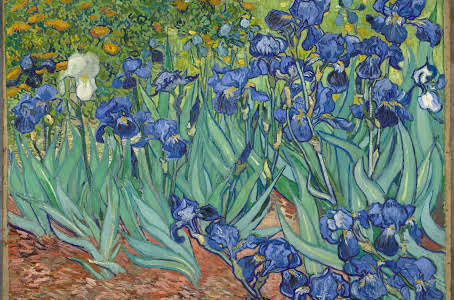
van Gogh’s “Irises” (Getty Museum)

Thursday, May 14, 2020

Since early today, I’ve taken virtual tours of the Louvre and Getty Museums. I began at the Louvre, the first museum popping into my mind because of its fame. The tour provided opportunities to pause before various artworks, to see and learn in detail about each. I’m interested in exploring the Louvre’s art, perhaps because of my fascination with the French film, “Portrait of a Lady on Fire”, which has a focus on fine art. But I left the Louvre and will return later.

Instead, I went to the Los Angeles Getty Museum, where often, I used to wander, sketch, and write about whatever captured my imagination. Many years ago, The Getty (as an unidentified bidder) acquired van Gogh’s “Irises” at a then-unheard of price of (I believe) $40M. That inspired me to go and see for myself that painting. There’s no recalling what I might have expected, either because of the artist’s incredibly famous name or the hugely-ticketed world famous painting. At the Gallery and for a long while I stood before it peering and slightly dumbfounded.

Physically, the painting seems relatively small, it’s certainly pretty and well executed, and resembles its hundreds of printed images. I tried to grasp what made it worth forty-grand (and probably more, if the auction house had revealed publicly that the unknown party competitively bidding was The Getty Museum; that’s an interesting story for another time).

Those days, I dreamed of becoming a writer, was enrolled in a creative writing class at UCLA, and practiced my writing much as possible. The painting and my questions about it seemed a good place to start putting immediate observations on paper. Maybe I’d work up some decent ideas and learn more about creativity. I pulled from my backpack a notebook and pen, stepped back and looked closely at the Irises before beginning to write.

I wrote first about the numbers of them and their overall arrangement, before graduating to their various sizes and stances. By now, having filled almost an entire page, my interest in the irises, overall and individually, had started to perk. I knew that ultimately it would be essential to develop a point of view, to have an opinion about the painting’s single white iris, featured at center left, and perhaps the whitish leaf balancing it at far right.

Popular opinion is that the white iris represents van Gogh, himself a social outsider. This has focused great attention on the work and an appreciation for that mysterious white iris. By the time I got around to writing about the white iris, I had become entirely fascinated by the work’s complexity and its artistic perfection. I could now see it as a whole with that single odd iris. In the end, I could not interpret the white iris as anything other than the popular conclusion. It probably is how van Gogh saw himself among others.

I learned from this experience that very great works of art are exactly that, and recognized that van Gogh’s brushstrokes are from a master painter. I also learned that an art viewer must take plenty of time to see details, to think closely about a work’s elements, each singularly, and all in total.

My virtual return to The Getty brought back a personal event of great learning. I’ll continue to organize my thoughts around that experience, perhaps to write more about those irises and me.

Dear Friends: This is a good time to visit a museum and escape to the recorded past. Diana

Storming ‘n Streaming

Wednesday, May 13, 2020

Yesterday a squall rushed through bringing slanting, heavy rains and massive winds. It provided little warning beforehand, catching me both outside and clear down by the barn. I’d have hung out there with a beer (from barn’s cooler) through the rains and winds. That choice wasn’t optimal because Miles, my Border Collie who deathly fears storms, would desperately try to claw his way into the house. So, covering my head with a piece of cardboard, I hurried uphill against battering rains and winds. My speedy arrival at the house prevented damage by Miles, clawing madly at woodwork that surrounds the entryway.

About once annually, we get a doozy storm like that, but not quite. Usually, a long hard downpour falls over a twenty-four hour period, steadily on and off. Yesterday’s storm lasted only a half hour, and this morning’s social media suggest that some local areas might have received snow. In any case, t’was a drenching.

Fortunately, having completed most of my hauling of brush to the landfill, I chose to take that wet chilly day off without feeling guilty. That way, I could focus on learning more about the recent film that has caught my interest: “Portrait of a Lady on Fire” (steaming on Hulu, in French with subtitles). Its emotionally moving and complex script drew me back, to absorb more slowly and in more narrow context what its characters were expressing. That closer review has reinforced a script that perfectly supports the film’s themes and correct, moody cinematography. The critical aspects fit together completely, like a great novel’s key elements.

Today is overcast likely with more rain. If again stuck inside, I’ll search recent back issues of major newspapers and magazines for what reviewers are streaming and appreciating. A problem, for example on Netflix and Hulu, is an avoidance of showing detailed movie casts and creators. Instead, they short-circuit those and move viewers rapidly on to more videos.

Here’s hoping today is warm and sunny enough to stay outside.

Dear Friends: Speaking of magazines, humorous self-isolating pieces are getting funnier. Diana

Squinting Ahead

Tuesday, May 12, 2020

These are strange days with some businesses reopening and others still closed. Unfortunately, many small businesses will have to remain shuttered. Try to imagine the needs of a small restauranteur or gift shop proprietor wanting to reopen profitably after the long shutdown. My small city’s major industry is hospitality, it’s dependent on tourist traffic. Nowadays we doubt that vacationers soon will be traveling again to find sport and entertainment opportunities.

Everybody’s first priority will be to work hard and focus on recouping capital reduced during the Corvid-19 shutdown. In a deep economic depression like this people will draw on reserves to stay afloat. Even when our general economic situation improves, individuals will have trouble replenishing spent capital. Corvid-19 has affected everybody worldwide. Many have drawn from retirement funds and similar resources previously considered untouchable before a future time.

For retirees this situation is awful. Most won’t find or could handle work valuable enough to replace capital utilized for their survival. Organizations do offer temporary forgiveness of bill-paying for mortgages and various loans, but that’s a setting-aside of obligations. All due balances ultimately must be paid.

In the days when I was a young worker, the periodic financial crises little affected me. I do recall having to line up with other drivers and wait in my vehicle for gasoline during a major shortage of the stuff. I was a low-wage earner who didn’t get laid off and could roll with the punches.

America’s recent economic crises were different. The 2008 mortgage debacle and this Corvid-19 pandemic have rocked our world. These dire situations have ravaged personal, national, and international resources. And worst, Corvid-19 ups the ante by giving us a specter of more to come.

One might wonder, for example, if 2019 weren’t an election year, might our government have handled differently those early warnings and international evidence of an oncoming pandemic? Would the Republicans and Trump have responded in ways more positive and productive? Can post-mortems teach or are they worthless? Is what has passed simply done and let’s move on?

Everybody knows we must try to pick up and reconnect many pieces. We need resources for the tough times ahead. Those very able will seek well-paying work and go about reopening their businesses. Let’s hope for across-the-board successes. We hope retirees still have or may find adequate resources to continue their adventure, as history’s longest-living and largest elderly population.

Dear Friends: Traditional governing and leadership methods seriously need revitalizing. Diana

Perfect Portrait

Monday, May 11, 2020

At last, my deep passion again is alive for the few great films that can tap fully into a viewer’s vision, intellect, and feelings. It’s because of a new film streaming on Hulu, “Portrait of a Lady on Fire”. This work is well-scripted, -directed, -photographed, and -performed. The film might be perfect. It’s spoken in French with subtitles. New to me is the writer/director, Céline Sciamma, whose catalog of work I intend to explore.

Maybe this isn’t a film for everyone. It’s a woman’s story, set in the late 1700s when few women had any independent rights or a path toward having income, unless she had a husband. The primary four characters are a painter, a promised bride, a housemaid, and the bride-to-be’s mother. The mother wants a portrait to present to the daughter’s suitor, a Milanese nobleman. In those days, a well-married daughter can stabilize a family’s finances.

This daughter will replace as a bride her older sister who, refusing to marry, committed suicide. This daughter is objecting and has refused to pose for a portrait. A male artist failing to capture her has departed. The mother now hires a woman, asking her to pretend to be a “walking companion” to the daughter. This will let the artist secretly observe her subject and paint the portrait.

The woman artist is cultured and relatively independent (she’ll ultimately inherit her father’s successful art gallery). She’s very talented and does manage to produce a painting. When it’s seen by the intended bride, she becomes angry over the secrecy and portrait. That painting is decent, but uninhabited by reality and disappoints. Here’s where the story pivots.

The mother wants to fire this painter, but the bride declares suddenly that she will pose. Thus, the painter stays and will work during a period when the mother is away traveling. This leaves on their own three young women, the painter, the bride, and a housemaid. The portrait painting continues, now with both artist and model. All three women become casual housemates, equal without rank, cooking for and reading to one another. The housemaid is pregnant and the others help her try lose the baby. Ultimately, all three become involved in a typical 18th Century abortion process.

A deep closeness between the painter and subject turns into a beautifully presented love story, with each bringing the other more alive. They’re a creative, spontaneous, joyful couple.

I’ll leave it there, but will add that I’ve re-watched this film, several times. I’ve wanted to absorb better its dialogue, lighting, and mood, and wanted to comprehend and sort its multiple themes. A film that attracts me so greatly is one I recommend without reservations to other serious viewers.

Tap on this link for the New York Times review: https://www.nytimes.com/2019/12/05/movies/portrait-of-a-lady-on-fire-review.html

Dear Friends: The upshot is that it pays to thumb often through our streaming options. Diana

A Careless Instant

Sunday, May 10, 2020

Today is another that’ll have me loading and dumping. It’s also Mother’s Day, a holiday I’ve not celebrated since my mom passed years ago, but the timing suggests that today dumpers might be a sparse group.

Yesterday all went well at the city landfill. Both my truck and trailer behaved. A problem occurred though and it was my fault. On first arriving, a guide flagged me toward a complicated space. After swinging my rig into position, the truck’s rear view mirrors didn’t show clearly how to back correctly into an open position between other rigs. When a young site worker offered to back my rig, I accepted gratefully. As he climbed into my truck I zeroed-in, that he was without gloves, had a mask hanging under his chin. He accurately backed the rig, easing my next steps, but I’d let my truck be exposed to possible contamination. And then, couldn’t find my hand sanitizer.

These days at home, we’ve learned steps for personal safety from television and computers. We’re alert to self-isolating guidelines, go into public infrequently, and at the grocery wear mask and gloves. Yesterday I learned that performing an unusual activity blocked my alertness to Corvid-19. At the dump site there were signs that reminded people to stay at least six feet apart. And yet, I let an unprotected stranger into my personal space.

He’s probably no disease spreader, but that situation taught me a lesson. My impulsive acceptance of help and afterwards doubts, were painful reminders to maintain a rigid vigilance during this active disease period.

On my next trip there and successfully backing the truck and trailer, I vowed to do my own driving always.

Dear Friends: As opportunities open to be among others, remember to practice safety. Diana

Endless Challenges

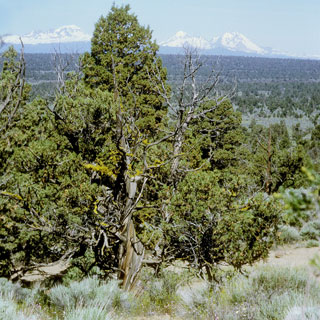
Western Junipers

Saturday, May 09, 2020

This is the first of a series of no-charge dumping days at the local trash site. For days, I’ll load piles of trimmed branches and greenery and haul to the landfill. To visualize my waiting piles, imagine the trash after six weeks of chainsaw work on trees. Half of my small acreage is covered in trees, mostly junipers, previously untouched for years.

This trimming began like a simple project. My kitchen window focuses my attention on a couple of tall trees. They’d been too-close together with tangled branches, and had half-sawn limbs from a previous owner’s clean-up. Those tangles and shortened limbs bothered me and I vowed to get rid of them someday. Viola! Corovid-19 and stay-at-home, I’m laid-off from work, and now, it’s time to wield a chainsaw.

Cleaning trees turned into a large process. My window hadn’t revealed that most other junipers, too, had dead limbs and tangles. I learned that improving sections of trees is like painting the inside of a house. One area that suddenly looks better highlights the neediness of another–or regarding my trees, all others. From then on, every afternoon, with chainsaws–one for reaching high and another for cutting low, I stayed busy. The discards grew into another challenge that required attention. Fortunately, my trimming frenzy ended in time to take advantage of the Landfill’s free spring clean-up days.

This morning, I’d feel more confident about dumping if it hadn’t been years since my big trailer last saw action. I’ve tested its hydraulics which seem to work, and am crossing fingers that at the site the bucket will lift and lower. My truck last summer hauled horses weekly back and forth over the Cascades, but it’s sat unused throughout winter. Years ago when I hauled frequently to the dump, I’ve had the trailer get stuck straight-up and refuse to lower. I’ve had the truck motor fail to start so I could leave the dump. Those times meant calling for a mobile repairman and waiting while blocking other dumpers until finally help arrived.

These days with nearly everybody stuck at home, we’re all probably cleaning properties. The lines for dumping will be long–and now, I’m on my way, too.

Dear Friends: Please keep a good thought for my being speedy and all going well. Diana

Riding

Friday, May 08, 2020

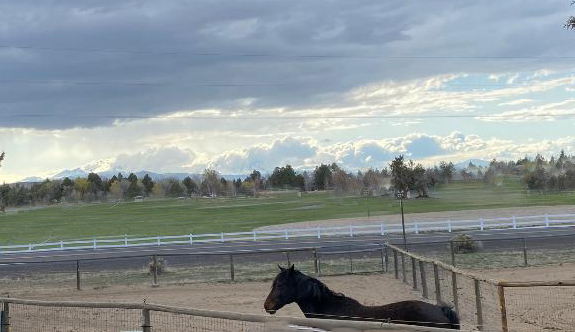
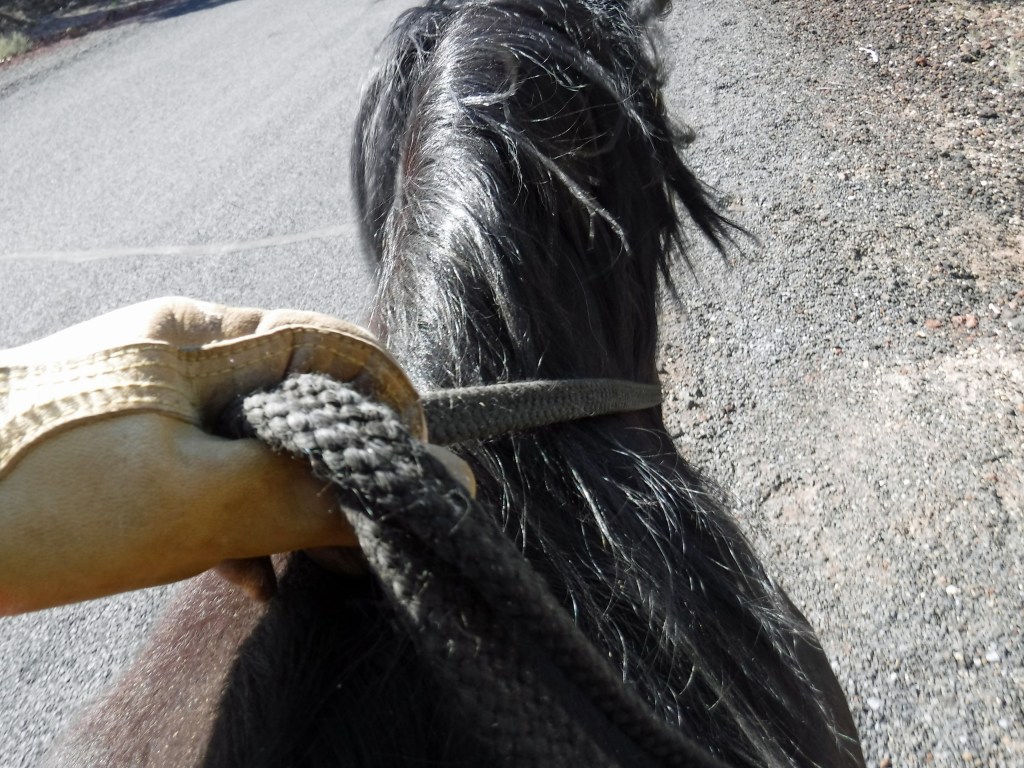
Sometimes accidental shots turn out to be the best photos.

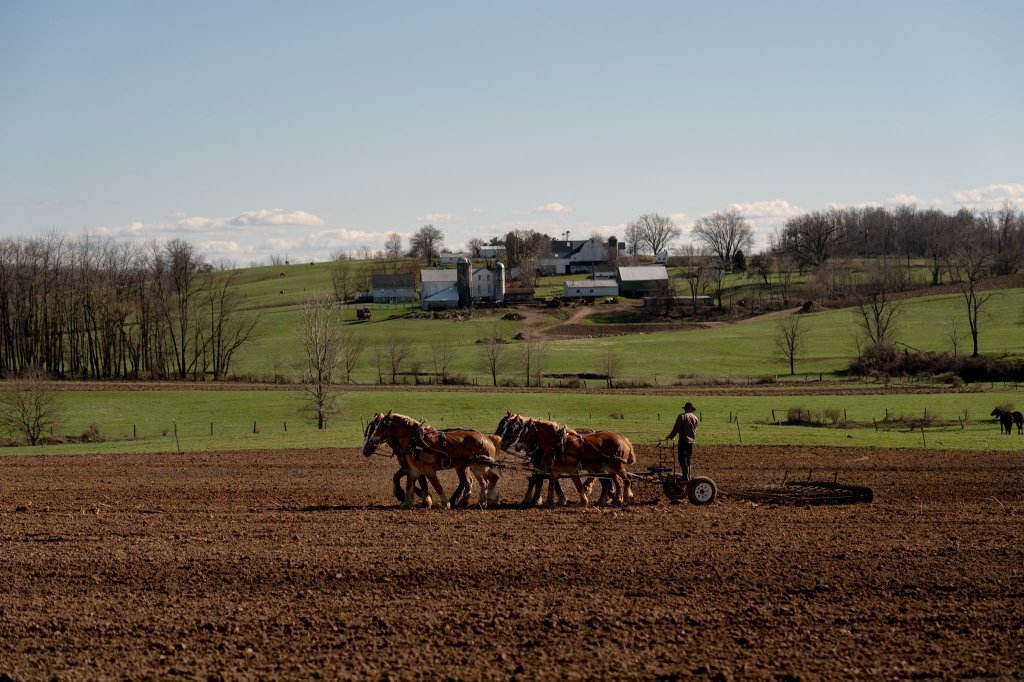
This season I’ll be on horseback instead of riding in a carriage or cart behind a horse. It’s a tough decision, not starting to drive again. The sport is fun and mine are wonderful carriage horses. I’ve experienced the see-saw, and mostly downward trend, of our economy, weighed it against the costs of having a horse in pulling condition. Since my horses must travel frequently on pavement, they need special horseshoes, with shock-absorbing pads, and all replaced regularly. Until the economy picks up with positive effects trickling to my level, I’ll choose to play less expensively.

My initial disappointment faded once I climbed into a saddle after years of riding only rarely. By now and several times, my horse has carried me through the local neighborhood. Riding again shows me another style of pleasure trip and lets me appreciate surroundings anew.

It helps to ride a trustworthy, unflappable horse that ignores vehicles passing or sudden loud sounds of construction work and airplane motors (we’re near the airport). My body is in tune to the horse’s energy, senses her attention to terrain and surroundings. Her memory is incredible. If once allowed to pause and chew on roadside gasses, she’ll remember the spot and I’ll feel her starting to move toward it when we’re nearby. Mostly she chooses to walk on the gravelly roadside instead of on pavement. Her regular hoofbeats put me into zen modes.

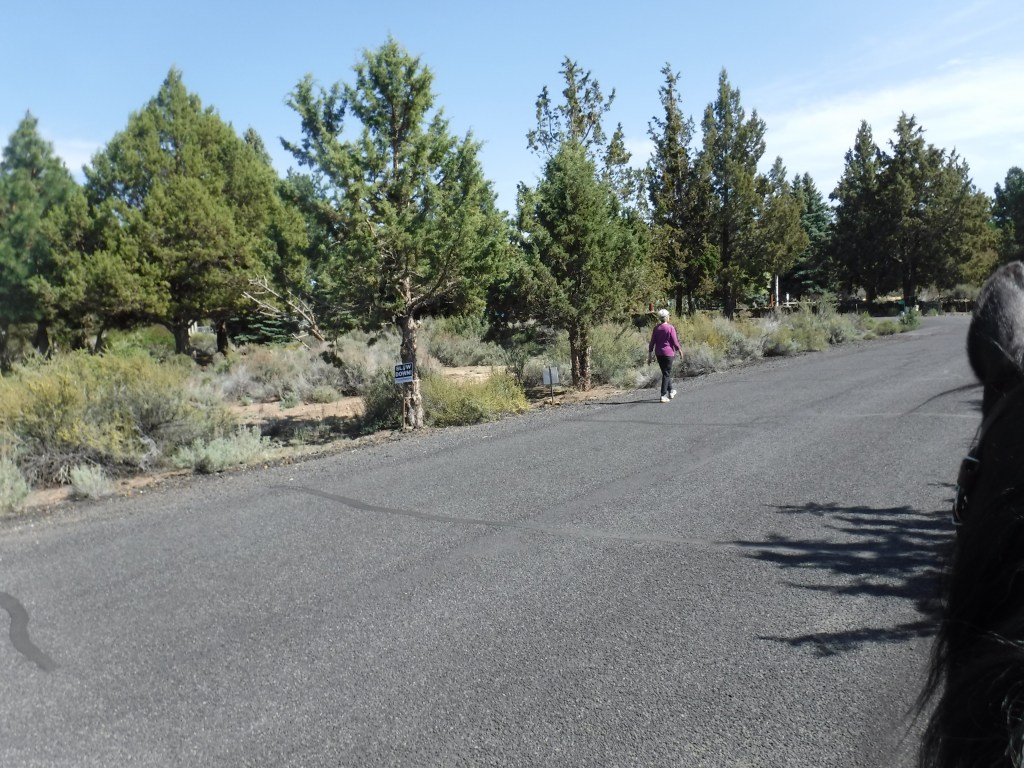
These days of semi-confinement cause many living in the area to go walking. The neighborhood loop where I’ve previously driven my horses and now ride has little traffic. It’s a popular area. Here, we’re approaching a lady who’s often out walking. When we catch up, she’ll slow down. We’ll walk alongside and chat with her.

My truck is about to become tied up for a string of days. It’s hitched to a large trailer, to haul brush and limbs to the dump. After all the needed disposing, I’ll hitch to the horse trailer, load up, and we’ll head off to public lands. There, I’ll ride one horse while ponying another. Our loyal donkey will follow loosely. The four dogs will run alongside. Those dogs! Out again on horse trails, beyond delighted!

Dear Friends: The ongoing, dipped economy forces us to adjust and simplify. Diana

Masking Ourselves

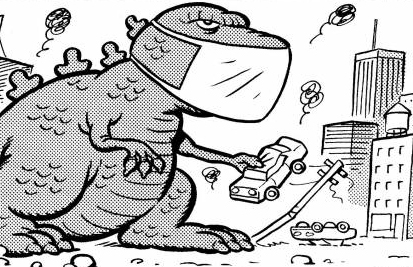
Sarszilla.

Thursday, May 07, 2020

I’m walking toward a market and masked as are most others around. This scenario makes me wonder why newstories aren’t full of robbery-related incidents. Until recently, an individual entering a store masked as mostly we are today would have appeared threatening. Where I live, in most places it’s legal to carry a firearm openly. In big box stores, I’ve seen on some individuals a holstered gun. It’s frightening, for even if a wearer’s overall attitude isn’t overtly threatening, the visual message is clear.

Think about data from scientific studies on human communications. The general consensus is that seven percent of our communications are verbal. The balance, or ninety-three percent of our communications are nonverbal–they’re visually transmitted. We may use full body language like dancing to communicate stories and feelings, or may express feelings by moving our arms and hands in various ways, or may elect to carry openly a highly destructive weapon in a typically non-threatening gathering. Everything we do expresses elements of our individual stories.

About masks, which we hope everyone in public wears, they cover facial features we’re used to seeing and evaluating. We accustomed to seeing maybe relaxed features with a kind mouth, or perhaps facial tension with jaw-clenching, tight lips. An individual’s Greek profile or Roman nose may create wonder about someone’s heritage, and are reminders that great art has made prominent features classic, ageless, interesting.

Our casual observations provide information about an individual’s demeanor, focus, and general intent. Someone who appears way different and out of the ordinary may become an object of concern.

These days, masks are more ordinary, making us try to understand what eyes convey while peering at one another over our masks. Sudden crinkles at eye corners may suggest a smile. With nonverbal communications increased, we acknowledge another in passing with a nod. We’re learning new ways of looking, unhelped by typical visuals.

So far maybe no masked robberies. Perhaps because most retail establishments have been closed, or because of orders for people to stay put. Even so, there’s an onslaught of gun-buying, and out on the streets many objectors, some with arms, are opposing orders to stay at home.

Dear Readers: These interesting times both invite questions and punch-up awareness. Diana