Respite On Horseback

Monday, September 28, 2020

My friend Anna and I went riding, and this photo shows us pausing while my dogs briefly swim. In the center and waiting with us is Miles, usually the first to leap into and out of a water body. The ears Anna’s camera is sighting through belong to Rosie (they’re very pretty!). We’re following a trail that ambles alongside the canal before looping gradually back to the trailhead.

Before this summer’s wildfires and persistent smoke, Anna and I often rode together. Almost every day I wanted to be on horseback, and riding alone I’d be on one and ponying another. Pimmy always followed the horses. Anna’s camera yesterday captured her tagging us.

Anna’s photos combine the beauties of horses, dogs, water, and desert. I didn’t carry a camera, for my main purpose in riding was to get into a recovery mode, to escape the worrying pressures of work, politics, and viruses. The horse’s each step seemed slightly to relax my shoulders. In horseback riding anything might occur, and safety requires an intent focus on animal welfare, trail types, terrain safety, and general surroundings. These immediate worries overcome larger-world concerns.

After riding I felt refreshed. But back home another world weighed-in. I couldn’t find my wallet! That didn’t make sense for I recalled stashing it, knew exactly where. Not finding the wallet was like “losing keys”, and I kept looking, drove to the trailhead to search the ground but no luck. Coming home, I decided to clean the horse trailer, which anyway needed it. After cleaning and cleaning…nothing. On the verge of quitting, I poked fingers into a dark corner, and voila!, my wallet!

A mind trick because of too many worries. Well, I’ll just keep on riding.

From an earlier ride here’s my friend Anna, on Rosie. A fine rider, Anna loves Rosie. She’s helped me understand better this sensitive, sometimes bossy mare.

Thanks for kindnesses from my neighbors: To Bill for providing political yard signs and tomatoes from his garden; and to Frank for sackfuls of apples from his tree for the horses, and they gobbled!

Dear Friends: I hesitate to carry on about politics, but how about those tax returns! Diana

Free Again

Sunday, September 27, 2020

We sample servers at Costco have off Sundays and Mondays, and my weekend has begun. Setting aside the current large sociological and political issues roiling my brain, I’m going horseback riding.

This is happening after several weeks of staying home. First, a seemingly unending string of smoky days and nights set many of us back on our heels. Breathing was uncomfortable, eyes burned, and throats stung. Most people tried spending lots of time indoors, but attempts locally to escape the discomforting smoke didn’t work.

When breathing’s a problem for humans, for pets it’s equally uncomfortable. During the smoky days, I didn’t load my horses and dogs and head off to a nearby national forest where we’ve enjoyed hours of freedom to play and explore. Even after that smoke cleared, my horses (and donkey!) have been spending their days hanging out in the loafing shed.

My pets are staying longer in place because of my part-time job that consumes time and energy. Interestingly, food producers are increasing their demands for in-store demos. Customers aren’t happy that we’re not cooking foods and serving freshly prepared samples. You’d think product demos wouldn’t be in great demand, but a pile of them are scheduled.

After months of lay-off and upon the company’s invitation to return to work, I said yes to working five days weekly. At first that felt okay, even was fun, but now I’m tired. So besides the smoke, my work has prevented horseback rides, hikes with dogs that run and swim, and tucked in, I’ve too-little off time to tackle a waiting, interesting, growing stack of books.

It’s hunting season, so today we’ll avoid the forest and instead go to a desertlike area where shooting isn’t permitted. No shooting means the horses needn’t sport red ribbons and the dogs won’t wear bright jackets. Today will be a restarting of regular outings, and it’ll be great.

Dear Friends: We’re most successful when balancing work, play, thoughtfulness. Diana

Transition

Saturday, September 26, 2020

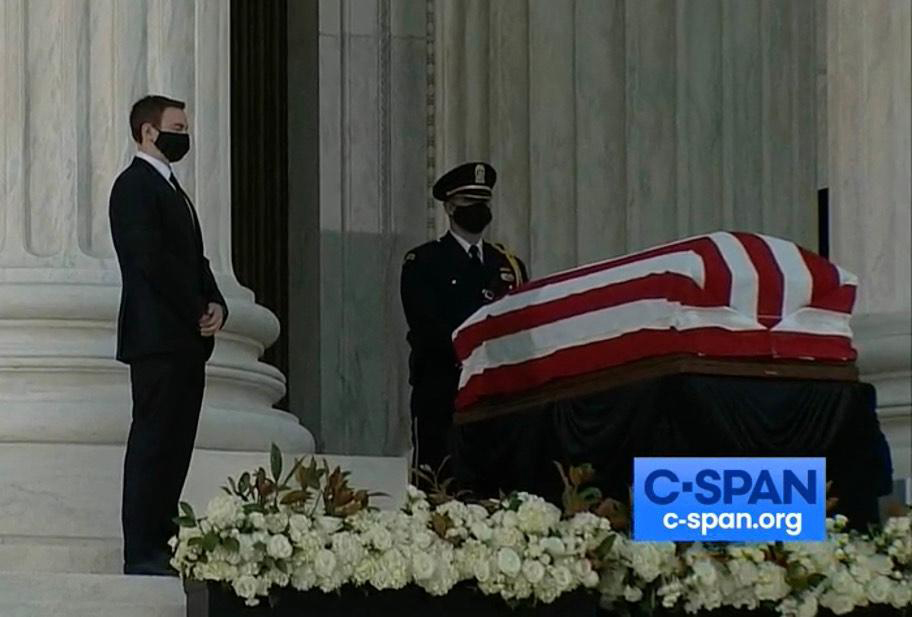
My long-time friend Linda sent this photo of her son David, at the Supreme Court and standing vigil at Ruth Bader Ginsburg’s coffin. This summer, David began clerking for Ginsburg and has been devastated by her passing. Ginsburg’s past and present law clerks took turns standing vigil over her.

Yesterday, I made the mistake of assuming that today she’d be buried in Arlington National Cemetery. Instead that is happening next week. Meanwhile, the American public will be distracted by the furor of an unprecedented process, an incredible rushing to fill Ginsburg’s seat with a presidential appointee, even as our presidential election is rolling, or (to be blunt) roiling.

Somewhere in every good story hides a joke. Our “2020 Story” is full of jokes and they’re even not hidden. Another is about to occur on Tuesday when the president and his opponent will debate. Trump’s idea of debating will be to deliver blows like a flying-wrestler would use to smash an opponent’s persona. In a recent article (link below), a psychiatrist advises Biden to respond to Trump’s lying and blustering by delivering a “humor sandwich”. That would mean tucking a genuine idea between a couple of jabs at Trump’s nonstop lying and prancing throughout his presidency.

My neighbor and friend Bill, active in Democratic politics, responded to my request for a yard sign supporting Biden and Harris. We discussed where to set the sign so it’s least-likely stolen. Our neighborhood has Biden-Harris supporters, but also has a busy through-road with passing MAGA-toughs. The roadside is unsafe and I’ll hinder the sign’s easy-pulling by finding a spot still visible and harder to access.

Here’s debate coaching for Biden from Dr. Richard A. Friedman: https://www.nytimes.com/2020/09/25/opinion/debate-trump-biden-lie.html

Dear Friends: Relentless tension will include a drama-fraught lame duck session. Diana

In Tribute

Photo by Kevin Dietsch/UPI

Friday, September 25, 2020

Today Americans again pay tribute to our incredible Ruth Bader Ginsburg.

This morning I see the hearse carrying her casket to the U. S. Capital. There she’ll lie in Statuary Hall, in state–a rare honor and for her very deserving. We’ve all benefited from Ginsburg’s high intelligence, rare determination, and knack for gaining a consensus among diversified groups. Right now, military honor guards are removing her casket from the hearse, I’m tearing-up again. Ginsburg never shied from appreciation and would have loved this. She physically was tiny and couldn’t be a heavy-lift for casket bearers.

As the casket bearers bow their heads, I’m crying. After a military salute, Nancy Pelosi speaks briefly, followed by Denise Graves, mezzo soprano (Ginsburg adored opera), accompanied on piano by Laura Ward. Graves sings a tribute, “Deep River”. Rabbi Lauren Holtzblatt reads Psalms 118, Verse 5, and speaks to “Justice, justice, justice”, a trio of words framed in Ginsburg’s Chamber and addressed in the Torah. Ginsburg has summarized her own achievements as an “Evening-out the rights of women and men.”

Ginsburg will be buried tomorrow in Arlington National Cemetery. Her family, observing Jews, had time to prepare for this, and surely with Ginsburg herself. This public ceremony lasting a week departs from a traditional Jewish requirement of burial within three days of passing.

She blazed a path for younger citizens. Those inspired by her work, already on that path, and many beginning law careers, will work to keep open America’s progress. We must keep faith in the promises of equality for all.

We all must take action, and above all vote in this presidential election.

Dear Friends: We’ve participated in years of progress and must ensure continuance. Diana

A Weighty Matter

Thursday, September 24, 2020

Last year for the first time I saw weighted blankets available in the store where I work. That seemed an odd but appealing notion, being covered by a weighted blanket. Not feeling need, I forgot weighted blankets until this year when again they showed up. Without pausing, I brought home a fifteen-pounder that boxed felt too heavy to bother with right away. Finally this week, I unpacked and tried the blanket.

Right away the extra weight pleased. Without first needing to shift around for a more comfortable position, I slept on my back and awoke feeling good. After that first night, with the blanket more familiar, I seemed rested in the mornings. My Amazon Halo Armband disagrees, reporting only “medium sleep”. Nightly a couple of times, I get up to let the dogs outside, and poor Halo “can’t get” my not sleeping through. I’m enjoying the blanket.

I often make gut decisions about products without first researching. Now tuned, I’m becoming more informed about the benefits of weighted blankets. They may soothe anxiety, ease insomnia, decrease nervous system activity, and reduce heart-rate. In my experience, the extra weight is comfortable and comforting. Sometimes I feel snuggled in a secure little cave, reminding me of the wonderful video, “My Octopus Teacher”, showing octopus slide into a tiny opening to its hidden nest.

Encouraged, I’ve begun exploring weighted vests. Those mostly are designed for working out, but I’m curious about very lightweight vests, and whether wearing one may increase comfort to one on foot. My comparison is a dog product, the snug “Thunder Jacket”, said to help calm an anxious animal.

Dear Friends: Continuing social conflicts urge an ongoing search for comfort. Diana

Farewell, RBG

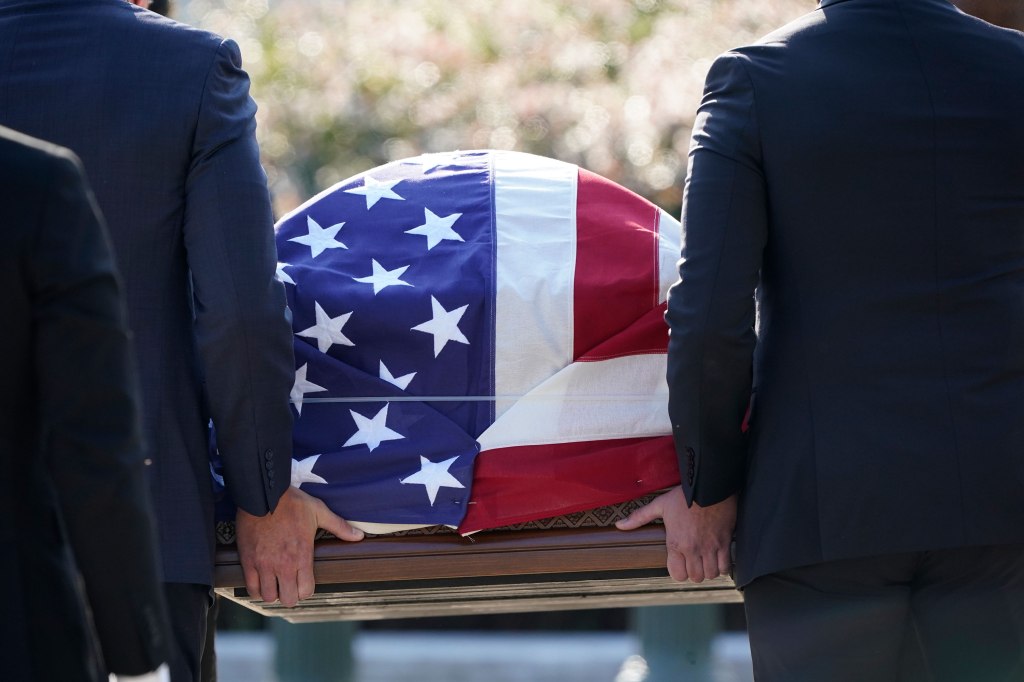
The flag-draped casket of Justice Ruth Bader Ginsburg arrives at the Supreme Court in Washington, Wednesday, Sept. 23, 2020. Ginsburg, 87, died of cancer on Sept. 18. (AP Photo/J. Scott Applewhite)

Wednesday, September 23, 2020

Watching the procession and setting of the casket carrying Ruth Bader Ginsburg at the Supreme Court. The arrival of her casket is touching, she’s carried in by some of her current and past law clerks. Once the coffin is resting, a confident woman Rabbi leads a memorial service. Chief Justice Roberts pays a tribute that’s warm, emotional, and genuine. This ceremony has me in awe and in tears.

I’m thinking about a world that Ginsburg was born into. In those days, human rights were limited or nonexistent depending on one’s gender, skin color, religious practices, income potential. During Ginsburg’s lifetime and through her legal work, people of all kinds gained more rights. She opened opportunities for higher education, better incomes, and socially-improved lives.

Many of us benefited from changes that arose in her legal work, from arguments before the Supreme Court to opinions from her seat on the Court. Social changes she worked toward have allowed for improved citizen equality, given more opportunities to hope, and granted to many better lives.

Immediately, her passing has given voice to political opposition, a high-battling that confronts citizens with an opposition incredibly ugly, reaching noise-levels rarely experienced in contemporary American history. Many citizens fear a rapid undermining of critical equalities, like personal choice and health care, that now exist for all through Ginsburg’s intelligent work.

Dear Friends: We watch, hold breaths, and hope for continuing equality in law. Diana

A Hiatus

Tuesday, September 22, 2020

Years ago, while working as a secretary in a university hospital I applied for another job in that hospital, one representing a promotion, more secretarial prestige, higher pay. I wanted the job badly but didn’t get it. During a debriefing after-the-fact, my interviewer said I’d been a high contender and was “a good citizen”. His odd comment made me wonder what “good citizen” meant in that context. To this day, I’m curious about why he made the point, and right then why I didn’t question his meaning.

It stayed in my mind, “Good citizen”. After first cropping up when I was young, timid, needy, afraid to question a superior, it pops frequently into my adult mind. Again now, I look at the question and wonder. My sense is that most people behave in a good citizen context. We obey laws, don’t steal, avoid untruths, and when possible help each other. So, what’s the rub, what puts great nations in today’s social turmoils? What the heck anyway is a good citizen?

The best I come up with is that good citizenship is in a beholder’s eyes. That’s abstract of course, but narrowing its meaning requires an understanding that fundamental beliefs may differ. We all know there’s no absolute conconses about what’s most correct, for individuals, families, larger social groups, and as a whole the nation.

Let’s start by remembering that America began with a smallish group that landed in Plymouth Rock. As that group’s population increased, it laid social ground rules having to do with staying safe, keeping at bay Native Americans, and acquiring goods necessary for survival. It’s easier for smallish groups to agree on parameters and perimeters that will represent community goals and norms. It’s easier to monitor good citizenship among those who participate actively in creating the norms, they tend to behave.

We understand that the “fathers of our country” while creating the Constitution, were far-sighted and careful about their planned parameters and perimeters. They debated, compromised, and established outcomes into laws. What they didn’t and couldn’t have anticipated, are the many and amazing achievements that humans have achieved over the last 100 or so years: the industrial revolution, achievements in science and medicine, communications, transportation, and extended human-life spans that explode populations.

These days, we can’t agree on what’s right or wrong. It depends on one’s perspective in nations with multiple perspectives. Everybody has a means to support or justify his or her beliefs and positions relative to what may comprise good citizenship. Along with most others, I’ve plenty of thoughts, ideas, opinions, and firm beliefs about what’s right and wrong. In these days when arguing is a non-gainer, we often decide to watch and wait.

I take an occasional hiatus from political and social furor. Like now, I’m reading a recent publication that contains an anthology of Native Nations poetry. It’s entitled, When the Light of the World was Subdued, Our Songs Came Through, edited by Joy Harjo. Its poetry is touching, wonderful, and expresses longings for distant times–of common beliefs, bonded families, and small communities. Those times when “good citizenship” was easier to understand and could be defined.

Dear Friends: This book, caring and teaching, touches to a reader’s heart and soul. Diana

Like Clay vs. Liston!

Monday, September 21, 2020

I’m running late this morning, having spent a couple hours absorbing headlines and videos from the weekend. In the wake of Judge Ginsburg’s passing is a political dirt-fight beginning, the likes of which I’ve never witnessed. I’m learning from history that such down-dirty fighting isn’t being invented now.

As an observer (and voter!), I take for granted many of today’s social improvements. Many were initiated during the 60s, but only lately have I realized their real beginnings. Following WWII, returning fighters represented many facets of American society in regard to gender, race, and creed. All had returning needs, but by law and tradition social benefits could be (and were) doled-out differently to citizens of various status. President Eisenhower recognized this and became the first modern American leader to address social gaps. He supported equal justice under law.

In his eight years in office Eisenhower appointed five justices to the Supreme Court. His “Warren Court” worked to change the nation’s legal structures. It promoted equality,, restructured voting districts, and decriminalized laws against interracial marriage and conceptrave usage. It initiated lots of other changes, too.

The Warren Court set the groundwork that enabled young attorney, Ruth Ginsburg, to begin her lifelong focus on correcting social rights for all citizens. This beginning to her story essentially came from those social changes begun after the War, initiated by Eisenhower and extended by Johnson. Following early social changes came open opposition. It began in the Nixon era and continued under Reagan. American political social battling since has continued and become ferocious.

Some observers assert that Republicans have learned to fight America’s social battles in ways that win, and that Democrats haven’t figured out how to gain desired wins. This is a question that’s mega-interesting through our current pre-election period. Already, immediately after Ginsburg’s passing, both parties with sleeves rolled-up have dived into hard-battle.

Dear Friends: In our ringside seats, we’re riveted to the breath-taking rounds. Diana

Adjusting to Angst

Sunday, September 20, 2020

I’ve spent today’s early hours reading from the archives of major publications. Old articles, by certifiable intellectuals and great writers, on the lives and accomplishments of such as Ruth Bader Ginsburg, Bob Dylan, and A. Hitler. This variety of individuals, their lives and great social impacts, interests me. It’s complicated, and in fact, I’m behaving weirdly while at work.

My head already full of current issues related politics, climate, economy, is overburdened by our loss of Judge Ginsburg. Besides losing that fabulous American, she passed exactly when early voting begins to elect our next President. It’s another ironic twist of 2020 fate that RBG’s passing left enough time for those in power to boast how quickly they’ll replace her. If that happens before presidential voting swings into full force, it’ll influence on-the-fence voters opposing liberal laws like those supporting abortion rights and health care for all.

At work for the last couple of days, I’ve thrown myself into hard-selling products to which I’m assigned. Sample-servers do their work by standing beside a product and talking about it in parrot-like manners. They repeatedly deliver five points: (1) product’s name, (2) producer, (3) price, (4) store location, and (5), the sales pitch, “Take some home today!” Server performance is measured by continued talking and covering those five points.

Servers receive sales goals on products. There’s not high-pressure to achieve these goals, but most would like to reach them. There’s a distant promise of bonus (details unclear) upon repeatedly hitting sales goals. Some servers speak on and on to the five points, others say little unless questioned or someone in authority watching. I generally ignore products that are uninteresting, have poor ingredients, or were produced in China. I put a little effort into the healthy products.

The last couple of working days and assigned to decent products, I’ve have been on fire. I’ve captured shoppers pushing carts through aisles and delivered long sales pitches. I’ve told shoppers they’re pulling wrong items off shelves and insisted they take home what I’m selling. What’s funny is that it’s worked and made my sales high. Interesting to me is that energetic selling which maybe surprises shoppers enough to have them pause, listen, and think.

My readings today of articles dealing with an array of political and social issues got me wondering about my weirdly-high sales energy. Maybe it’s an outlet for high emotions arising from current (and probably all 2020) events. These are tipping points: the unhappy loss of Ginsburg against a noisy chest-thumping by those in power.

Who could stretch imagination enough to visualize a Ted Cruise on the Supreme Court? Who are those unable to support good logic, like separating Church and State, supporting human equality, the right of having a choice, availability of health care, and recovery of a healthy world environment!

Dear Friends: Encourage all to pause, think, and vote for effective leadership. Diana

Notorious

Saturday, September 19, 2020

We who share similar worldviews about politics, environment, and social issues today mourn for RBG. She seemed a beloved family member, was a champion, had a superb mind and incredibly effective negotiating skills. She helped make it possible for many who otherwise wouldn’t have dared to dream to achieve educations and careers.

A girl like me, when I grew up in Oklahoma, was destined to marry a “right guy”, who had a financially capable future, or otherwise, figure out how to tread the very narrow path toward self-support. My best dreams for independence were to become an executive secretary. A road toward that was learning to type. I got down-solid that skill which helped me find jobs, for it turned out that I didn’t marry.

The turmoil-filled sixties forced a growing social awareness and caused huge rallies around common desires for changing the handlings of social, political, and environmental issues. That era produced social pioneers like RBG who began to readdress the old rules. Their kind of work opened new paths for many who took advantage of more opportunities for formal education. Acquiring knowledge eventually can alter worldviews and life directions.

Formal education, along with RBG’s legal arguments for gender and pay equality among workers, benefited everybody. Opportunities opened for the kinds of work few had dreamed of finding. Gradually, I was able to identify and achieve a career, and largely because of RBG’s successful legal arguments.

Without RBG on the Supreme Court, ahead are tumultuous battles. They’ve already begun. I’m grateful while looking forward for being able to look backward. To an era that permitted women to control the welfare of our bodies. To our increased access to health care. To better educational opportunities that allowed individuals find work offering relative happiness and more financial freedom.

RIP, RBG!